
Enterprise Data Marketplace Implementation for Governed, Reusable Data Products
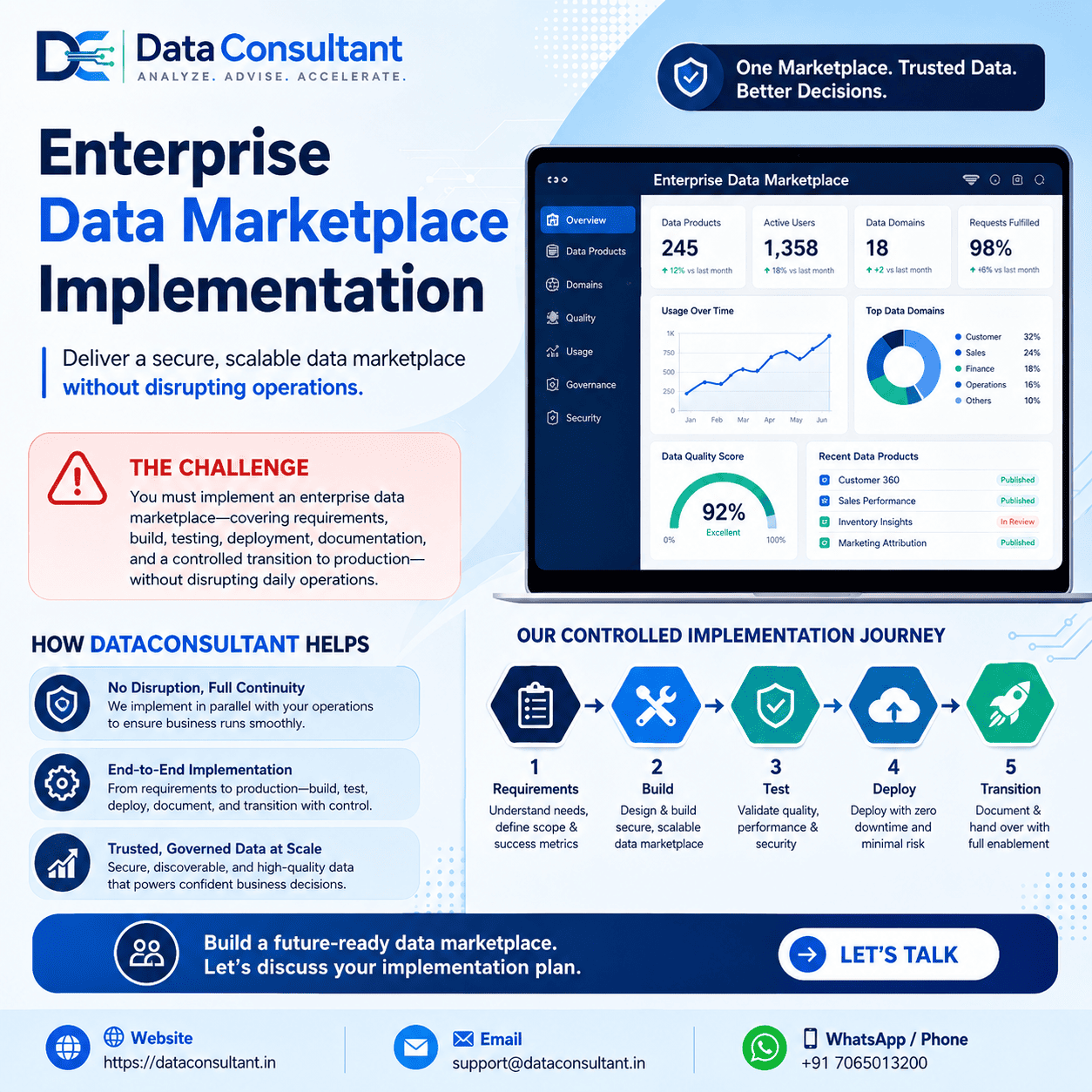
DataConsultant helps enterprise data teams implement a marketplace experience where authorised users can discover, understand, request and reuse governed data products. The work connects product metadata, ownership, quality evidence, lineage, access workflows, platform interfaces, automation and operational support so the marketplace functions as an engineering capability rather than a catalogue-only front end.
Scope, timeline and commercial terms are confirmed after reviewing the target users, product domains, metadata and catalogue estate, access model, integrations, environments, control requirements and rollout expectations.
Discoverable Products
Consistent product metadata, ownership, documentation and search across domains.
Visible Trust Signals
Quality, lineage, classification and operating information presented where consumers make decisions.
Governed Access
Request, approval and provisioning flows connected to identity and policy responsibilities.
Repeatable Operations
Onboarding, testing, change, support and telemetry designed for ongoing marketplace use.
When a Catalogue Exists but Trusted Data Is Still Hard to Find and Use
A marketplace implementation is useful when the problem is no longer just documenting assets. The gap is often the engineering between discoverability, product ownership, access, trust evidence and the interfaces consumers actually need.
Discovery without context
Users can search a catalogue but cannot tell which product is authoritative, supported or suitable for a specific decision or workload.
Ownership is not operational
Domain owners and stewards are named, but publishing, change, support and lifecycle responsibilities are not embedded into the product workflow.
Access remains manual
Consumers discover useful data and then leave the marketplace for email, tickets or bespoke approvals with little policy context or traceability.
Trust evidence is fragmented
Quality, lineage, classifications, usage, freshness and known limitations sit in separate tools or are missing from the consumer experience.
Product onboarding is inconsistent
Each domain publishes metadata, interfaces and documentation differently, creating avoidable support effort and poor interoperability.
No operating loop after launch
Usage, access failures, product changes, quality issues and adoption feedback are not connected to accountable improvement workflows.
Turn Product Discovery Into a Governed Consumption Journey
Share where users currently search for data, how access is approved, which tools hold metadata and lineage, and where product ownership breaks down. We can scope an implementation path around the real friction.
What Enterprise Data Marketplace Implementation Actually Builds
The service turns marketplace intent into a working, governed delivery capability. It defines and configures how data products are published, described, searched, evaluated, requested, provisioned, changed and supported across the enterprise.
The implementation can connect an existing catalogue or marketplace technology with domain-owned products, platform interfaces, identity services, policy and approval workflows, quality and lineage evidence, observability and product operations. The objective is not to force every dataset into one tool; it is to create a consistent consumer journey and repeatable engineering pattern around trusted, reusable products.
Implementation Scope From Product Publication to Operational Support
Final scope is shaped by existing platforms and maturity. The implementation can cover a focused pilot, a marketplace capability build, integration into an existing catalogue, or a phased enterprise rollout.
Marketplace experience
Configure product browsing, search, filters, product pages, documentation patterns and consumer journeys.
- Product taxonomy
- Search and filters
- Consumer journeys
Product onboarding
Define repeatable publication standards and engineering workflows for domain-owned data products.
- Product templates
- Metadata minimums
- Lifecycle gates
Metadata & lineage integration
Map technical and business metadata, ownership, lineage and usage context into the marketplace experience.
- Catalogue mapping
- Lineage signals
- Ownership context
Access workflows
Connect identity, policy, approval, entitlement and provisioning responsibilities to product requests.
- Request routing
- Approval logic
- Access evidence
Quality & trust signals
Surface relevant quality, freshness, classification, service expectations and known limitations.
- Quality evidence
- Readiness status
- Consumer warnings
Platform & interface integration
Connect marketplace records to tables, APIs, files, streams, semantic products and supported delivery endpoints.
- Interface registry
- Deep links
- Integration patterns
Automation & deployment
Automate repeatable onboarding, metadata validation, environment promotion and configuration where appropriate.
- Quality gates
- CI/CD alignment
- Configuration automation
Observability & operations
Define product telemetry, support routes, issue handling, change notices and operational ownership.
- Usage signals
- Support runbooks
- Change workflow
Define a Pilot That Tests Real Products, Real Controls and Real Consumers
A useful pilot should prove product onboarding, discovery, access, trust evidence and support—not only the visual interface. We can help choose a representative domain and acceptance criteria.
A Marketplace Architecture That Connects Products, Trust, Access and Consumption
The exact platform stack varies. The implementation pattern below shows the engineering responsibilities that usually need to connect for a governed consumer journey.
Implementation Deliverables Designed for Build, Validation and Handover
Outputs are adapted to the chosen platform and delivery model. The aim is to leave working capability, test evidence and operating documentation rather than an architecture diagram without an implementation path.
Implementation baseline
Current products, tools, metadata, workflows, controls, dependencies, environments and delivery gaps.
Solution design
Target components, integration map, responsibilities, non-functional requirements and transition decisions.
Marketplace information model
Product metadata, ownership, interfaces, trust fields, status, lifecycle and documentation standards.
Configured experience
Search, browse, product pages, filters, documentation and request journeys for agreed pilot scope.
Metadata integration
Mappings and synchronisation for catalogue, ownership, lineage, classifications and usage context.
Access workflow integration
Request, approval, entitlement, provisioning and audit steps aligned to agreed control responsibilities.
Onboarding automation
Repeatable templates, validation rules, automation and deployment patterns where technically appropriate.
Validation pack
Functional tests, metadata checks, access tests, control evidence and documented acceptance criteria.
Operational runbooks
Onboarding, support, incident, change, deprecation, access and product-maintenance procedures.
Rollout and handover backlog
Next domains, dependencies, product waves, technical debt, adoption actions and knowledge-transfer material.
How the Marketplace Moves From Existing Estate to an Operable Pilot and Rollout
The sequence keeps architecture, product standards, control integration and user experience connected. Each stage is adjusted to the platforms already in place and the delivery responsibilities agreed with internal teams and vendors.
Mobilise
Confirm sponsors, pilot users, domains, environments, responsibilities, constraints and acceptance criteria.
Baseline
Review products, metadata, catalogue, access, quality, lineage, interfaces and operational gaps.
Design
Define target architecture, information model, product standards, workflows and non-functional needs.
Build
Configure marketplace capabilities, integrations, templates, automation and required environments.
Onboard
Publish representative products with real metadata, interfaces, owners, trust signals and access paths.
Validate
Test discovery, access, control evidence, usability, product quality signals and support procedures.
Scale & Handover
Prioritise rollout waves, transfer runbooks and establish the product onboarding and improvement cadence.
Need to Connect Catalogue, Access and Data-Product Workstreams Into One Delivery Plan?
Bring the current architecture, platform ownership and priority product list. We can help turn separate metadata, IAM, governance and engineering activities into an implementation backlog with dependencies and acceptance criteria.
Choose Implementation When the Organisation Is Ready to Operationalise Marketplace Behaviour
A marketplace can begin with imperfect foundations, but it still needs accountable product owners, usable metadata and control responsibilities. The right starting point depends on whether the primary problem is design, readiness or implementation.
Good fit for implementation
- Priority domains and representative data-product candidates are identifiable.
- A catalogue, metadata platform or marketplace technology exists or has been selected.
- Users need a more consistent route from discovery to governed access.
- Identity, access, quality, lineage or workflow services can be integrated.
- Domain teams can accept publication, change and support responsibilities.
- The organisation wants a pilot that can become a repeatable rollout pattern.
May need foundation work first
- No accountable owner can define or support data products.
- Basic metadata, terminology or source ownership is too incomplete for meaningful discovery.
- Identity and access responsibilities are unresolved or technically unstable.
- The requirement is mainly to decide whether a marketplace is appropriate.
- The organisation expects a portal alone to fix data quality or governance problems.
- There is no representative user group available to validate the pilot experience.
Embed Governance, Security and Reliability Into the Product Journey
The marketplace should make required controls easier to follow and easier to evidence. Control design remains proportionate to the data, platform, jurisdiction and risk profile in scope.
Identity & least privilege
Connect user identity, roles or attributes, approval responsibilities and entitlement boundaries to product access.
Classification & privacy
Expose relevant sensitivity, purpose, sharing, retention, residency and handling information at decision points.
Quality & lineage
Show the evidence consumers need to judge suitability, dependencies, known issues and impact of change.
Auditability & monitoring
Record material access and workflow events and connect operational signals to accountable review paths.
Lifecycle & change
Define publication, versioning, compatibility, deprecation, revocation and support expectations for products.
Custom Scope and Pricing Based on the Marketplace You Need to Implement
A fixed public fee is not appropriate without knowing the existing estate and implementation boundary. Commercial terms are confirmed after discovery so the proposal can distinguish configuration, integration, remediation, automation, rollout and operating support.
Scoped Implementation Proposal
Share the target platform, number of domains and products, current metadata and catalogue landscape, identity and access approach, required integrations, environments, control requirements and rollout expectations. DataConsultant can then define responsibilities, deliverables, assumptions, acceptance criteria and a commercial model.
Request Marketplace Implementation PricingGet a Proposal Based on Your Product Count, Platform Estate and Integration Boundary
A scoped proposal is more useful than a generic package because implementation effort is driven by the systems, controls, metadata and operating changes that must work together.
Why Consider DataConsultant for Marketplace Implementation
The implementation needs to bridge data engineering, domain ownership, governance, metadata, access control and operational support. The engagement is structured around explicit responsibilities and usable handover material rather than platform configuration in isolation.
Engineering-led delivery
Connect marketplace design to integrations, interfaces, deployment, testing, observability and operational ownership.
Domain and platform alignment
Make domain product responsibilities work with shared platform, governance and service-management capabilities.
Control by design
Integrate access, classification, quality, lineage and evidence requirements into the product journey where they matter.
Consumer-centred implementation
Validate discovery and access with real users and representative products instead of measuring success by portal deployment alone.
Repeatable onboarding patterns
Use templates, validation rules and automation to reduce one-off product publication and inconsistent domain practices.
Operational handover
Document support, change, onboarding and improvement responsibilities so the marketplace can be sustained after launch.
Enterprise Data Marketplace Implementation FAQs
Answers to common enterprise questions about scope, prerequisites, platforms, access, quality, rollout, pricing, delivery and operational support.
What is enterprise data marketplace implementation?
How is implementation different from a data catalogue deployment?
Do we need a data mesh before implementing a marketplace?
What needs to exist before implementation starts?
Can DataConsultant work with our existing catalogue or governance platform?
What deliverables can we expect?
How are access, privacy and security handled?
Can the marketplace expose APIs, tables, files, streams and semantic products?
How are data quality and lineage represented?
How long does enterprise data marketplace implementation take?
How is enterprise data marketplace implementation priced?
Can we start with one domain or a limited pilot?
Can DataConsultant work alongside internal teams and platform vendors?
What happens after the marketplace goes live?
Request an Enterprise Data Marketplace Scope Review
Share your contact details and requirement. DataConsultant can review the likely implementation boundary, dependencies, client inputs, control considerations and next step.