
Data Mart Development for Faster, Governed Business Analytics
Design and build business-focused analytical data marts that turn trusted source data into consistent dimensions, measures and reporting-ready structures. DataConsultant helps define the model, engineer repeatable data movement, validate quality and hand over an operable serving layer for analytics teams.
Vendor-neutral by default. Final architecture, delivery plan and commercial scope are confirmed after discovery.
Faster reporting delivery
Give analytics teams a focused serving layer instead of repeatedly reshaping raw enterprise data.
Consistent business measures
Model shared dimensions, measures and transformation rules for the decisions the mart supports.
Controlled analytical access
Apply appropriate security, quality, lineage and ownership controls at the serving layer.
More supportable operations
Build repeatable loads, tests, monitoring and runbooks so the mart can be changed and operated safely.
When a Data Mart Is the Right Engineering Response
A data mart is most useful when a defined business audience needs governed, analysis-ready data without recreating complex transformations in every report. The engagement starts by confirming whether a mart is the right pattern or whether the underlying warehouse, lakehouse, semantic layer or source process should be addressed first.
Move from repeated report logic to a governed analytical product
Data mart development turns scattered extracts, recurring joins and duplicated business logic into a maintained data product with explicit grain, dimensions, measures, refresh behaviour and control points. The design can sit over an existing warehouse or lakehouse, or form part of a broader modernisation programme.
DataConsultant keeps the work engineering-led: the business question drives the model, but the build includes data movement, testing, security, deployment, documentation and operational supportability.
Different dashboards calculate the same KPI differently or maintain separate extracts and transformation steps.
Analysts need a smaller, domain-oriented structure that matches common reporting and drill paths.
Raw or highly normalised structures make routine analytical workloads slower and harder to maintain.
Existing marts depend on brittle ETL, undocumented rules, manual reconciliation or ageing database patterns.
Not sure whether you need a new mart or should simplify the current one?
Share the reporting need, current platform and source constraints. We can help frame the engineering decision before committing to a build.
What Data Mart Development Can Include
The scope is tailored to the business domain, source landscape and target platform. It can cover a focused mart build, remediation of an existing mart or a repeatable pattern for multiple marts across an enterprise analytical platform.
Requirements & source mapping
Translate business questions into defined data grain, source requirements, refresh expectations and acceptance criteria.
- Stakeholder and reporting requirement discovery
- Source inventory and dependency mapping
- Source-to-target mappings and rule definitions
Dimensional & relational modelling
Design business-ready structures with explicit grain, keys, relationships, slowly changing dimensions and measure logic where appropriate.
- Star or snowflake schema design where justified
- Conformed dimensions and fact structures
- Naming, keys, constraints and model standards
ETL / ELT engineering
Build ingestion and transformation paths that are repeatable, testable and appropriate for the required latency.
- Batch, micro-batch or CDC where relevant
- Transformation and dependency orchestration
- Retries, idempotency and schema-change handling
Physical design & performance
Align physical structures with workload patterns, concurrency, storage and platform-specific optimisation options.
- Partitioning and clustering decisions
- Indexing or file-layout choices where applicable
- Query and load performance testing
Semantic & BI serving
Prepare the mart to support governed analytical consumption without hard-wiring it to a single reporting pattern unnecessarily.
- Business-friendly columns and hierarchies
- Semantic or metric-layer alignment where in scope
- BI connectivity and representative query validation
Quality, security & operations
Engineer controls needed to trust, operate and change the mart after go-live.
- Validation, reconciliation and exception handling
- Role-based access and data protection controls
- Monitoring, lineage, runbooks and handover
From Source Data to a Business-Ready Data Mart
The exact architecture depends on the enterprise platform. A common pattern separates source ingestion, governed transformation, the mart serving layer and analytics consumption so business logic can be tested, operated and changed with clear boundaries.
1. Source systems
ERP, CRM, operational databases, files, APIs and governed upstream data products.
2. Curated platform layer
Warehouse, lakehouse or staging structures where source data is standardised and prepared.
3. Domain data mart
Facts, dimensions, measures and business-oriented structures engineered for the target analytical domain.
4. Analytics & decisions
Semantic models, BI, governed self-service, extracts or downstream analytical applications.
Where a Data Mart Can Create Practical Analytical Focus
Data marts are most effective when their subject boundary, grain and consumers are explicit. The examples below illustrate common patterns; actual scope should be based on business decisions and the organisation’s existing data architecture.
Finance performance
Curate ledger, planning and operational data for management reporting, variance analysis, profitability and controlled financial metrics.
Sales & customer analytics
Combine customer, product, channel and transaction data for pipeline, revenue, retention and segmentation analysis.
Operations & supply chain
Structure order, inventory, fulfilment and supplier data for operational visibility, service-level analysis and process improvement.
Controlled reporting
Provide a repeatable, reconciled serving layer for recurring management or regulated reporting processes without claiming statutory compliance.
What the Engagement Can Produce
Deliverables are agreed during discovery and vary by the current platform, whether the mart is net-new or being modernised, and the level of deployment and operational support included.
| Deliverable | What it covers | Why it matters |
|---|---|---|
| Requirements & source-to-target map | Business questions, grain, source fields, transformation rules, refresh expectations and dependencies. | Creates traceability between the analytical need and the engineered data product. |
| Logical / dimensional model | Facts, dimensions, relationships, keys, hierarchies, measures and modelling decisions. | Makes business meaning and structural choices explicit before physical implementation. |
| Physical mart design | Tables, views, partitions, clustering or indexing choices and environment-specific structures. | Aligns the model with workload, platform and maintainability requirements. |
| ETL / ELT implementation | Ingestion, transformations, orchestration, dependencies, error handling and deployment assets. | Provides a repeatable path from trusted source data to the mart. |
| Validation & reconciliation evidence | Data-quality tests, source-to-target checks, totals, exceptions and agreed acceptance results. | Provides evidence that the mart behaves as intended for the scoped use case. |
| Security & operational handover | Access design, monitoring expectations, runbooks, release guidance, ownership and support information. | Helps the client operate and change the mart after delivery. |
Have sources, KPIs and a target platform but no reliable serving layer?
We can turn that scope into a concrete mart model, source-to-target mapping and engineering backlog before or as part of implementation.
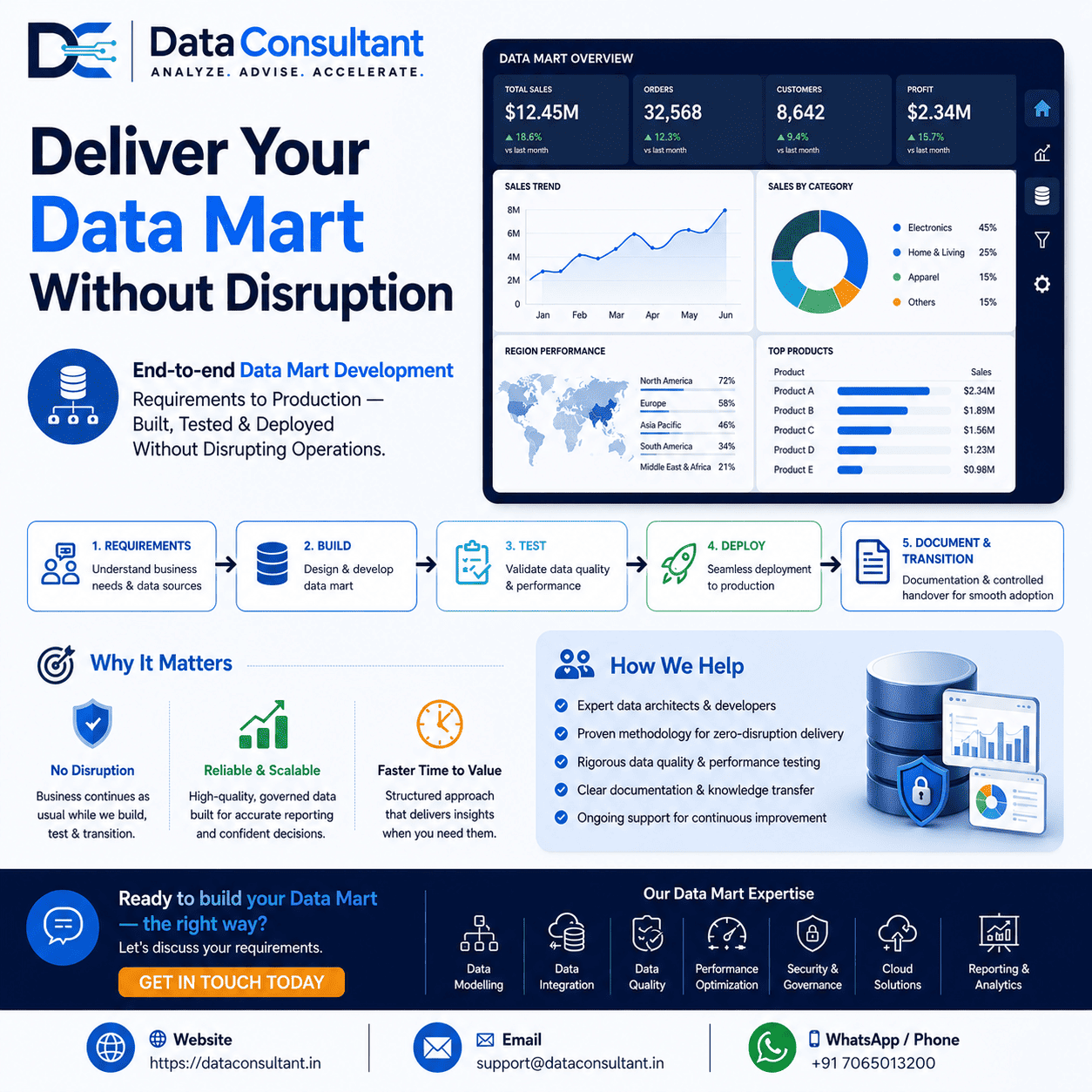
A Controlled Path from Analytical Need to Operable Data Mart
The sequence is adapted to the environment, but the work normally moves through explicit requirements, model design, engineering, validation and handover rather than treating the mart as a collection of reporting tables.
Align
Confirm decisions, consumers, grain, latency, acceptance criteria and scope boundaries.
Profile
Inspect sources, dependencies, quality conditions, keys, history and platform constraints.
Model
Define logical, dimensional and physical structures with transformation rules.
Build
Engineer pipelines, transformations, tests, access controls and deployment assets.
Validate
Reconcile data, exercise workloads, resolve defects and obtain agreed acceptance evidence.
Transition
Document operations, ownership, release process, monitoring and knowledge transfer.
Inputs That Make the Data Mart Build More Predictable
Missing evidence does not automatically block discovery, but it should be identified as a constraint rather than silently assumed. Early access to the following information improves design quality and reduces rework.
Engineer the Data Mart to Be Trusted After Go-Live
The serving layer needs more than correct SQL. The design should make failures visible, changes controlled and ownership clear enough for the mart to remain reliable as sources and business requirements evolve.
Data reliability
Define completeness and freshness checks, transformation tests, reconciliation, retry behaviour, idempotency and clear treatment of late or invalid records.
Metadata & lineage
Document key business definitions, source mappings, transformation logic and lineage integrations where supported by the client’s platform and governance tooling.
Access & protection
Apply least-privilege access, role or group-based permissions and platform-native protection controls based on data classification and enterprise policy.
Observability
Expose failed loads, unusual row counts, freshness issues, dependency failures and other service signals needed by the operating team.
Change & deployment
Use version-controlled code, review, environment promotion and repeatable deployment practices aligned to the client’s DataOps approach.
Recovery & continuity
Design reload, backfill, restore and recovery approaches appropriate to the target platform and agreed business continuity requirements.
A data mart should be supportable, not just queryable.
Bring us your current load failures, reconciliation pain or brittle reporting logic and we can help turn them into explicit engineering controls and remediation priorities.
Data Mart Engineering Across Modern Warehouse and Lakehouse Estates
Recommendations remain requirements-led. DataConsultant can work with existing enterprise platforms and select technology patterns based on workload, data gravity, skills, security, cost, integration and operational support considerations.
Custom Scope & Pricing for Data Mart Development
DataConsultant does not publish a fixed fee for this enterprise engineering service. A written quote is prepared after the required mart scope, source landscape, platform constraints, validation depth and deployment responsibilities are understood.
Scope-led commercial proposal
The proposal can be structured around a focused mart build, legacy mart modernisation, a multi-mart programme or defined engineering support. Commercials are tied to agreed scope and deliverables rather than an invented package price.
- Clear objectives, assumptions and dependencies
- Defined deliverables and acceptance approach
- Named client inputs and responsibilities
- Implementation and handover scope made explicit
What affects effort and price
- Number of marts, domains, sources and source interfaces
- Data volume, history, refresh frequency and latency expectations
- Data-model complexity, business-rule density and semantic requirements
- Source quality, reconciliation effort and backfill or migration needs
- Target platform readiness, environments and deployment automation
- Security, privacy, lineage, audit and operational control requirements
- Testing depth, BI dependencies, documentation and knowledge transfer
Check the Fit Before You Build
A focused data mart can simplify analytics, but it should not become another isolated silo. Discovery should confirm the use case, upstream governance and long-term ownership before implementation begins.
A strong fit when
- A defined business domain needs repeatable analytical data at an agreed grain.
- Source data and ownership are sufficiently understood to engineer controlled transformations.
- Current dashboards duplicate complex logic or depend on unmanaged extracts.
- An enterprise warehouse or lakehouse needs a domain-specific serving layer.
- A legacy mart can be modernised with a clear validation and cutover path.
Consider another intervention first when
- The real issue is missing source data, unresolved ownership or poor source-system controls.
- The requirement is only a one-off extract with no sustained analytical product need.
- The enterprise platform has fundamental reliability or architecture problems that should be stabilised first.
- Multiple teams need the same enterprise-wide data product and a shared curated layer would reduce duplication.
- Business metric definitions are still materially disputed and require governance decisions before engineering.
Services That May Support the Data Mart Programme
Use related services only where they solve a distinct adjacent requirement, such as broader platform engineering, model design or implementation on a specific modern data platform.
Ready to turn a reporting domain into a maintained analytical data product?
Tell us what business area the mart will serve, where the source data lives and what is difficult today. We will use that context to shape the next engineering conversation.
Data Mart Development FAQs
Answers below explain the service scope and buyer considerations without assuming a particular platform, fixed timeline or pre-defined commercial package.
A data mart is a curated analytical data store organised around a defined business domain, subject area or decision need. It typically contains selected, transformed and modelled data that makes reporting and analysis easier for a specific audience while retaining agreed controls for quality, access, lineage and change.
A data warehouse or lakehouse usually provides a broader enterprise or multi-domain analytical foundation. A data mart narrows that foundation into a business-focused serving layer for areas such as finance, sales, operations or customer analytics. The right pattern depends on the existing platform, data ownership, latency, governance and reporting requirements.
Yes. A common approach is to reuse governed data from an existing warehouse or lakehouse and create a purpose-built mart for a defined analytical workload. The engagement can assess source readiness, modelling choices, transformation logic, security, quality controls and serving requirements before implementation.
The design can use dimensional star schemas, snowflake structures, relational models or other justified patterns depending on the business questions, source structures, semantic requirements, platform capabilities and workload characteristics. Modelling decisions are made from requirements rather than applied as a fixed template.
It can when the business need and platform support the required latency. The design may use batch, micro-batch, change data capture or streaming patterns. Freshness targets, source constraints, transformation complexity, cost and operational support need to be agreed before choosing the ingestion and refresh pattern.
The engineering scope can include source-to-target checks, completeness and validity rules, duplicate controls, referential checks, transformation tests, reconciliation totals, exception handling and operational monitoring. Acceptance criteria are defined against the data mart use case and the evidence available from source systems.
The design can incorporate least-privilege access, role or group-based permissions, data classification, masking or row-level controls where supported, environment separation, auditability and platform-native security capabilities. Requirements are aligned with the organisation’s security, privacy and governance policies.
Data marts can be implemented on a range of cloud and analytical platforms, including warehouse and lakehouse technologies. Platform selection remains requirements-led and can consider an organisation’s existing investments in services such as Microsoft Fabric, Databricks, Snowflake, BigQuery, Amazon Redshift, Azure data services and related orchestration, transformation and BI tooling.
Typical outputs can include requirements and source-to-target mappings, dimensional or relational models, physical design, transformation and load logic, data pipelines, data-quality tests, reconciliation evidence, access-control design, deployment assets, technical documentation and operational runbooks. Final deliverables are confirmed during scoping.
A reliable duration is confirmed after discovery. Timing depends on the number and complexity of sources, data history, quality condition, refresh frequency, modelling complexity, platform readiness, security requirements, validation cycles, BI dependencies and whether migration or backfill work is included.
DataConsultant does not publish a fixed fee for this service. Pricing is scope-led and confirmed through a Request a Quote process after the number of marts, source complexity, data volume and latency, modelling depth, transformation effort, testing, security, deployment, documentation and support requirements are understood.
Yes. Modernisation can include assessing legacy mart structures, rationalising duplicated logic, improving dimensional models, rebuilding ETL or ELT, moving workloads to a modern warehouse or lakehouse, strengthening quality and lineage, improving performance and creating a controlled migration and reconciliation plan.
Useful inputs include business reporting requirements, KPI definitions, source inventories, sample data or profiling results, existing warehouse or lakehouse models, data-flow diagrams, security requirements, quality issues, current reports and dashboards, refresh expectations, deployment standards and access to accountable business and technical stakeholders.
Plan a Data Mart That Fits Your Platform and Business Decisions
Share the business domain, source systems, current analytical platform and the reporting or data-quality problem you need to solve. DataConsultant can use that context to scope the next step and identify the information required for a reliable proposal.
- Focused on the exact mart use case and current-state constraints
- Architecture and modelling decisions tied to operating requirements
- Scope, assumptions and dependencies made explicit before delivery
- Custom commercial proposal after discovery