
What Is Privacy Data?
What is privacy data? Privacy data is information that identifies a person, relates to an identifiable person, or can be combined with other information to reveal something about them. In formal privacy laws, the usual terms are personal data or personal information; “privacy data” is a practical business expression rather than a single universal legal category.
The central decision is not simply whether a database contains names or email addresses. Organisations must determine which data can identify people directly or indirectly, why it is collected, who can access it, how long it is retained, where it moves, and what could happen if it is misused. A technology request such as “encrypt the customer table” is therefore only one part of a broader business, governance and operational problem.
Start by mapping the business purpose and the people affected. Then classify the data, confirm lawful and approved use, reduce unnecessary collection, define access and retention controls, and assign accountable owners. External data consulting support may help when definitions conflict, data flows are unclear, systems are fragmented, or a business needs an evidence-based privacy data roadmap.
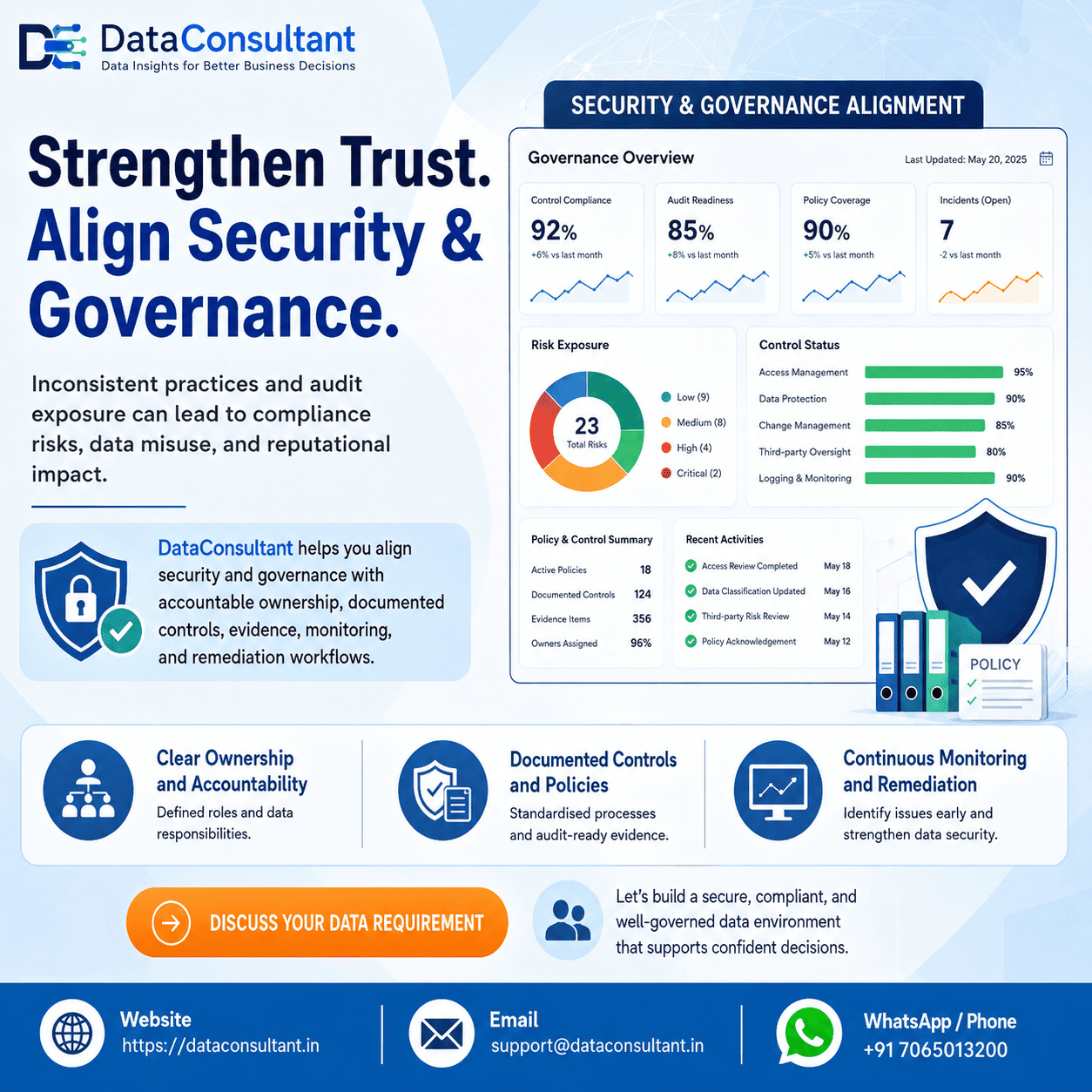
Quick Answer: Privacy Data Is About Identifiability
Privacy data includes information that identifies a person directly, such as a name or government identifier, and information that may identify someone indirectly when combined with other records, such as device identifiers, precise location, account activity or behavioural profiles.
The practical rule is to evaluate context, not labels. A field that looks anonymous in one system may become identifying after linkage with customer, employee, transaction or device data. Sensitive categories, children’s data, biometric data, health information and financial details usually require stronger controls because misuse may create greater harm.
Do not engage a consultant before defining the business decision or operational problem. Use a short diagnostic when data categories, flows or ownership are unclear; a defined project when classification, governance, architecture or implementation outputs can be scoped; and ongoing support only when privacy data operations genuinely require continuous oversight.
Key Takeaways
- Privacy data is contextual: identifiability depends on what data exists, what can be linked and who can access it.
- Data readiness starts with an inventory: organisations need evidence of sources, uses, transfers, owners and retention.
- Internal ownership is essential: privacy, security, legal, data, technology and business teams must share accountable decisions.
- Scope should be explicit: require defined systems, data domains, jurisdictions, deliverables, acceptance criteria and exclusions.
- Governance must follow the lifecycle: collection, use, sharing, storage, access, deletion and incident response all matter.
- Deliverables should enable action: expect classification rules, data-flow findings, risk priorities, control requirements and a roadmap.
- Knowledge transfer prevents dependency: internal teams need usable documentation, decision records and operating procedures.
Table of Contents
- Define privacy data in business context
- Check privacy data maturity
- Choose the right response
- Map access, flows and governance
- Implement proportionate controls
- Estimate cost and resources
- Measure privacy data capability
- Apply the definition in practice
- Decide where specialist support fits
- Summary
Define Privacy Data in Its Business Context
Privacy data is best understood as information connected to an identifiable individual and the decisions made about that information. The exact legal definition depends on jurisdiction, but the operating question is consistent: could this data, alone or with reasonably available information, identify a person or materially affect them?
Direct identifiers are only the starting point
Names, personal email addresses, phone numbers, customer numbers, employee IDs and official identifiers are obvious examples. Less obvious examples include IP addresses, advertising identifiers, cookie IDs, location histories, voice recordings, photographs, support transcripts, purchase histories and detailed behavioural patterns.
Sensitive data needs stronger treatment
Some privacy data can create greater risk because it concerns health, biometrics, genetics, religion, political views, sexuality, criminal matters, children or precise financial circumstances. The applicable categories vary by law, so organisations should confirm jurisdiction-specific requirements rather than relying on a generic label.
Pseudonymised data may still be personal data
Replacing names with codes reduces exposure, but the data may remain identifiable when a key, account system or other dataset can reconnect the record to a person. True anonymisation requires a much stronger assessment of whether re-identification is reasonably possible.
The UK Information Commissioner’s Office explains that personal data can identify someone directly or indirectly and that identifiability must be assessed in context. See the ICO guidance on personal data.
Check Privacy Data Maturity Before Buying Tools
A privacy platform cannot compensate for unclear purposes, incomplete inventories or disputed ownership. Before selecting software or launching a large compliance programme, assess whether the organisation can answer five practical questions.
A useful maturity check covers data discovery, classification, consent or other lawful-use records, vendor transfers, access controls, retention, deletion, incident response and evidence of review. The NIST Privacy Framework offers a risk-based structure for identifying and managing privacy risk without prescribing one technology stack.
Choose the Right Privacy Data Response
The correct response may be internal action, a software tool, a short diagnostic, a defined consulting project or ongoing support. Choose according to problem clarity, capability, urgency and continuity rather than assuming that a larger programme is automatically safer.
| Option | Best fit | Expected outputs | Internal requirement | Main risk |
|---|---|---|---|---|
| Internal team | Clear scope, accessible evidence and sufficient privacy, security and data capability | Updated inventory, controls, procedures and training | Named owners with protected delivery time | Competing priorities or capability gaps leave blind spots |
| Software tool | Processes and classification rules are already defined | Discovery, workflow, consent, request or retention support | Configuration, integration, validation and governance | Automation creates false confidence when source data is incomplete |
| Short diagnostic | Data flows, responsibilities or risk priorities are unclear | Current-state findings, risk register and prioritised roadmap | Stakeholder interviews and evidence access | Recommendations stall without an accountable sponsor |
| Defined consulting project | Classification, governance, architecture or implementation can be scoped | Policies, control requirements, implementation plan and handover | Cross-functional decisions and acceptance criteria | Scope expands across every system and jurisdiction |
| Ongoing consultant support | New products, vendors, data uses and regulations create recurring work | Reviews, governance support, issue resolution and updates | Regular prioritisation and internal ownership | Dependency develops if knowledge is not transferred |
| Dedicated specialist or managed team | Substantial continuous workload across multiple data domains | Predictable operating capacity, controls and reporting | Executive sponsor and defined operating model | Capacity is wasted when decisions and access are delayed |
A hybrid model is often practical: internal leaders retain accountability while external specialists provide diagnostics, technical depth, documentation and temporary delivery capacity.
Map Privacy Data Access, Flows and Governance
Effective privacy data management requires evidence of how information moves through systems and business processes. A list of databases is not enough. The organisation should connect data categories to purposes, people, applications, vendors, locations, access roles, retention rules and deletion methods.
Prepare the right inputs
- System and application inventory, including shadow tools and spreadsheets.
- Data dictionaries, schemas, sample fields and known classification rules.
- Process maps for customer, employee, supplier and user journeys.
- Vendor lists, contracts, data-processing terms and cross-border transfer details.
- Identity and access records, privileged-access procedures and audit logs.
- Retention schedules, deletion workflows, backups and archive arrangements.
- Privacy notices, consent records, request procedures and incident records.
- Named business, legal, privacy, security, technology and data owners.
Apply lifecycle governance
Controls should follow privacy data from collection to deletion. This includes purpose limitation, minimisation, accuracy, access approval, secure use, controlled sharing, retention and accountable disposal. The official text of the EU General Data Protection Regulation is one authoritative reference for organisations operating within its scope. Other jurisdictions use different terminology and obligations, so obtain appropriate legal interpretation where necessary.
The OECD overview of data governance also helps frame data stewardship, access, sharing and accountability as organisation-wide operating questions rather than isolated compliance tasks.
Implement Proportionate Privacy Data Controls
Implementation should prioritise the highest-risk data uses and the controls that can be operated consistently. Avoid launching a broad catalogue of policies without connecting them to systems, workflows and accountable owners.
Use a phased implementation path
- Confirm scope: select priority business processes, systems, jurisdictions and affected groups.
- Validate the inventory: test whether documented data sources and flows match operational reality.
- Classify and prioritise: identify direct, indirect and sensitive identifiers and assess likely harm.
- Define controls: specify minimisation, access, encryption, retention, deletion, monitoring and review requirements.
- Pilot changes: implement in one manageable process or system and test evidence, usability and exceptions.
- Transfer ownership: document decisions, train owners and establish recurring review.
Expected deliverables may include a data inventory, classification standard, data-flow maps, risk and issue register, control matrix, retention requirements, access recommendations, vendor-risk findings, implementation backlog, governance roles, quality-assurance evidence and handover materials.
Decision rule: implement the smallest set of controls that materially reduces a defined privacy risk, then verify that people and systems can operate those controls before scaling.
Estimate Privacy Data Cost and Resources
Cost depends on scope, system count, data fragmentation, jurisdictions, vendor complexity, legacy architecture, documentation quality and the level of remediation required. Discovery is usually faster when the organisation already has reliable inventories, architecture diagrams and accountable owners.
A short diagnostic may involve focused interviews, document review and sampling across priority systems. A defined project can take several weeks or months when it includes classification, data-flow validation, policy design, technical requirements, remediation planning and pilot implementation. Enterprise-wide programmes take longer because business units, legal requirements and technology dependencies must be coordinated.
Budget for internal participation
Privacy and legal teams interpret obligations; security teams define protective controls; data and technology teams provide schemas, logs and architecture evidence; business owners explain purposes and operational exceptions; procurement provides vendor information; and executives resolve risk and investment decisions. A proposal that ignores this participation understates the real resource requirement.
Measure Privacy Data Capability, Not Paperwork
Useful measurement shows whether the organisation understands its privacy data, applies controls consistently and can respond to change. Counts of policies or completed training sessions are not enough on their own.
- Percentage of priority systems with validated data inventories and owners.
- Coverage and age of data-flow and vendor-transfer records.
- Access exceptions, privileged access and unresolved review findings.
- Retention and deletion controls tested against real systems and backups.
- Time and evidence quality for data-subject or consumer-rights requests.
- Number and severity of privacy risks without accountable treatment plans.
- Completion of remediation actions against agreed acceptance criteria.
- Internal ability to maintain classifications, decisions and procedures after handover.
Measures should be interpreted carefully. A rise in reported issues may indicate improved detection rather than deteriorating control. Review trends alongside changes in systems, products, workforce, vendors and reporting maturity.
Practical Privacy Data Decisions
Ecommerce customer profiles
An ecommerce business treats email addresses as its only privacy data. Marketing systems also hold device IDs, browsing behaviour, inferred interests, order history and location signals. The mistaken assumption is that removing names makes the dataset anonymous. The better decision is a short diagnostic covering identity linkage, purpose, access and retention. Likely outputs include a classification map, data-flow findings and prioritised control actions. Marketing, ecommerce, technology, privacy and vendor owners must participate.
Employee analytics in spreadsheets
A professional-service company shares workforce reports through manual spreadsheets. The apparent requirement is password protection, but the real problem includes excessive fields, uncontrolled copies, unclear recipients and indefinite retention. A defined project can redesign the reporting process, minimise data, establish role-based access, define retention and create approved templates. HR, finance, IT and privacy owners need to validate the operating model.
AI assistant using support conversations
A startup wants to use customer-support transcripts to train or ground an AI assistant. The team assumes a vendor contract resolves privacy risk. The actual questions concern purpose, notices, lawful use, sensitive content, minimisation, retention, model access and output leakage. A privacy and AI readiness assessment should precede implementation. Deliverables may include use-case boundaries, data preparation rules, technical controls, testing requirements and a staged pilot decision.
Decide Where Privacy Data Support Fits
External specialist support is most useful when the organisation cannot confidently define privacy data, reconcile inventories, map complex flows, assign ownership or translate risk into implementable data and technology requirements. It may also help when a migration, analytics platform, AI use case, merger or new operating model changes how personal information is collected and used.
A data assessment and audit engagement may be appropriate for an unclear current state. A data governance engagement may help define ownership, classification, policies and operating controls. Where remediation involves pipelines, platforms or integration, a data engineering service may support implementation after requirements are approved.
Before appointing support, define the problem, systems, jurisdictions, required evidence, internal stakeholders, deliverables, exclusions, security expectations, budget, timeline, knowledge transfer and ownership after completion.
Summary
Privacy data is information that identifies, relates to or can reasonably be linked to an individual. The correct business response depends on context: internal staff may be sufficient when scope and ownership are clear; a software tool may help when processes and rules are already defined; a short diagnostic is useful when data flows, classifications or risks are uncertain; and a defined project is justified when governance, architecture or implementation outputs can be scoped.
Ongoing support or a managed team is appropriate only when privacy data work is substantial and continuous. Whatever model is chosen, validate business goals, data quality, access, governance and internal ownership. Agree scope, budget, timeline, security requirements, documentation, quality assurance, knowledge transfer and handover before delivery begins.
Need a practical privacy data roadmap? DataConsultant can help assess data use, clarify governance requirements and translate findings into prioritised implementation work.
Frequently Asked Questions
What is privacy data?
Privacy data is information that identifies a person, relates to an identifiable person or can be combined with other information to identify them. Formal laws usually call it personal data or personal information. Confirm the applicable legal definition for each jurisdiction and assess identifiability in the context of your systems and available linked data.
Is privacy data the same as personal data?
Usually, “privacy data” is an informal business phrase for personal data or personal information, but it is not a single globally standardised legal term. Use the exact terminology and definitions in the laws that apply to your organisation. Internally, document one approved classification standard so teams do not apply inconsistent labels.
What are common examples of privacy data?
Examples include names, contact details, account identifiers, employee records, device IDs, IP addresses, location data, purchase history, support conversations, photographs and behavioural profiles. Sensitive information may require stronger controls. Review combinations of fields because data that appears non-identifying in isolation may identify someone after linkage.
Is anonymised data still privacy data?
Genuinely anonymised data may fall outside some personal-data laws, but removing names alone is not enough. Pseudonymised records can remain personal data when a key or another dataset enables re-identification. Document the anonymisation method, test re-identification risk and review the result as data and technology change.
How should a business identify privacy data?
Start with business processes, systems, data fields, integrations, vendors and user journeys. Map direct and indirect identifiers, purposes, access, transfers, retention and owners. Validate documentation against real samples, logs and operational interviews. A short diagnostic may help when inventories are incomplete or teams disagree about scope.
Can software automatically find all privacy data?
Discovery tools can scan structured and unstructured sources, but they cannot reliably determine every business purpose, lawful use, contextual identifier or ownership decision. Software works best after classification rules, scope and review procedures are defined. Validate results with business, privacy, security, data and technology stakeholders.
What should be prepared for a privacy data assessment?
Prepare system inventories, schemas, data dictionaries, process maps, vendor lists, contracts, access records, retention schedules, privacy notices, request procedures and incident records. Identify accountable stakeholders and known gaps. Do not provide unrestricted production access without approved security, minimisation and confidentiality arrangements.
How long does a privacy data project take?
A focused diagnostic may take several weeks when scope, evidence and stakeholders are ready. A defined remediation project may take several months if it covers many systems, business units, vendors or jurisdictions. Confirm phases, dependencies, acceptance criteria and internal time commitments before agreeing a timeline.
Who owns privacy data governance after a project?
The organisation should retain accountability. Privacy, security, legal, data, technology and business owners need defined responsibilities, decision rights and review routines. Contracts should clarify ownership of inventories, models, code, documentation and other deliverables. Require knowledge transfer and maintainable procedures rather than permanent dependency on an external provider.
When is ongoing privacy data support appropriate?
Ongoing support is appropriate when new products, vendors, systems, analytics or AI use cases create continuous review and governance work. It may include assessments, control reviews, data-quality coordination, issue management and roadmap updates. Use a one-off project when the need is bounded and internal owners can maintain the result.
At DataConsultant.in, we help organisations turn data and AI priorities into governed, reliable, and practical business capability.