
How to Choose a Governance Risk Compliance Tool
A governance risk compliance tool should create one controlled way to connect obligations, risks, controls, evidence, issues and accountable owners. The buying decision is therefore not “Which GRC platform has the most features?” but “Which platform supports the governance and control decisions our organisation must make repeatedly, with evidence we can trust?” The main caution is to avoid buying software before defining the operating problem. If your difficulty is unclear ownership, duplicated controls or inconsistent risk language, technology alone will not fix it.
Start by mapping the decisions that are currently slow, manual or hard to evidence. A short diagnostic is enough when the organisation cannot yet agree on its risk taxonomy, control library or target workflow. A defined implementation project is appropriate when requirements, owners and priority processes are clear. Ongoing specialist support becomes useful only when new regulations, controls, integrations and reporting needs create continuing design and administration work.
This guide is for business owners, risk and compliance leaders, technology teams, data leaders, internal audit, security, procurement and executives evaluating whether a GRC platform is necessary and how to choose one without turning it into an expensive record-keeping system.
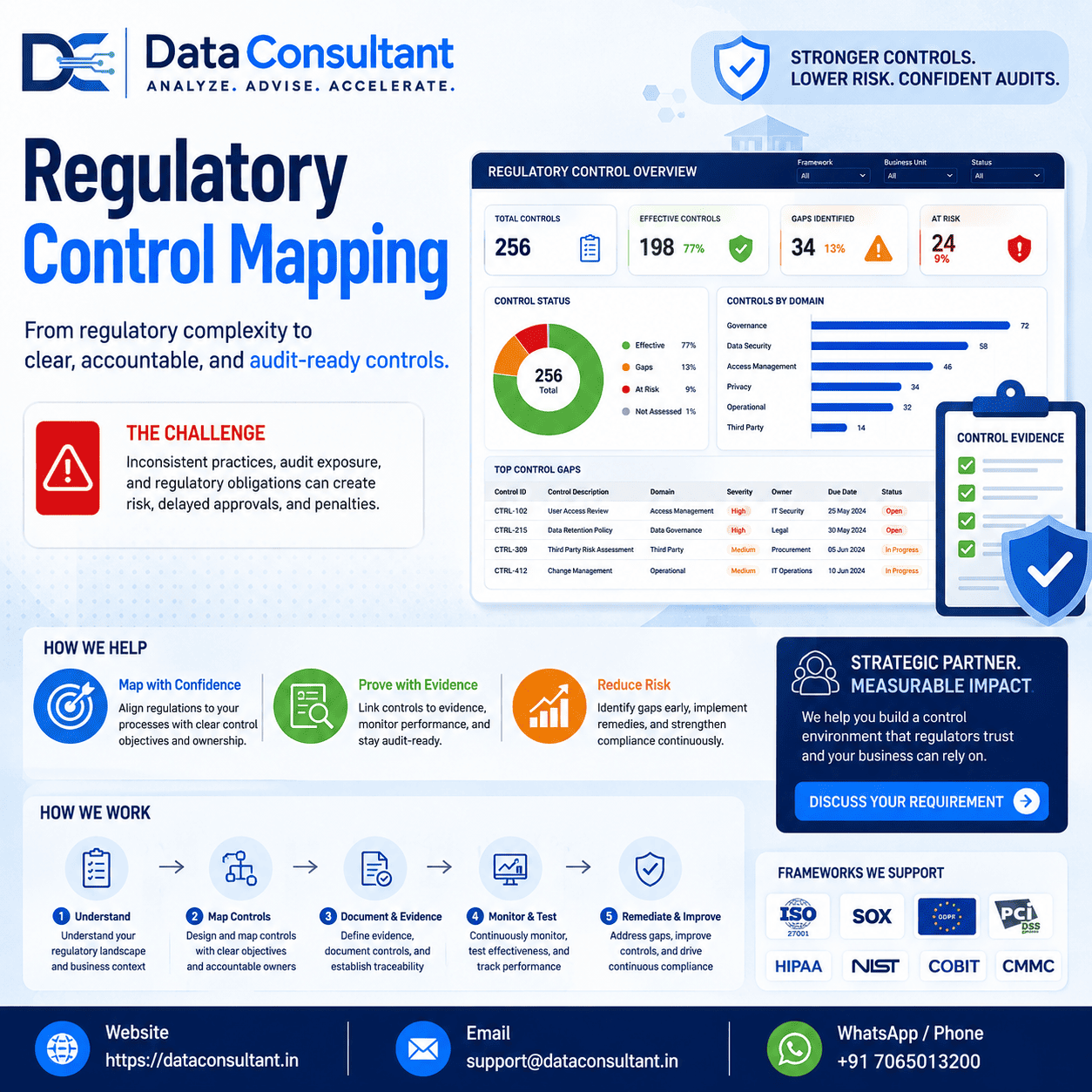
Quick Answer: Choose for Traceability and Ownership
Choose a GRC tool when the organisation needs stronger traceability across obligations, risks, controls, evidence, issues and approvals than current spreadsheets, email and document repositories can provide. The best-fit platform is the smallest one that supports your priority workflows, user roles, reporting obligations and integration needs without forcing unnecessary complexity.
Use a diagnostic first when control ownership, taxonomies or evidence requirements are unclear. Use a defined implementation when the operating model is understood and you need configuration, migration, integration, testing and rollout. Use ongoing support only when governance content, regulations, control automation or reporting requirements will continue to change.
Do not treat the tool as the risk programme. Governance still requires accountable owners, judgement, challenge, policy decisions and evidence review.
Key Takeaways
- Start with the control decision: define which obligations, risks, controls, evidence and issues must be connected.
- Check data readiness: duplicated controls, inconsistent taxonomies and weak ownership should be rationalised before migration.
- Keep internal ownership: risk, compliance, business, technology and audit teams must agree who owns records and approvals.
- Scope implementation tightly: prioritise a few high-value workflows before attempting enterprise-wide coverage.
- Design governance into the platform: roles, access, segregation, review frequency, retention and auditability matter as much as dashboards.
- Require usable deliverables: configuration documentation, mappings, test evidence, operating procedures and handover should be explicit.
- Plan knowledge transfer: internal administrators and control owners need to understand how the platform works after implementation support ends.
Table of Contents
- Decide whether a GRC tool is necessary
- Check control and data readiness
- Compare platform and workflow options
- Define evidence, security and integration needs
- Pilot the highest-value GRC workflow
- Estimate cost and internal effort
- Measure whether GRC decisions improve
- Apply the decision to practical scenarios
- Review GRC tool FAQs
- Summary and next step
Buy a GRC Tool Only When the Workflow Needs One
The strongest reason to adopt a GRC platform is not regulatory pressure by itself. It is the need to make governance and assurance work repeatable across many owners, controls, systems or obligations. If evidence is gathered by email, control tests are tracked in separate spreadsheets and leadership reports are assembled manually, a platform may reduce fragmentation. If the process is small and stable, a controlled register and existing workflow tools may remain sufficient.
Separate process failure from software failure
Ask what is actually going wrong today. Are obligations not mapped to controls? Are the same controls being tested repeatedly by different teams? Are issue owners unclear? Is evidence missing or impossible to verify? Are risk reports late because data lives in different systems? These are platform-relevant problems. By contrast, disagreement about risk appetite, weak management challenge or unclear accountability requires governance decisions before software configuration.
Decision rule: if you cannot describe the target workflow on one page—including trigger, owner, evidence, review, exception and approval—the implementation is not ready for a large configuration project.
Clean the Risk and Control Data Before Migration
A GRC implementation exposes data-quality problems quickly. Control libraries often contain duplicates, inconsistent naming, stale owners, different frequencies and obligations mapped at the wrong level. Migrating that material unchanged creates a cleaner-looking version of the same problem.
For the risk-management layer, ISO 31000:2018 risk management guidance provides a useful reference for integrating risk management with governance, strategy, planning and reporting. A GRC platform should support your chosen operating model rather than dictate one.
Compare GRC Options by Operating Model Fit
“GRC tool” can mean anything from a structured register to a multi-module enterprise platform. Compare options against the number of workflows, owners, integrations and assurance requirements you actually need.
| Option | Best fit | Strength | Internal requirement | Main risk |
|---|---|---|---|---|
| Controlled spreadsheet or register | Small scope, few owners, stable requirements | Low complexity and fast change | Strong manual discipline | Weak scale, traceability and workflow control |
| Existing ticketing or workflow tool | Simple issue, approval or attestation workflows | Uses familiar technology | Clear data model and reporting design | Risk-control relationships can become awkward |
| Focused GRC module | One priority process such as controls, third-party risk or compliance | Faster targeted implementation | Defined taxonomy and owners | Future modules may not integrate cleanly |
| Enterprise GRC platform | Multiple risk domains, obligations and assurance teams | Cross-process traceability and reporting | Governance, architecture and administration capacity | Complexity exceeds organisational maturity |
| Custom-built workflow | Highly distinctive process with strong engineering capability | Tailored user experience and integration | Product ownership and long-term maintenance | Ongoing support becomes a software product commitment |
The comparison should include future administration effort. A platform that can model every scenario may still be the wrong choice if only a specialist team can maintain it.
Define Evidence, Security and Integration Requirements
The core technical question is whether the platform can preserve the meaning and provenance of governance information while making work easier. Controls should link to the risks or obligations they address. Evidence should show where it came from, who reviewed it, when it was valid and what decision followed. Issues should preserve ownership, due dates, approvals and escalation history.
Design the evidence model before automation
- Define which controls require evidence and at what frequency.
- Specify acceptable evidence sources, formats, owners and retention.
- Separate evidence collection from evidence assessment.
- Record exceptions, compensating controls and reviewer decisions.
- Preserve an audit trail for material changes to risk, control and issue records.
For cybersecurity governance, the NIST Cybersecurity Framework 2.0 is designed to help organisations understand, assess, prioritise and communicate cybersecurity risk, and its Govern function emphasises risk governance and alignment with enterprise risk management. A GRC platform can support those outcomes, but the framework does not require a particular product.
Prioritise integrations that improve traceability
Common candidates include identity systems for users and roles, ticketing tools for remediation, document repositories for policies, HR systems for employee or organisational data, security tooling for control evidence and cloud platforms for configuration signals. Integrate where the connection reduces manual re-entry or improves evidence quality. Avoid creating a large integration programme before the data model and process are stable.
Where personal information is processed, the NIST Privacy Framework offers a voluntary risk-based structure for identifying and managing privacy risk. Use it as a governance reference where relevant to your jurisdiction and obligations, not as a substitute for legal advice.
Pilot One High-Value GRC Workflow Before Scaling
A pilot should prove that the operating model works in the tool, not merely that screens can be configured. Choose a process with visible pain, clear owners and enough complexity to test real controls—for example quarterly control attestation, regulatory obligation mapping or issue remediation.
Expect implementation deliverables you can operate
- Confirmed scope, process maps and acceptance criteria.
- Risk, control, policy and obligation data model.
- Role and access matrix, including privileged administration.
- Configured workflows, notifications, review rules and escalation paths.
- Migration mapping, data-quality log and reconciliation evidence.
- Integration specifications and test results.
- User acceptance testing, defect log and release decision.
- Operating procedures, administrator guide and knowledge-transfer materials.
Price the GRC Operating Model, Not Just Licences
Total cost is influenced by modules, named or concurrent users, third-party risk volumes, data storage, integrations, reporting, sandbox environments, implementation services and support. The larger cost can be internal: subject-matter experts must rationalise controls, approve workflows, validate migrated records, test reports and support adoption.
Ask vendors and implementation partners to separate one-off configuration from recurring administration. Also identify what happens when regulations change, a new business unit joins, controls are redesigned or a new evidence source is integrated. A low initial price can create a high long-term operating cost if every change needs specialist configuration.
Budget test: estimate the people required to own taxonomy, content, access, integrations, release management and user support after go-live. If no one owns those responsibilities, the platform will deteriorate regardless of licence cost.
Measure Better GRC Decisions, Not More Records
A successful platform should improve how quickly and reliably the organisation can answer governance questions: Which obligations apply? Which controls mitigate the relevant risks? Is the control operating as intended? What evidence supports that conclusion? Which issues are overdue? Who accepted the residual risk?
- Control and evidence completion against agreed schedules.
- Time taken to identify accountable owners and supporting evidence.
- Issue ageing, escalation and closure quality.
- Reduction in duplicated or conflicting control records.
- Percentage of material changes with complete approval history.
- Reporting effort required to produce governance or assurance views.
- User adoption among actual control owners and reviewers, not only administrators.
Measures should be defined before implementation so the organisation has a baseline. Do not claim that a platform reduced risk simply because the number of recorded controls increased.
Practical GRC Tool Decisions in Four Situations
Spreadsheet control testing is breaking down
A growing financial-services team runs quarterly control attestations through multiple spreadsheets and email chains. The pain is version confusion, overdue evidence and manual reporting. A focused GRC module is a credible fit because the workflow, owners and review cycle are already understood. The first project should rationalise the control register, define evidence rules and pilot one business area before migration expands.
A startup has ten core compliance controls
A startup with a small number of controls wants an enterprise GRC suite because customers ask for assurance. The need may be better documentation and accountability rather than a large platform. A controlled register, policy repository and existing ticketing workflow can be sufficient until control volume, audit frequency or customer requirements increase.
An enterprise has duplicate controls across teams
Risk, security, privacy and internal audit maintain separate control libraries that describe similar activities in different language. Buying a new platform before rationalisation will preserve the duplication. Start with a diagnostic that maps obligations, controls, owners and assurance activities. Configure the platform only after the target control model is agreed.
Evidence collection needs automation
A technology organisation has mature controls but spends large amounts of time collecting recurring evidence from cloud and identity systems. A GRC platform may add value if it can integrate with those sources, preserve evidence provenance and route exceptions to owners. The key test is whether automation improves review quality and traceability rather than simply generating more artefacts.
FAQs About Governance Risk Compliance Tools
What is a governance risk compliance tool?
A governance risk compliance tool is software used to organise governance obligations, risks, controls, policies, evidence, assessments, issues and reporting in a connected workflow. The useful distinction is not the label “GRC” but whether the platform supports your actual operating model, control owners and evidence process. Verify the workflows you need before comparing feature lists.
When does a business need a governance risk compliance tool?
A business usually needs one when risk, control and compliance work has outgrown spreadsheets, email and disconnected repositories, or when leadership cannot trace obligations to controls and evidence reliably. A tool is less urgent when the scope is small, ownership is clear and existing systems already provide controlled workflows. Confirm the problem and target users before buying.
Can a GRC platform replace risk and compliance professionals?
No. A platform can standardise workflows, reminders, evidence collection, mappings and reporting, but people still decide risk appetite, interpret obligations, approve exceptions, assess control design and judge whether evidence is sufficient. Treat automation as support for accountable decisions, not a substitute for accountable owners.
What should we prepare before selecting a GRC tool?
Prepare your main obligations or frameworks, risk taxonomy, control library, policy structure, issue process, evidence sources, user roles, approval flows, reporting needs and integration constraints. Also document the biggest pain points in the current process. Without those inputs, demonstrations can look impressive while hiding fit gaps.
How should a governance risk compliance tool handle evidence?
It should let you define evidence requirements, owners, frequency, source, review status, retention and links to relevant controls or obligations. Where possible, evidence collection can be integrated or automated, but reviewers should still be able to see provenance and assess sufficiency. Avoid a design that turns evidence into an unstructured attachment archive.
What integrations matter most for a GRC platform?
The important integrations depend on the use case. Common needs include identity and access management, ticketing, document repositories, HR systems, security tools, cloud platforms and data sources used for control evidence. Prioritise integrations that remove repeated manual work or improve traceability; do not integrate systems simply because a connector exists.
How much does a governance risk compliance tool cost?
Cost varies with user numbers, modules, workflow complexity, integrations, data migration, implementation services, support and change effort. Compare total cost of ownership rather than licence price alone. A lower-priced platform can become expensive if it needs heavy customisation or creates substantial manual administration.
How long does GRC tool implementation take?
A focused implementation can move relatively quickly when scope, taxonomy, controls, owners and integrations are already defined. Enterprise programmes take longer because data cleansing, control rationalisation, workflow design, security review, migration, testing and adoption must be coordinated. Pilot one high-value process before broad rollout where uncertainty is high.
How do we measure whether a GRC tool is working?
Measure whether the platform improves traceability, timeliness, ownership and decision quality in the processes it supports. Useful indicators can include overdue control actions, evidence completeness, issue ageing, duplicate controls, workflow cycle time and reporting effort, provided the measures are defined consistently. Do not treat logins or record counts as proof of risk reduction.
Summary: Choose the Smallest GRC Model That Works
A governance risk compliance tool is useful when disconnected workflows make it difficult to connect obligations, risks, controls, evidence, issues and accountable decisions. Internal staff and existing workflow software may be sufficient for a small, stable scope. A short diagnostic is the better starting point when risk language, controls or ownership are inconsistent. A defined GRC project is justified when the target operating model is clear and configuration, migration, integration, testing and rollout are required. Ongoing support or a managed capability is appropriate only when the content, integrations and governance workload are genuinely continuous.
Before committing, validate business goals, data quality, access, governance and internal ownership. Confirm scope, budget, timeline, security, documentation, quality assurance, knowledge transfer and handover expectations in practical terms. If your main problem is the quality and governance of the underlying risk, control or compliance data, DataConsultant data governance support can help clarify taxonomies, ownership, control information and implementation requirements before or alongside a tool decision.
Discuss GRC data and governance readinessAt DataConsultant.in, we help organisations turn data and AI priorities into governed, reliable, and practical business capability.