
Governance, Risk and Compliance: A Practical Guide
Governance, risk and compliance works best as one business operating system, not three disconnected control functions. Governance sets decision rights and accountability, risk management identifies and treats uncertainty, and compliance converts legal, regulatory, contractual and policy obligations into controlled work. The practical decision is not whether to buy a GRC platform first. It is whether your organisation can clearly connect obligations and risks to owners, processes, data, controls, evidence and management decisions.
Start with the business outcomes and exposures that matter: protecting customer data, maintaining reliable financial or operational reporting, meeting sector obligations, controlling privileged access, managing third parties or preparing for audit. A tool can organise records and workflows, but it cannot resolve unclear ownership, conflicting policies, weak source data or control activities that do not operate in practice.
This guide helps boards, founders, risk and compliance leaders, data and technology teams, operations managers and procurement functions decide when internal improvement is sufficient, when a short diagnostic is useful, when a defined GRC project is justified and when ongoing specialist support is appropriate.
Quick Answer: Build the Operating Model First
A governance, risk and compliance programme is appropriate when the organisation needs a repeatable way to understand obligations, assess risks, assign controls, collect evidence, manage issues and report to decision-makers. Begin by defining the business scope and accountable owners. Do not start with software configuration before agreeing what decisions the programme must support.
Use a short diagnostic when obligations, risk ownership, control coverage or evidence quality are unclear. Use a defined project when the target processes and deliverables can be scoped, such as a control library, risk register, policy framework, data-governance model or compliance workflow. Choose ongoing support when regulatory change, control testing, third-party review or risk reporting creates a continuous workload.
The main caution is that GRC documentation is not proof of control effectiveness. Policies, registers and dashboards are useful only when they reflect real processes, reliable data, accountable owners and evidence that can be tested.
Key Takeaways
- Governance defines accountability: decision rights, escalation routes and ownership must be explicit.
- Risk links uncertainty to action: assess material exposure, treatment choices, tolerances and residual risk.
- Compliance is broader than audit: obligations must be translated into operational requirements and evidence.
- Data quality affects every GRC decision: unreliable inventories, ownership records or control evidence distort reporting.
- Start with a bounded scope: one regulation, process, risk domain or business unit is often better than an enterprise-wide launch.
- Keep internal ownership: external specialists can structure and accelerate the work, but management remains accountable.
- Plan knowledge transfer: control owners and programme teams need documentation, training and maintainable workflows.
Table of Contents
- Define the GRC decision and scope
- Assess governance and data readiness
- Compare delivery options
- Design controls, evidence and technology
- Implement a phased GRC programme
- Estimate cost and internal resources
- Measure control and risk outcomes
- Apply GRC to practical situations
- Decide where specialist support fits
- Summary
Define the GRC Decision Before Selecting Tools
The first task is to define which management decision, exposure or obligation needs better control. “Implement GRC” is too broad to scope. A useful objective is specific, such as establishing evidence for privacy obligations, reducing unmanaged privileged access, creating consistent third-party risk reviews or aligning business continuity risks with executive reporting.
Separate governance, risk and compliance needs
Governance questions include who approves policy, accepts risk, funds remediation and receives escalation. Risk questions include what could prevent objectives, how exposure is assessed and which treatments are proportionate. Compliance questions include which obligations apply, how they map to processes and controls, and what evidence demonstrates operation.
These domains overlap but should not be collapsed into one undifferentiated register. A legal obligation may create several risks; one control may address multiple obligations; and a risk may be accepted even though a mandatory requirement cannot be waived.
Choose a bounded starting scope
- One regulatory or contractual obligation set.
- One high-risk process, such as customer-data access or supplier onboarding.
- One control domain, such as identity, retention or change management.
- One business unit or geography with a clear executive sponsor.
- One reporting problem, such as inconsistent risk ratings or overdue remediation.
A bounded scope produces evidence, lessons and reusable components before wider rollout. Expand only after ownership, terminology and operating routines work in practice.
Assess Governance, Data and Ownership Readiness
GRC readiness depends less on organisation size than on clarity. A growing business can build proportionate controls with simple tools, while a large enterprise can struggle if ownership, inventories and evidence are fragmented.
Check the minimum inputs
- Business objectives, organisation structure and decision authorities.
- Applicable laws, regulations, contracts, standards and internal policies.
- Process, system, data, supplier and asset inventories relevant to scope.
- Existing risk assessments, incidents, findings, exceptions and audit reports.
- Current controls, owners, frequency, evidence sources and testing results.
- Risk appetite, tolerance or escalation criteria where available.
Missing inputs do not prevent progress, but they change the engagement. When records conflict or ownership is disputed, discovery and data-quality work should precede automation.
Compare Internal, Tool and Consulting Options
The right delivery model depends on problem clarity, internal capability, urgency, breadth and continuity. Software is useful when the operating model is sufficiently defined; consulting is useful when the organisation still needs to diagnose, design or coordinate that model.
| Option | Best fit | Expected outputs | Internal requirement | Main risk |
|---|---|---|---|---|
| Internal team | Clear scope, capable owners and manageable workload | Policies, assessments, control updates and reporting | Protected time, authority and cross-functional access | Operational priorities delay remediation |
| GRC software | Defined workflows, taxonomies and evidence requirements | Central registers, workflows, alerts and dashboards | Configuration ownership and reliable source data | Digitising weak processes creates false confidence |
| Short diagnostic | Unclear obligations, risk ownership or control coverage | Gap analysis, maturity findings and prioritised roadmap | Stakeholder interviews and evidence access | Recommendations stall without executive ownership |
| Defined consulting project | Scoped framework, control, data or implementation need | Operating model, registers, mappings, workflows and handover | Named owners, decisions and acceptance criteria | Scope expands across every risk domain |
| Ongoing specialist support | Continuous monitoring, testing, reporting or regulatory change | Reviews, issue tracking, control testing and advisory support | Regular prioritisation and internal accountability | Dependency grows without knowledge transfer |
| Dedicated specialist or managed team | Substantial multi-domain workload requiring coordinated capacity | Consistent delivery across risk, compliance, data and reporting | Executive sponsor and defined governance cadence | Capacity is wasted if decisions and scope remain unclear |
A hybrid approach is often proportionate: internal leaders retain accountability while specialists provide diagnostic, design, technical or operational capacity for a defined period.
Design Controls, Evidence and Technology Together
A workable GRC design connects each obligation or risk to a control objective, control activity, owner, frequency, evidence source, testing method and escalation route. This traceability enables management to see what is required, whether the control operates and what happens when it fails.
Build a usable control model
- Use a controlled vocabulary for risks, obligations, controls, issues and evidence.
- Distinguish preventive, detective and corrective controls.
- Identify whether a control is manual, automated or dependent on another process.
- Define control ownership separately from evidence provision and independent testing.
- Record exceptions, compensating controls, remediation dates and risk acceptance.
- Avoid duplicating the same control for every framework when one control genuinely supports several requirements.
Treat GRC data as managed business data
Risk ratings, control status and compliance dashboards depend on master data and evidence quality. Define naming conventions, identifiers, ownership, update frequency, lineage and retention for GRC records. Integrations with identity systems, ticketing tools, asset inventories, HR systems, vendor platforms or data catalogues should have reconciliation and failure handling.
The NIST Cybersecurity Framework 2.0 explicitly includes governance within cybersecurity risk management. The ISO 37301 compliance management standard provides a reference for establishing and improving a compliance management system. These frameworks can inform structure, but the organisation must still interpret its own obligations and risk context.
Technology decision rule: configure a GRC platform only after agreeing the taxonomy, ownership, workflows, evidence and reporting decisions it must support. Otherwise, the implementation may centralise inconsistency rather than reduce it.
Implement GRC Through a Controlled Sequence
A phased implementation reduces disruption and makes assumptions testable. It also prevents teams from spending months building an enterprise taxonomy before proving that owners can maintain the records.
Require implementation deliverables
- Scope statement, stakeholder map and decision authorities.
- Obligation, risk, control and evidence inventories.
- Risk and control taxonomy with definitions and rating rules.
- Process maps, responsibility assignments and escalation routes.
- Configured workflows, data requirements and integration specifications.
- Pilot results, issue backlog and remediation priorities.
- Testing approach, quality-assurance records and acceptance criteria.
- Operating procedures, training, documentation and handover materials.
Estimate GRC Cost, Time and Resources
GRC cost is shaped by scope breadth, regulatory complexity, number of entities and systems, quality of existing inventories, control maturity, integration requirements, testing depth and the amount of organisational change required. A software licence is only one component.
A focused diagnostic may take several weeks when stakeholders and records are accessible. A defined implementation may take several months if it includes taxonomy design, control mapping, platform configuration, integrations, evidence migration, testing and training. Enterprise programmes take longer because they require coordination across business units, jurisdictions and assurance functions.
Budget for internal participation
Executive sponsors must make scope and risk decisions. Legal and compliance teams interpret obligations. Process and control owners explain actual work. Technology and data teams support inventories, integrations and access. Internal audit or assurance teams may advise on testing independence. Procurement and security may review external providers and platforms.
Cost estimates should distinguish discovery, design, implementation, licences, data preparation, integration, training, control testing, remediation and ongoing operation. Fixed-price work is more feasible when scope and acceptance criteria are clear; time-based support may be more suitable when discovery or regulatory change creates uncertainty.
Measure Control Operation and Risk Decisions
Measure whether the GRC programme improves decision quality, control reliability and issue response—not merely whether registers are complete. Metrics should help managers act and should disclose data limitations.
- Percentage of in-scope obligations mapped to approved controls and accountable owners.
- Control tests completed, failed or overdue, separated by materiality.
- Time to assign, escalate and remediate significant issues.
- Risk acceptance decisions with named authority and review dates.
- Evidence completeness, freshness and reconciliation exceptions.
- Repeat findings or incidents linked to ineffective remediation.
- Third-party reviews completed according to risk tier.
- Policy exceptions, overdue attestations and unresolved ownership gaps.
Avoid a single composite “GRC score” unless its calculation and limitations are transparent. Aggregation can hide a small number of high-impact failures behind a large volume of low-risk activity.
Practical Governance, Risk and Compliance Decisions
Privileged data access is poorly evidenced
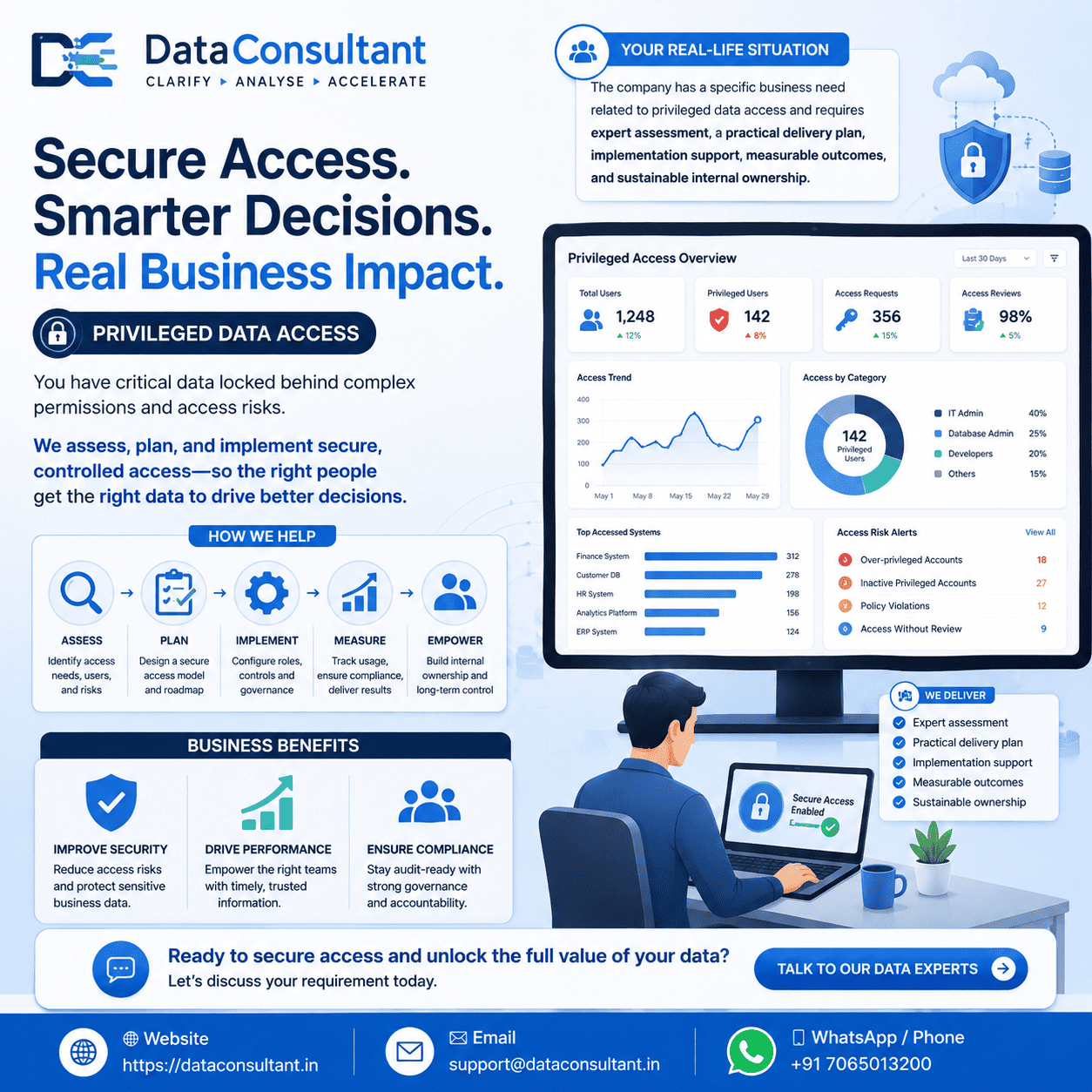
An ecommerce business can approve administrator access, but cannot reliably show who reviewed access, why it remained necessary or when it was removed. The mistaken assumption is that buying a GRC platform will solve the problem. The actual issue spans identity data, joiner-mover-leaver processes, ownership and evidence retention. A defined project should map the process, clean access records, set review rules, configure evidence capture and pilot the control with technology, HR, security and business owners.
Supplier compliance reviews are inconsistent
A professional-services firm uses different questionnaires for similar suppliers and cannot explain why some reviews are repeated while others are waived. A short diagnostic can establish risk tiers, minimum evidence, decision authorities and exception handling. The likely deliverables are a supplier taxonomy, due-diligence workflow, control mapping, approval matrix and reporting requirements. Procurement, legal, security and service owners must participate.
A startup is preparing for enterprise customers
A growing software company receives security and privacy questionnaires but has limited policies and informal controls. It does not necessarily need a complex platform. A proportionate project can create an obligation inventory, accountable policies, priority controls, evidence folders and a remediation roadmap. Internal leaders must own the commitments made to customers and avoid presenting planned controls as already operating.
An enterprise has multiple control libraries
Different business units maintain separate controls for privacy, cybersecurity, finance and operational resilience. The apparent need is consolidation; the actual problem includes inconsistent definitions, duplicate evidence and unclear ownership. A phased harmonisation project can establish common control objectives, preserve necessary local variation, map frameworks and define a migration approach. Assurance teams should validate that consolidation does not remove material requirements.
Decide Where Specialist GRC Support Fits
External support is useful when the organisation needs independent diagnosis, specialist regulatory or data-governance knowledge, control and evidence design, platform requirements, integration planning, implementation capacity or ongoing analytical support. It is less useful when management has not defined a business owner or is unwilling to make risk and remediation decisions.
For a defined engagement, require a clear scope, assumptions, stakeholder commitments, deliverables, acceptance criteria, data-access rules, security requirements, quality assurance, documentation, knowledge transfer and handover. Clarify ownership of configured workflows, mappings, code, reports and supporting materials.
DataConsultant.in can support governance and data maturity assessments, control-data design, data governance, technical discovery, implementation roadmaps, reporting requirements and ongoing specialist capacity where these directly address the organisation’s GRC problem.
Summary
Governance, risk and compliance is useful when an organisation needs a connected and repeatable way to manage obligations, uncertainty, controls, evidence, issues and accountable decisions. Internal staff may be sufficient when the scope is clear, data is reliable and capable owners have time. A software tool may be suitable when taxonomies, workflows and evidence requirements are already defined.
Use a short diagnostic when obligations, ownership, risk ratings, control coverage or evidence quality are uncertain. Use a defined project when the organisation can scope an operating model, control framework, data improvement or implementation outcome. Choose ongoing support or a managed team when monitoring, testing, reporting and regulatory change create a substantial continuing workload.
Before proceeding, validate the business goal, data quality, access, governance, internal ownership, scope, budget, timeline, security, documentation, quality assurance, knowledge transfer and handover expectations.
Frequently Asked Questions
What is governance, risk and compliance?
Governance, risk and compliance is a coordinated operating approach for assigning decision rights, managing uncertainty and meeting legal, regulatory, contractual and policy obligations. It connects risks and obligations to controls, owners, evidence, issues and reporting. The exact scope should reflect the organisation’s objectives and jurisdictions rather than a generic checklist.
How do I know whether my organisation needs a GRC programme?
A GRC programme is useful when obligations, risks, controls or evidence are fragmented across teams and management cannot obtain a reliable view. Common signals include repeat findings, unclear ownership, inconsistent risk ratings, overdue remediation and manual evidence collection. Start with a bounded diagnostic before committing to an enterprise platform.
Should we buy GRC software or improve processes first?
Improve the operating model first when ownership, terminology, workflows or evidence are unclear. Software can then centralise and automate defined processes. Buying a platform before resolving these questions can digitise inconsistency and create misleading dashboards. Document requirements and pilot critical workflows before wider configuration.
What information should we prepare for a GRC assessment?
Prepare business objectives, organisation and process maps, applicable obligations, system and supplier inventories, risk registers, policies, controls, audit findings, incidents, exceptions and available evidence. Identify accountable stakeholders and known data gaps. Where records conflict, treat reconciliation as part of discovery rather than assuming one source is correct.
How much does a governance risk and compliance project cost?
Cost depends on scope, regulatory complexity, number of entities and systems, data quality, control maturity, integrations, testing and change-management needs. Separate diagnostic, design, software, implementation, training and ongoing-operation costs. A credible estimate requires a defined scope and stakeholder commitments; licence price alone is not a reliable comparison.
How long does GRC implementation take?
A focused diagnostic may take several weeks, while a defined implementation may take several months. Timelines increase with fragmented records, multiple jurisdictions, complex integrations, security reviews and slow ownership decisions. A phased pilot provides a more reliable schedule than attempting immediate enterprise-wide rollout.
Who should own governance, risk and compliance?
Executive management retains accountability, while responsibilities are distributed across legal, compliance, risk, security, privacy, finance, operations, technology and control owners. A central GRC team may coordinate the framework, but it should not become the nominal owner of every business risk or control. Decision rights and escalation routes should be documented.
How should GRC control effectiveness be measured?
Measure whether controls operate as designed, evidence is current, significant failures are escalated and remediation is completed. Combine control testing, issue ageing, repeat findings, evidence quality and risk decisions. Avoid relying solely on policy publication, attestations or dashboard completion percentages, which may not demonstrate real operation.
Can a GRC consultant guarantee compliance?
No. A consultant can help interpret requirements, assess gaps, design controls, improve data and support implementation, but cannot guarantee compliance or remove management accountability. Legal interpretation may require qualified counsel, and control effectiveness depends on ongoing operation. Verify scope, assumptions, evidence and decision ownership before engagement.
When is ongoing GRC support appropriate?
Ongoing support is appropriate when regulatory change, control testing, third-party reviews, issue management or executive reporting creates recurring specialist work. It should include clear priorities, service boundaries, documentation and knowledge transfer. A one-off project may be sufficient when the need is narrow and internal owners can maintain the resulting controls.
Need a Clear GRC Starting Point?
Use a focused diagnostic to clarify obligations, risks, control gaps, evidence quality, data requirements and the most proportionate implementation path.
Discuss your GRC requirementAt DataConsultant.in, we help organisations turn data and AI priorities into governed, reliable, and practical business capability.