
Explain Data Security: What Businesses Need to Protect
To explain data security simply, describe it as protecting data from unauthorised access, disclosure, alteration, loss and disruption while keeping it usable for authorised people. The practical goal is not to install the largest possible security stack. It is to understand which data matters, where it moves, who needs access, what could go wrong and which controls reduce those risks to an acceptable level. A business problem such as leaked customer records, altered financial data or an unavailable operational database is different from a technology request such as “buy encryption” or “add a security platform”. Start with the risk and the data, then select controls.
For most organisations, data security combines governance and technical measures: data classification, ownership, access control, authentication, encryption, secure configuration, logging, backups, incident response and regular review. The familiar confidentiality, integrity and availability model provides a useful way to test whether protections are balanced. A control that protects secrecy but makes critical data unrecoverable is not a complete solution.
This guide helps business, technology, data, risk and operations leaders understand what data security includes, how it differs from privacy and cybersecurity, which controls matter at different maturity levels, and when internal teams, software tools, a short assessment or specialist consulting support are appropriate.
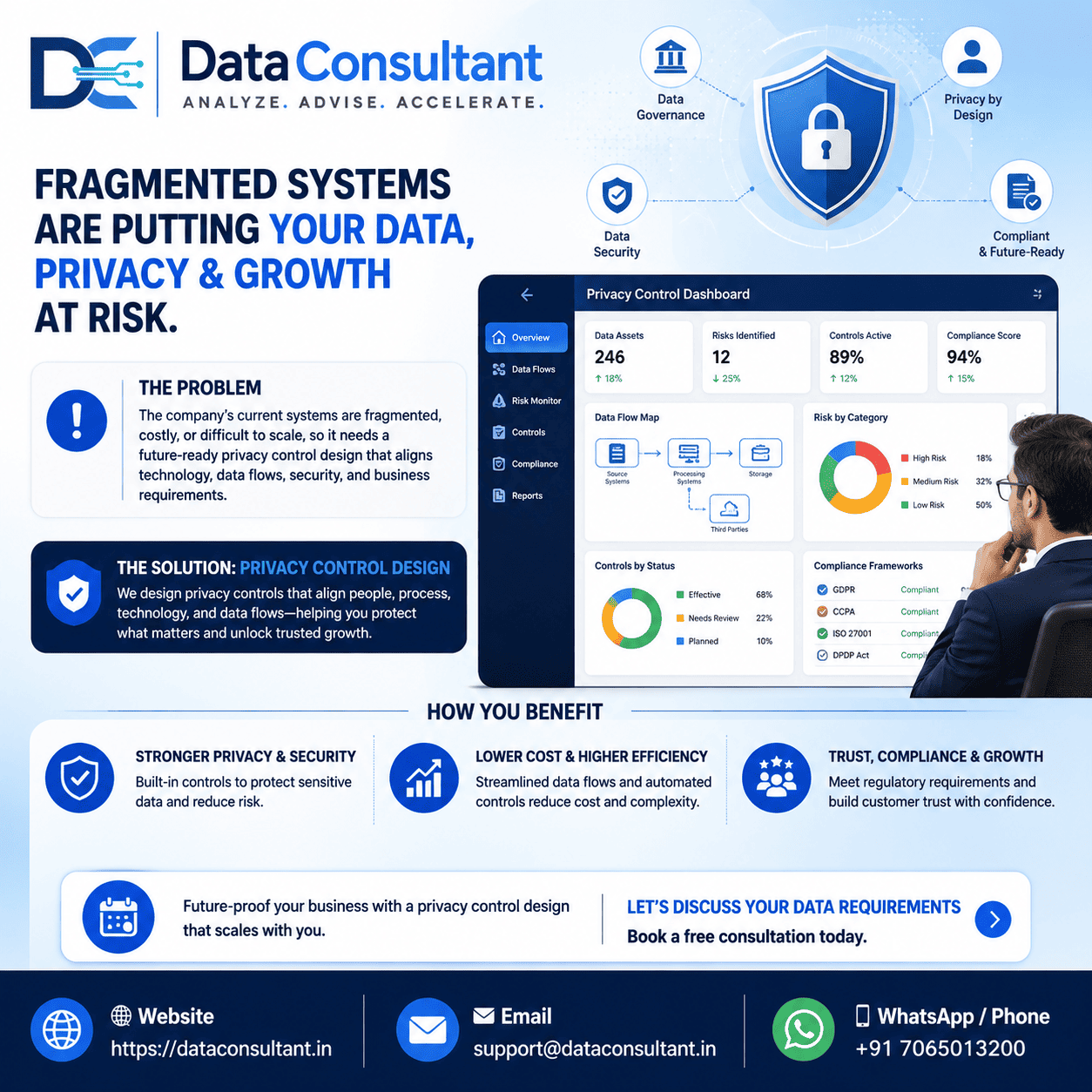
Quick Answer: Protect Data by Risk and Business Need
Data security should protect three outcomes: confidentiality, so only authorised users and systems can access data; integrity, so data cannot be improperly changed or destroyed; and availability, so authorised users can obtain it when required. NIST uses these three concepts as core information-security objectives in its confidentiality, integrity and availability glossary.
Use internal teams when the data, risks and required controls are already understood. Buy or configure a security tool when the gap is mainly functional and ownership is clear. Use a short data-security assessment when systems, permissions, data flows or risk priorities are uncertain. Use a defined consulting project when remediation needs specialist architecture, governance or implementation support. Choose ongoing support only when control operation, monitoring or change is genuinely continuous.
The main caution is to avoid hiring a consultant or buying technology before defining the business decision or operational problem. Security controls are easier to justify and test when each one is linked to a specific data asset, threat, vulnerability, owner and expected security outcome.
Key Takeaways
- Protect outcomes, not just systems: data security must preserve confidentiality, integrity and availability.
- Know the data first: classification, location, ownership and data flows determine which controls are proportionate.
- Limit access deliberately: identities, roles, privileges and periodic reviews are central to preventing unnecessary exposure.
- Combine preventive and recovery controls: encryption and access controls matter, but tested backups and incident response matter too.
- Keep internal ownership: security, data and business leaders must own risk decisions even when external specialists assist.
- Scope evidence and deliverables: a good assessment produces prioritised findings, control recommendations, owners and a workable remediation roadmap.
- Transfer knowledge: documentation, operating procedures and handover should reduce long-term dependency on consultants.
Table of Contents
- Define what data security must protect
- Assess data-security maturity
- Build a practical control baseline
- Choose internal, tool or consulting support
- Implement controls across the data lifecycle
- Estimate effort, cost and dependencies
- Measure whether controls work
- Apply the decision to real situations
- Use specialist support where it adds value
- Summary
Define the Data Security Outcome Before Choosing Controls
Start by defining the data and harm you are trying to prevent. “Secure the database” is too vague. “Prevent unauthorised payroll-data access while preserving approved HR and payroll processing” is a useful control objective because it identifies the data, authorised purpose and undesirable event.
NIST describes information security in terms of protection from unauthorised access, use, disclosure, disruption, modification or destruction in order to provide confidentiality, integrity and availability. That definition is useful because it keeps security broader than secrecy alone. See the NIST information security definition.
Separate data security from related disciplines
Cybersecurity protects digital systems and networks against cyber threats. Information security protects information in any form. Data security focuses specifically on protecting data throughout storage, use and movement. Data privacy focuses on appropriate and lawful handling of personal data. In a real operating model these disciplines overlap, but the distinction prevents accountability from becoming unclear.
For personal information, privacy requirements often create explicit security expectations. The UK Information Commissioner’s Office explains that organisations should use appropriate technical and organisational measures to process personal data securely in its guide to data security.
Assess Data Security Maturity Before Expanding Technology
A mature security programme does not mean every control is sophisticated. It means the organisation can identify important data, assign ownership, understand risks, operate proportionate controls and produce evidence that those controls work. Weak maturity often shows up as unclear data inventories, shared accounts, excessive access, undocumented exports, inconsistent retention, untested backups or security monitoring that cannot be tied to business-critical data.
Check five readiness areas
- Business clarity: which data supports critical decisions, operations, customers or regulatory obligations?
- Data visibility: where is sensitive data stored, copied, exported, integrated and backed up?
- Access ownership: who approves access, who reviews it and how are privileged users controlled?
- Technical protection: are encryption, configuration, endpoint, network, logging and recovery controls appropriate to the risk?
- Operational ownership: who monitors exceptions, investigates incidents, tests recovery and tracks remediation?
Decision rule: if the business cannot confidently answer where sensitive data is, who can access it and how it would be recovered after loss or ransomware, begin with discovery and assessment before adding more security tooling.
Build Data Security Around a Practical Control Baseline
The right control set depends on data sensitivity, system architecture, threat exposure and business tolerance for disruption. ISO/IEC 27001 provides a recognised risk-based framework for establishing, implementing, maintaining and continually improving an information security management system; see the ISO/IEC 27001 overview. It should be adapted to the organisation rather than treated as a checklist that guarantees security.
Core controls to evaluate
- Data inventory and classification: identify critical, personal, confidential and regulated data and record responsible owners.
- Identity and access management: use individual accounts, least privilege, strong authentication and periodic access reviews.
- Encryption and key management: protect appropriate data at rest and in transit, with controlled keys and recovery procedures.
- Secure configuration and patching: reduce exploitable weaknesses in databases, endpoints, servers, cloud services and applications.
- Logging and monitoring: record important access and administrative events and define who investigates suspicious activity.
- Backup and recovery: maintain protected backups and test restoration against realistic recovery objectives.
- Data loss and sharing controls: govern exports, removable media, email, collaboration platforms, APIs and third-party transfers.
- Incident response: define escalation, containment, evidence preservation, communication and recovery responsibilities.
CISA’s guidance for securing businesses emphasises practical measures such as backup planning and encryption. Its Secure Your Business guidance is a useful operational reference, particularly for smaller organisations that need a prioritised starting point.
Choose the Smallest Data Security Support Model That Fits
The best support model depends on problem clarity, internal capability, urgency and whether the work is one-off or continuous. A security platform may be useful when requirements are clear; it is a poor substitute for undefined ownership or an unknown data estate.
| Option | Best fit | Expected output | Internal requirement | Main risk |
|---|---|---|---|---|
| Internal team | Clear risks, known controls and manageable scope | Configuration, procedures and control evidence | Security, data and business ownership | Competing priorities delay remediation |
| Software tool | Specific functional gap such as access, monitoring or backup | Technical capability and operational alerts | Clear requirements, integration and control owners | Tool is deployed without process or accountability |
| Short data diagnostic | Unknown data flows, conflicting risk views or unclear priorities | Current-state assessment, gaps and prioritised roadmap | Stakeholder interviews and evidence access | Findings stall without funded owners |
| Defined consulting project | Complex remediation with a scoping boundary | Designs, control implementation, testing and handover | Decisions, approvals and technical cooperation | Scope expands without acceptance criteria |
| Ongoing consultant support | Regular review, monitoring or security change workload | Advisory support, control reviews and improvement backlog | Operating cadence and accountable sponsor | Dependency if knowledge is not transferred |
| Dedicated specialist or managed team | Substantial continuous workload across several disciplines | Predictable delivery capacity and coordinated operations | Governance, service measures and retained ownership | Cost without value if scope and outcomes are vague |
Use the least complex option that can close the defined risk. If the organisation already knows the problem and can operate the control, internal delivery or a targeted tool may be enough. If ownership, architecture or risk priorities are unclear, a diagnostic should come first.
Implement Data Security Across the Data Lifecycle
Security must follow data from collection and creation through storage, processing, sharing, analytics, backup, archival and deletion. Controls fail when one stage is protected but copies or downstream uses are ignored.
Protect data in storage, use and transit
Encryption can reduce exposure when data is stolen or intercepted, but it depends on sound key management, identity controls and application design. The ICO explains the role of encryption as a safeguard against unauthorised or unlawful processing in its encryption and data protection guidance.
For analytics and AI, include the full path: source systems, ETL or ELT pipelines, data lakes or warehouses, notebooks, BI tools, model environments, APIs and exports. Check service accounts, secrets, privileged roles and third-party data flows. Development teams should know which datasets are approved for testing and whether production data must be minimised, masked or replaced with synthetic data.
Make responsibility explicit
Security teams can define standards and monitor risk, but data owners and business leaders still decide who needs access and which operational trade-offs are acceptable. Platform and engineering teams implement controls. Privacy, legal and compliance teams advise on applicable obligations. Internal audit or independent assurance may test whether key controls are designed and operating as intended.
Estimate Data Security Cost from Scope and Complexity
Data security cost is driven by more than licence fees. The largest effort can sit in discovery, legacy-system remediation, identity clean-up, data classification, cloud redesign, integration, evidence collection, testing and change management. A narrow assessment with well-documented systems may take weeks; an enterprise remediation programme across cloud, databases, endpoints and third parties can take months and may need phased delivery.
Internal participation is part of the cost. Business owners must classify impact and approve access. Data and application teams explain flows and dependencies. Security teams define standards and test controls. Infrastructure and cloud teams implement changes. Procurement and legal teams may need to review vendors and contracts. A proposal that omits these dependencies understates the real work.
Budgeting rule: estimate discovery, remediation, control operation and evidence separately. A cheaper tool does not reduce total cost if the business still needs extensive integration, data clean-up, access redesign and manual monitoring.
Measure Data Security with Operating Evidence
Measure whether controls reduce defined risks and work consistently. Policy publication, training completion and tool deployment are useful administrative indicators, but they do not prove that sensitive data is adequately protected.
- Percentage of privileged and high-risk access reviewed on schedule.
- Number and age of stale, orphaned or excessive accounts identified and removed.
- Coverage of encryption for defined sensitive-data stores and transfers.
- Backup restoration success and ability to meet recovery objectives.
- High-risk vulnerability and patch remediation against agreed timelines.
- Logging coverage for critical systems and investigation of priority alerts.
- Control exceptions, overdue remediation items and repeated root causes.
- Incident exercises, response times and lessons incorporated into procedures.
Metrics should be interpreted in context. A falling alert count could indicate better controls or weaker detection. A rising exception count could indicate deteriorating security or better visibility. Review measures with business, data and technology owners and connect them to material risks rather than treating them as isolated dashboard numbers.
Data Security Decisions in Real Business Situations
Shared payroll folder with broad access
A growing business discovers that a shared folder containing payroll and employee documents is accessible to many former project members. The mistaken assumption is that a new document-management platform is the first requirement. The immediate problem is excessive access and weak ownership. A focused access review, data classification exercise and remediation plan may be enough. Likely outputs include an owner register, role-based access model, access-removal actions and a repeatable review procedure.
Cloud analytics platform before security design
An ecommerce team wants to centralise customer and transaction data in a cloud warehouse for faster reporting. The mistake is treating security as a final deployment checklist. The actual work is to define sensitive fields, ingestion paths, service identities, administrator privileges, encryption, audit logging, development access and export rules before scale. A defined consulting project may help when internal teams lack cloud-data security architecture experience, but platform ownership must remain internal.
Ransomware concern with untested backups
A professional-services company has endpoint protection and nightly backups but has never tested restoration of its most important client and finance data. Buying another detection product may not address the immediate resilience gap. The better decision is to test backup isolation, restoration, recovery priorities and incident responsibilities, then strengthen prevention based on the findings. Specialist support is useful if recovery architecture or ransomware readiness is unclear.
Use Data Security Specialists Only Where They Add Value
External data and security support is most useful when the organisation needs an independent assessment, clearer data ownership, a risk-based control baseline, secure data architecture, remediation planning or implementation assurance. It can also help when data governance and security are disconnected—for example, when teams cannot identify authoritative data owners or consistently control copies across reporting and analytics environments.
DataConsultant can support a focused data assessment or audit when the main need is to identify gaps and prioritise remediation, or data governance support when ownership, classification, access decision-making and control responsibilities need to be strengthened. The engagement should stay limited to the actual data-security problem rather than expanding into unrelated transformation work.
Summary: Secure the Data Before Expanding the Stack
Data security is the practical discipline of keeping data confidential, accurate and available while preventing unauthorised access, disclosure, alteration, loss and disruption. Internal staff may be sufficient when risks and controls are understood. A software tool may be sufficient when the functional gap is specific and governance is already defined.
Use a short assessment when the organisation cannot clearly map important data, access, control gaps or priorities. Use a defined project when remediation requires temporary specialist architecture, engineering, governance or assurance. Choose ongoing support or a managed team only when the workload is genuinely continuous and internal ownership remains clear.
Before committing budget, validate the business objective, data sensitivity, quality, location, access, governance, security architecture, scope, timeline, internal capacity, documentation, testing, knowledge transfer and handover. The strongest outcome is not a larger security stack; it is a control environment that owners understand and can operate.
FAQs About Data Security
How do you explain data security in simple business terms?
Data security is the set of technical and organisational measures used to keep data confidential, accurate and available to authorised people when they need it. In practice, that means knowing what data you hold, limiting access, protecting data in storage and transit, monitoring activity, maintaining recoverable backups and responding to incidents. The controls should match the sensitivity and business importance of the data rather than applying the same treatment everywhere.
What is the difference between data security and data privacy?
Data security focuses on protecting data from unauthorised access, alteration, loss or disruption. Data privacy focuses on whether personal data is collected, used, shared, retained and deleted lawfully and appropriately. They overlap: privacy obligations usually depend on effective security, but strong security alone does not prove that a business has a valid purpose or lawful basis for using personal data.
What are confidentiality, integrity and availability?
Confidentiality means data is accessible only to authorised people and systems. Integrity means data remains accurate, complete and protected from unauthorised or accidental change. Availability means authorised users can access data and services when required. These three outcomes are commonly used to explain information security and help businesses decide which risks and controls matter most.
Which data security controls should a small business prioritise?
Start with an inventory of important and sensitive data, strong identity and access controls, multi-factor authentication where supported, encryption for suitable data, secure backups with tested restoration, patching, endpoint protection, logging, staff awareness and a simple incident-response process. Priorities should be risk-based: protect the data and systems whose loss, disclosure or corruption would cause the greatest operational, legal or customer impact.
When does a business need a data security consultant?
External support is useful when the organisation cannot clearly map sensitive data, assess control gaps, define access models, secure a data platform, prepare for an audit or regulation, or translate security requirements into an implementation plan. A consultant is not automatically necessary when the problem is narrow, the controls are understood and internal security and data teams have enough capacity to implement and validate them.
Can buying a security tool solve a data security problem?
A tool can solve a defined technical gap, but it rarely fixes unclear data ownership, excessive permissions, inconsistent classification, weak processes or missing accountability. Before buying technology, define the risk, the data affected, the control objective, integration requirements, owners and evidence needed to show the control works. Tool selection should follow that definition rather than replace it.
How should data security be built into analytics and AI projects?
Security should be designed into data access, pipelines, storage, model development and operational use. Limit datasets to what is needed, separate development from production where appropriate, protect credentials and secrets, review permissions, log sensitive activity, secure data in transit and at rest where appropriate, and define retention and incident procedures. AI projects should also examine whether prompts, retrieved context, model outputs or third-party services may expose sensitive information.
How long does a data security assessment take?
A focused assessment can often be completed in a few weeks when the scope, systems, data owners and evidence are clear. Larger environments take longer because data may be spread across cloud platforms, databases, file stores, SaaS tools and third parties. The useful output is not the fastest report; it is a prioritised risk and remediation plan that owners can understand, fund and implement.
How do you measure whether data security is improving?
Use evidence that shows controls are operating, not only that policies exist. Useful measures can include privileged-access review completion, stale-account removal, encryption coverage, backup restoration success, patch and vulnerability remediation, logging coverage, incident response exercises, control exceptions and time to resolve high-risk findings. Measures should be linked to defined risks and reviewed with accountable business and technology owners.
Need a Data Security Assessment?
Share the data types, systems, access concerns, security incidents or control gaps you are trying to address. DataConsultant can help determine whether internal remediation, a targeted tool, a short assessment, a defined project or ongoing specialist support is the proportionate next step.
Discuss your requirementAt DataConsultant.in, we help organisations turn data and AI priorities into governed, reliable, and practical business capability.