
Data Privacy Example: What Good Privacy Looks Like in Practice
A useful data privacy example is a business collecting only the personal data it needs for a defined purpose, explaining that use clearly, limiting access, retaining the data for an approved period and deleting or anonymising it when the purpose ends. The central decision is not which privacy tool to buy; it is whether the organisation can explain why the data is needed, where it moves, who uses it, what controls apply and who owns the outcome. If those answers are unclear, start with the business process and data flow before adding technology.
Consider an ecommerce checkout. A delivery address may be necessary to ship an order, while a date of birth may be unnecessary unless there is a specific age-related requirement. The privacy issue is therefore not simply “protect customer data”. It is to connect purpose, collection, access, sharing, retention and deletion to a real business need. The same reasoning applies to employee records, marketing analytics, customer support transcripts and AI use cases.
This guide shows practical privacy situations and helps business, technology, risk and data leaders decide whether an internal fix, a software configuration, a short diagnostic, a defined consulting project or ongoing support is the proportionate next step.
Quick Answer: A Data Privacy Example That Works
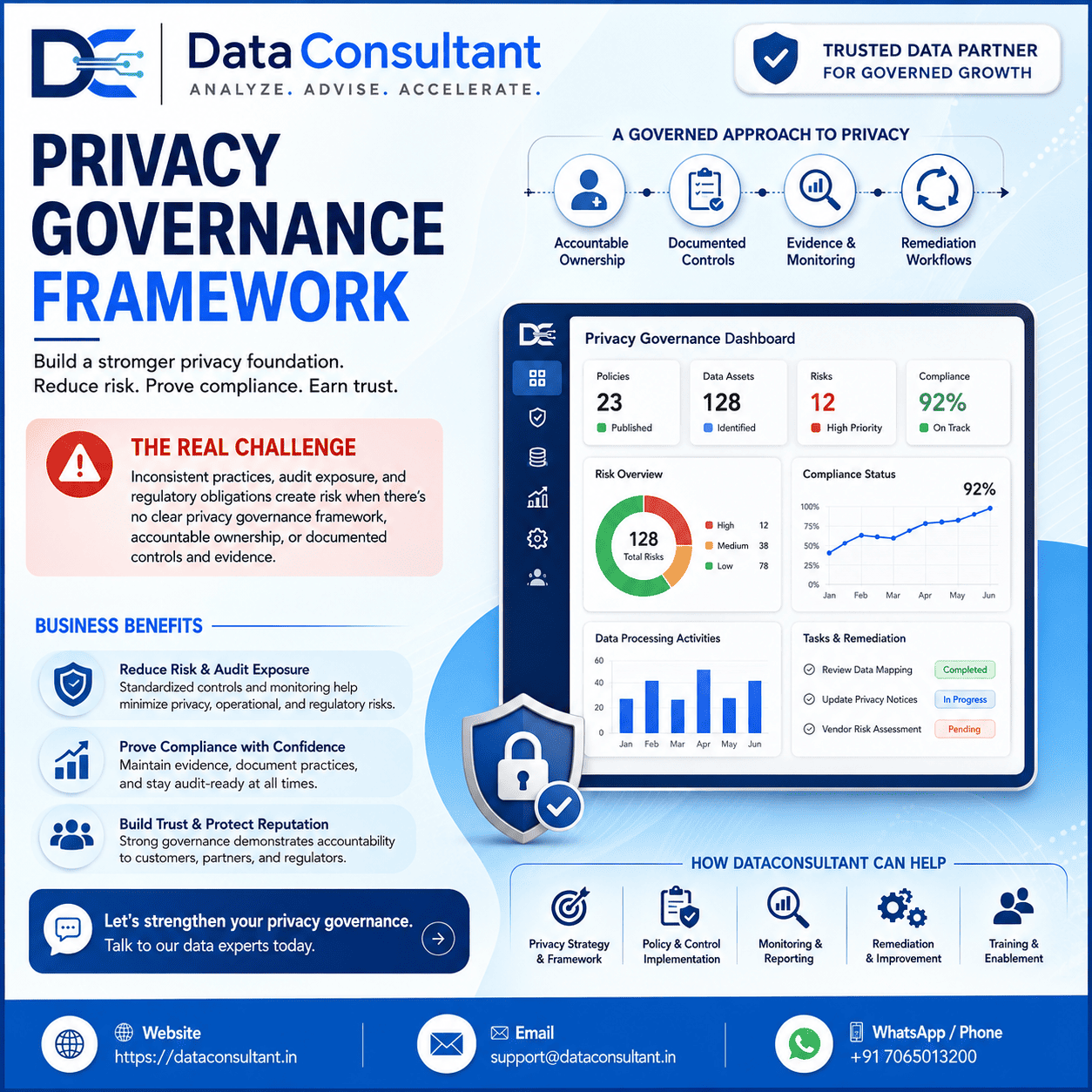
A strong privacy example has five visible elements: a defined purpose, proportionate data collection, controlled access and sharing, a justified retention period, and evidence that someone owns the controls. If one of those elements is missing, the process may still be secure but privacy governance is incomplete.
Use internal staff when the process is understood and the gap is small. Configure a tool when requirements are clear but execution needs automation. Use a short diagnostic when teams disagree about data flows, ownership or risks. Use a defined project when the organisation needs repeatable controls, remediation and implementation. Ongoing support is justified only when privacy and data-governance work is genuinely continuous.
The main caution is simple: do not hire a consultant or buy privacy software before defining the business decision or operational problem. A privacy notice, consent banner or data-discovery tool cannot compensate for an unclear purpose or unmanaged source-system process.
Key Takeaways
- Start with purpose: every personal-data field should have a clear link to a business need.
- Minimise before protecting: data that is not needed should not be collected merely because a system allows it.
- Keep internal ownership: consultants can assess and design controls, but accountable business and technology owners must operate them.
- Scope the privacy problem: distinguish policy gaps from data-flow, access, retention, supplier or system-design problems.
- Expect usable deliverables: data maps, risk findings, control requirements, remediation priorities and handover should support real implementation.
- Connect privacy and security: both matter, but a well-secured use can still be inappropriate if the purpose or collection is unjustified.
- Transfer knowledge: privacy improvements should leave internal teams able to explain and maintain the controls.
Table of Contents
- See privacy through real business decisions
- Review practical data privacy examples
- Check privacy and data readiness
- Compare internal, tool and consulting options
- Define evidence, access and stakeholders
- Turn privacy findings into controls
- Estimate cost, time and resources
- Measure privacy control effectiveness
- Decide where specialist support fits
- Summary
See Data Privacy Through Business Decisions
Privacy becomes practical when it is attached to a business decision rather than treated as a generic compliance statement. The first question is: what are we trying to achieve with this personal data? Only then should the organisation decide what information is necessary, who may use it and how long it should remain identifiable.
This logic is reflected in widely used privacy principles. The UK Information Commissioner’s Office data-protection principles emphasise lawfulness, fairness and transparency, purpose limitation, data minimisation, accuracy, storage limitation, security and accountability. The EU GDPR text on EUR-Lex contains the corresponding Article 5 principles for processing personal data.
Separate privacy from a technology request
A request such as “install a consent platform” or “encrypt this database” is not yet a complete privacy requirement. The platform may be useful, and encryption may be necessary, but neither answers whether the organisation should collect the data in the first place, whether the use is compatible with the stated purpose, or whether the retention period is justified.
A practical action is to write one sentence for each processing activity: “We use [data] from [source] to achieve [purpose] for [people/process], accessed by [roles], retained for [period], and shared with [recipients] where required.” Any blank or disputed field identifies a governance question that should be resolved before implementation.
Practical Data Privacy Examples and Better Decisions
The examples below are not legal conclusions. They show how privacy principles translate into operating choices and how to decide the smallest useful intervention.
Ecommerce checkout collects unnecessary profile data
Situation: an online store asks every buyer for delivery details, date of birth, gender and interests. The mistaken assumption is that more customer data will always improve future marketing. The actual privacy problem is purpose and minimisation: several fields may not be needed to complete the sale.
Better decision: the product and marketing teams should first define which fields support order fulfilment, fraud controls or a clearly communicated optional purpose. Likely deliverables include a field-level purpose review, revised forms, updated data flows, retention rules and test evidence. A consultant is useful only if ownership, requirements or cross-system impacts are unclear.
Recruitment files remain accessible after hiring
Situation: CVs, interview notes and identity documents remain in shared folders that former hiring-panel members can still access. The mistaken assumption is that the issue is solved by adding another privacy policy. The actual problem is access governance and retention.
Better decision: HR, technology and security owners should define role-based access, removal triggers, approved storage locations and retention rules. A short diagnostic may be enough when the repositories are limited; a defined project is more appropriate when data is spread across email, collaboration tools, applicant systems and local drives.
Marketing reuses customer data for a new purpose
Situation: a team wants to combine customer service records with campaign data to build a new audience model. The assumption is that data already held by the company can automatically be reused. The privacy question is whether the new use is compatible with the original purpose, properly communicated and governed.
Better decision: map the original collection context, proposed use, data fields, recipients and individual expectations before building the pipeline. The ICO purpose-limitation guidance provides a useful reference for thinking about specified purposes and reuse. Where legal interpretation is required, involve qualified legal or privacy counsel rather than treating a data consultant as a substitute.
AI support tool receives full customer transcripts
Situation: a support team plans to send complete chat transcripts to an AI service to generate summaries. The mistaken assumption is that removing a customer name is sufficient. The actual decision includes whether all transcript content is necessary, what sensitive information may appear, where data is processed, how long it is retained and what human review is required.
Better decision: start with data minimisation, approved fields, supplier and transfer review, access controls, retention, testing and a limited pilot. The NIST Privacy Framework can help organisations structure privacy-risk activities across identify, govern, control, communicate and protect functions.
Check Privacy and Data Readiness Before Buying Tools
Privacy improvement can start before the data environment is perfect, but it needs enough visibility to distinguish a real control gap from a documentation gap. Assess readiness across purpose clarity, data inventory, access, retention, supplier flows, governance and ownership.
- Business clarity: can the owner explain why each processing activity exists?
- Data visibility: are key systems, spreadsheets, exports, shared folders and third-party flows known?
- Control evidence: can teams show how access, deletion, retention and incident handling work in practice?
- Decision rights: is it clear who approves new uses, exceptions and remediation priorities?
- Internal capacity: can business and technology teams make changes after findings are agreed?
The OECD privacy principles provide a technology-neutral reference covering collection limitation, data quality, purpose specification, use limitation, security safeguards, openness, individual participation and accountability. For organisations operating in India, the Ministry of Electronics and Information Technology’s DPDP Rules 2025 page is an official source for the published rules and related implementation materials.
If teams cannot agree on the basic data flow, do not begin with enterprise tooling. A limited discovery or assessment can establish the baseline and prevent automation of a misunderstood process.
Choose the Smallest Privacy Intervention That Fits
The right option depends on problem clarity, internal capability, urgency, the number of systems and whether the need is one-off or continuous. The table is a decision aid, not a price ranking.
| Option | Best fit | Typical outputs | Internal requirement | Main risk |
|---|---|---|---|---|
| Internal team | Known process, clear ownership, limited gap | Updated forms, access, retention or documentation | Available business and technology owners | Work is deprioritised or inconsistently applied |
| Software tool | Requirements are defined and automation is the main gap | Discovery, workflow, records or control automation | Configuration ownership and integration capability | Tool automates an unclear or unsuitable process |
| Short data diagnostic | Unknown data flows, conflicting views or uncertain risk | Current state, gaps, priorities and roadmap | Stakeholder interviews and evidence access | Findings stall without a remediation owner |
| Defined consulting project | Controls, operating model and implementation need design | Data map, control design, remediation backlog, testing and handover | Cross-functional participation and change capacity | Scope expands without acceptance criteria |
| Ongoing consultant support | Privacy governance and remediation are recurring | Advisory, control review, backlog support and governance cadence | Regular prioritisation and internal decision makers | Dependency if knowledge is not transferred |
| Dedicated specialist or managed team | Substantial continuous workload across multiple domains | Predictable operational capacity and coordinated delivery | Executive sponsor, service model and governance | Cost exceeds value if demand is intermittent |
A hybrid model is often practical: external specialists can establish the baseline and control design while internal business, privacy, security and technology teams own decisions and ongoing operation.
Define Privacy Evidence, Access and Stakeholders
A useful assessment needs evidence from the real process. Policies are important, but they should be tested against system configuration, user access, sample records, integrations and operational behaviour.
Prepare the minimum evidence set
- business purpose and process owner;
- systems, repositories and third parties involved;
- categories of personal data and data subjects;
- source, destination and transformation of the data;
- access roles, privileged users and review evidence;
- retention schedules, deletion workflows and exceptions;
- privacy notices, consent or other relevant processing records where applicable;
- security controls, incident records and known remediation items;
- contracts or supplier information needed to understand data sharing.
Bring the people who can make decisions
Business owners explain purpose and acceptable use. Technology teams explain systems and change constraints. Security teams explain protection and incident controls. Privacy or legal teams interpret applicable obligations. Procurement may be needed for suppliers, and data-governance teams can help with ownership, metadata and quality. A consultant can coordinate evidence and design recommendations, but should not invent missing business decisions.
Turn Privacy Findings Into Operable Controls
Implementation should convert each finding into an owner, action, acceptance criterion and evidence requirement. A finding such as “excessive access” is too vague to close. A better requirement specifies which roles should have access, what approval is needed, how access is removed, how often it is reviewed and what evidence proves the control operated.
Prioritise work by privacy impact, business dependency, implementation effort and control weakness. Some actions may be immediate—removing obsolete access or unnecessary fields. Others may require system redesign, supplier changes or a staged migration.
Practical rule: do not treat documentation as the final deliverable when the underlying process still behaves differently. The target state should be reflected in forms, system settings, integrations, access models, retention jobs, user procedures and test evidence where relevant.
For AI or analytics use cases, a small pilot can be valuable when it deliberately limits the dataset, defines approved use, measures operational value and tests privacy controls before wider deployment.
Estimate Privacy Cost, Time and Internal Resources
Privacy work is driven less by document count than by process complexity. Cost increases with the number of systems, data stores, suppliers, jurisdictions, business units and unresolved ownership questions. Poor documentation also increases effort because consultants must reconstruct the current state before designing improvements.
A focused diagnostic may take a few weeks. A defined project can run for several months when it includes data discovery, control design, technology changes, supplier remediation, testing and handover. Large programmes can take longer, particularly when remediation depends on platform roadmaps or business-process redesign.
Budget for internal participation
The external fee is only part of the resource requirement. Plan for interviews, evidence extraction, design decisions, security review, legal or privacy input, technology changes, user testing, policy updates, training and ongoing control ownership. A cheaper proposal can become more expensive if it assumes internal teams will produce artefacts or perform remediation that they do not have capacity to complete.
Measure Whether Privacy Controls Work in Practice
Measure observable control performance rather than relying on policy publication or training completion alone. The strongest measures are tied to the privacy problem that triggered the work.
| Problem | Possible measure | Evidence |
|---|---|---|
| Unnecessary collection | Fields removed or justified against approved purposes | Form design, data dictionary, approval record |
| Excessive access | Access aligned to approved roles and review cycle | User-role extract, review sign-off, removals |
| Over-retention | Records disposed of according to approved rules | Retention configuration, deletion logs, exceptions |
| Unclear data sharing | Material recipients documented and governed | Data flow, contract record, transfer review |
| Weak accountability | Findings assigned, tracked and independently verified | Risk register, remediation evidence, testing results |
Do not promise that a privacy programme will eliminate incidents or guarantee compliance. Use measures to show whether defined controls are operating and whether known risk is being reduced, then review exceptions and failures as new information.
Use Specialist Privacy Support Where It Adds Value
External support is most useful when the organisation needs an independent baseline, cannot reconcile its data flows, lacks sufficient data-governance capacity or needs help turning privacy requirements into implementable controls. DataConsultant.in can support a focused assessment or audit engagement where current-state evidence and prioritised remediation are the main need, or a data governance engagement where ownership, data controls, metadata, retention or operating-model questions need to be resolved.
Specialist data consulting should complement, not replace, qualified legal advice. Where the decision depends on interpreting a specific law, regulatory obligation, contractual term or individual right, involve the appropriate legal or privacy counsel.
Summary: Start With Purpose, Then Choose the Support
A practical data privacy example begins with a clear purpose and shows how the organisation limits collection, controls access and sharing, sets retention, protects the data and assigns accountability. Internal staff may be enough when the process and fix are clear. A tool is useful when requirements are stable and execution needs automation. A short diagnostic fits unclear data flows or disputed ownership. A defined project is justified when controls, remediation and implementation need coordinated design. Ongoing support or a managed team fits substantial recurring work.
Before committing budget, validate the business goal, data quality, system access, privacy and security requirements, accountable owners, scope, timeline, documentation, testing and handover. The best engagement is the smallest one that creates a controlled, maintainable outcome.
FAQs on Data Privacy Examples and Decisions
What is a simple data privacy example?
A simple data privacy example is an online retailer collecting a customer’s delivery address to fulfil an order, restricting access to staff who need it, using it only for the stated purpose, retaining it only as long as required, and deleting or anonymising it according to an approved retention rule. The privacy work is not just the notice: it includes purpose, minimisation, access, retention, security and accountability.
How is data privacy different from data security?
Data security focuses on protecting data from unauthorised access, loss or misuse. Data privacy is broader: it also asks whether personal data should be collected, why it is used, whether the use is fair and transparent, how long it is kept, who it is shared with and how individuals can exercise relevant rights. Strong security can support privacy, but security alone does not define a lawful or appropriate use.
When does a privacy issue need a consultant rather than an internal fix?
Use an internal fix when the purpose, data flows, owners and required controls are already clear and the change is small. A short privacy or data-governance diagnostic can be useful when teams disagree about what personal data is held, why it is used, who has access, which rule applies or how a new use should be assessed. A defined project is more appropriate when the organisation needs a repeatable privacy operating model, data inventory, control design, remediation roadmap or implementation support.
What information should we prepare for a privacy assessment?
Prepare the business purpose, systems involved, categories of personal data, data sources, recipients, user roles, retention rules, privacy notices, consent or other relevant processing records, supplier arrangements, security controls, incident history and known gaps. The assessment will be more useful if business, technology, security, legal or privacy owners can explain how the process works in practice rather than relying only on policy documents.
Can a software tool solve a data privacy problem?
A tool can help with discovery, consent records, data mapping, access control, retention workflows or request handling when requirements are already defined. It cannot decide the business purpose, resolve ownership disputes, determine whether a proposed use is appropriate, or repair inconsistent source-system practices by itself. Buy or configure technology after the organisation has clarified the process, accountable owners and acceptance criteria.
How much does data privacy consulting cost?
Cost depends on the number of systems and business processes, data sensitivity, jurisdictions, documentation quality, stakeholder availability, integration complexity and whether the work is diagnostic, design, remediation or ongoing support. A tightly scoped review costs less than an enterprise-wide inventory and control programme. Compare proposals by defined outputs, assumptions, internal effort, exclusions and handover rather than by day rate alone.
How long does a data privacy improvement project take?
A focused diagnostic for one process may take a few weeks when evidence and stakeholders are available. A broader programme covering data discovery, control design, supplier flows, retention, remediation and implementation can take several months or longer. Timelines expand when systems are undocumented, data ownership is unclear, legal interpretation is unresolved or changes depend on multiple technology teams.
What deliverables should a privacy engagement provide?
Useful deliverables may include a current-state data flow, processing inventory, risk and gap assessment, prioritised remediation roadmap, control requirements, data-minimisation recommendations, retention and access decisions, governance roles, implementation backlog, testing evidence, documentation and handover materials. The exact set should match the problem; a small diagnostic should not be burdened with enterprise artefacts that will not be used.
Who owns privacy controls after the consultant leaves?
The organisation should retain accountable internal ownership. Business owners should understand the purpose and acceptable use of personal data, technology and security teams should operate relevant technical controls, and privacy or legal functions should provide appropriate oversight. Contracts should also clarify ownership and access to project documents, code, configurations, data maps and other artefacts needed for continuity.
How do we know whether privacy improvements are working?
Measure control operation and business behaviour, not policy publication alone. Useful evidence can include fewer unnecessary data fields, completion of approved retention actions, access reviews, resolution of privacy-risk findings, timely handling of data-subject requests where applicable, improved documentation quality, successful control testing and fewer unmanaged data stores. Treat these as indicators rather than guaranteed outcomes.
Need a Focused Privacy Diagnostic?
If your teams cannot agree on what personal data is held, why it is used, who owns it or which controls should change first, a bounded diagnostic can create a practical baseline before a larger technology or transformation commitment.
Explore Assessment SupportAt DataConsultant.in, we help organisations turn data and AI priorities into governed, reliable, and practical business capability.