
Data and Privacy: A Practical Business Decision Guide
Data and privacy should be managed as a business decision system, not as a policy document or a software purchase. Start by identifying why information is collected, whose data is involved, which decisions depend on it, who can access it, how long it is needed and what could go wrong for the people or organisation affected. The central caution is to avoid beginning with a technology request—such as a consent platform, customer-data platform, analytics dashboard or AI tool—before the purpose, ownership and acceptable use of the data are clear.
A business may be able to improve a narrow process using internal staff when its data flows and responsibilities are already understood. A short diagnostic is more suitable when teams disagree about what data exists, why it is used or which controls apply. A defined project is justified when mapping, governance design, technical remediation, vendor review or implementation can be scoped. Ongoing support is appropriate only when new products, data uses, suppliers, regulations or AI initiatives create a genuinely recurring workload.
This guide helps founders, boards, technology leaders, operations teams, marketing and ecommerce teams, finance leaders, privacy functions, security teams and procurement professionals decide what level of data and privacy work is appropriate, what evidence and stakeholder access are required, and what a credible engagement should deliver.
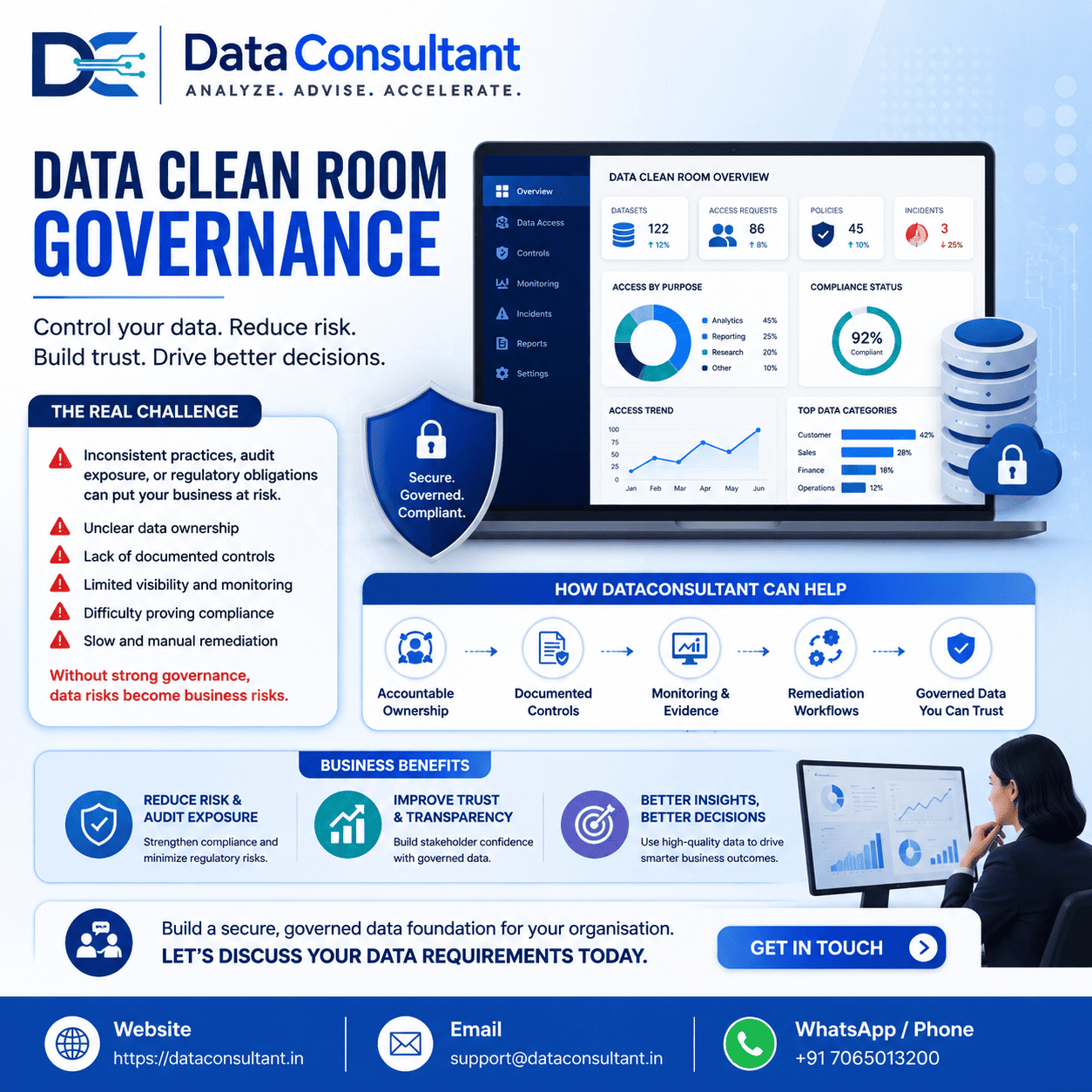
Quick Answer: Link Data Use to Accountable Decisions
Manage data and privacy by connecting every important dataset and processing activity to a defined purpose, an accountable owner, approved users, retention rules and evidence of control. Prioritise the activities that affect people, involve sensitive information, combine multiple sources, rely on third parties or support automated decisions.
Use internal staff when the scope is narrow and responsibilities are clear. Use a short diagnostic when the organisation lacks a reliable data map or cannot agree on risks and priorities. Use a defined project when specific outputs—such as a processing inventory, governance model, remediation plan or privacy-by-design workflow—can be accepted and handed over. Choose ongoing support when review and control work will continue across changing products and data uses.
Do not engage a consultant before defining the business decision or operational problem. External expertise can clarify uncertainty and accelerate structured work, but it cannot replace executive accountability, system access, stakeholder time or operational ownership.
Key Takeaways
- Purpose comes first: collect and use data only when the business need and expected benefit are clear.
- Data visibility is essential: privacy decisions are weak when systems, transfers, vendors and retention periods are unknown.
- Internal ownership cannot be outsourced: business, data, security, legal and operations teams need named responsibilities.
- Scope must produce usable outputs: require decision records, inventories, risk findings, controls, owners and a prioritised roadmap.
- Governance and security must connect: access, quality, sharing, retention and incident response should operate as one control environment.
- Implementation matters more than policy volume: evidence of working procedures is more useful than documents nobody follows.
- Knowledge transfer protects continuity: internal teams need the documentation and capability to maintain decisions after handover.
Table of Contents
- Define the data purpose and privacy decision
- Assess data visibility and ownership
- Compare internal, tool and consulting options
- Set privacy, security and access requirements
- Implement controls through a phased plan
- Estimate cost, time and internal effort
- Measure control effectiveness and trust
- Apply the decision to practical situations
- Decide where specialist support fits
- Summary
Define the Data Purpose Before Selecting Controls
The first decision is not which privacy platform to buy. It is whether each data activity has a clear, necessary and proportionate purpose. Describe the operational outcome, the people affected, the information required and the decision the data will support. Remove fields, uses and access that cannot be justified.
Separate a business need from a data habit
Organisations often retain information because it may be useful later, copy customer data into spreadsheets for convenience or share broad datasets with suppliers because narrower access is difficult. These habits create cost, uncertainty and exposure. A defensible design starts with the minimum data and access required to complete a defined task.
Identify impact, not only legal categories
Personal data can create harm even when it is not conventionally described as highly sensitive. Location histories, behavioural profiles, purchase patterns, device identifiers and inferred interests may affect autonomy, reputation, opportunity or safety. Assess how data is combined and used, not only the label attached to an individual field.
Decision rule: if the business cannot explain the purpose, affected people, minimum information, owner and retention period in plain language, the processing activity is not ready for automation or scale.
Assess Data Visibility, Quality and Internal Ownership
A privacy programme is ready to progress when the organisation has enough visibility to make evidence-based decisions. Perfection is unnecessary, but unknown systems, undocumented transfers and disputed ownership should be treated as findings rather than hidden behind a policy.
Build a usable data map
Record the source, purpose, data categories, people involved, destinations, users, third parties, storage location, retention rule and accountable owner for important processing. Link the map to system and vendor records so it can support access reviews, impact assessments, incident response and change approval.
Test the five readiness conditions
- The business purpose and expected decision are defined.
- Data sources, transfers and major dependencies are visible.
- Quality limitations and identity-matching risks are understood.
- Access, security, retention and third-party controls have owners.
- Internal teams can maintain decisions and evidence after implementation.
The NIST Privacy Framework provides a voluntary structure for managing privacy risk through enterprise risk management. The OECD data-governance resources also highlight the need to balance data use, control and trust across stakeholders.
Compare Internal, Tool and Consulting Options
The correct option depends on problem clarity, internal capability, breadth, urgency and continuity. A tool can automate known requirements, but it cannot decide why data is needed, resolve competing interpretations or assign ownership.
| Option | Best fit | Expected outputs | Internal requirement | Main risk |
|---|---|---|---|---|
| Internal team | Clear issue, accessible evidence and sufficient capability | Focused policy, process or control improvement | Named owner and protected delivery time | Work loses priority or misses specialist issues |
| Software tool | Requirements and workflows are already defined | Inventory, request, consent or workflow automation | Configuration, integration and governance ownership | Automating incomplete or inaccurate decisions |
| Short diagnostic | Unknown data flows, conflicting views or uncertain risk | Current-state map, priority findings and roadmap | Stakeholder access and evidence sharing | Recommendations stall without an executive owner |
| Defined consulting project | Specific governance, remediation or implementation outcome | Design, controls, implementation support, documentation and handover | Cross-functional decisions and acceptance criteria | Scope expands across every system and policy |
| Ongoing support | Recurring product, vendor, analytics or compliance reviews | Advice, assessments, control reviews and improvement backlog | Operating cadence and prioritisation | Dependency if knowledge is not transferred |
| Dedicated specialist or managed team | Substantial continuous workload across disciplines | Predictable capacity for governance and delivery | Executive sponsor and integrated working model | Capacity is wasted without clear demand and ownership |
A hybrid model is often practical: internal leaders retain accountability while specialists provide diagnostics, technical depth, implementation support and independent challenge.
Set Privacy, Security and Access Requirements
Privacy and information security overlap but are not interchangeable. Security asks whether information is protected; privacy also asks whether the data should be collected, whether the use is fair, how it affects people and how choices or rights are handled.
Define evidence for every important control
- Approved purposes and data-use decisions.
- Role-based access and periodic access reviews.
- Retention schedules linked to operational deletion.
- Vendor instructions, contracts and transfer records.
- Data-quality correction and identity-matching controls.
- Impact assessment and change-review procedures.
- Incident escalation, investigation and communication responsibilities.
- Training tied to actual roles and system permissions.
The ICO data-protection audit framework offers practical accountability areas for organisations reviewing their privacy management. Indian organisations should also assess the applicability of the official Digital Personal Data Protection Act, 2023 and obtain jurisdiction-specific legal advice where required.
Treat analytics and AI as changes in data use
A new model, customer profile, recommendation engine or AI assistant may change the purpose, sensitivity, recipients and impact of existing data. Reassess the data flow before launch. Confirm training-data permissions, output access, human review, logging, retention and the ability to investigate harmful or inaccurate results.
Implement Data Controls Through a Phased Plan
Start with the highest-value and highest-risk data journeys rather than attempting to document the entire organisation at the same depth. A controlled pilot should prove that the operating model works before it is extended.
Use a practical implementation sequence
- Diagnostic: confirm business priorities, data flows, gaps, stakeholders and risk.
- Decision design: define purpose, ownership, control requirements and acceptance criteria.
- Pilot: implement the approach for one product, department or data journey.
- Remediation: fix access, retention, quality, vendor, documentation or technical issues.
- Handover: transfer records, procedures, training and the improvement backlog to internal owners.
Expect decision-ready deliverables
- Prioritised data and privacy risk assessment.
- Processing and data-flow inventory at the agreed level of detail.
- Ownership and responsibility model.
- Control requirements and implementation backlog.
- Impact-assessment and change-review templates.
- Vendor and data-sharing review findings.
- Policies and procedures tied to operational evidence.
- Training, documentation, quality assurance and handover records.
Estimate Cost, Time and Internal Resources
Cost is driven by scope and uncertainty. The main factors include the number of systems and business units, data sensitivity, jurisdictions, third parties, legacy technology, documentation quality, technical remediation, integration work and the availability of internal experts.
A narrow diagnostic may involve interviews, evidence review and a prioritised roadmap. A defined implementation can take several weeks or months depending on system access and decision speed. An enterprise programme may require phased work because inventories, contracts, controls, remediation and operating-model changes cannot be completed credibly as a single documentation exercise.
Budget for internal participation
Business owners must explain purpose and operational practice. Data and engineering teams provide lineage, integrations and quality evidence. Security teams validate protection. Legal or privacy specialists interpret obligations. Procurement supports supplier decisions. Leadership resolves priorities and accepts residual risk. A proposal that assumes minimal internal involvement is unlikely to create sustainable capability.
Measure Control Effectiveness, Not Document Volume
Measure whether important data decisions are visible, owned and followed. Policy publication is an activity, not evidence that risk is controlled.
- Percentage of priority data journeys with an accountable owner and current record.
- Completion and quality of impact assessments for material changes.
- Access-review findings and time taken to remove inappropriate access.
- Retention exceptions and evidence of operational deletion.
- Third-party review coverage and unresolved high-priority findings.
- Accuracy and completion of individual-rights or customer-request workflows where applicable.
- Incident response speed, root-cause quality and remediation completion.
- Closure of prioritised actions with documented acceptance evidence.
- Internal capability to maintain inventories, decisions and controls without external dependency.
Report limitations alongside progress. A reduction in incidents may reflect lower detection, and a completed inventory may become stale quickly. Use measures that encourage accurate evidence and responsible escalation rather than superficial compliance.
Practical Data and Privacy Decisions
Ecommerce personalisation with scattered customer data
An ecommerce business wants a customer-data platform to improve personalisation. The mistaken assumption is that consolidation is primarily an integration project. The actual issue is that marketing, service and transaction data have different purposes, permissions, quality levels and retention rules. A short diagnostic should map the customer journey, identity matching, access and vendor flows before platform configuration. Deliverables may include a purpose map, minimum-data design, consent and preference requirements, quality rules, impact assessment and phased implementation plan.
Manual spreadsheets containing employee information
A growing professional-services company shares workforce spreadsheets by email and wants encryption software. Encryption may help, but the underlying problem includes duplicated files, excessive access, uncertain retention and no authoritative source. A defined project can redesign the process, establish role-based access, migrate records to an approved system, remove redundant copies and document ownership. HR, operations, technology and security teams must participate.
AI assistant using customer-support conversations
A support operation plans to use historical conversations to train or configure an AI assistant. The confusion is that existing possession of the conversations automatically permits every new use. The better decision is to reassess purpose, customer expectations, sensitive content, vendor access, retention, output review and incident handling. A focused privacy and AI-readiness review may be sufficient before a limited pilot.
Decide Where Specialist Support Fits
Specialist support is useful when evidence is fragmented, responsibilities cross departments, technical and governance decisions interact, or the organisation needs an independent assessment before committing to technology or large-scale change. It is less useful when the business has not assigned an internal decision owner or cannot provide access to relevant stakeholders and systems.
DataConsultant.in support may be relevant for data maturity assessment, data mapping, governance and ownership design, data-quality review, architecture and integration planning, privacy-by-design coordination, analytics and AI readiness, defined implementation projects, ongoing advisory support or a dedicated data and AI team. The appropriate scope should match the actual data problem rather than a broad catalogue of services.
Need a structured starting point? A focused diagnostic can establish the current data flows, privacy risks, internal owners and practical priorities before a larger programme is approved.
Discuss your data and privacy prioritiesSummary
Use internal staff when the data purpose is clear, the scope is limited and the organisation has sufficient capability and ownership. Configure a software tool when workflows and requirements are already defined. Use a short diagnostic when data visibility, risk or accountability is uncertain. A defined project is justified when mapping, governance, remediation or implementation can be scoped with milestones and acceptance criteria. Ongoing support or a managed team fits a substantial recurring workload across products, vendors, analytics, AI and governance.
Before committing, validate business goals, data quality, access, privacy and security requirements, governance ownership and the organisation's ability to maintain the result. Agree scope, budget, timeline, evidence, documentation, quality assurance, knowledge transfer and handover in proportion to the work. “At DataConsultant.in, we help organisations turn data and AI priorities into governed, reliable, and practical business capability.”
Frequently Asked Questions
What does data and privacy mean for a business?
Data and privacy describes how an organisation collects, uses, shares, retains, protects and deletes information, particularly personal data. The practical requirement is to connect each data use to a clear business purpose, approved access, defined ownership and proportionate controls. Review the applicable laws and sector rules before treating a general framework as sufficient.
How do we know whether our data use creates a privacy risk?
Privacy risk exists when data processing may affect people through unwanted exposure, unfair decisions, excessive monitoring, loss of control or misuse. Map the data flow, identify the people affected, test necessity and proportionality, and record who can access the information. A formal impact assessment may be appropriate for high-risk or unfamiliar processing.
Should we buy a privacy tool or engage a consultant?
Buy or configure a tool when requirements, data owners, workflows and control rules are already clear. Use a short diagnostic when teams disagree about data locations, lawful use, retention or accountability. Engage a consultant for a defined project when specialist mapping, governance design, remediation or implementation support is needed; software alone cannot settle unclear policy or ownership.
What information should we prepare for a data and privacy review?
Prepare a list of systems, data sources, processing purposes, data categories, user groups, third parties, retention rules, security controls, incidents, policies and current responsibilities. Include planned analytics or AI use cases. Gaps are acceptable, but they should be identified openly so the review can prioritise evidence rather than assumptions.
How does data quality affect privacy?
Poor data quality can create privacy harm when records are inaccurate, duplicated, outdated or linked to the wrong person. It can also make access, correction, deletion and retention requests harder to complete. Privacy work should therefore include data-quality ownership, correction processes, lineage and controls for matching or merging records.
Can anonymisation remove all privacy obligations?
Not automatically. Data may remain identifiable when direct identifiers are removed but combinations, linkage or external information can reveal individuals. Assess re-identification risk, access conditions and the intended use. Pseudonymised data still requires protection because the link to a person can usually be restored with additional information.
How much does a data and privacy project cost?
Cost depends on the number of systems, jurisdictions, data types, third parties, legacy issues, documentation quality and the depth of technical remediation. A focused diagnostic is usually smaller than a full governance and implementation programme. Compare proposals by scope, evidence, deliverables, internal time, handover and ongoing ownership rather than price alone.
How long does a data and privacy review take?
A focused review of one process or use case may take several weeks when stakeholders and evidence are available. An organisation-wide programme may take months because inventories, risk decisions, contracts, controls, remediation and training must be coordinated. Timelines increase when ownership is unclear or system documentation is incomplete.
Who should own data privacy after a consultant leaves?
Internal leaders must retain accountability. Legal or privacy specialists may interpret obligations, while business owners define purpose, data teams manage quality and lineage, security teams manage protection, and operations teams maintain procedures. The engagement should leave an ownership register, decision records, documentation, training and a prioritised improvement backlog.
When is ongoing data and privacy support appropriate?
Ongoing support is appropriate when new products, analytics, AI use cases, vendors or jurisdictions create recurring review work, or when the organisation lacks sufficient internal privacy and data-governance capacity. It should include a clear operating cadence and knowledge transfer so external support strengthens rather than replaces internal ownership.