
How to Be Compliant with GDPR
To be compliant with GDPR, an organisation must understand what personal data it processes, establish a lawful basis for each purpose, provide transparent information, protect the data, respect individual rights, control processors and international transfers, and be able to demonstrate these decisions. The practical starting point is not a privacy-policy rewrite or a software purchase. It is a documented review of business purposes, data flows, systems, suppliers, retention practices, security controls and accountable owners.
GDPR compliance is not a one-time certificate or a promise that risk has disappeared. It is an operating discipline. A small organisation with limited, low-risk processing may manage much of the work internally using a focused data inventory and clear procedures. A business with unclear data flows may need a short diagnostic. A defined remediation project is appropriate when gaps can be scoped, while ongoing privacy, governance or data support is justified when processing, vendors, products or regulatory exposure change continuously.
This decision guide helps founders, business owners, technology leaders, marketing teams, ecommerce businesses, finance and operations leaders, privacy teams and procurement functions decide what GDPR work is required, what evidence to maintain, where data consulting support may add value and when legal advice is also necessary.
Quick Answer: Build Evidence Around Each Data Use
An organisation is more likely to be compliant with GDPR when it can explain, for every material use of personal data, what is collected, why it is needed, which lawful basis applies, who receives it, how long it is retained, how it is secured and how people can exercise their rights. These decisions should be reflected in systems, contracts, notices and staff procedures—not only in policy documents.
Use internal staff when processing is limited and responsibilities are clear. Use a short GDPR data diagnostic when teams cannot agree where personal data sits, which vendors process it or whether existing notices match reality. Use a defined project when the organisation needs a data inventory, records of processing, retention controls, processor reviews, rights-handling workflows, transfer assessments or remediation. Choose ongoing support when products, campaigns, integrations and suppliers change frequently.
The main caution is to avoid treating GDPR as a documentation exercise detached from operational data. A polished privacy notice cannot correct excessive collection, uncontrolled exports, unclear consent, weak access controls or indefinite retention.
Key Takeaways
- Map real processing: record personal-data categories, purposes, sources, recipients, systems, locations, retention and owners.
- Choose lawful bases carefully: consent is only one option and should not be used when it is not genuinely freely given, specific and withdrawable.
- Limit data by design: collect only what is necessary, restrict access and remove data when the approved retention period ends.
- Keep accountable ownership: business, technology, security, legal and operational teams must own the controls they operate.
- Scope deliverables: require an evidence register, prioritised remediation plan, procedures, contracts, testing and handover.
- Control suppliers and transfers: processor terms, due diligence and transfer safeguards must match the actual data flow.
- Maintain the programme: new systems, campaigns, AI uses and vendors should trigger privacy review rather than bypass it.
Table of Contents
- Define what GDPR compliance means
- Map personal data and ownership
- Choose the right compliance approach
- Apply lawful, fair and minimal processing
- Implement rights, security and breach controls
- Plan resources, evidence and review cycles
- Apply GDPR decisions to real situations
- Decide where specialist support fits
- Summary
Define GDPR Compliance as an Operating Capability
GDPR compliance means being able to apply the regulation’s principles to actual processing and demonstrate that application. The core principles include lawfulness, fairness and transparency; purpose limitation; data minimisation; accuracy; storage limitation; integrity and confidentiality; and accountability. The official regulation is available through EUR-Lex.
Start with the business purpose. “We want more customer data” is not a defined purpose. “We need an email address to deliver an order confirmation” is clearer. Each purpose should have an owner, a lawful basis, necessary data fields, approved recipients, retention logic and controls. Where profiling, monitoring, large-scale sensitive data or other high-risk processing is planned, assess whether a data protection impact assessment is required before deployment.
Separate legal interpretation from data implementation
Legal specialists interpret obligations, contractual positions and jurisdiction-specific risk. Data, technology and operational teams implement the decisions in databases, applications, workflows, access models, retention jobs and vendor integrations. A gap often appears when legal documentation says one thing but the systems do another. Effective compliance connects both disciplines and records who approved each decision.
Decision rule: do not begin with a generic GDPR checklist. Begin with the processing activities that create the greatest risk, affect the most people or are least understood.
Map Personal Data Before Buying Compliance Tools
A reliable data map is the foundation for most GDPR decisions. It should show where personal data enters the organisation, how it changes, which systems store it, which teams use it, which external parties receive it, where it is transferred and how it is deleted. A tool can help maintain this information, but it cannot infer business meaning or ownership without knowledgeable staff.
Minimum information for each processing activity
- Business purpose and accountable owner.
- Categories of individuals and personal data.
- Source systems, collection channels and data lineage.
- Lawful basis and any conditions for special-category data.
- Internal recipients, processors and independent controllers.
- Storage locations and international transfer routes.
- Retention period, deletion method and exceptions.
- Security controls, access roles and monitoring.
- Privacy notice, consent record or legitimate-interest assessment where relevant.
- Rights-handling and incident-response dependencies.
Organisations should also decide whether they must appoint a data protection officer, maintain formal records of processing activities or complete impact assessments. The European Data Protection Board guidance library provides official guidance on these and other GDPR topics.
Choose the Smallest GDPR Approach That Closes the Gap
The right approach depends on processing complexity, internal capability, urgency, geographic reach and the quality of existing evidence. More consulting is not automatically better. The objective is to establish dependable controls and internal ownership without creating unnecessary dependency.
| Approach | Best fit | Expected outputs | Internal requirement | Main risk |
|---|---|---|---|---|
| Internal team | Limited processing, clear systems and capable privacy owners | Data inventory, procedures, notices and evidence register | Time from business, IT, security and legal stakeholders | Blind spots remain outside the reviewing team |
| Compliance software | Known requirements and a need to manage repeatable workflows | Registers, request tracking, assessments and reporting | Configured ownership, accurate inputs and administration | The tool becomes a repository for incomplete information |
| Short data diagnostic | Unclear data flows, suppliers, lawful bases or priorities | Current-state findings, risk ranking and remediation roadmap | Interviews, system evidence and decision-maker access | Recommendations stall without assigned owners |
| Defined remediation project | Specific gaps across inventory, retention, rights, contracts or controls | Implemented controls, documentation, testing and handover | Cross-functional delivery and acceptance criteria | Scope expands into unrelated legal or security work |
| Ongoing specialist support | Frequent product, vendor, marketing or data-use changes | Reviews, updates, monitoring and issue resolution | Regular prioritisation and governance meetings | Internal capability does not develop |
| Dedicated privacy and data team | Large-scale, sensitive, regulated or multinational processing | Continuous governance, assurance and coordinated delivery | Executive sponsorship and clear operating model | Roles overlap or accountability becomes diffuse |
A hybrid model is common: internal owners make business decisions, legal counsel interprets obligations, and data or technology specialists implement and test the required controls.
Apply Lawful, Fair and Minimal Data Processing
Every processing purpose needs a lawful basis before processing starts. Contract may support data needed to provide a requested service. Legal obligation may apply to statutory records. Legitimate interests may be appropriate when the interests are documented, necessity is tested and individual rights do not override them. Consent requires a genuine choice and a practical withdrawal mechanism. Public task and vital interests apply in narrower circumstances.
Make transparency match the real system
Privacy information should describe actual purposes, data categories, recipients, retention, rights and transfer arrangements in clear language. Layered notices can help people find important information without forcing every detail into one screen. Review notices whenever a new purpose, data source, vendor or automated decision is introduced.
Reduce data before adding controls
Security cannot fully compensate for collecting unnecessary data. Remove fields that do not support an approved purpose, avoid copying production data into testing environments, use pseudonymisation or anonymisation where appropriate, and design default settings to limit exposure. The UK Information Commissioner’s Office provides practical guidance through its data protection guidance and resources.
Set retention as an executable rule
A retention schedule should connect record categories to legal, contractual and operational needs. It should also define the disposal action, owner, system mechanism and any approved hold. “Keep until no longer needed” is difficult to operate and demonstrate. Test deletion across backups, exports, analytics stores and processor systems where technically and contractually applicable.
Implement Rights, Security and Breach Controls
Individuals may have rights of access, rectification, erasure, restriction, portability, objection and protections relating to automated decision-making, depending on the circumstances. A reliable workflow must verify identity proportionately, find data across relevant systems, apply exemptions correctly, coordinate processors, meet deadlines and record the decision.
Design security around processing risk
Use appropriate technical and organisational measures such as role-based access, strong authentication, encryption where suitable, secure development, logging, vulnerability management, backup controls, staff training and supplier assurance. The correct measures depend on the nature, scope, context and risk of the processing. Security teams should be able to show how controls reduce identified risks rather than relying on a generic control list.
Prepare for personal-data breaches
Incident response should help teams identify whether personal data is involved, contain the event, assess likely risk to people, preserve evidence and decide whether notification is required. Under GDPR, certain breaches must be reported to the relevant supervisory authority without undue delay and, where feasible, within 72 hours after awareness. High-risk breaches may also require communication to affected individuals. Maintain a breach log even when notification is not required.
Control processors and international transfers
Before appointing a processor, assess its ability to provide sufficient guarantees, agree required contractual terms, understand subprocessors and define return or deletion at termination. For transfers outside the European Economic Area, identify the transfer mechanism and assess whether supplementary measures are needed. Do not assume that a cloud contract or vendor badge resolves the transfer analysis.
Plan GDPR Resources, Evidence and Review Cycles
The cost of GDPR work is driven by the number of systems, business units, data subjects, vendors, jurisdictions and high-risk activities—not simply employee count. A small ecommerce company with many advertising, payment and fulfilment integrations may have more complex data flows than a larger organisation with a narrow business model.
A focused diagnostic may involve stakeholder interviews, system reviews, sample testing and a prioritised roadmap. A remediation project may take several weeks or months depending on data discovery, contract review, engineering changes, retention automation, request workflows and approvals. Continuous support is justified when change volume creates a persistent review workload.
Require evidence that can be maintained
- Processing inventory and records of processing where required.
- Lawful-basis decisions and consent evidence where applicable.
- Legitimate-interest assessments and impact assessments.
- Privacy notices and change history.
- Processor due diligence, contracts and transfer documentation.
- Retention schedule and deletion-test results.
- Rights-request log and response procedures.
- Incident log, breach assessments and notification decisions.
- Training records, policy approvals and assurance findings.
- Remediation backlog with owners, deadlines and acceptance evidence.
Decision rule: budget for internal participation. External specialists cannot validate business purposes, approve risk or sustain controls without accountable owners inside the organisation.
Practical GDPR Compliance Decisions
Ecommerce marketing data is spread across vendors
An ecommerce business believes updating its cookie banner will make it compliant with GDPR. The actual issue is broader: customer identifiers move between the website, email platform, analytics tools, advertising networks and customer-support system, while retention and controller relationships are unclear. A short diagnostic should map the flows, classify each party, review consent and other lawful bases, and prioritise notice, contract, configuration and deletion changes. Marketing, ecommerce, IT, legal and procurement owners must participate.
A professional-services firm keeps every client file
A firm stores proposals, engagement documents, communications and exported contact lists indefinitely because staff fear deleting useful history. The mistaken assumption is that business value automatically justifies permanent storage. A defined remediation project can classify records, identify legal and operational retention needs, configure archive and deletion rules, document exceptions and test disposal. Legal, client-service, records-management and technology teams need to approve the outcome.
A startup plans AI profiling before privacy review
A startup wants to score user behaviour with an AI model before it has stable data definitions, a clear purpose or a way to explain the outcome. Buying an AI governance tool would not resolve the underlying questions. The better decision is a limited privacy and data-readiness assessment covering purpose, lawful basis, necessity, data quality, bias risk, transparency, security and impact-assessment requirements. The pilot should proceed only after owners accept the controls and limitations.
Use Specialist Support Where Data Controls Need Delivery
External support is useful when the organisation needs an independent data-flow assessment, a prioritised GDPR remediation roadmap, records of processing, retention implementation, processor and transfer mapping, rights-request workflows, privacy-by-design support or evidence that controls operate as intended. It can also help when internal legal, privacy and technology teams understand their own areas but lack a shared implementation plan.
DataConsultant can support defined discovery, data governance, data quality, architecture, implementation planning and ongoing data operations where these directly contribute to the GDPR objective. The engagement should state which legal interpretations are provided by qualified counsel and which deliverables concern data, systems, governance and operational implementation.
Summary: Make GDPR Controls Work in Practice
A business is more likely to be compliant with GDPR when it can connect each use of personal data to a valid purpose, lawful basis, transparent notice, minimal collection, appropriate security, controlled sharing, defined retention and workable individual-rights procedures. Internal staff may be sufficient when processing is limited and ownership is clear. A software tool may help when requirements and workflows are already defined, but it cannot decide business purposes or repair inaccurate source information.
Use a short diagnostic when data flows, vendors, lawful bases or priorities are unclear. Use a defined project when remediation can be expressed through specific outputs, acceptance criteria, budget and timeline. Ongoing support or a dedicated team may be appropriate when processing changes continuously or involves substantial scale, sensitivity or geographic complexity. Validate business goals, data quality, access, governance and internal ownership before committing to technology or broad implementation.
Expect proportionate scope, security review, documentation, quality assurance, knowledge transfer and handover. Seek qualified legal advice where interpretation, regulatory exposure or contractual responsibility requires it, while ensuring operational teams can implement and maintain the resulting decisions.
At DataConsultant.in, we help organisations turn data and AI priorities into governed, reliable, and practical business capability.
Frequently Asked Questions
What does being compliant with GDPR mean?
It means applying GDPR principles and obligations to real personal-data processing and being able to demonstrate the decisions. This normally includes lawful bases, transparent information, data minimisation, security, retention, rights handling, processor controls, transfer safeguards, breach procedures and accountable governance.
Does every organisation need a GDPR consultant?
No. An organisation with limited processing, clear ownership and capable internal staff may manage the work itself. Specialist support is more useful when data flows are unclear, processing is high risk, several systems or suppliers are involved, remediation requires technical delivery, or internal teams need an independent assessment.
Is a privacy policy enough for GDPR compliance?
No. A privacy policy or notice is only one part of compliance. Operational practices must match it. Excessive collection, unlawful processing, poor security, uncontrolled sharing, weak rights handling or indefinite retention cannot be corrected by wording alone.
What data should be included in a GDPR inventory?
Record the purpose, data categories, individuals affected, source, systems, recipients, processors, locations, lawful basis, retention, security controls, transfer routes and accountable owner for each material processing activity. Include offline records and exports where they remain part of the processing.
Do we always need consent to process personal data?
No. GDPR provides several lawful bases. Consent is appropriate only when it is freely given, specific, informed, unambiguous and easy to withdraw. Contract, legal obligation, legitimate interests and other bases may be more suitable depending on the purpose and circumstances.
How long does a GDPR compliance project take?
A focused diagnostic may take a few weeks when stakeholders and evidence are available. Remediation may take several weeks or months depending on system complexity, data discovery, contract changes, engineering work, retention automation, rights workflows and approvals. Continuous review is needed where processing changes frequently.
How much does GDPR compliance cost?
Cost depends on the number of systems, vendors, business units, jurisdictions and high-risk activities, as well as the quality of existing documentation and controls. Include internal staff time, legal review, technical changes, supplier work, training, testing and ongoing maintenance when estimating the full cost.
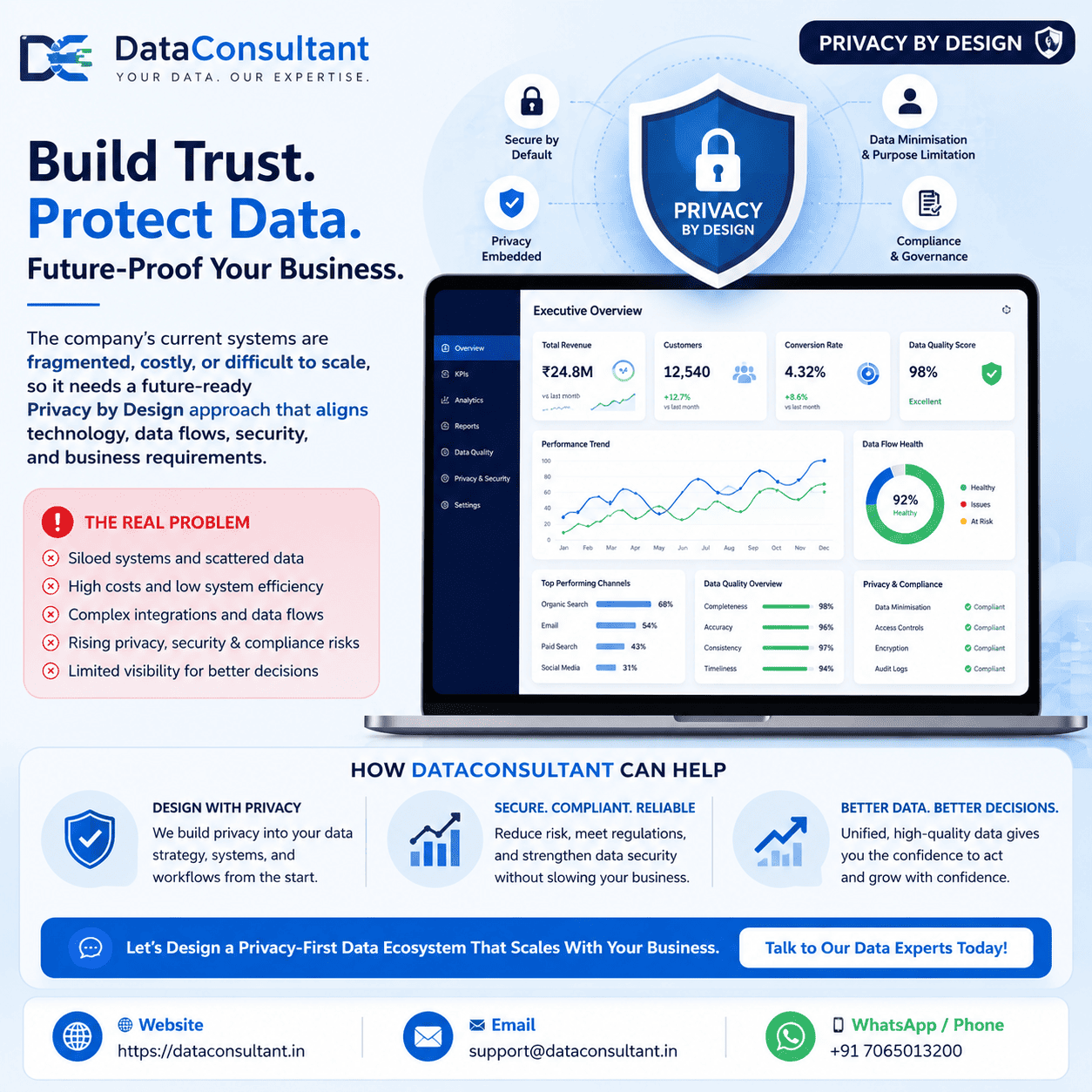
What is privacy by design under GDPR?
Privacy by design means considering data-protection principles, risks and safeguards when a product, service or process is planned, rather than adding privacy controls after deployment. It includes purpose definition, minimisation, access control, retention, transparency, testing and documented approval.
How often should GDPR compliance be reviewed?
Review should be risk based and triggered by meaningful change, including new products, data uses, vendors, transfers, AI systems, security incidents or regulatory guidance. Organisations should also schedule periodic reviews of processing records, retention, access, contracts, notices and unresolved actions.