
Compliance with GDPR: A Practical Business Guide
Compliance with GDPR means building lawful, transparent and accountable personal-data practices into normal business operations. Start by identifying which personal data you hold, why you use it, who controls each processing activity and what evidence demonstrates that the controls work. The central decision is not whether the organisation owns enough privacy documents; it is whether real systems, teams and suppliers process personal data consistently with defined purposes, legal bases, retention rules, individual rights and appropriate security.
Do not begin with a consent banner, policy rewrite or compliance platform before defining the processing that must be governed. A technology request may conceal a wider operating problem: unclear data ownership, excessive collection, inconsistent customer records, unapproved exports, indefinite retention or vendors operating without suitable instructions. A short diagnostic can clarify scope. A defined remediation project is suitable when gaps and deliverables can be bounded. Ongoing support is appropriate only when monitoring, assessments, supplier reviews and product changes create a continuing workload.
This guide helps founders, business leaders, technology teams, privacy functions, procurement teams and data owners decide what GDPR compliance requires, which work can be handled internally and where specialist data-governance support may be proportionate. It is practical guidance rather than legal advice; complex territorial, employment, surveillance, health-data or international-transfer questions should be reviewed by qualified counsel.
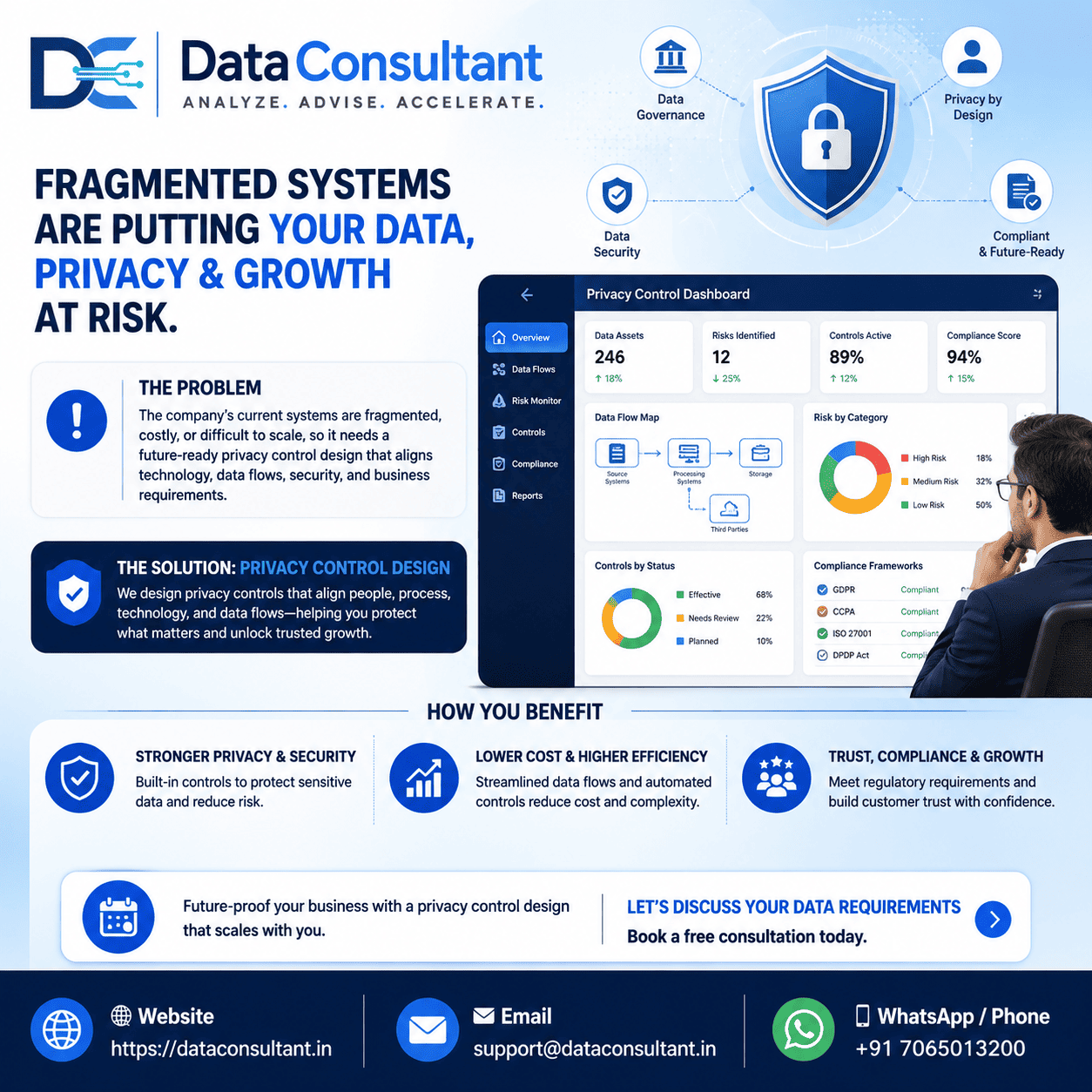
Quick Answer: Make GDPR Compliance Operational
A business is closer to GDPR compliance when it can explain what personal data it processes, its purpose and legal basis, where the data moves, how long it is retained, which suppliers receive it, how people exercise their rights and how risks are controlled. Those answers should be supported by current records and working procedures, not assumptions.
Use internal staff where processing is limited, ownership is clear and the team has sufficient privacy, security and data-management capability. Use a short diagnostic where the data estate or obligations are uncertain. Use a defined project for discovery, remediation, privacy notices, contracts, retention, rights workflows, DPIAs or control implementation. Use ongoing advisory or managed support where products, suppliers and data uses change continuously.
The main caution is to avoid treating GDPR as a one-off documentation exercise. Accountability requires an organisation to maintain, review and demonstrate appropriate measures as processing and risks evolve.
Key Takeaways
- Map actual processing: identify personal data, purposes, systems, recipients, locations, retention and accountable owners.
- Choose legal bases deliberately: consent is not the default answer for every processing activity.
- Connect policy to operations: privacy notices, contracts and retention schedules must match real workflows.
- Design for individual rights: teams need a verified process for finding data and responding within applicable deadlines.
- Use risk-based controls: security, DPIAs and supplier oversight should reflect the nature, scale and impact of processing.
- Keep internal ownership: consultants and tools can support compliance, but accountability remains with the organisation.
- Maintain evidence: review processing records, incidents, training and controls when systems, suppliers or purposes change.
Table of Contents
- Define the GDPR compliance decision
- Map personal data and accountability
- Compare compliance delivery options
- Set lawful-processing and rights controls
- Implement security and privacy by design
- Plan cost, time and internal resources
- Measure whether controls work
- Apply the decision to real situations
- Decide where specialist support fits
- Summary
Define the GDPR Compliance Decision First
The first task is to decide which processing activities need attention and what outcome must be achieved. “Become GDPR compliant” is too broad to scope responsibly. A useful objective is specific: establish lawful and transparent marketing data use, create a repeatable rights-request process, reduce retention risk, assess a new profiling feature or bring processor contracts and supplier oversight under control.
Confirm whether the GDPR applies
Territorial scope depends on establishment and processing context. The regulation can also apply to some organisations outside the EU when they offer goods or services to people in the EU or monitor their behaviour there. Identify the relevant entities, customers, employees, websites, applications and monitoring activities before assuming the business is outside scope.
Separate controller and processor duties
A controller determines purposes and essential means. A processor acts on documented instructions. Joint controllers share decisions over processing. The same organisation may occupy different roles for different activities. Misclassification affects notices, contracts, rights handling, breach coordination and accountability, so document the role for each material processing activity rather than assigning one label to the entire company.
Decision rule: define one processing activity, one accountable owner and one required outcome at a time. This turns an abstract compliance goal into work that can be assessed, prioritised and accepted.
Map Personal Data Before Designing Controls
A processing inventory is the operational foundation for compliance. It should show categories of people and data, purposes, legal bases, systems, sources, recipients, international transfers, retention, security measures and owners. The inventory does not need to begin as a perfect enterprise catalogue, but it must be credible enough to expose unowned or excessive processing.
The European Commission’s overview of GDPR processing principles describes lawfulness, fairness, transparency, purpose limitation, data minimisation, accuracy, storage limitation, integrity and confidentiality, and accountability. Use these principles as tests against each processing activity.
Check readiness across five areas
- Business clarity: the purpose and intended outcome are specific enough to assess.
- Data visibility: teams can locate data across core systems, exports, spreadsheets and suppliers.
- Ownership: a named business owner can approve purposes, retention and access.
- Governance: legal-basis, notice, contract, transfer and rights requirements are understood.
- Operational capacity: technology, security, legal, procurement and service teams can implement changes.
Where these areas are unclear, begin with discovery rather than purchasing software. A tool cannot reliably classify processing or assign accountability without informed business decisions.
Compare GDPR Compliance Delivery Options
The correct delivery model depends on scope clarity, risk, internal capability and the frequency of change. The table compares practical options rather than assuming every organisation needs a large consultancy programme.
| Option | Best fit | Expected outputs | Internal requirement | Main risk |
|---|---|---|---|---|
| Internal team | Limited processing, clear ownership and capable privacy, legal and security staff | Policies, records, workflows, reviews and remediation | Time, authority and cross-functional cooperation | Compliance work loses priority or becomes siloed |
| Software tool | Requirements and operating processes are already defined | Workflow, inventory, request, consent or assessment support | Configuration, data stewardship and control ownership | Automation creates false confidence in incomplete records |
| Short diagnostic | Scope, data flows, ownership or priority is unclear | Gap findings, risk themes and prioritised roadmap | Interviews, system evidence and decision-makers | Findings are not implemented |
| Defined project | Remediation can be scoped by processing area or control set | Inventories, notices, contracts, DPIAs, workflows, controls and handover | Named owners, acceptance criteria and implementation access | Scope expands without clear boundaries |
| Ongoing support | Products, vendors, jurisdictions and data uses change regularly | Reviews, assessments, advice, monitoring and control updates | Operating cadence and accountable internal sponsor | Dependency if knowledge and decisions remain external |
| Managed data-governance team | Substantial recurring workload across privacy, data and technology | Predictable multidisciplinary capacity and coordinated delivery | Executive ownership and integration with internal functions | Capacity is wasted where decision rights remain unclear |
A hybrid model is often proportionate: internal leaders retain decisions and accountability, while specialists support discovery, control design, implementation and knowledge transfer.
Set Lawful Processing and Rights Controls
Every material processing activity needs a clear purpose and an appropriate legal basis. Consent is only one option and must meet specific conditions. Legitimate interests requires a structured assessment of purpose, necessity and impact. Contract applies only where processing is objectively necessary for the contract with the individual. Special-category data requires an additional condition.
The European Commission’s transparency guidance for organisations outlines information that should be provided when personal data is collected, including purposes, legal basis, retention, recipients, transfers and rights.
Build a dependable rights-request workflow
- Provide recognised request channels and train frontline staff to identify informal requests.
- Verify identity proportionately without collecting unnecessary additional data.
- Search relevant systems, archives, mailboxes and processors using a documented method.
- Review exemptions and third-party information before disclosure or deletion.
- Record dates, decisions, communications and evidence of completion.
- Test whether the process still works after systems, vendors or organisational structures change.
Align processors and international transfers
Processor selection should include due diligence, documented instructions, confidentiality, security, subprocessor controls, assistance with rights and breaches, deletion or return, and audit information. International transfers require a valid transfer mechanism and, where relevant, assessment of the destination and supplementary measures. Contract templates should not substitute for understanding the actual data flow.
Implement Security and Privacy by Design
Privacy by design means considering data-protection principles at the beginning of product, process and system decisions. Minimise fields, restrict access, shorten retention, separate environments, protect exports and make privacy-preserving defaults the normal configuration rather than an optional setting.
The ICO’s accountability and governance guidance describes measures such as policies, processing records, contracts, security, breach records, DPIAs and data-protection officers. Jurisdiction-specific guidance should be applied carefully because UK GDPR requirements and terminology may differ from EU GDPR implementation.
Use DPIAs before high-risk processing
A data protection impact assessment should begin while material design choices can still change. Describe the processing and necessity, assess risks to people, define mitigations and record approval. Typical triggers include systematic evaluation, large-scale sensitive-data processing and systematic monitoring, but context determines whether risk is high.
Prepare for personal data breaches
Create an incident process that connects security response with privacy risk assessment. Teams should know how to escalate suspected breaches, identify affected data, assess consequences, preserve evidence and decide whether authority or individual notification is required. Under the GDPR, qualifying authority notifications generally must be made without undue delay and, where feasible, within 72 hours after awareness. Record the reasoning even when a breach is not notified.
Plan Cost, Time and Internal Resources
Cost is driven by the number of entities, systems, processing activities, suppliers, jurisdictions and high-risk uses—not simply employee count. Poor data visibility increases discovery effort. Legacy platforms increase remediation complexity. Frequent product launches, acquisitions or international transfers increase review and maintenance needs.
A focused diagnostic can often be scoped around selected systems or processing activities. A defined remediation programme may take several weeks or months depending on evidence access and decision speed. Enterprise-wide work commonly proceeds in phases because inventories, retention, contracts, access control and rights workflows involve different owners.
Budget for internal participation
Business owners must define purposes. Technology teams provide system and data-flow evidence. Security teams assess controls and incidents. Procurement manages processors. Legal and privacy specialists interpret obligations. Customer service and HR operate rights workflows. A proposal that excludes these people understates the real resource requirement.
Decision rule: prioritise high-risk, high-volume and poorly understood processing first. Do not spend the entire budget polishing policies while uncontrolled data flows remain unchanged.
Measure Whether GDPR Controls Work
Compliance measurement should show whether obligations are met consistently and whether risks are reduced. Avoid a single percentage score that hides incomplete evidence or treats all processing as equally important.
- Percentage of material processing activities with an owner, purpose, legal basis and reviewed record.
- Rights requests completed accurately within applicable deadlines, including processor dependencies.
- High-risk projects assessed before launch and mitigations tracked to closure.
- Processor contracts and due diligence reviewed according to risk.
- Retention rules implemented in systems rather than documented only in schedules.
- Access reviews, security testing and breach exercises completed with findings resolved.
- Privacy notices reconciled with actual data uses and updated after material changes.
Evidence quality matters more than cosmetic completeness. Test a sample end to end: select a customer journey, trace the data, verify the notice and legal basis, inspect access and retention, simulate a rights request and confirm supplier obligations.
Apply GDPR Decisions to Real Situations
Ecommerce marketing data is fragmented
An ecommerce business assumes a consent platform will resolve its risk. The actual problem is that email, advertising and customer-service tools use inconsistent identifiers and suppression rules. A short diagnostic should map sources, purposes, legal bases and processor flows. Likely deliverables include a marketing data map, consent and objection rules, notice updates, suppression controls and ownership. Marketing, technology and customer-service teams must participate.
A professional firm stores files indefinitely
A professional-service company believes a new privacy policy is sufficient. The actual issue is uncontrolled shared drives containing client, applicant and employee data with no reliable retention action. A defined project is more suitable, covering data discovery, retention decisions, access review, deletion workflows, exception handling and evidence. Legal, records, IT and business owners must agree how operational and statutory needs affect retention.
A startup plans predictive profiling
A startup wants to launch behavioural scoring before it has defined the purpose, lawful basis, transparency, data-quality limits or human oversight. The better decision is to pause implementation and complete a focused DPIA and data-readiness assessment. Deliverables may include purpose definition, necessity analysis, risk controls, model-data boundaries, notice requirements and a go, revise or stop decision. Product, data, security and legal leaders must own the outcome.
Decide Where Specialist Data Support Fits
External support is proportionate where the organisation needs an independent assessment, clearer data ownership, processing discovery, data-governance design, technical control planning or coordinated remediation. It should not replace legal advice where legal interpretation is central, and it should not displace internal accountability.
A data assessment and audit engagement may help establish the current state and prioritised roadmap. A data governance project may help define ownership, metadata, quality, retention and operational controls. Use a defined scope, evidence requirements, acceptance criteria, documentation and knowledge-transfer plan.
Discuss a GDPR Data-Governance Requirement
Summary
Compliance with GDPR is an operating capability, not a certificate or one-time policy exercise. Internal staff may be sufficient where data use is limited, ownership is clear and capable teams can maintain records, rights, security and supplier controls. A software tool is useful after requirements and responsibilities are defined, but it cannot choose purposes or demonstrate accountability by itself.
Use a short diagnostic when scope, data flows or priorities are unclear. Use a defined project when the organisation needs bounded remediation, implementation, documentation and handover. Ongoing support or a managed team is justified where products, suppliers, jurisdictions and high-risk uses change continuously. Before committing, validate business goals, data quality, access, governance, internal ownership, scope, budget, timeline, security, quality assurance and knowledge transfer.
At DataConsultant.in, we help organisations turn data and AI priorities into governed, reliable, and practical business capability.
Frequently Asked Questions
What does compliance with GDPR require from a business?
Compliance with GDPR requires a business to identify the personal data it processes, define lawful purposes and legal bases, provide transparent information, respect individual rights, limit retention, secure the data and demonstrate accountability. The exact measures depend on the organisation’s role, processing activities and risks. Confirm the applicable jurisdictions and obtain legal advice for disputed or high-risk interpretations.
Does the GDPR apply to a business outside the European Union?
It can. The GDPR may apply where an organisation outside the EU offers goods or services to people in the EU or monitors their behaviour there. Establishment, targeting and processing context matter, so a customer’s location alone is not always decisive. Map the relevant activities and confirm territorial scope before relying on an exemption.
Is consent required for every use of personal data?
No. Consent is one possible legal basis, but it is not automatically the most appropriate. Other bases may include contract, legal obligation, vital interests, public task or legitimate interests, depending on the processing. Record the chosen basis before processing and avoid using consent where people cannot freely refuse or withdraw it.
What records should we keep to demonstrate GDPR compliance?
Keep records proportionate to your role and risk, such as processing inventories, lawful-basis decisions, privacy notices, processor contracts, retention rules, rights-request logs, security controls, breach records, training evidence and data protection impact assessments. Documentation should reflect actual operations rather than policy wording alone and should be reviewed when systems or purposes change.
When is a data protection impact assessment needed?
A data protection impact assessment is needed before processing that is likely to create a high risk to people’s rights and freedoms. Common triggers include extensive profiling, large-scale use of sensitive data or systematic monitoring, although the full assessment depends on context. Complete it early enough to change the design and consult the relevant authority where residual high risk remains.
How should a business manage GDPR requests from individuals?
Create a verified intake and case-management process for access, correction, deletion, restriction, objection and portability requests. Identify all relevant systems, check exemptions, respond within the applicable deadline and keep an audit trail. Staff should know how to recognise a request even when it does not use legal terminology.
What should happen after a personal data breach?
Contain the incident, preserve evidence, assess affected data and people, record the facts and evaluate the risk to rights and freedoms. Where notification is required, the relevant supervisory authority generally must be informed without undue delay and, where feasible, within 72 hours of awareness. High-risk cases may also require communication to affected people. Follow the rules of the applicable jurisdiction.
Can a software tool make an organisation GDPR compliant?
No. Tools can support discovery, consent records, rights requests, retention, access control or monitoring, but they cannot decide purposes, legal bases, accountability or organisational responsibility on their own. Buy a tool only after defining requirements, data ownership and operating processes; otherwise it may automate an incomplete or inaccurate compliance model.
When is external GDPR and data-governance support appropriate?
External support is useful when the data estate is unclear, teams disagree about ownership, processing inventories are incomplete, high-risk initiatives need assessment or the organisation lacks specialist capacity. A short diagnostic may be enough for prioritisation; a defined project suits remediation and implementation; ongoing support fits recurring governance work. Internal leaders must still own decisions and evidence.