
What Is Data Integrity?
What's data integrity? Data integrity is the assurance that data remains accurate, complete, consistent, traceable and protected from unauthorised or accidental alteration throughout its lifecycle. For a business, the practical question is whether people can rely on a record, report or model enough to make a decision, complete an operation, demonstrate accountability or meet a control requirement.
The main caution is that data integrity is not solved by buying a dashboard, database or AI tool before defining the business problem. A report may look polished while its source records are duplicated, definitions conflict, transformations are undocumented or users can overwrite values without an audit trail. Start with the decision or process that depends on the data, identify what must be true for that data to be trusted, and then examine where those conditions fail.
Some integrity issues can be handled by internal teams through clearer definitions, validation rules and access controls. Others justify a short diagnostic, a defined remediation project or ongoing data-governance support. This guide explains how to distinguish those situations, what evidence and stakeholders are required, what deliverables to expect and how to measure improvement without assuming that technology alone will create trustworthy data.
Quick Answer: Data Must Stay Trustworthy
Data has integrity when it can be shown to be accurate enough for its purpose, complete where required, consistent across relevant systems, protected from improper change and traceable from source to use. The NIST data integrity glossary frames integrity around guarding against improper modification or destruction and supporting authenticity.
Use internal staff when the affected data, process and ownership are clear. Use a software tool when rules and responsibilities are already defined and the main gap is enforcement or monitoring. Use a short data diagnostic when reports conflict, root causes are uncertain or teams disagree about definitions. Use a defined consulting project when remediation can be scoped across data quality, lineage, controls, integration or migration. Choose ongoing support only when integrity monitoring and governance are genuinely continuous.
Do not hire a consultant before naming the business decision or operational process at risk. “Improve our data” is too broad; “ensure monthly revenue is reconciled across billing, refunds and the general ledger” is a workable integrity objective.
Key Takeaways
- Integrity is lifecycle-wide: trustworthy capture, storage, transfer, transformation, reporting, retention and deletion all matter.
- Quality and integrity overlap: quality asks whether data is fit for use; integrity protects its trustworthiness and continuity.
- Ownership is essential: every critical data element needs accountable business and technical owners.
- Controls need evidence: validation, access rules, lineage, audit logs and reconciliation should be documented and testable.
- Scope by business risk: prioritise data that affects money, customers, operations, safety, compliance or executive decisions.
- Deliverables must be usable: expect findings, rules, issue priorities, control designs, remediation plans, documentation and handover.
- Knowledge transfer prevents dependency: internal teams must understand how to operate and monitor the controls after external support ends.
Table of Contents
- Understand what data integrity protects
- Diagnose integrity failures in business data
- Choose internal, tool or consulting support
- Define controls, access and governance
- Plan a proportionate integrity programme
- Estimate cost, time and internal effort
- Measure integrity without false precision
- Apply integrity decisions to real situations
- Decide where specialist support adds value
- Summary
Data Integrity Protects Business Meaning
Data integrity protects more than individual values. It preserves the meaning, context and evidence that allow a person to understand where data came from, what happened to it and whether it is suitable for a specific decision.
Five practical integrity conditions
- Accuracy: values correctly represent the relevant real-world event, person, product or transaction.
- Completeness: required fields, records and relationships are present rather than silently omitted.
- Consistency: the same business concept is represented compatibly across systems, reports and time periods.
- Validity and control: formats, ranges, approvals and permitted changes follow defined rules.
- Traceability: users can follow important data from source through transformation to final use.
ISO 8000 addresses data quality concepts and measurement, including how quality can be managed as an organisational process. The ISO 8000-8 overview is a useful reference for understanding information and data quality concepts, while integrity controls translate those concepts into operational evidence.
Integrity is not the same as security
Security helps prevent unauthorised access, alteration and loss. Integrity also covers authorised but incorrect actions, such as entering the wrong customer identifier, applying inconsistent calculation logic or manually overwriting a spreadsheet formula. A secure system can still contain unreliable data, and high-quality data can lose integrity if changes are not controlled.
Diagnose Why Business Data Cannot Be Trusted
Start with symptoms that affect a decision, process or obligation. Then trace the problem backwards through reports, transformations, integrations and source capture. This avoids treating every anomaly as a database issue.
Common symptoms and likely causes
| Business symptom | Possible integrity cause | Evidence to inspect | First decision |
|---|---|---|---|
| Finance, sales and operations report different revenue | Different definitions, timing rules or source mappings | KPI definitions, transformation logic, reconciliation files | Run a cross-functional diagnostic before rebuilding dashboards |
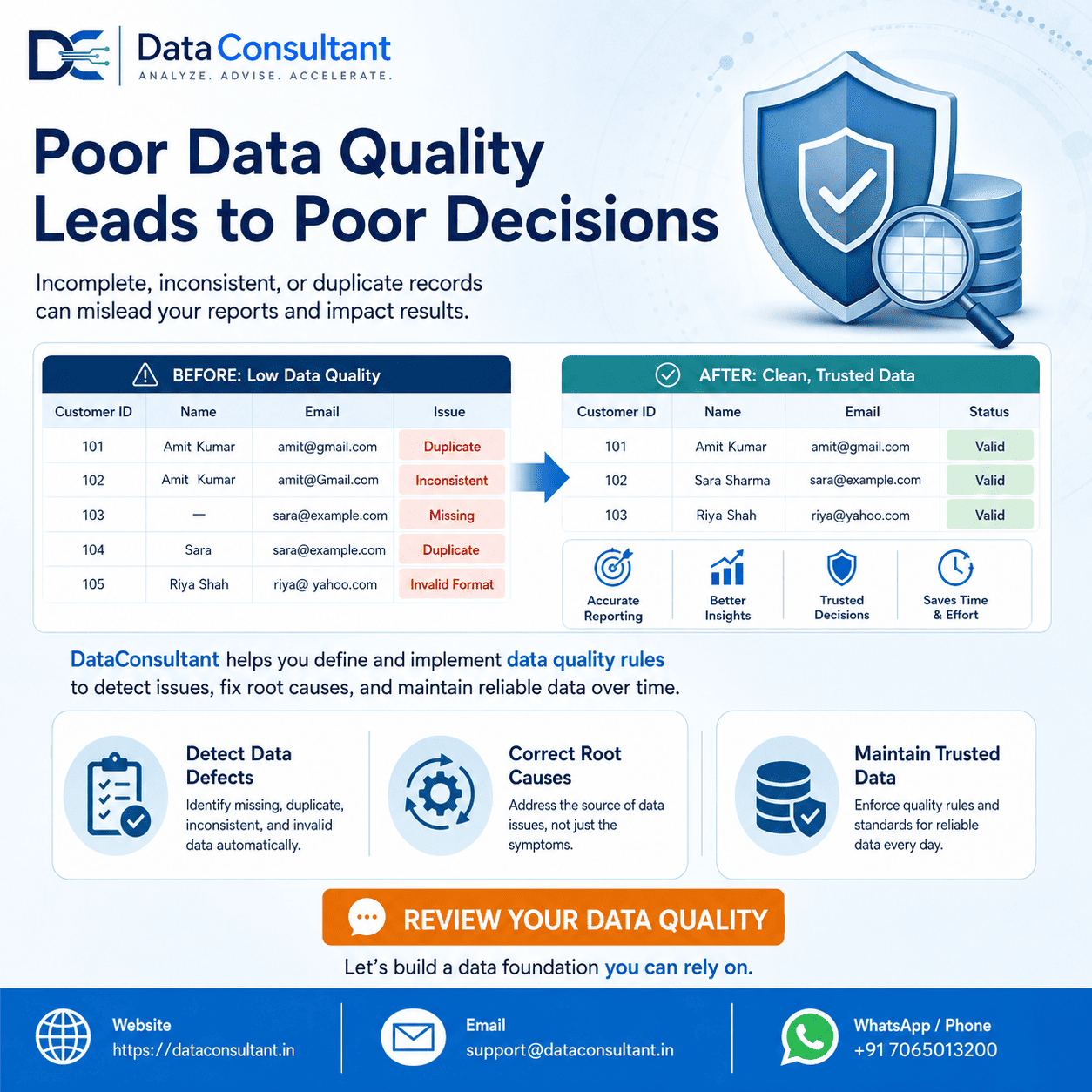
| Customer records are duplicated or incomplete | Weak identifiers, entry controls or matching rules | Source forms, duplicate rates, master-data rules | Fix capture and ownership before large-scale cleansing |
| Historical results change without explanation | Uncontrolled edits, backfills or undocumented logic changes | Audit logs, version history, deployment records | Introduce change control and reproducible processing |
| Teams spend days reconciling spreadsheets | Manual hand-offs, copied formulas and unclear source authority | Workbook lineage, approvals, source extracts | Standardise the process before automating it |
| AI or forecasts produce unstable outputs | Inconsistent training data, missing context or changing labels | Dataset versions, feature definitions, provenance records | Delay scale-up until data readiness is assessed |
The correct starting point is the smallest investigation that can identify the failure path and assign an accountable owner.
Diagnostic rule: when teams disagree about which number is correct, do not choose a new reporting tool first. Establish the authoritative source, definition, timing rule and reconciliation method.
Choose the Smallest Suitable Integrity Response
The response should match problem clarity, risk, internal capability and continuity. Not every integrity issue requires a large consulting programme.
| Option | Best fit | Expected outputs | Internal requirement | Main risk |
|---|---|---|---|---|
| Internal team | Clear issue, limited scope and capable owners | Corrected rules, controls and documented process | Time, authority and technical access | Competing priorities leave root causes unresolved |
| Software tool | Rules are defined and enforcement is the main gap | Validation, monitoring, audit logs or matching | Configuration, ownership and review | Automating unclear rules creates faster inconsistency |
| Short data diagnostic | Conflicting reports or uncertain root cause | Findings, risk map, lineage view and prioritised roadmap | Stakeholder interviews and evidence access | Recommendations stall without accountable owners |
| Defined consulting project | Scoped remediation across systems, controls or migration | Rules, designs, remediation, testing, documentation and handover | Business, data and technology participation | Scope expands without acceptance criteria |
| Ongoing consultant support | Recurring monitoring, governance and issue resolution | Control reviews, quality monitoring and improvement backlog | Regular prioritisation and governance cadence | Dependency grows if knowledge is not transferred |
| Dedicated specialist or managed team | Substantial continuous workload across several disciplines | Predictable capacity for governance, engineering and assurance | Executive sponsor and operating model | Cost is wasted without internal adoption and authority |
A hybrid model is often practical: internal owners define business meaning and approve changes, while external specialists provide diagnostic, architecture, data-quality or governance capability for a defined period.
Integrity Controls Need Access and Accountability
A professional assessment requires enough evidence to test how data is created, changed and used. Access should be limited to what is necessary and governed through existing security, privacy and procurement controls.
Inputs and stakeholders to prepare
- Priority decisions, reports, regulatory outputs or operational processes.
- Source-system inventories, data models, dictionaries and interface documentation.
- Transformation logic, ETL or ELT jobs, reconciliation methods and report calculations.
- Sample records, defect logs, incident history and known manual workarounds.
- Access roles, change approvals, audit logs, retention rules and backup arrangements.
- Business data owners, process owners, analysts, engineers, security, privacy, risk and internal audit representatives where relevant.
Governance and security are part of integrity
Controls should define who may create, change, approve and correct critical data. They should also show how exceptions are detected and resolved. The ISO 8000-51 data-governance overview highlights the role of data policy statements, while the FDA data integrity guidance illustrates how regulated environments expect reliable records, controls and review. Apply sector-specific obligations with qualified legal, compliance or regulatory advice.
Implement Integrity Improvement in Controlled Phases
Begin with a bounded business use case and critical data elements. Establish the current failure path, agree target rules, remediate the causes, test the controls and transfer ownership. Large enterprise programmes should repeat this pattern by domain rather than attempting to cleanse everything at once.
Expected deliverables from a defined project
- Problem statement, scope, risk criteria and critical-data inventory.
- Current-state lineage, process map and control assessment.
- Data definitions, ownership register and acceptance rules.
- Prioritised defect backlog with root causes and remediation owners.
- Validation, reconciliation, access, change and monitoring control designs.
- Remediation scripts or configuration changes with testing evidence where in scope.
- Operating procedures, dashboards, exception workflows and escalation paths.
- Quality assurance, documentation, knowledge transfer and formal handover.
Do not move directly from findings to mass correction. Fix the process that creates defects, preserve evidence, test changes on representative data and define how corrected records will be approved.
Integrity Cost Depends on Scope and Evidence
Cost is influenced by the number of systems, data volumes, sensitivity, integration complexity, historical defects, documentation quality, regulatory expectations and the amount of internal participation available. A well-bounded diagnostic is materially different from enterprise master-data remediation or a regulated migration.
A short diagnostic may be completed within a few weeks when access and stakeholders are ready. A defined project can take several weeks or months. Multi-domain programmes usually need phased delivery because source processes, architecture, governance and operating behaviour must change together.
Budget for internal work
Business owners must define meaning and accept outcomes. Data engineers provide technical evidence and implement approved changes. Security and privacy teams review access. Operations teams change source processes. Internal audit, risk or compliance may need to test controls. A proposal that includes only consultant days but ignores these commitments is incomplete.
Measure Integrity at Critical Decision Points
Do not reduce integrity to one enterprise score. Use measures linked to critical datasets, controls and business consequences, and show the limitations of each measure.
- Percentage of critical data elements with approved definitions and owners.
- Validation failure, duplicate, missing-value and reconciliation exception rates.
- Coverage of source-to-report lineage for high-risk reports.
- Number and age of unresolved integrity issues by severity.
- Frequency of unauthorised or unexplained changes.
- Time required to detect, investigate and correct defects.
- Control-test pass rates and evidence completeness.
- Reduction in manual reconciliation only where the change can reasonably be attributed.
Agree baselines and thresholds before remediation. A falling defect count may reflect better data, weaker detection or changes in volume, so interpret trends with operational context.
Practical Data Integrity Decisions
Ecommerce revenue does not reconcile
An ecommerce business sees different revenue in the payment gateway, commerce platform, marketing dashboard and finance ledger. The mistaken assumption is that a new BI tool will create one truth. The actual problem is inconsistent treatment of refunds, taxes, cancellations, timing and currency. A short diagnostic should define the authoritative calculation, map lineage and identify control gaps. Likely deliverables include a KPI dictionary, reconciliation design, issue backlog and ownership register. Finance, ecommerce, marketing and data engineering must participate.
Professional services relies on spreadsheets
A consulting company manually combines timesheets, expenses, billing and project forecasts. Management wants reporting automation. The integrity risk is not only manual effort; copied formulas, changing project codes and undocumented overrides can alter results. A defined project may standardise identifiers, establish controlled inputs, automate reconciliations and create documented reports. Internal finance and operations owners must approve definitions and continue exception review after handover.
Startup wants predictive analytics too early
A startup wants churn prediction, but customer status labels change, events are not captured consistently and product identifiers have been reused. The better decision is to delay advanced modelling, repair collection and definitions, and run a limited readiness assessment. Deliverables may include an event taxonomy, data-quality rules, lineage, a collection roadmap and clear model-readiness criteria. Product, engineering, marketing and data owners must share accountability.
Enterprise plans a warehouse migration
An enterprise is moving reporting workloads to a new data platform. The mistaken assumption is that migration automatically improves integrity. Historic transformations, undocumented exceptions and inconsistent master data can simply be reproduced in the new environment. A defined migration-assurance workstream should profile critical data, reconcile old and new outputs, document lineage, test controls and secure business sign-off. Ongoing support may be justified during phased cutover.
Use Specialist Support Where Integrity Risk Is Material
External support is most useful when integrity problems cross functions or systems, the root cause is disputed, a migration or AI initiative depends on reliable data, regulated evidence is required or internal teams lack specialist capacity. It should not replace accountable internal ownership.
DataConsultant can support a focused data assessment or audit, a defined data quality management project, relevant data governance support, or ongoing specialist assistance where integrity monitoring is continuous. The engagement should remain limited to the actual decision, data domain and risk.
Summary: Protect Trust Before Scaling Data Use
Data integrity means maintaining trustworthy, traceable and controlled data from capture to use. Internal staff may be sufficient when the problem and ownership are clear. A software tool may be sufficient when rules are already agreed and the main need is enforcement, monitoring or audit evidence.
Use a short diagnostic when reports conflict, lineage is uncertain or teams disagree about the cause. Use a defined project when remediation, testing, documentation and handover can be scoped. Choose ongoing support or a managed team only when governance, monitoring and improvement are genuinely continuous.
Before committing, validate the business goal, critical data, quality, access, governance, internal ownership, scope, budget, timeline, security, quality assurance, knowledge transfer and handover. The objective is not perfect data; it is proportionate confidence that important data is reliable enough for its intended decision or process.
FAQs About Data Integrity
What's data integrity in simple terms?
Data integrity means data remains accurate, complete, consistent, traceable and protected from unauthorised or accidental change throughout its lifecycle. It is not just about preventing hacking; it also depends on sound capture, validation, processing, access, documentation and correction practices.
How is data integrity different from data quality?
Data quality describes whether data is fit for a particular purpose, using dimensions such as accuracy, completeness, timeliness and consistency. Data integrity is broader: it protects the trustworthiness and continuity of data across creation, storage, transfer, transformation and use. Strong integrity supports quality, but the two terms are not identical.
What are common signs of poor data integrity?
Typical signs include conflicting reports, unexplained record changes, duplicate customers, missing fields, broken source-to-report lineage, manual spreadsheet overrides, inconsistent KPI definitions, weak access controls and teams spending excessive time reconciling numbers before decisions can be made.
Can software alone fix data integrity problems?
Software can enforce validation, permissions, audit logs, matching rules and monitoring, but it cannot resolve unclear ownership, disputed definitions, poor source processes or weak accountability by itself. A tool works best after the organisation defines the data, controls, responsibilities and business decisions it must support.
When should a business use a data integrity consultant?
External support is useful when the problem crosses systems or departments, reports conflict, data lineage is unclear, regulated evidence is required, a migration is planned or internal teams lack time or specialist capability. A short diagnostic is often the right first step when the causes are uncertain.
What information is needed for a data integrity assessment?
Prepare priority business decisions, critical reports, source-system details, data dictionaries, process maps, sample records, known incidents, access roles, transformation logic, integration documentation, retention rules and the names of accountable business and technical stakeholders. Access should be proportionate and securely controlled.
How much does data integrity improvement cost?
Cost depends on the number of systems, record volumes, data sensitivity, lineage complexity, level of documentation, required controls, remediation effort and internal participation. A limited assessment costs less than enterprise-wide master-data, migration or governance work. Proposals should separate discovery, remediation and ongoing monitoring.
How long does a data integrity project take?
A focused diagnostic may take a few weeks when stakeholders and evidence are available. A defined remediation project may take several weeks or months, particularly where systems, integrations, ownership and historic records must change. Enterprise programmes usually proceed in phases rather than through one large correction exercise.
How should data integrity be measured and maintained?
Use measures tied to critical data, such as validation failure rates, duplicate rates, completeness, reconciliation exceptions, unauthorised changes, unresolved ownership issues, lineage coverage and time to correct defects. Review controls regularly, monitor high-risk datasets and keep accountable owners responsible for decisions and remediation.
Need a Data Integrity Diagnostic?
Share the decision or process at risk, the affected reports or systems, known data issues, current controls and available stakeholders. DataConsultant can help determine whether internal action, a tool configuration, a short diagnostic, a defined remediation project or ongoing support is proportionate.
Discuss your requirementAt DataConsultant.in, we help organisations turn data and AI priorities into governed, reliable, and practical business capability.