
What Is Data Integrity?
What is data integrity? Data integrity means data remains accurate, complete, consistent, traceable and protected from unauthorised or unintended change throughout its lifecycle. For a business, the practical question is not whether every dataset is perfect. It is whether the information used for a particular decision, transaction, report, model or regulatory obligation can be trusted enough for that purpose.
The main caution is to avoid treating data integrity as a software feature alone. A database can enforce formats and relationships, but it cannot decide which revenue definition is correct, who owns a customer record, whether a manual adjustment is justified or whether a source process captures the right information. Start with the business decision and the consequences of error, then examine the data, systems, controls and ownership behind it.
Internal teams may resolve a limited, well-understood issue. A tool may help when rules and ownership are already clear. A short diagnostic is appropriate when reports conflict or root causes are uncertain. A defined project is justified when remediation, integration, migration or governance outputs can be scoped. Ongoing support is useful only when data integrity requires continuous monitoring, stewardship and control improvement.
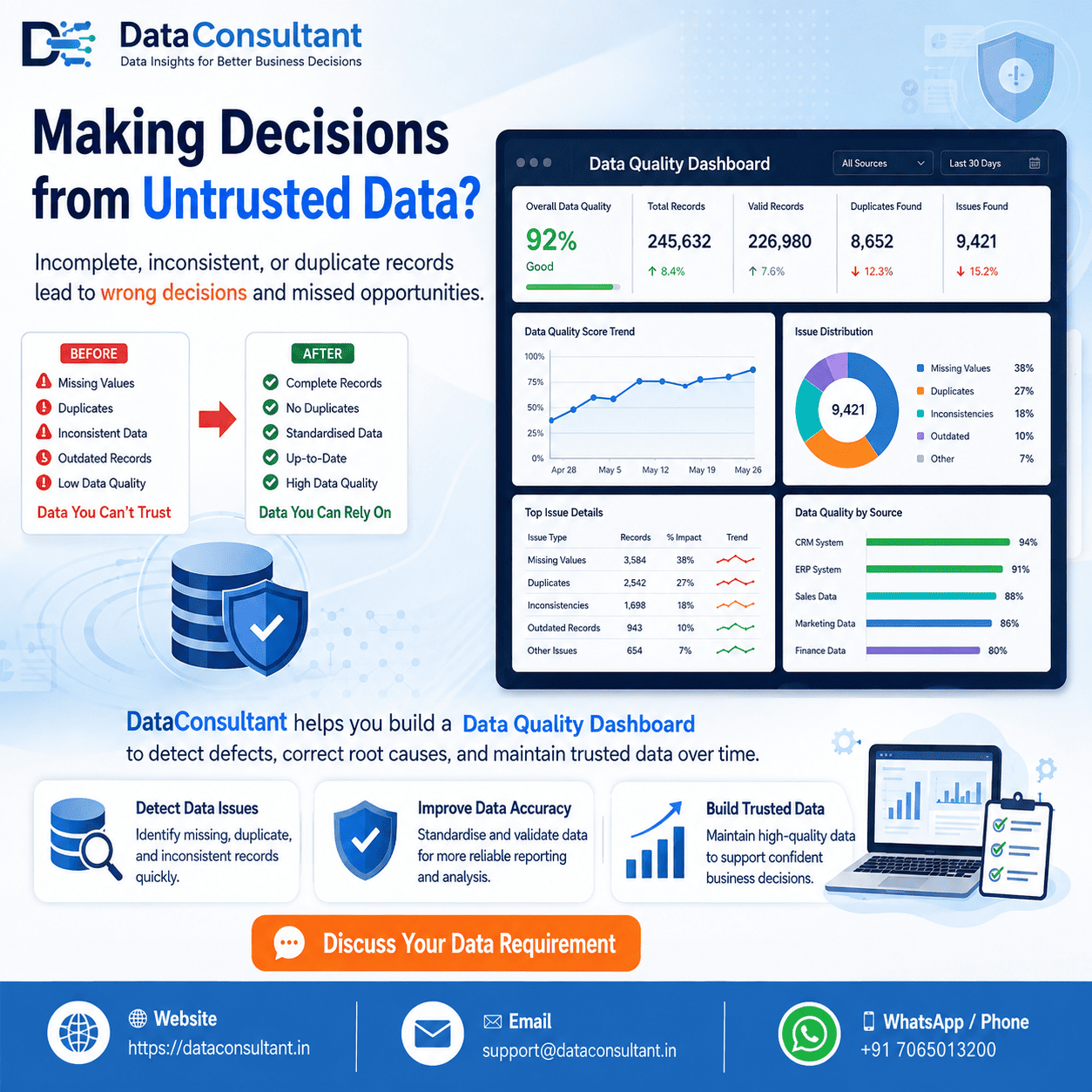
Quick Answer: Trust Data for Its Intended Use
Data has integrity when authorised users can rely on it for a defined purpose and can understand where it came from, how it changed and which limitations apply. This requires valid source capture, consistent definitions, controlled transformations, suitable access, reconciliation, auditability and timely correction.
Use a diagnostic when you cannot explain why reports disagree, where records are changed or which system is authoritative. Use a defined project when the problem can be converted into deliverables such as data rules, lineage, remediation, migration controls or monitoring. Use ongoing support when new sources, integrations and business changes continually create integrity risk.
Do not appoint a consultant before defining the decision or operational problem. “Improve our data” is too broad; “ensure recognised revenue reconciles between the commerce platform, payment provider and finance ledger” is actionable.
Key Takeaways
- Integrity is purpose-specific: decide which records and decisions need the highest level of trust.
- Quality and integrity overlap: integrity also covers traceability, controlled change and protection across the lifecycle.
- Source processes matter: downstream dashboards cannot repair missing or wrongly captured facts without business input.
- Ownership is essential: named data owners and stewards must approve definitions, exceptions and remediation priorities.
- Controls should be proportionate: validation, access, audit trails and reconciliation should match business and regulatory risk.
- Deliverables need acceptance criteria: require evidence that rules, fixes and monitoring work as intended.
- Knowledge transfer prevents dependency: internal teams need documentation, operating procedures and control ownership after handover.
Table of Contents
- Define data integrity in business terms
- Recognise integrity failure symptoms
- Compare response options
- Design integrity controls
- Implement remediation in phases
- Estimate cost, time and resources
- Measure integrity continuously
- Apply the decision to real situations
- Decide when specialist support fits
- Summary
Define Data Integrity Through Business Risk
Data integrity is best defined through the decision or process that could fail. A customer email address used for a newsletter has different consequences from a bank account used for payment, a stock quantity used for fulfilment or a clinical record used for treatment. The required controls should reflect that difference.
Data integrity is more than accuracy
Accuracy asks whether a value correctly represents reality. Integrity asks whether the record remains dependable through creation, storage, transfer, transformation and use. A value can be accurate at capture but lose integrity if it is overwritten without trace, mapped to the wrong customer, duplicated during integration or combined with a conflicting definition.
The NIST data integrity glossary provides a security-oriented reference, while NIST guidance on destructive events describes controls such as backups, secure storage, integrity checking and audit logs. These technical controls are important, but business rules and ownership remain necessary.
Common integrity dimensions
- Accuracy: values represent the intended real-world fact.
- Completeness: required records and fields are present.
- Consistency: equivalent facts agree across systems and reports.
- Validity: values follow approved formats, ranges and business rules.
- Uniqueness: one entity is not represented by uncontrolled duplicates.
- Traceability: origins, transformations and corrections can be followed.
- Protection: unauthorised creation, deletion or modification is prevented or detected.
Recognise When Data Integrity Is Failing
Integrity problems usually appear as operational disagreement before they appear as a technical diagnosis. Teams spend time reconciling numbers, customers receive contradictory information, managers distrust dashboards or migrations repeatedly fail acceptance testing.
Warning signs include duplicate customers, negative stock without explanation, unexplained spreadsheet overrides, missing timestamps, broken foreign-key relationships, reports that cannot reconcile to source transactions and access rights that allow users to change critical records without review.
Choose the Smallest Suitable Integrity Response
The correct response may be an internal fix, a configured tool, a diagnostic, a defined consulting project or continuous support. Compare the options against problem clarity, capability, continuity and ownership rather than assuming a larger programme is better.
| Option | Best fit | Expected outputs | Internal requirement | Main risk |
|---|---|---|---|---|
| Internal team | Known issue, accessible data and sufficient expertise | Rule correction, process fix, test evidence and documentation | Available owner, analyst and technical capacity | Root causes remain hidden outside the team’s view |
| Software tool | Definitions are clear and the gap is validation, profiling or monitoring capability | Configured rules, alerts, workflows and reports | Internal design, integration and governance ownership | Tool automates unclear or incorrect rules |
| Short diagnostic | Reports conflict, causes are uncertain or scope is disputed | Issue map, evidence, risk ranking and prioritised roadmap | Stakeholder interviews and system access | Recommendations stall without accountable owners |
| Defined consulting project | Remediation, migration, integration or governance outputs can be scoped | Rules, lineage, fixes, controls, tests, documentation and handover | Business and technical participation with acceptance decisions | Scope expands across every data problem |
| Ongoing consultant support | Sources, reports and integrity requirements change continuously | Monitoring, issue triage, control tuning and advisory support | Regular prioritisation and retained internal ownership | Dependency grows if knowledge is not transferred |
| Dedicated specialist or managed team | Substantial recurring workload across several data disciplines | Predictable capacity for governance, engineering, quality and analytics | Executive sponsor and operating cadence | Capacity is wasted without a governed backlog |
A hybrid approach is often practical: external specialists diagnose and design controls while internal owners approve definitions, change source processes and operate the controls after handover.
Design Controls Around the Data Lifecycle
Effective integrity controls are layered. Preventive controls stop invalid changes, detective controls identify exceptions, and corrective controls restore trustworthy data without hiding the original record or decision trail.
Protect capture and change
- Use required fields, permitted-value lists, format checks and reasonableness limits at entry.
- Apply role-based access, segregation of duties and approval for high-risk changes.
- Keep timestamps, source identifiers, version history and audit trails.
- Prevent uncontrolled exports and spreadsheet copies from becoming unofficial systems of record.
Protect relationships and transformations
- Use primary keys, referential constraints and duplicate-detection rules.
- Document mappings, calculation logic and lineage through ETL or ELT pipelines.
- Reconcile record counts, financial totals and key balances between stages.
- Test schema changes, migration rules and error handling before production release.
The ISO 8000 data-rule guidance is relevant when requirements need to be expressed as rules that information systems can process. For personal data, the ICO accuracy principle guidance explains the need to take reasonable steps to correct or erase inaccurate personal data. Apply the laws and standards relevant to your jurisdiction and sector.
Implement Integrity Remediation in Phases
Start with the smallest dataset that materially affects a decision or obligation. Trying to “clean all data” creates an unbounded programme and often produces cosmetic fixes without changing the source process.
- Frame the decision: identify the report, transaction, model or control that needs trustworthy data.
- Trace the lifecycle: map capture, storage, transformation, transfer and consumption.
- Profile and reconcile: quantify missing, duplicated, invalid, inconsistent and unmatched records.
- Find root causes: separate source-process failures from mapping, integration, access or reporting defects.
- Prioritise by risk: address issues with the highest operational, financial, customer, security or regulatory consequence.
- Fix and validate: remediate data and process controls, then test against defined acceptance criteria.
- Transfer ownership: assign monitoring, exception handling, documentation and change-control responsibilities.
Practical rule: correct the process that creates the defect before repeatedly cleaning the downstream dataset. Otherwise the same integrity issue will return.
Data Integrity Cost Follows Scope and Complexity
Cost is driven less by row count than by the number of systems, transformations, owners and unresolved definitions involved. A small dataset crossing six platforms may be harder to fix than a large table with stable rules and one accountable owner.
Key cost and timeline drivers include data access, historical depth, number of sources, undocumented transformations, quality of metadata, security review, migration complexity, manual workarounds, stakeholder availability and the amount of remediation that must occur in source applications.
A focused diagnostic may take several weeks. A defined remediation or migration-control project can take several months. Continuous integrity monitoring may require ongoing governance, engineering and operational support. Contracts should distinguish discovery, implementation, third-party licences, internal effort and post-handover support.
Measure Integrity With Decision-Relevant Controls
A single “data quality score” can hide serious risk. Measure the failures that matter to the intended use and show whether controls prevent, detect and correct them.
- Percentage of records passing critical validation rules.
- Duplicate, orphaned or unmatched record rates.
- Reconciliation differences between source and target systems.
- Unauthorised or unexplained changes to controlled fields.
- Age and volume of unresolved integrity exceptions.
- Coverage of lineage, ownership and approved definitions.
- Time to detect, investigate and correct high-risk defects.
- Repeat-defect rate after remediation.
Review measures whenever business processes, source systems or reporting definitions change. Monitoring that is not tied to an owner and response procedure becomes another unused dashboard.
Data Integrity Decisions in Real Situations
Ecommerce reports disagree on revenue
An ecommerce business assumes it needs a new dashboard because marketing, commerce and finance reports show different revenue. The actual issue is inconsistent treatment of refunds, tax, discounts, payment timing and cancelled orders. A short diagnostic should define the decision, trace transactions and reconcile definitions before any dashboard rebuild. Deliverables may include an approved revenue definition, source-to-report lineage, reconciliation rules and an exception process. Finance, ecommerce and data owners must participate.
A professional-services firm relies on spreadsheets
A growing firm assumes spreadsheet errors will disappear after buying business intelligence software. The real integrity risk is uncontrolled timesheet corrections, inconsistent project codes and manual revenue-recognition adjustments. A defined project can standardise source capture, establish identifiers, introduce review controls and automate reporting. The tool becomes useful only after the operating rules are agreed.
A startup wants predictive analytics
A startup plans churn prediction but has changed event tracking several times and cannot reliably link users across product, billing and support systems. The better decision is to delay advanced modelling, define identities and events, repair pipelines and monitor completeness first. Specialist guidance may help establish an AI-readiness roadmap, but internal product and engineering ownership is essential.
An enterprise migrates a data warehouse
An enterprise treats migration as a technical copy exercise. The real risk is that legacy transformations, manual adjustments and historic exceptions are undocumented. A defined migration-assurance project should inventory critical datasets, agree reconciliation thresholds, test lineage and preserve audit evidence. Business owners must approve which historic anomalies are corrected, retained or retired.
Use Specialist Support When Integrity Risk Is Cross-Functional
A data consultant is most useful when the problem crosses business definitions, source processes, data architecture, integration, governance and operational ownership. External support can provide independent diagnosis, specialist methods and temporary delivery capacity, but it cannot replace accountable internal decisions.
DataConsultant.in support may be appropriate for a data maturity assessment, data-quality diagnostic, governance design, lineage and metadata work, migration assurance, integration controls, reporting reconciliation or ongoing data-quality operations. A professional engagement should define scope, access, stakeholders, deliverables, acceptance criteria, security boundaries, documentation, quality assurance, knowledge transfer and handover.
Discuss a Data Integrity Requirement
Summary
Data integrity means preserving data so it remains accurate, complete, consistent, traceable and appropriately protected for its intended use. Internal staff may be sufficient when the issue is clear and capability is available. A software tool may help when rules, ownership and integration requirements are already defined. Use a short diagnostic when teams disagree about the problem, a defined project when remediation outputs can be scoped, and ongoing support or a managed team when integrity work is substantial and continuous.
Before acting, validate the business goal, data quality, access, governance and internal ownership. Then set a proportionate scope, budget and timeline, protect security, require evidence-based testing, document decisions and transfer control ownership during handover. “At DataConsultant.in, we help organisations turn data and AI priorities into governed, reliable, and practical business capability.”
Frequently Asked Questions
What is data integrity?
Data integrity is the condition in which data remains accurate, complete, consistent, traceable and protected from unauthorised or unintended change throughout its lifecycle. It depends on both technical controls and disciplined business processes, including validation, ownership, access management, audit trails, reconciliation and controlled correction.
How is data integrity different from data quality?
Data quality describes whether data is fit for its intended use, often across dimensions such as accuracy, completeness, timeliness and consistency. Data integrity is broader: it also addresses whether data remains trustworthy as it is created, transferred, transformed, stored, accessed and changed. Strong integrity supports quality, but the terms are not identical.
What are the main types of data integrity?
Common categories include physical integrity, which protects storage and infrastructure; logical integrity, which protects rules and relationships inside systems; entity integrity, which keeps records uniquely identifiable; referential integrity, which preserves valid relationships between records; and domain integrity, which restricts values to permitted formats and ranges.
What causes poor data integrity in a business?
Typical causes include manual re-entry, unclear data ownership, duplicated records, inconsistent definitions, weak validation, uncontrolled spreadsheet changes, faulty integrations, incomplete migrations, excessive access rights, missing audit logs and source-system processes that allow incomplete or contradictory information to be captured.
How can an organisation test data integrity?
Start with critical decisions and datasets, then test record completeness, uniqueness, valid ranges, reconciliation to source systems, relationship rules, timestamps, change history and access controls. Combine automated profiling with interviews and process walkthroughs because a technically valid record can still be misleading if the business definition or workflow is wrong.
Does a new data platform automatically improve integrity?
No. A modern warehouse, lakehouse, database or business intelligence platform can enforce stronger controls, but it cannot resolve disputed definitions, poor source capture, missing ownership or undocumented manual adjustments on its own. Integrity improves when platform controls are combined with governance, process redesign, testing and accountable stewardship.
When should a business use a data integrity consultant?
External support is useful when reports conflict across teams, migrations or integrations are high risk, auditability is weak, internal ownership is unclear, regulated data is involved, or the organisation lacks the capacity to diagnose root causes. A short diagnostic is often enough before committing to a larger remediation or platform project.
What should a data integrity improvement project deliver?
Useful deliverables may include a prioritised issue register, data lineage, ownership and stewardship roles, data rules, profiling results, reconciliation controls, target architecture, access-control recommendations, remediation backlog, acceptance criteria, test evidence, operating procedures, dashboards for monitoring and knowledge-transfer materials.
How long does data integrity improvement take?
A focused assessment may take several weeks when the scope and access are clear. Remediation can take months when problems span multiple source systems, integrations, teams or historical datasets. Timelines are driven by issue severity, data volume, dependency complexity, security review, decision speed and the availability of business owners.
How should data integrity be measured over time?
Use measures tied to business risk and process performance, such as failed validation rates, duplicate records, unmatched transactions, reconciliation exceptions, unauthorised changes, stale records, unresolved issues, lineage coverage and the time taken to detect and correct defects. Targets should reflect the intended use of each dataset rather than one universal score.