
MDM Master Data Management: When and How to Start
MDM master data management is appropriate when inconsistent records for customers, products, suppliers, employees or locations are blocking reliable operations and decisions across systems. The central decision is not simply whether to buy an MDM platform. It is whether the organisation has a cross-system master-data problem that requires shared definitions, accountable ownership, governed matching and controlled distribution of trusted records.
Start with the business consequence: duplicate customers affecting service, mismatched product attributes delaying ecommerce launches, supplier records creating procurement risk, or conflicting location hierarchies distorting reporting. Do not begin with a technology shortlist before defining the entity, decisions, processes and source systems involved. A local data-cleaning task may be enough for one application; a short diagnostic may be better when the problem is unclear; a defined MDM project is justified when rules and outputs can be scoped; and ongoing support is useful only when stewardship and change are genuinely continuous.
This guide helps business, data, technology, finance, marketing, operations, risk and procurement leaders determine whether MDM is needed, what readiness is required, which implementation model fits, what deliverables to expect and how to retain ownership after external specialists leave.
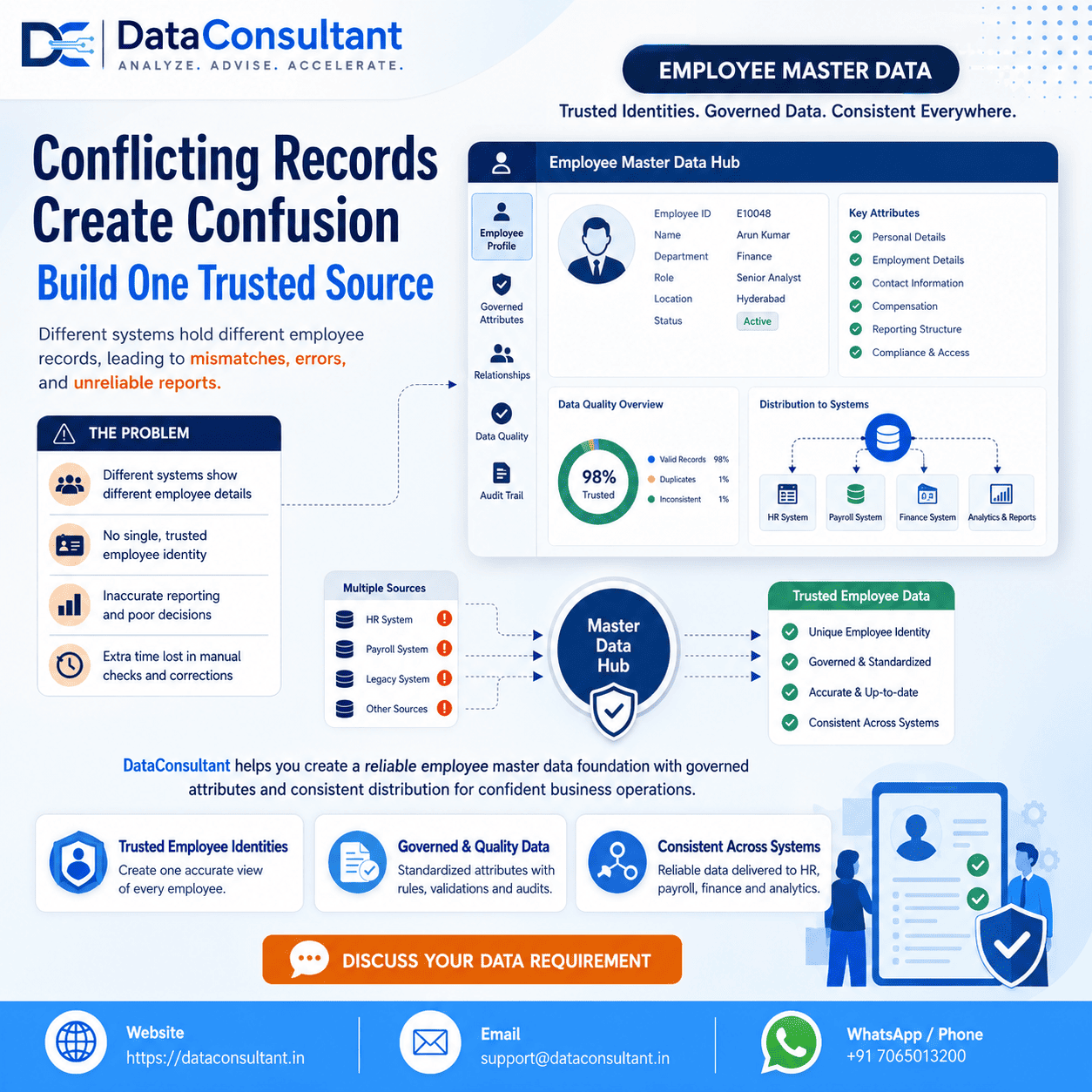
Quick Answer: Use MDM for Cross-System Consistency
Use MDM when several applications, teams or regions need the same core entity data but cannot reliably agree on identity, attributes, hierarchies or ownership. The practical test is whether inconsistent master records repeatedly create transaction failures, manual reconciliation, reporting disputes, customer friction, regulatory exposure or avoidable operational work.
Use a short diagnostic when teams disagree about the problem, data quality is uncertain or a software purchase is being discussed before requirements are clear. Use a defined project when one domain, a known group of sources and measurable outputs can be scoped. Choose ongoing support when new records, rules, exceptions and source changes require sustained stewardship and technical maintenance.
The main caution is to avoid hiring a consultant or selecting a platform before defining the business decision and operational process. MDM cannot compensate for unresolved accountability, weak source-system controls or a lack of internal ownership.
Key Takeaways
- Begin with one business-critical domain: select customer, product, supplier, employee or location data based on operational impact.
- Confirm cross-system need: MDM is most relevant when several systems require consistent identity, attributes or hierarchies.
- Keep business ownership internal: domain owners and data stewards must approve definitions, exceptions and quality rules.
- Assess source-data readiness: profiling, identifiers, lineage and process controls influence cost more than record count alone.
- Scope concrete deliverables: require a domain model, source map, matching rules, workflows, integrations, tests, documentation and handover.
- Design governance with technology: access, privacy, security, retention and audit requirements must be reflected in the operating model.
- Plan knowledge transfer: internal teams need the skills and evidence to operate, monitor and improve MDM after implementation.
Table of Contents
- Identify the master-data decision
- Check MDM readiness
- Compare implementation options
- Define architecture and governance
- Pilot one domain
- Estimate cost and resources
- Measure MDM outcomes
- Review practical examples
- Decide where specialist support fits
- Summary
Identify the Master-Data Decision Before Choosing MDM
MDM should solve a recurring decision or process problem involving a shared business entity. Define which record must be trusted, who uses it, where disagreement occurs and what happens when the wrong value is selected.
Separate master data from transactional data
Master data describes relatively stable entities such as a customer, product, supplier, employee, asset or location. Transactional data records events such as orders, payments, shipments or service interactions. MDM governs the shared entity definitions that transactions reference; it is not a replacement for transaction processing, a data warehouse or general data cleansing.
Look for repeatable cross-system symptoms
- The same customer has several identifiers and service teams cannot see a complete relationship.
- Product descriptions, units, categories or regulatory attributes differ between ERP, ecommerce and warehouse systems.
- Supplier names, bank details or tax information are created repeatedly without consistent approval.
- Location and organisational hierarchies produce different regional or departmental reports.
- Teams spend material time reconciling records before analysis, campaigns, procurement or reporting.
If the problem is confined to one application and one owner can correct it through local controls, an enterprise MDM programme may be unnecessary. The decision rule is to escalate to MDM when shared identity and governance must persist across processes and systems.
Check Business, Data and Ownership Readiness
MDM does not require perfect data, but it requires enough evidence and ownership to make governed decisions. Assess five dimensions: business clarity, source-system knowledge, data quality, governance and operating ownership.
Data profiling should test completeness, uniqueness, validity, consistency and referential integrity rather than relying on stakeholder impressions. The ISO 8000-8 data-quality concepts provide a useful reference for measuring information and data quality, while ISO 8000-150 addresses roles and responsibilities for data-quality management.
Readiness rule: postpone platform configuration when no one can approve a golden record, resolve exceptions or change the upstream process that creates poor data.
Compare Internal, Tool and Consulting Options
The correct response depends on problem clarity, internal capability, urgency, integration complexity and the need for continuity. MDM technology is only one option within a wider data-management decision.
| Option | Best fit | Expected outputs | Internal requirement | Main risk |
|---|---|---|---|---|
| Internal team | One domain, clear rules and available data expertise | Definitions, cleansing, controls and local integration | Dedicated ownership and delivery time | Work stalls behind operational priorities |
| Software tool | Requirements and operating model are already defined | Matching, workflows, hierarchy and record distribution | Configuration, integration, stewardship and governance | Technology automates unresolved rules |
| Short diagnostic | Symptoms are clear but causes, scope or ownership are uncertain | Source inventory, profiling, maturity findings and roadmap | Stakeholder access and representative records | Recommendations remain unowned |
| Defined consulting project | A domain and target outcomes can be scoped | Design, rules, pilot, integrations, testing and handover | Business, data, security and technology participation | Scope expands across systems and domains |
| Ongoing consultant support | Rules, sources and exceptions change continuously | Monitoring, tuning, stewardship support and releases | Regular prioritisation and internal decision makers | Dependency grows without knowledge transfer |
| Dedicated specialist or managed team | Large, continuous, multi-domain workload | Predictable capacity across governance and delivery | Executive sponsor and operating cadence | Capacity is wasted without adoption |
A hybrid approach is often practical: internal owners define policy and approve exceptions, while external specialists accelerate profiling, architecture, implementation and capability transfer.
Define the MDM Architecture and Governance Model
An MDM design must explain how records are identified, matched, approved, stored and shared. The architecture should fit the business process rather than force every domain into one technical pattern.
Choose the operating pattern deliberately
A registry approach links identifiers while source systems retain most attributes. Consolidation creates a central analytical master. Coexistence synchronises selected mastered values with source applications. A centralised or transactional model creates and governs master records primarily in the MDM hub. The right pattern depends on latency, authority, integration and process-control needs.
Specify identity, survivorship and hierarchy rules
- Define business keys, technical identifiers and cross-reference rules.
- Document deterministic and probabilistic matching thresholds.
- Set survivorship by attribute, source, freshness and approval status.
- Model parent-child, household, product-category, supplier and location hierarchies where relevant.
- Create exception queues for records that should not be merged automatically.
The DAMA Dictionary of Data Management provides consistent terminology across data-management disciplines. For exchanged master data, ISO 8000-110 addresses syntax, semantic encoding and conformance considerations.
Build privacy and security into record handling
Limit access to attributes according to role, purpose and jurisdiction. Define audit trails, retention, deletion, consent dependencies, encryption, segregation of duties and incident procedures. Customer and employee domains may carry personal data; supplier records may contain sensitive banking information. Governance should reflect applicable law and internal policy rather than treating a generic MDM design as compliance assurance.
Pilot One Domain Before Enterprise Expansion
A pilot should prove that governed master data improves a real process. Select one domain, a limited set of sources and a measurable operational outcome. Avoid choosing the most politically complex domain merely because it appears strategically important.
- Frame the outcome: identify the transaction, decision or report affected by inconsistent master data.
- Profile source records: quantify duplicates, missing attributes, invalid values and identifier conflicts.
- Agree the model: define attributes, identifiers, hierarchies, ownership and acceptance rules.
- Configure and integrate: implement matching, workflows, interfaces and controlled record distribution.
- Test exceptions: include ambiguous matches, source conflicts, reversals and stewardship escalation.
- Measure and hand over: compare baseline outcomes, document controls and train internal owners.
Acceptance criteria should cover business rules, data-quality thresholds, interface behaviour, security, performance, auditability, reconciliation and rollback. A pilot is successful when the organisation can operate the process reliably—not merely when a demonstration produces a cleaner record.
Data Quality and Integration Drive MDM Cost
MDM cost is influenced less by the label “customer MDM” or “product MDM” than by the number and condition of sources, matching complexity, workflow design and change required in upstream systems.
| Driver | Why it matters | Evidence to prepare |
|---|---|---|
| Source systems | Each source adds mapping, access, reconciliation and release dependencies | Inventory, owners, interfaces and change windows |
| Data quality | Poor identifiers and inconsistent attributes increase profiling and rule design | Samples, duplicate rates, missing fields and known exceptions |
| Matching complexity | Names, addresses, multilingual values and shared accounts may need probabilistic rules | Confirmed matches, non-matches and false-positive tolerances |
| Integration pattern | Batch, API, event and bidirectional synchronisation have different effort and risk | Architecture diagrams, latency needs and interface standards |
| Governance workflow | Approvals, segregation of duties and audit needs affect configuration and staffing | Roles, policies, service levels and escalation paths |
| Change management | Users must adopt new creation, update and exception processes | Impacted roles, training needs and process owners |
Request estimates by phase: diagnostic, design, pilot, implementation, migration, testing, training and ongoing operation. Include internal stakeholder time, platform licences, environments, integration work and stewardship capacity. A credible estimate states assumptions and exclusions rather than promising a fixed result before profiling.
Measure Record Trust and Operational Use
MDM success should be measured through the quality and use of mastered records, not the number of records loaded into a hub. Establish a baseline before implementation and assign an owner to every measure.
- Duplicate and suspected-match rates by domain and source.
- Completeness and validity of business-critical attributes.
- Time required to create, approve or correct a master record.
- Exception backlog, ageing and resolution quality.
- Reconciliation differences between consuming systems.
- Adoption of governed identifiers and hierarchies in target processes.
- Operational incidents attributable to incorrect or inconsistent master data.
Do not claim revenue, savings or compliance solely from MDM. Link improvements cautiously to the relevant process and account for other changes such as system replacement, policy updates or staffing.
Apply the MDM Decision to Real Situations
Ecommerce product records conflict across channels
An ecommerce business assumes it needs a new product-information tool because titles, sizes and category labels differ across its ERP, marketplace feeds and website. Profiling shows that the actual problem is inconsistent product identifiers, unclear attribute ownership and manual category mapping. A defined product-MDM pilot is the better decision. Likely deliverables include a product model, identifier rules, category hierarchy, source-to-target mappings, stewardship workflow and channel integration tests. Merchandising, operations and technology teams must approve definitions and exceptions.
A services company duplicates customer organisations
A professional-services company asks for a single customer dashboard, but CRM, finance and project systems represent the same client through different legal names and account structures. Building the dashboard first would preserve the disagreement. A short customer-data diagnostic should map identifiers, legal entities, parent relationships and account ownership. The likely output is a prioritised roadmap that may lead to a customer-MDM project or narrower CRM and billing controls.
A multi-location group cannot align supplier data
A multi-location business finds repeated suppliers, inconsistent payment terms and conflicting banking records. The mistaken assumption is that a one-time cleanse will solve the issue. The underlying problem is decentralised supplier creation without shared validation or approval. A defined supplier-MDM project can establish onboarding rules, identifiers, duplicate detection, sensitive-field controls and integration with procurement and finance. Procurement, finance, security and local operations must participate.
A startup considers MDM too early
A startup with one operational platform and a small customer base proposes an enterprise MDM hub before launching analytics. Its records are accessible, ownership is clear and cross-system conflict is limited. Internal data standards, validation rules and disciplined identifiers are more proportionate. The better decision is to postpone MDM, document scalable controls and reassess when additional platforms, regions or data domains create a genuine shared-master requirement.
Use Specialist Support Where MDM Complexity Is Real
External support is most useful when an organisation needs independent profiling, a data-maturity assessment, domain and governance design, matching expertise, architecture review, integration planning, implementation assurance or temporary delivery capacity. It is less useful when the business has not assigned an owner or cannot provide source access and stakeholder time.
A professional engagement should specify the domain, source systems, business outcomes, assumptions, deliverables, acceptance criteria, security requirements, responsibilities, documentation, intellectual-property terms, knowledge transfer and handover. DataConsultant can support a focused data assessment and audit, a defined data-governance engagement, implementation through the data-engineering service, or sustained capacity through managed data and AI support when the need is genuinely continuous.
Practical next step: document one affected business process, one master-data domain, the systems involved and three examples of record disagreement. That evidence is enough to decide whether internal correction, a diagnostic or a scoped MDM project is proportionate.
Summary
MDM is appropriate when several systems and teams need consistent, governed records for the same core entities. Internal staff may be sufficient where the domain is limited, rules are clear and capability is available. A software tool may be appropriate when the operating model and integration requirements are already defined. A short diagnostic is useful when causes, scope, ownership or data quality remain uncertain. A defined project is justified when one domain, sources, outputs and acceptance criteria can be scoped. Ongoing support or a managed team fits substantial, changing workloads that cannot yet be sustained internally.
Before committing, validate the business goal, source-data quality, access, privacy and security constraints, governance, internal ownership, scope, budget and timeline. Require documentation, quality assurance, knowledge transfer and a clear handover so that trusted master data becomes an internal capability rather than a permanent external dependency.
At DataConsultant.in, we help organisations turn data and AI priorities into governed, reliable, and practical business capability.
Frequently Asked Questions
What is MDM master data management?
MDM master data management is the governed practice of creating and maintaining reliable, consistent records for core business entities such as customers, products, suppliers, employees and locations. It combines ownership, standards, matching rules, workflows, technology and monitoring. The next step is to identify which entity and business decision are causing the greatest operational risk or friction.
How do I know whether my organisation needs MDM?
MDM is worth evaluating when the same customer, product, supplier or location appears differently across systems and those differences disrupt reporting, service, compliance, procurement or operations. Occasional duplicates in one application may need only local cleansing. Repeated cross-system disagreement usually warrants a diagnostic covering processes, identifiers, ownership and data flows.
Can an MDM software platform solve master-data problems by itself?
No. A platform can support matching, survivorship, workflow, hierarchy and distribution, but it cannot decide the organisation’s authoritative definitions, ownership model or acceptable exceptions. Buy or configure technology only after business rules, source systems, stewardship responsibilities and target outcomes are clear. Otherwise the platform may automate existing inconsistency.
Which master-data domain should we implement first?
Start with the domain that has a clear business owner, measurable operational pain and manageable source-system scope. Customer, product, supplier, employee and location data are common candidates, but the correct first domain depends on the decision being blocked. Avoid launching several domains together unless governance and delivery capacity are already mature.
What information is needed before an MDM engagement starts?
Prepare a source-system inventory, representative records, key identifiers, known duplicate patterns, data definitions, integration diagrams, business-process examples, access constraints and named stakeholders. Include evidence of where inconsistent master data affects decisions or transactions. Sensitive data should be minimised and shared through approved controls rather than copied into informal working files.
How much does an MDM implementation cost?
Cost depends on the number of domains and sources, data volume and quality, matching complexity, integration method, workflow design, platform licensing, migration, testing, change management and ongoing stewardship. A focused diagnostic costs less than a full implementation. Request a phased estimate with assumptions, internal resource needs, acceptance criteria and recurring operating costs.
How long does an MDM project take?
A short diagnostic may take several weeks when stakeholders and evidence are available. A scoped single-domain pilot may take a few months, while enterprise programmes involving many systems, regions and workflows can take longer. Timelines are commonly extended by unclear ownership, delayed access, poor source data, integration dependencies and unresolved business rules.
Who should own master data after implementation?
Business owners should remain accountable for definitions, policy and outcomes, while data stewards manage day-to-day quality decisions and technology teams operate platforms and integrations. Ownership must be documented by domain and decision type. A consultant can establish the model and transfer knowledge, but should not become the permanent substitute for internal accountability.
When is ongoing MDM support appropriate?
Ongoing support is appropriate when source systems, product ranges, customer channels, regulations, acquisitions or data volumes continue to change. It may include rule tuning, exception analysis, stewardship coaching, quality monitoring, hierarchy updates and release support. A one-off project may be sufficient where scope is stable and internal teams can operate the controls confidently.