
Master Data Management Tools: A Practical Decision Guide
Master data management tools are appropriate when inconsistent customer, product, supplier, location or account records are blocking important business processes and the organisation is ready to govern a shared version of those entities. The central decision is not simply which platform has the longest feature list. It is whether the business has a defined master-data problem, accountable owners, sufficient source-system access and a realistic plan for matching, stewardship, integration and adoption.
Start with the business process that is failing. Examples include duplicate customer records affecting service, conflicting product attributes delaying ecommerce updates, inconsistent supplier identifiers weakening procurement controls, or unreliable hierarchies distorting finance reporting. A software purchase should follow that diagnosis, not replace it. When definitions, ownership or source processes remain unclear, a short diagnostic is usually more valuable than an immediate implementation.
This decision guide explains how to compare MDM approaches, assess organisational and technical readiness, define requirements, estimate cost and implementation effort, and decide where internal teams, software vendors or specialist consulting support should contribute.
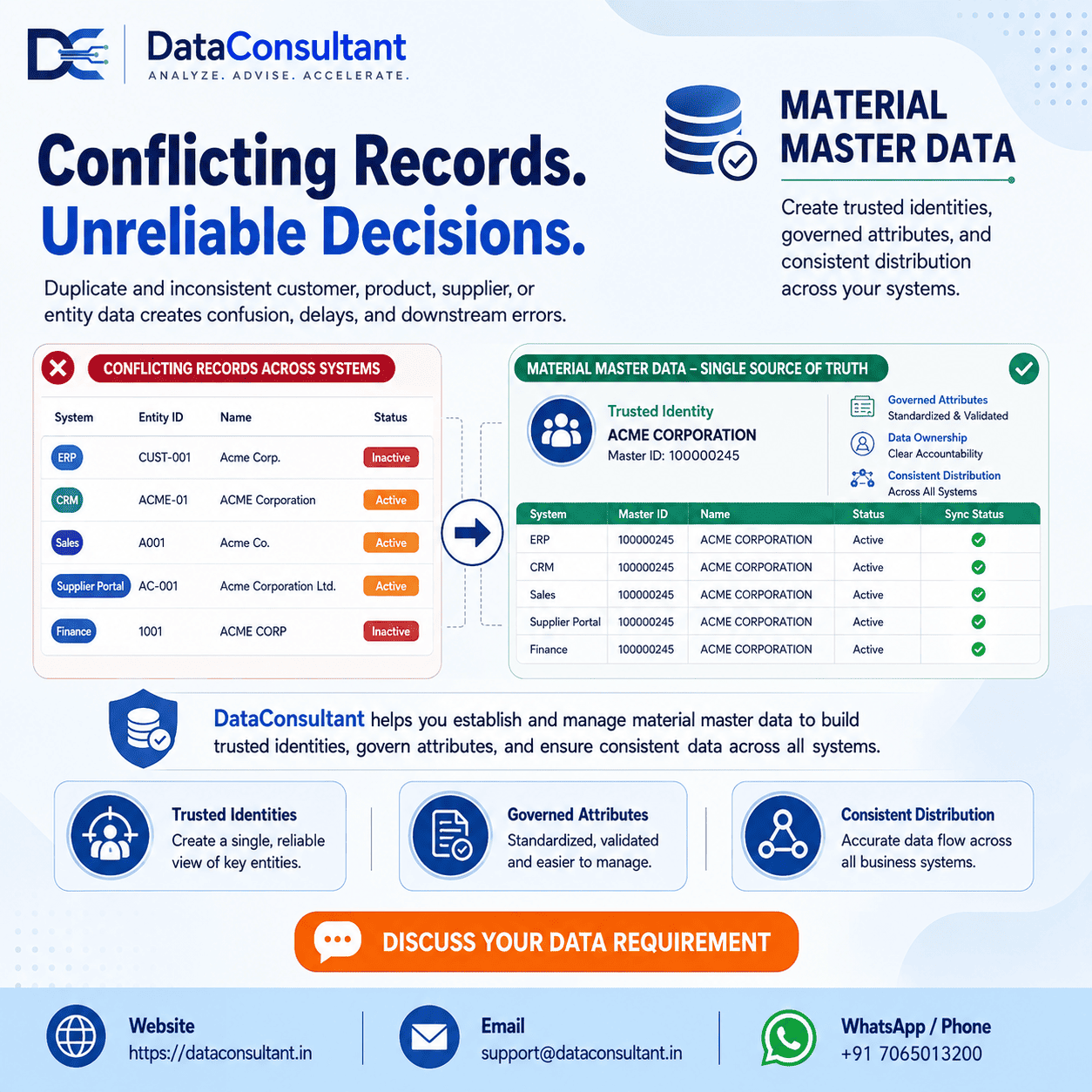
Quick Answer: Choose MDM Around a Governed Business Need
Choose an MDM tool only after defining which entity must become more reliable, which processes consume it and who owns the resulting golden record. The platform should support the required matching, survivorship, hierarchy, workflow, quality, lineage and distribution patterns without creating unnecessary complexity.
Use a short diagnostic when duplicates, definitions, ownership or integration constraints are uncertain. Use a defined implementation project when one or more domains, source systems, outputs and acceptance criteria can be scoped. Choose ongoing support when stewardship, quality monitoring, onboarding of new systems and rule changes create a continuing operational workload.
The main caution is that MDM is an operating model supported by technology. It will not compensate for weak source-system controls, unresolved business definitions or missing internal accountability.
Key Takeaways
- Define the domain and business outcome: customer, product, supplier and location data require different rules, owners and workflows.
- Assess readiness before procurement: source access, identifiers, quality profiles and governance roles must be sufficiently clear.
- Select an architecture deliberately: registry, consolidation, coexistence and centralised patterns create different operational consequences.
- Test with representative data: matching and survivorship claims should be validated against real duplicates, exceptions and hierarchies.
- Scope deliverables and acceptance criteria: require rules, models, integrations, workflows, test evidence, documentation and handover.
- Retain internal ownership: data owners and stewards remain accountable after implementation partners leave.
- Plan ongoing operations: mastered data needs monitoring, exception handling, rule maintenance and controlled change.
Table of Contents
- Decide whether MDM software is necessary
- Assess master-data readiness
- Compare MDM operating approaches
- Define technical and governance requirements
- Pilot matching, workflows and integration
- Estimate cost, effort and ownership
- Measure trusted-data outcomes
- Apply the decision to real situations
- Choose the right implementation support
- Summary
Decide Whether MDM Software Is Necessary
An MDM platform is justified when the organisation needs a controlled, repeatable way to identify and distribute trusted entity records across several systems or business units. A spreadsheet, database table or integration rule may be enough when the scope is small, definitions are stable and one team controls the process.
Start with the blocked process
Describe the operational consequence of unreliable master data. A product-data problem may delay channel launches because dimensions, descriptions and category assignments disagree. A customer-data problem may prevent service teams from recognising the same person across ecommerce, CRM and support systems. A supplier-data problem may create duplicate payments or inconsistent risk screening. These are specific process failures; “we need a single source of truth” is not yet a sufficient requirement.
Separate MDM from adjacent capabilities
MDM is closely related to data quality, metadata, integration and governance, but it is not identical to them. A data catalogue helps people discover and understand data assets. Data-quality tooling profiles and validates records. Integration platforms move and transform data. MDM coordinates identity, authoritative attributes, hierarchies, stewardship and distribution for selected business entities. Some products combine these functions, but the business still needs to define which capability is solving which problem.
Decision rule: do not procure MDM because records are generally “messy”. Procure it when a governed master record and repeatable cross-system control are necessary for named processes, decisions or obligations.
Assess Master-Data Readiness Before Procurement
Readiness does not require perfect data, but the organisation should know enough about its entities, sources and owners to run a credible evaluation. Without this preparation, vendors may demonstrate attractive workflows that do not reflect the organisation’s actual duplication, hierarchy or integration challenges.
Prepare evidence for each domain
- Representative extracts from systems that create or consume the entity.
- Definitions of the entity, key attributes and authoritative sources.
- Known duplicate patterns, identifier conflicts and missing values.
- Hierarchy and relationship rules, including valid exceptions.
- Current data-quality checks, reconciliation work and manual workarounds.
- Named data owners, stewards, system owners and process stakeholders.
- Privacy, residency, retention and access-control constraints.
A data maturity assessment can help when these elements are incomplete. The objective is not to score the organisation for its own sake; it is to identify whether a pilot can produce a trustworthy decision and which prerequisites must be addressed first.
Compare MDM Operating Approaches, Not Brands Alone
The most important comparison is how mastered records will relate to operational systems. Product names and packaging change, while the underlying operating choices remain material to architecture, ownership and risk.
| Option | Best fit | Expected output | Internal requirement | Main risk |
|---|---|---|---|---|
| Internal process and controls | One domain, few systems and clear ownership | Definitions, controlled lists and manual stewardship | Disciplined process owners | Does not scale across complex systems |
| Data-quality or integration tool | Definitions are clear; validation or movement is the main gap | Profiles, rules, transformations and monitoring | Technical capability and governance | Identity and survivorship remain fragmented |
| Short MDM diagnostic | Problem, domain or architecture is uncertain | Current-state findings, options and prioritised roadmap | Stakeholder interviews and data access | Recommendations stall without sponsorship |
| Registry or consolidation MDM | Cross-system identity or analytical golden records are needed | Linked or consolidated trusted records | Matching rules and consumption design | Operational systems may continue diverging |
| Coexistence or centralised MDM | Mastered attributes must improve operational processes | Governed records synchronised across systems | Workflow, integration and change ownership | Implementation complexity expands quickly |
| Managed MDM capability | Continuous multi-domain stewardship and engineering are required | Predictable operations, monitoring and change delivery | Executive sponsor and service governance | Dependency grows without knowledge transfer |
A phased approach is often proportionate: diagnose the highest-value domain, test a limited architecture, then expand only after matching, workflow, integration and ownership have been validated.
Define Matching, Governance and Integration Requirements
A credible requirement set combines business rules with technical and control needs. Generic requirements such as “AI matching”, “real-time integration” or “360-degree view” should be translated into measurable scenarios.
Test identity, survivorship and hierarchy rules
For each domain, specify how records are matched, which attributes are authoritative, how conflicts are resolved and when a steward must intervene. Product MDM may depend on variant and category hierarchies. Customer MDM may require householding, consent-aware identity and regional restrictions. Supplier MDM may require legal-entity verification, banking controls and ownership relationships.
Define workflow and accountability
Document who may create, approve, merge, split, enrich or retire records. Include service levels for exceptions and escalation routes for disputed ownership. Governance guidance from DAMA International can provide a useful professional reference, but the operating model still needs to reflect the organisation’s own decision rights and regulatory context.
Specify integration and security boundaries
Map batch, event, API and file-based exchanges; required latency; source-of-record responsibilities; downstream consumers; failure handling; lineage; auditability; and deployment constraints. Apply risk-based information security controls aligned to the organisation’s policies and, where relevant, frameworks such as ISO/IEC 27001. Privacy and access rules should be tested through the full record lifecycle rather than added after design.
Pilot MDM With Representative Records and Exceptions
A proof of concept that uses clean demonstration data proves very little. A useful pilot should include real duplicate patterns, incomplete attributes, conflicting identifiers, hierarchy exceptions, steward decisions and at least one downstream consumption path.
- Confirm the use case: identify the process, domain, systems and measurable acceptance criteria.
- Profile the sources: quantify completeness, uniqueness, validity, duplication and known anomalies.
- Configure a limited model: implement essential attributes, matching, survivorship and hierarchy rules only.
- Run stewardship workflows: test queues, approvals, merges, splits, audit history and escalation.
- Integrate one consumer: prove how trusted records are published and how failures are handled.
- Review evidence: compare rule accuracy, manual effort, governance fit and operating cost before scaling.
Implementation should include data migration and reconciliation, non-functional testing, security review, user acceptance, operational procedures, monitoring and rollback planning. For cloud services, use the vendor’s official architecture, security and service-limit documentation rather than relying only on sales materials.
Estimate the Full Cost of MDM Ownership
Licence price is only one component. Total cost depends on the number of domains and records, deployment pattern, connectors, data-quality services, environments, implementation effort, custom workflows, migration, testing, training and long-term stewardship.
Internal effort is a material cost
Business owners must define authoritative attributes and approve survivorship rules. System teams must explain source behaviour and support integration. Security, privacy and risk teams may need to review deployment and access. Stewards need capacity to resolve exceptions. Procurement should compare these commitments alongside external fees.
Complexity increases non-linearly
Adding a second domain is not simply repeating the first. Customer, product and supplier data have different models, identifiers, quality patterns, stakeholders and controls. Real-time coexistence also creates more operational dependency than analytical consolidation. A phased business case should show which benefits depend on each added domain or integration.
Measure Trusted Records and Better Processes
MDM success should be measured against the process problem that justified the programme. Technical record counts are useful, but they do not by themselves show that the organisation is making better use of mastered data.
- Precision and recall of matching rules using reviewed samples.
- Completeness and validity of critical attributes by domain.
- Number and age of unresolved stewardship exceptions.
- Adoption of mastered identifiers and hierarchies by consuming systems.
- Reduction in repeated reconciliation or duplicate maintenance where evidenced.
- Process outcomes such as faster product onboarding or more consistent supplier control, while accounting for other contributing changes.
- Documentation, training and internal capability sufficient to operate the solution.
Define baselines before implementation and retain test evidence. Avoid claiming compliance, savings or revenue improvement unless those outcomes have been independently validated and can reasonably be attributed to the programme.
Apply the MDM Decision to Real Situations
Ecommerce product data conflicts across channels
An ecommerce business assumes it needs a large enterprise MDM suite because product titles, dimensions and categories differ between its ERP, marketplace feeds and storefront. The actual problem is a combination of unclear attribute ownership, weak onboarding controls and channel-specific transformations. A focused product-data diagnostic followed by a limited product MDM or PIM integration pilot is more proportionate. Deliverables should include an attribute model, ownership matrix, quality rules, hierarchy design, feed mapping, pilot configuration and handover. Merchandising, operations and technology teams must participate.
Customer duplicates block service and reporting
A multi-location service company wants a “customer 360” platform. Its CRM, billing and support systems use different identifiers, and legal entities sometimes share contacts. The better decision is to test customer identity rules and required use cases before selecting architecture. A registry or consolidation approach may be enough for analytics, while operational synchronisation requires stronger workflow and consent controls. Likely deliverables include source profiling, match testing, identity rules, privacy analysis, integration design and steward procedures.
Supplier records create procurement control gaps
An enterprise finds duplicate suppliers, inconsistent tax identifiers and fragmented ownership records. Buying software immediately would automate unresolved policy decisions. A defined project should first establish the supplier entity model, verification sources, approval workflow, banking-change controls and ownership relationships. The MDM tool can then be evaluated against those scenarios. Procurement, finance, risk, security and system owners need to agree acceptance criteria.
A startup considers MDM before core processes stabilise
A startup with two operational systems sees inconsistent account names and considers enterprise MDM. Its data volume is modest and one team controls both applications. Clear naming standards, a controlled account table, validation rules and an integration fix may solve the immediate issue. The company should revisit MDM when domains, jurisdictions, acquisitions or system fragmentation create a genuinely continuous governance need.
Choose Support That Matches the MDM Decision
Internal teams are sufficient when the problem is well defined, the data is accessible, governance roles are active and the required architecture is within existing capability. A software vendor can demonstrate product functions and implementation methods, but the organisation should retain independent ownership of requirements and acceptance criteria.
A short external diagnostic is useful when teams disagree about the entity, the source of truth, the business case or the appropriate MDM style. A defined consulting project is justified when architecture, matching, data quality, integration, workflow, testing and handover must be coordinated. Ongoing specialist support or a managed team may be appropriate when multi-domain stewardship, monitoring, onboarding and change delivery are continuous but internal hiring is incomplete or too slow.
DataConsultant.in can support MDM assessment, requirements, data quality, governance, architecture, implementation planning and delivery assurance where those capabilities directly match the organisation’s problem. The engagement should preserve internal decision rights, transparent scope and practical knowledge transfer.
Summary
Master data management tools are useful when an organisation must govern shared customer, product, supplier, location or account records across systems and processes. Internal staff or a smaller data-quality and integration solution may be sufficient when scope is limited, definitions are stable and one team can maintain control. A short diagnostic is the better starting point when business goals, entity rules, data quality, access, governance or ownership remain uncertain.
A defined MDM project is justified when domains, sources, matching rules, workflows, integrations and acceptance criteria can be scoped. Ongoing support or a managed team is appropriate only when stewardship, monitoring and change are genuinely continuous. Before committing budget, validate the business goal, data evidence, architecture, security, timeline, documentation, quality assurance, knowledge transfer and handover requirements.
Need a structured MDM decision? DataConsultant.in can help assess the problem, define vendor-neutral requirements and plan a proportionate diagnostic, pilot or implementation.
Discuss your MDM requirementFrequently Asked Questions
What are master data management tools?
Master data management tools are software platforms used to identify, match, govern, consolidate and distribute trusted records for core business entities such as customers, products, suppliers, locations and accounts. They usually combine data modelling, matching, survivorship, workflow, stewardship, quality controls, lineage, APIs and integration capabilities.
How do you choose the right master data management tool?
Start with the business decisions and processes affected by inconsistent master data, then define the domains, source systems, matching rules, governance roles, integration needs and operating model. Compare tools through representative use cases and a controlled proof of value rather than feature lists alone.
Is an MDM tool enough to fix poor master data?
No. A tool can automate matching, workflows and distribution, but it cannot resolve unclear ownership, weak source-system processes, disputed definitions or missing governance. Organisations need accountable data owners, stewardship procedures, quality rules, escalation paths and adoption across operational teams.
What is the difference between registry, consolidation and coexistence MDM?
A registry style links records while leaving most source data in place. Consolidation creates a central trusted analytical record. Coexistence allows mastered data to be improved centrally and synchronised back to source systems. The right style depends on operational requirements, integration constraints and control needs.
Should a small business buy an enterprise MDM platform?
Usually not unless entity complexity, regulation, system fragmentation or growth plans justify it. A smaller organisation may begin with clearer ownership, controlled reference data, data-quality rules and focused integration. A lightweight tool or limited domain pilot can be more proportionate than an enterprise-wide platform.
What data should be prepared before an MDM implementation?
Prepare representative source extracts, data dictionaries, entity definitions, identifiers, quality profiles, duplicate examples, hierarchy rules, reference data, integration maps and known exceptions. Stakeholders should also document which systems create, update and consume each mastered attribute.
How long does an MDM implementation take?
A narrow discovery and pilot may take several weeks, while a multi-domain operational programme can take many months. Timing depends on source-system access, data quality, matching complexity, workflow design, integration, security review, testing, migration, governance decisions and business adoption.
What are the main cost drivers for MDM tools?
Costs are influenced by licensing or consumption pricing, number of domains and records, deployment model, connectors, data-quality services, implementation effort, custom workflows, cloud infrastructure, testing, migration, training and ongoing stewardship. Internal stakeholder time is often a significant resource commitment.
How should MDM success be measured?
Measure outcomes linked to the original business problem: duplicate reduction, completeness of critical attributes, matching accuracy, exception resolution time, adoption of governed records, fewer manual reconciliations, reliable hierarchy use and improved downstream process performance. Validate measures before and after implementation.
When is external MDM consulting support useful?
External support is useful when the organisation needs an independent diagnostic, domain and operating-model design, vendor-neutral requirements, architecture and integration planning, data-quality analysis, implementation assurance, governance setup or temporary specialist capacity. Internal ownership should remain clear throughout the engagement.
At DataConsultant.in, we help organisations turn data and AI priorities into governed, reliable, and practical business capability.