
Governmental Data Consulting: A Decision Guide
Governmental data consulting is most useful when a public-sector organisation has a defined service, policy, operational or reporting decision that is being blocked by unreliable data, fragmented systems, unclear ownership or a temporary shortage of specialist capability. The practical starting point is not a dashboard, cloud platform or AI tool. It is a business question: what decision, service outcome, control or operational process must improve, and what evidence is preventing the organisation from acting confidently?
A governmental data problem may be solvable by internal staff, a better-configured tool or a focused process fix. External support becomes more appropriate when the organisation needs an independent diagnostic, specialist architecture or engineering knowledge, cross-agency governance, a defined analytics project, implementation support or continuing capacity that cannot be provided internally at the required pace.
This guide helps government departments, agencies, public bodies, regulated organisations, procurement teams and delivery leaders decide whether to use internal capability, buy technology, run a short data diagnostic, commission a defined consulting project or establish ongoing specialist support. It also explains the access, governance, stakeholders, deliverables, cost drivers and handover conditions a professional engagement should include.
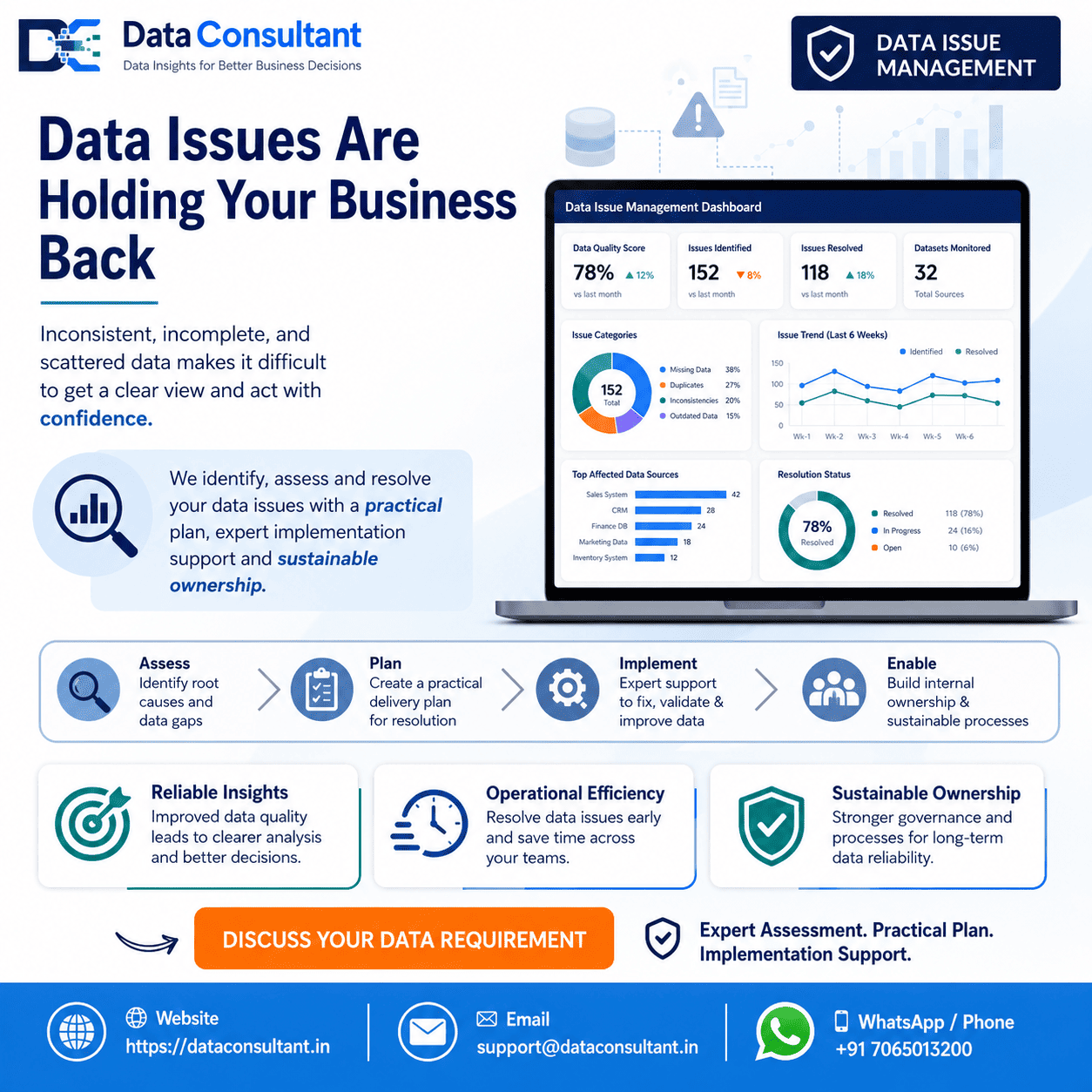
Quick Answer: Use Consulting for a Defined Data Blocker
Use a governmental data consultant when the organisation can point to a material data blocker but lacks the specialist capacity, independence or coordination needed to resolve it. Examples include conflicting performance measures, inaccessible operational data, weak data ownership, ageing integration patterns, unreliable reporting, governance gaps or an AI use case that cannot proceed safely without better data foundations.
Choose a short diagnostic when the problem is unclear. Choose a defined project when objectives, deliverables and acceptance criteria can be scoped. Choose ongoing support only when the work is genuinely recurring, such as continuous data-quality management, reporting optimisation, governance operations or specialist analytics demand across several functions.
The main caution is to avoid hiring a consultant before defining the public decision or operational problem. Technology-first work can create new dashboards, platforms or pilots without resolving the underlying ownership, quality, interoperability or governance issue.
Key Takeaways
- Start with public value and the decision: define the service, policy, control or operational outcome that needs better data.
- Check data readiness early: poor quality, inaccessible sources and inconsistent identifiers can determine the real scope.
- Keep internal ownership: a senior sponsor, data owners, technical teams and service owners must remain accountable.
- Scope deliverables precisely: require findings, requirements, designs, implementation outputs, evidence, documentation and handover appropriate to the problem.
- Build governance into delivery: access, privacy, security, records, interoperability and AI risk should shape the solution from the beginning.
- Choose the smallest engagement that works: internal action, a tool change or a limited diagnostic may be enough.
- Plan knowledge transfer: public bodies should retain the documentation, skills and operational ownership needed after external support ends.
Table of Contents
- Decide whether the issue is really a data problem
- Check public-sector data readiness
- Compare internal, tool and consulting options
- Define access, governance and stakeholders
- Expect decision-ready consulting deliverables
- Understand cost, timing and procurement drivers
- Measure capability, not consultant activity
- Apply the decision to governmental scenarios
- Use specialist support only where it fits
- Summary
First Decide Whether the Issue Is Really a Data Problem
A data consultant is appropriate only when better management or use of data is central to the outcome. Public organisations often receive requests framed as “build a dashboard”, “move data to the cloud” or “introduce AI”, even when the real problem is unclear policy ownership, inconsistent service processes, missing source fields or disagreement about what a metric means.
Separate decision failure from technology demand
Ask what decision is currently slow, disputed or poorly evidenced. Then trace which data is needed, where it originates, who owns it, how reliable it is and what constraints apply. If the answer exposes process or policy gaps rather than a technical data issue, resolve those first. If it exposes fragmented sources, unclear definitions, integration limits, governance gaps or analytical uncertainty, specialist data support may be justified.
The OECD describes data governance as the technical, policy and regulatory framework for managing data across its value cycle, and its work on a data-driven public sector emphasises leadership, rules, architecture, infrastructure and trust. That makes governance a delivery concern rather than an administrative add-on. See the OECD data governance guidance and its data-driven public sector framework.
Decision rule: if the organisation cannot state the decision, service or control that should improve, commission a limited discovery exercise before approving a larger platform, analytics or AI programme.
Check Public-Sector Data Readiness Before Delivery
Governmental data initiatives do not require perfect data, but they do require enough clarity to work safely and productively. Readiness is strongest when the organisation has an accountable sponsor, identifiable data owners, controlled access, a realistic view of quality, known integration constraints and a defined route for privacy, security and records decisions.
Use the diagnostic to expose blockers
- Confirm the service, policy or operational decision to be improved.
- List the datasets, source systems, interfaces and manual workarounds involved.
- Identify data owners, system owners, information-security contacts and service owners.
- Review known quality issues, duplicate records, missing identifiers and inconsistent definitions.
- Document access restrictions, retention rules, sharing agreements and jurisdiction-specific obligations.
- Check whether procurement, security accreditation or architecture review will affect the sequence.
Compare Internal, Tool and Consulting Options
The correct governmental data decision may be to use existing staff, configure a tool, run discovery, commission a defined project or establish continuing support. Compare options by problem clarity, specialist need, duration and internal ownership rather than by supplier category.
| Option | Best fit | Typical output | Internal requirement | Main risk |
|---|---|---|---|---|
| Internal team | Clear problem, accessible data and sufficient skills | Focused analysis, reporting or process improvement | Protected staff time and accountable ownership | Operational priorities crowd out delivery |
| Software tool | Definitions and processes are clear; functionality is the main gap | Configured reporting, workflow, catalogue or platform capability | Architecture, governance and adoption capability | Tool does not resolve underlying quality or ownership issues |
| Short data diagnostic | Problem, quality or architecture is uncertain | Findings, root causes, options and prioritised roadmap | Stakeholder access and evidence sharing | Recommendations stall without an owner |
| Defined consulting project | Specialist work can be scoped with milestones | Requirements, designs, implementation, testing and handover | Cross-functional participation and acceptance criteria | Scope expands across agencies or systems |
| Ongoing consultant support | Recurring analytics, governance or quality demand | Regular advisory, optimisation and operational support | Prioritisation cadence and knowledge transfer | Dependency if internal capability does not grow |
| Dedicated specialist or managed team | Continuous multi-disciplinary workload | Predictable capacity across data disciplines | Executive sponsor, backlog and delivery governance | Capacity is wasted if demand is not prioritised |
A hybrid is often practical in public-sector environments: external specialists address a defined gap while internal service, policy, data and technology owners retain authority over decisions, standards and long-term operation.
Define Access, Governance and Stakeholders Up Front
Governmental data engagements can fail before technical work begins if access, approval routes and decision rights are unclear. A credible scope should identify who can approve data access, who understands source-system semantics, who owns the public service or policy outcome, and who will accept the deliverables.
Minimum inputs for a useful engagement
- A named business or service problem and executive sponsor.
- Representative data samples or controlled system access where permitted.
- Current reports, KPI definitions, data dictionaries and architecture documents where available.
- Known privacy, security, records, sovereignty, interoperability and procurement constraints.
- Access to operational users who understand exceptions and manual workarounds.
- A route for decisions when definitions, ownership or technical options conflict.
Information security requirements should be incorporated into the design and operating model. ISO/IEC 27001 provides a recognised framework for establishing and continually improving an information security management system. For AI-enabled use cases, the NIST AI Risk Management Framework offers a voluntary approach to identifying and managing AI risks across sectors.
Expect Decision-Ready Consulting Deliverables
The output of governmental data consulting should be usable by the organisation after the engagement ends. Deliverables must therefore connect diagnosis to implementation and handover rather than stop at a high-level presentation.
Match deliverables to the data problem
- Governance problem: decision rights, ownership model, stewardship responsibilities, issue workflow, policy gaps and implementation roadmap.
- Data-quality problem: profiling results, critical-data-element definitions, root causes, controls, remediation backlog and monitoring approach.
- Architecture problem: current-state findings, target-state architecture, interoperability requirements, migration sequence and design decisions.
- Analytics problem: KPI definitions, semantic model, dashboard or analytical outputs, validation evidence and operating procedures.
- AI-readiness problem: use-case assessment, data suitability, governance requirements, evaluation plan, risk controls and phased implementation options.
Require acceptance criteria for each major output. If a roadmap is expected, define whether it must include priorities, dependencies, owners, indicative effort, procurement implications and measurable decision points. If code, models, pipelines or dashboards are delivered, clarify repository access, documentation, testing and rights to reuse.
Cost and Timing Depend on Governmental Complexity
Governmental data consulting costs are shaped by scope rather than a single market rate. The largest drivers are usually the number of data sources, legacy-system complexity, access restrictions, quality problems, specialist disciplines, cross-agency dependencies, security review, documentation depth, procurement requirements and implementation responsibility.
A short diagnostic can stay focused when stakeholders and evidence are accessible. A defined architecture, integration or governance project takes longer when multiple systems, suppliers or jurisdictions are involved. Ongoing support should be justified by a recurring backlog, not by an assumption that external capacity is permanently required.
Budget for internal government participation
External delivery still consumes internal capacity. Service owners must clarify operational priorities. Data owners explain definitions and acceptable use. Technology teams provide access and architecture context. Security, privacy, records and procurement teams may need formal review. Managers must evaluate whether outputs are operationally usable. A proposal that excludes these dependencies is likely to underestimate time and effort.
Commercial rule: compare the complete delivery model, including internal time, access preparation, governance review, implementation, documentation and transition—not only the consultant fee.
Measure Capability, Not Consultant Activity
Governmental data consulting is successful when it improves the organisation’s ability to make, explain and sustain better data-supported decisions within its governance constraints. Hours worked, workshops held and dashboards produced are activity measures; they do not prove useful capability.
- Improved agreement on KPI definitions and data ownership.
- Documented reduction in unresolved critical data-quality issues where the project directly addressed them.
- Faster or more reliable production of required reports where process evidence supports the change.
- Adoption of governed data products, pipelines, dashboards or issue-management processes.
- Clearer architecture decisions and fewer undocumented manual interfaces.
- Successful handover to named internal owners with usable documentation.
- For AI, evidence that evaluation, human oversight and monitoring controls are operating as designed.
Agree measures before implementation so the team can distinguish consulting effects from policy changes, system releases, staffing changes, new statutory requirements or unrelated operational improvements.
Governmental Data Consulting Decisions in Practice
Conflicting service-performance figures
A public agency has three reports showing different service-processing times. Leaders request a new executive dashboard. The better first step is a diagnostic because the underlying definitions, event timestamps and exclusions differ. Likely outputs include a metric dictionary, source-to-report lineage, quality findings, governance decisions and a prioritised reporting fix. A dashboard comes later, after the measure is stable.
Legacy systems block cross-agency reporting
Two government bodies need a shared operational view, but identifiers and data formats do not align. Buying another BI licence will not solve interoperability. A defined data-engineering and architecture project is more appropriate, with deliverables covering source mapping, canonical definitions, integration design, security controls, test cases, migration sequencing and handover to internal platform owners.
AI assistant proposed before data ownership
A department wants an internal AI assistant over policy and case-management information. Documents are duplicated, access classifications vary and ownership is unclear. The right first engagement is AI and data readiness, not production deployment. The assessment should identify authoritative sources, access boundaries, evaluation criteria, records implications, human oversight and a limited pilot scope. Advanced implementation should wait until the information foundation is sufficiently controlled.
Recurring governance backlog across departments
A ministry has established governance roles but faces a continuous backlog of data-quality issues, metadata decisions and cross-functional analytics requests. A one-off project may not provide enough continuity. Ongoing specialist support can be justified if the organisation retains prioritisation authority, uses a transparent backlog and requires knowledge transfer so permanent dependence does not become the operating model.
Use Specialist Support Only Where It Fits
External governmental data support is most relevant when the public organisation needs an independent assessment, a specialist architecture or engineering capability, stronger governance, a defined analytics implementation, AI readiness work or continuing specialist capacity. The scope should remain tied to the actual service, policy or operational decision.
DataConsultant can support a focused data assessment or audit, data governance engagement, data engineering project or data analytics engagement. Where the workload is continuous and multi-disciplinary, managed data and AI support may be considered only after demand, ownership and governance are clear.
Summary
Governmental data consulting is appropriate when a public-sector organisation has a meaningful data blocker and needs specialist expertise, independent diagnosis or temporary delivery capacity to resolve it. Internal staff remain the better choice when the problem is clear and capability exists. A software tool is suitable when definitions, processes and governance are already established. A short diagnostic works when teams disagree about the problem or data readiness. A defined project works when outputs and acceptance criteria can be scoped. Ongoing support is justified only for genuinely recurring demand.
The strongest engagements begin with the public decision, make data quality and governance visible, define internal ownership, state access and stakeholder dependencies, produce usable deliverables and end with documentation and knowledge transfer. Advanced analytics and AI should be delayed when the underlying data, access or accountability foundation is not ready.
Governmental Data Consulting FAQs
What does governmental data consulting mean?
Governmental data consulting is specialist support for public-sector organisations that need to improve how data is governed, integrated, analysed, shared or used for decisions and services. A consultant may assess maturity, clarify requirements, design architecture, improve data quality, plan analytics, support governance or help prepare a controlled implementation and handover.
When should a government organisation hire a data consultant?
Use external support when an important public-sector decision is blocked by unreliable data, fragmented systems, unclear ownership, weak reporting, limited specialist capacity or a time-bound need for architecture, governance, analytics or implementation expertise. Do not hire a consultant merely because a new tool or AI initiative is fashionable.
Can internal government teams solve the problem instead?
Yes. Internal teams are usually the better choice when the business question is clear, data is accessible, the required skills already exist and staff can allocate enough time and ownership. A consultant adds value when specialist knowledge, independent diagnosis, temporary capacity or cross-functional coordination is genuinely missing.
Is a software platform enough for governmental data problems?
Sometimes. A tool can help when processes, definitions, data sources, security requirements and ownership are already clear and the main gap is functionality. It is unlikely to solve conflicting KPI definitions, poor source data, missing governance, unclear requirements or unresolved interoperability on its own.
What information should be ready before a governmental data engagement?
Prepare the business decision or service problem, known datasets and systems, data owners, current reports, policy and security constraints, architecture documentation where available, stakeholder contacts, procurement boundaries and examples of data-quality or reporting issues. Imperfect documentation is acceptable, but missing access and ownership can slow discovery.
How long does a governmental data consulting project take?
Timelines depend on scope, access, approvals, procurement, security review, data quality and integration complexity. A focused diagnostic may be relatively short, while architecture, integration, governance or analytics implementation can require a phased programme. A credible proposal should state assumptions, milestones, dependencies and acceptance criteria rather than promise a universal duration.
How much does governmental data consulting cost?
Cost is mainly driven by problem complexity, number of systems and datasets, specialist disciplines required, security and compliance work, stakeholder coordination, implementation depth, documentation and the amount of ongoing support. Compare the total delivery model and internal resource requirement, not only a day rate or headline project fee.
How should privacy, security and AI risk be handled?
Treat privacy, security, records obligations and data governance as design constraints from the start. Define lawful and approved access, data minimisation where applicable, environments, roles, retention, auditability and escalation. For AI-related work, public-sector teams should also establish use-case ownership, risk assessment, testing, human oversight and monitoring appropriate to their jurisdiction and risk profile.
What should a governmental data consultant deliver?
Deliverables should match the problem and may include a maturity assessment, prioritised roadmap, requirements, KPI dictionary, data-quality findings, governance roles, architecture diagrams, integration specifications, dashboard or analytics outputs, implementation backlog, test evidence, operating procedures, training, documentation and a clear handover. The contract should define acceptance criteria and ownership of reusable assets.
Need to clarify a governmental data problem? If your organisation has a defined public-sector data, governance, architecture, analytics or AI-readiness decision but is unsure about scope, DataConsultant can help structure a proportionate diagnostic or delivery plan.