
Governance Framework for Reliable Business Data
A governance framework gives an organisation a practical way to decide who owns data, who may use it, which rules apply and how quality, access and risk decisions are made. Build one when recurring data problems are caused by unclear accountability rather than by a missing dashboard or software feature. The main caution is to avoid starting with a governance tool or a large policy library before defining the business decisions the framework must support.
The practical starting point is to identify a small number of high-value data domains, name the people accountable for them, document the decisions those people must make, and define the minimum policies, standards, evidence and escalation routes needed to operate safely. A short diagnostic is often enough when ownership, quality or priorities are uncertain. A defined project is appropriate when the operating model and first-domain implementation can be scoped. Ongoing support makes sense only when governance work is genuinely continuous.
This decision guide is for founders, boards, data and technology leaders, finance and operations teams, risk, compliance, privacy, security and procurement teams. It explains what a workable governance framework contains, how mature an organisation needs to be, what implementation requires, how to compare internal delivery with tools and specialist support, and how to judge whether governance is producing useful business capability.
Quick Answer: Build Governance Around Decisions
A useful governance framework is an operating system for data decisions. It defines accountable owners, stewardship responsibilities, standards, access rules, quality expectations, issue escalation and evidence. It should make recurring decisions easier and more consistent, not simply add committees or documents.
Use a short diagnostic when teams disagree about ownership, reports conflict or controls are unclear. Use a defined governance project when you can scope domains, roles, policies, workflows, tooling needs, milestones and handover. Choose ongoing support when stewardship, data-quality monitoring, policy maintenance and cross-functional decision-making create a continuing workload.
Do not hire a consultant or buy governance software before defining the operational problem. A catalogue cannot decide who owns “customer”, a policy cannot repair broken source-system processes, and a committee cannot compensate for missing executive accountability.
Key Takeaways
- Start with decision rights: define who can approve definitions, access, quality thresholds, changes and exceptions.
- Govern priority domains first: customer, product, finance or operational data should be prioritised by business value and risk.
- Keep business ownership: technology can enable governance, but domain accountability belongs with business leaders.
- Match scope to maturity: a lightweight framework can be more effective than an enterprise programme introduced too early.
- Integrate privacy and security: classification, access, retention, sharing and exceptions should connect to existing risk controls.
- Require usable deliverables: role maps, standards, workflows, decision logs, measures, roadmap and handover matter more than presentation volume.
- Transfer knowledge: the organisation should be able to operate and adapt the framework after external support ends.
Table of Contents
- Define governance decisions and ownership
- Check governance maturity and readiness
- Compare internal, tool and consulting options
- Set policies, controls and technical requirements
- Implement a first data domain
- Estimate cost, time and resource needs
- Measure whether governance is working
- Apply the framework to real situations
- Decide when specialist support fits
- Summary
Define Data Decisions Before Governance Roles
Begin by listing the recurring decisions that currently produce delay, disagreement or risk. Typical examples include approving a KPI definition, deciding who may access customer data, accepting a quality threshold, resolving duplicate master records, approving a new data source, sharing data with a third party, or deciding whether a model may use a sensitive attribute.
Assign accountability at the decision level
A data owner should have authority to make or sponsor decisions for a defined domain. A steward helps operate the rules, maintain definitions and coordinate issues. Technology teams implement controls and platforms. Privacy, security, legal and risk functions provide specialist constraints and approvals. The model fails when everyone is consulted but nobody is accountable.
Use a simple decision-rights matrix for each priority domain: decision, accountable owner, contributors, evidence required, service expectation and escalation route. This is usually more useful than beginning with a large organisation chart.
Decision rule: if a governance role cannot be linked to a recurring business or control decision, reconsider whether the role is necessary.
Match the Governance Framework to Data Maturity
Governance can start before data is clean or architecture is modern, but the design must reflect current maturity. An early-stage business may only need named owners, a shared KPI dictionary, access rules and a monthly issue review. A regulated enterprise may need formal domain councils, lineage, policy evidence, quality controls, exception workflows and auditable decision records.
The OECD overview of data governance describes governance as spanning technical, policy and regulatory arrangements across the data value cycle. That breadth is useful, but an organisation still needs to translate it into a manageable operating model for its own domains and risks.
Compare Governance Delivery Options by Problem
The right delivery model depends on whether the problem is clarity, capability, technology or ongoing workload. Software is useful only after the organisation understands the governance processes it expects the software to support.
| Option | Best fit | Expected output | Internal requirement | Main risk |
|---|---|---|---|---|
| Internal team | Clear scope, experienced owners and limited domains | Roles, standards, workflows and operating cadence | Executive sponsor and available domain owners | Competing priorities reduce follow-through |
| Governance software | Processes are defined and need scale or automation | Catalogue, workflow, lineage, quality or evidence support | Clear requirements and platform ownership | Tooling formalises unresolved ambiguity |
| Short diagnostic | Ownership, maturity or priorities are unclear | Current-state findings, gaps and prioritised roadmap | Interviews, documents and system evidence | Recommendations stall without an accountable sponsor |
| Defined consulting project | Operating model and first-domain implementation are required | Framework, policies, roles, pilot, measures and handover | Cross-functional participation and approvals | Scope expands across too many domains at once |
| Ongoing consultant support | Governance workload is recurring but internal capacity is limited | Stewardship support, reviews, issue resolution and updates | Regular prioritisation and retained ownership | Dependency grows if knowledge is not transferred |
| Dedicated specialist or managed team | Continuous multi-domain governance needs predictable capacity | Coordinated delivery across ownership, quality and controls | Executive governance and operating cadence | Cost is wasted when business participation is weak |
Choose the smallest model that can resolve the current governance problem. A diagnostic can precede a tool decision, and a first-domain project can demonstrate whether the operating model works before enterprise expansion.
Set Data Policies, Controls and Evidence
A governance framework becomes operational when policies and standards are tied to actions, owners and evidence. Prioritise the rules that affect real decisions: data classification, access, approved use, retention, sharing, quality thresholds, metadata, change control and exceptions.
Connect policy to technical controls
- Define how data domains, critical elements and authoritative sources are identified.
- Document who approves access and how sensitive or restricted data are classified.
- Set measurable quality rules for critical fields and define who resolves failures.
- Establish minimum metadata, lineage and business-definition requirements where they support decisions.
- Define retention, deletion, sharing and third-party evidence requirements according to applicable obligations.
- Create an exception path so urgent or unusual cases can be handled transparently rather than bypassing governance.
The NIST Privacy Framework provides a risk-management approach for privacy, while NIST is also developing a Data Governance and Management Profile to connect governance and management priorities across NIST resources. Use such frameworks as reference points, then map them to your actual legal, contractual and operational context.
Where information-security management is relevant, align governance responsibilities with the organisation’s established security-management system rather than creating parallel approval routes. The goal is coordinated accountability, not duplicated controls.
Implement One Data Domain Before Scaling
Governance is easier to test in a bounded domain with visible business value. Choose a domain such as customer, product, supplier or finance data where ownership, definitions, access or quality issues already matter. Avoid selecting the most politically difficult domain simply to prove ambition.
Use a phased first-domain pilot
Start with evidence gathering: existing definitions, reports, data flows, access rules, known quality issues, policy obligations and decision forums. Then confirm the owner and steward roles, define the critical governance decisions, agree standards and thresholds, configure only the necessary workflow or tooling, and run the model through real issues.
Document what changed during the pilot. If owners cannot make decisions, policies are too abstract, quality rules generate noise or meetings have no actionable output, fix the operating model before adding more domains.
Governance Cost Depends on Scope and Data Friction
There is no meaningful universal price for a governance framework. Cost is driven by how many domains are in scope, how fragmented the systems are, how much documentation exists, the number of stakeholders, regulatory and contractual constraints, current data quality, tooling requirements and the amount of change needed in business processes.
A short diagnostic is lower-cost because it limits implementation. A defined project requires more effort because it produces roles, standards, workflows, measures and a pilot. Ongoing support creates recurring cost but can be appropriate where stewardship, access review, data-quality remediation and policy maintenance remain substantial.
Plan internal effort as part of the budget
Governance cannot be outsourced completely. Domain owners must make decisions, stewards need time to maintain definitions and issues, technology teams must implement controls, and privacy, security or legal specialists may need to review sensitive uses. A low external fee can still become an expensive programme if internal participation was not planned.
Measure Governance Through Decisions and Control
Measure whether the framework improves the consistency, speed and evidence of governance decisions. Do not rely on the number of meetings, policies or catalogue entries as primary success measures.
- Percentage of priority data domains with an accountable owner and active steward.
- Coverage of agreed definitions for critical metrics and data elements.
- Age and recurrence of unresolved data-quality issues.
- Time required to approve or reject access requests and policy exceptions.
- Evidence that agreed standards are used in reporting, analytics and system changes.
- Number and cause of repeated governance exceptions or ownership escalations.
- Completion of agreed stewardship actions and periodic policy reviews.
The right measures depend on the original problem. If inconsistent KPIs triggered the programme, definition adoption and reconciliation should matter. If sensitive-data access was the issue, approval quality, evidence and exception rates are more relevant.
Choose Governance Actions for Real Data Problems
Example 1: conflicting ecommerce revenue metrics
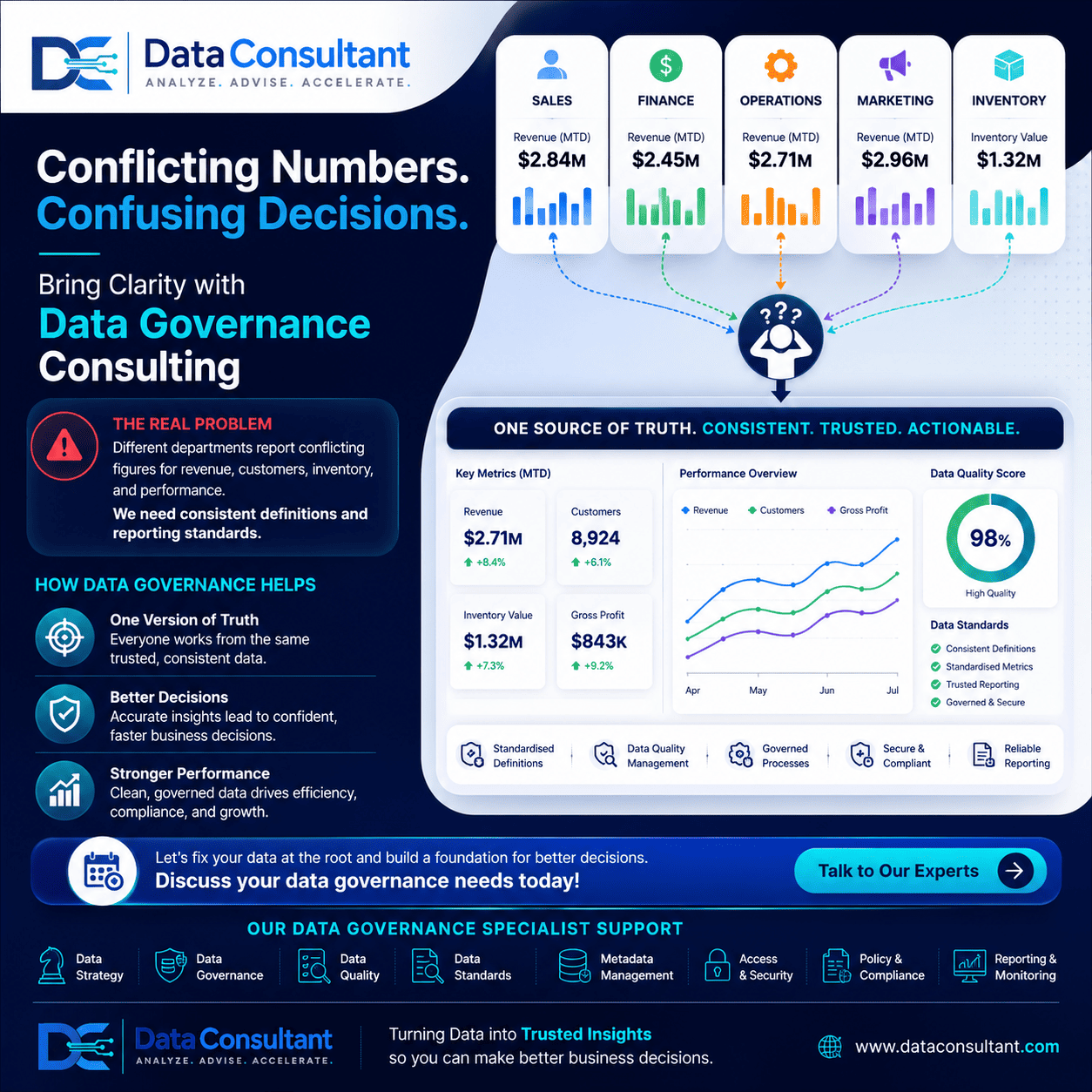
An ecommerce business sees different revenue totals in finance, marketing and executive dashboards. The mistaken assumption is that a new BI tool will fix reporting. The actual problem is inconsistent definitions, source selection and ownership. A focused governance diagnostic should identify authoritative sources, name the owner for revenue definitions, document calculation rules and establish change control. Finance, marketing, analytics and engineering must participate.
Example 2: multi-location customer records
A growing business has duplicate customer records and inconsistent contact permissions across locations. The initial request is for a master-data platform. Before buying one, the business needs decisions about customer identity, survivorship rules, stewardship, lawful use and exception handling. A defined governance and master-data project can produce the ownership model, critical rules, quality thresholds and technical requirements that make a later platform decision more defensible.
Example 3: startup planning AI too early
A startup wants predictive analytics and AI agents but product events are incomplete and key business measures change between teams. The better decision is to delay advanced modelling, establish reliable collection, agree core definitions, assign domain owners and define acceptable use. A lightweight governance framework plus a data-readiness roadmap is more appropriate than an enterprise governance programme.
Example 4: regulated enterprise access controls
An enterprise has formal security controls but business teams still cannot explain who may approve new uses of sensitive data. The gap is not authentication technology; it is decision accountability. A governance project should map data classes to owners, permitted uses, privacy and security review, evidence, retention and escalation. Existing security platforms should implement the decisions rather than become a separate governance layer.
Use Specialist Support When Governance Crosses Teams
External support is most useful when the problem is cross-functional, politically difficult or technically connected to architecture, data quality and analytics. A specialist can provide an independent maturity assessment, facilitate ownership decisions, design the operating model, define first-domain deliverables and help translate governance requirements into implementation work.
At DataConsultant.in data governance services, relevant support may include governance assessment, role and operating-model design, data-quality and metadata requirements, implementation roadmaps, first-domain pilots, documentation and knowledge transfer. Where the problem is not yet clear, a broader assessment or audit can help separate governance gaps from architecture, reporting or process issues.
Use internal teams when ownership and scope are already clear and the organisation has experienced people with available time. Use a tool when governance processes are defined and need automation. Use a consultant when clarity, design or implementation capacity is missing temporarily. Use ongoing or managed support only when the workload is persistent enough to justify it.
Summary
A governance framework is useful when data decisions repeatedly fail because ownership, standards, access, quality or escalation are unclear. Internal staff may be sufficient for a narrow domain with strong ownership. A software tool may be sufficient when processes and requirements are already defined. A short diagnostic is a better first step when teams disagree about the problem or maturity is uncertain. A defined project is justified when the organisation needs an operating model, policies, workflows, first-domain implementation and handover. Ongoing support or a managed team fits only when governance work remains continuous.
Before committing, validate the business goals, priority data domains, data quality, access, privacy and security constraints, executive sponsorship and internal ownership. Scope deliverables, budget, timeline, documentation, quality assurance, knowledge transfer and acceptance criteria in proportion to the risk and complexity of the work.
Governance Framework FAQs
What is a governance framework for data?
A governance framework for data is the operating structure that defines who can make data decisions, which policies and standards apply, how ownership and stewardship work, how quality and access are controlled, and how issues are escalated and measured. It should connect business accountability with technical controls rather than exist only as a policy document.
How do I know whether my business needs a governance framework?
You probably need a governance framework when teams disagree about KPI definitions, data ownership is unclear, access decisions are inconsistent, data quality problems recur, regulatory or contractual obligations are difficult to evidence, or analytics and AI initiatives depend on data that nobody clearly owns. A small organisation may need a lightweight framework rather than a large governance office.
What should a governance framework include?
A practical framework usually includes decision rights, accountable data owners, operational stewards, policies and standards, data-quality rules, access and privacy controls, metadata or catalogue expectations, issue and exception workflows, change management, meeting cadence, measures, and documentation. The exact design should match business risk, scale and data maturity.
Who should own data governance in a company?
Executive accountability should sit with a leader who can resolve cross-functional decisions, while individual data domains need named business owners. Data stewards, technology teams, security, privacy, risk and analytics teams support execution. Governance should not be treated as an IT-only responsibility because many of the key decisions concern business definitions, permitted use and accountability.
Can software create a governance framework for us?
Software can support catalogue management, lineage, access workflows, policy evidence, data quality and stewardship tasks, but it does not replace decision rights, ownership or operating rules. Buy or configure tooling after the organisation knows which governance processes it needs. Otherwise the tool can digitise ambiguity rather than resolve it.
How much does a data governance framework cost?
Cost depends on scope, number of data domains, system complexity, regulatory requirements, current documentation, tooling, data quality, stakeholder availability and whether implementation is internal or supported externally. A focused diagnostic and first-domain pilot costs less than an enterprise-wide governance programme. Compare total internal and external effort, not only software licence fees.
How long does governance framework implementation take?
A focused diagnostic and operating-model design may be completed in several weeks when stakeholders and evidence are available. A first-domain pilot can take additional weeks, while enterprise implementation commonly requires phased work over several months. Timelines extend when ownership is disputed, data inventories are incomplete, access controls are fragmented or policy approvals are slow.
How should a governance framework handle privacy and security?
Privacy and security should be built into decision rights, data classification, access approval, retention, sharing, incident response and exception handling. The framework should align with applicable laws, contracts and internal risk policies. It should also record who approves sensitive uses and what evidence is retained, rather than assuming a single security tool provides governance.
How do we measure whether data governance is working?
Measure whether governance decisions are being made and sustained. Useful indicators can include ownership coverage for priority domains, unresolved data issues, time to approve access, recurrence of quality defects, use of agreed definitions, completion of stewardship actions, policy exceptions and evidence quality. Avoid treating meeting counts or catalogue size as proof of business value.
When should we use a data consultant for governance framework work?
Use a data consultant when the problem crosses functions, ownership is contested, current maturity is uncertain, governance must connect to architecture and analytics, or the organisation needs a time-bounded diagnostic, operating model, implementation roadmap or pilot. Internal teams may be sufficient when the scope is small, decision rights are clear and experienced owners have time to lead the work.
Need a Practical Governance Starting Point?
If ownership, data quality, access or governance scope is unclear, start with a focused assessment before committing to enterprise tooling or a large transformation programme.
Discuss Data Governance SupportAt DataConsultant.in, we help organisations turn data and AI priorities into governed, reliable, and practical business capability.