
Data Management Master: When to Get Expert Help
A data management master approach is useful when a business needs one governed, reliable way to define, own, integrate and maintain critical data. The central decision is not whether to buy another platform. It is whether the organisation can resolve the business problem with existing staff, needs a short diagnostic, requires a defined data management project, or has a continuous need that justifies ongoing specialist support.
Start with the decision or operation being blocked. Conflicting revenue reports, duplicate customer records, inconsistent product codes, manual reconciliations and unclear ownership are business symptoms. “We need a data lake”, “we need master data management software” or “we should use AI” are technology requests. A consultant should not be engaged until the underlying decision, process or risk is clear enough to investigate.
This guide explains what a data consultant does, how to assess readiness, what access and stakeholders are required, how costs and timelines change, which deliverables to expect, and when internal staff or a software tool may be the better choice.
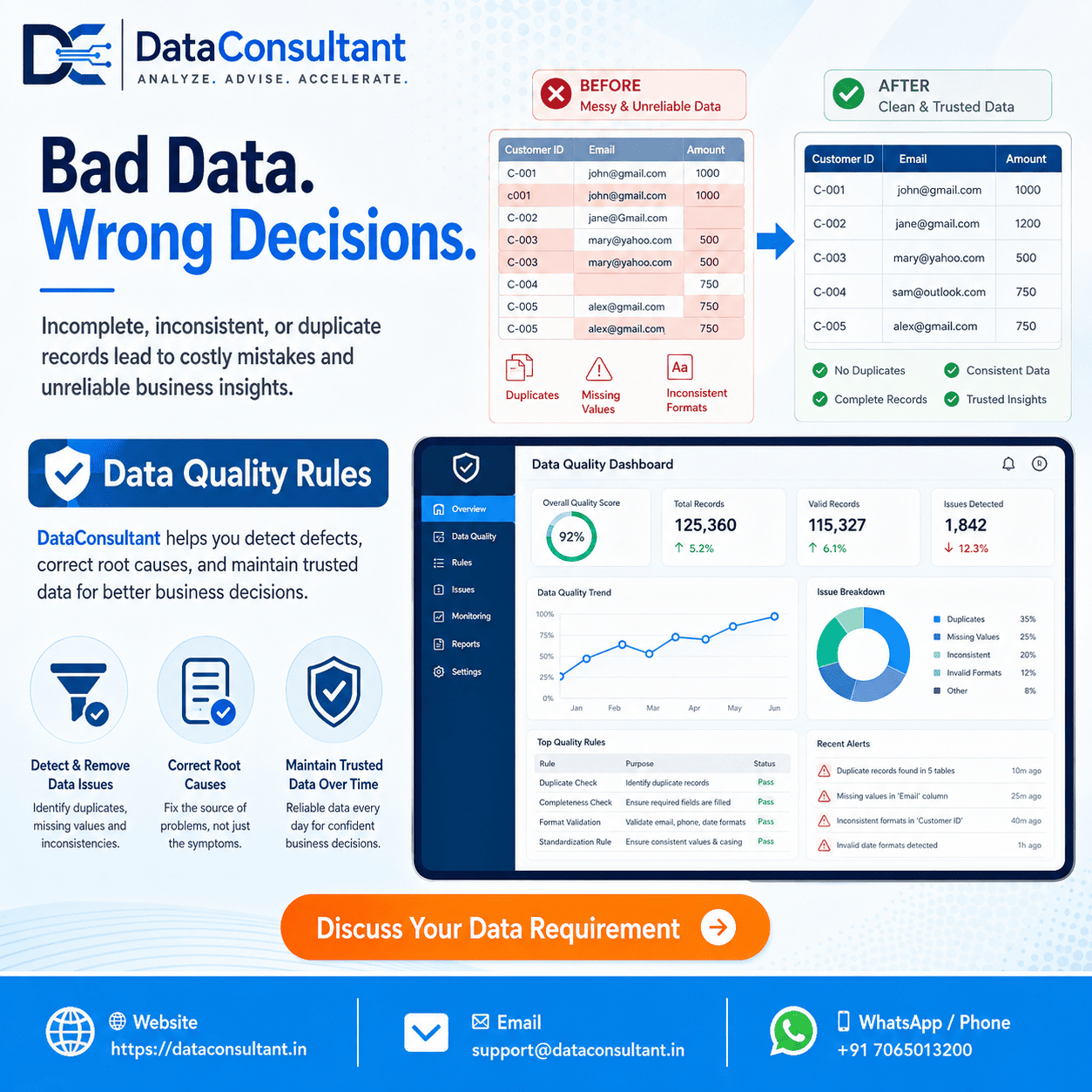
Quick Answer: Match Support to the Data Problem
Use internal staff when the business question is defined, data is accessible, the team has the required capability and the work is limited. Configure a tool when definitions, ownership and processes are already settled and the main gap is functionality.
Use a short diagnostic when teams disagree about the problem, reports conflict or data quality is uncertain. Use a defined consulting project when outputs such as a target data model, quality framework, governance design, integration plan or implementation roadmap can be scoped. Choose ongoing support only when governance, data quality, reporting or platform optimisation creates a genuinely recurring workload.
The main caution is to avoid beginning with dashboards, automation or AI before checking the reliability and ownership of the underlying data.
Key Takeaways
- Define the business decision: identify which report, workflow, customer process or risk is being affected.
- Check data readiness: access, quality, definitions and source-system behaviour determine feasible scope.
- Keep internal ownership: consultants can guide and deliver, but accountable business and technical owners must remain.
- Scope evidence and outputs: require findings, decisions, artefacts, acceptance criteria and a realistic roadmap.
- Build governance into delivery: privacy, security, retention and approval requirements affect design choices.
- Plan knowledge transfer: documentation, training and operating procedures should support continuity after handover.
Table of Contents
- Recognise when data management is the real problem
- Assess data maturity before committing
- Compare internal, tool and consulting options
- Prepare access, stakeholders and controls
- Define deliverables and implementation phases
- Estimate cost, time and resource drivers
- Measure capability, not activity
- Apply the decision to realistic situations
- Choose the right level of specialist support
- Summary
Hire Help When Unreliable Data Blocks Decisions
A data consultant is most useful when the organisation cannot confidently explain why important data differs, who owns the definition, how it moves between systems or what must change. The role is to turn an ambiguous data issue into an evidence-based decision and a deliverable plan.
What a data consultant does in practice
The consultant may interview business and technical stakeholders, trace data from source systems to reports, profile representative datasets, identify duplicated or missing records, assess data models and integrations, define quality rules, map ownership, document risks and prioritise remediation. Depending on scope, the work may extend to data architecture, master data management, metadata, business intelligence, migration, governance or implementation support.
The useful output is not simply a presentation. It is a set of decisions and artefacts that internal teams can use: agreed definitions, issue evidence, target-state options, responsibilities, requirements, milestones and acceptance criteria.
Do not confuse a data problem with a tool request
A dashboard cannot reconcile two departments that define active customer differently. A master data tool cannot decide who may approve a product hierarchy. A warehouse does not automatically correct missing source fields. Technology becomes valuable after the organisation has clarified meaning, ownership, controls and intended use.
Decision rule: if the team cannot state the business question, affected data domain, accountable owner and expected decision, begin with discovery rather than implementation.
Assess Data Maturity Before Committing
Data maturity determines how much of the engagement will be spent diagnosing foundations rather than building outputs. A business does not need perfect data, but it needs enough access, cooperation and ownership to investigate the problem safely.
Five readiness checks
- Business clarity: the affected decision or operational process can be described.
- Data access: authorised samples, reports and system documentation can be provided.
- Data quality evidence: known issues, reconciliations and exceptions are available, even if incomplete.
- Governance boundaries: privacy, security, retention and regulatory constraints are known.
- Internal ownership: named business and technical stakeholders can make decisions and review outputs.
Low maturity does not prevent consulting, but it changes the first deliverable. Instead of promising an implementation, the engagement may need to produce a maturity assessment, issue register, ownership map and phased roadmap.
Compare Internal, Tool and Consulting Options
The correct option depends on problem clarity, internal capability, urgency, continuity and the type of output required. Compare the whole operating model rather than the external fee alone.
| Option | Best fit | Expected output | Internal requirement | Main risk |
|---|---|---|---|---|
| Internal team | Clear question, accessible data and sufficient capability | Analysis, fixes and documentation | Protected time and accountable ownership | Operational priorities delay the work |
| Software tool | Definitions and processes are already agreed | Configured workflow, controls or repository | Requirements, administration and adoption support | Technology is used to avoid unresolved decisions |
| Short data diagnostic | Conflicting reports, uncertain quality or unclear scope | Findings, evidence, priorities and roadmap | Interviews, samples and decision-makers | Recommendations stall without an owner |
| Defined consulting project | Specialist outputs can be scoped and accepted | Design, implementation artefacts, testing and handover | Subject experts, system access and approvals | Scope expands without acceptance criteria |
| Ongoing consultant support | Recurring quality, governance or analytics demand | Regular advice, monitoring and delivery support | Prioritisation cadence and internal sponsor | Dependency develops without knowledge transfer |
| Dedicated specialist or managed team | Substantial continuous work across disciplines | Predictable capacity and coordinated delivery | Operating model, backlog and executive oversight | Capacity is wasted when priorities are unstable |
A hybrid model is often practical: external specialists diagnose or design the solution, while internal owners approve definitions, change source processes and sustain the operating controls.
Prepare Access, Stakeholders and Controls
A data management engagement depends on internal participation. Consultants cannot infer business meaning from columns and tables alone, and unrestricted production access is neither necessary nor appropriate for every project.
Inputs and access
- Representative data samples and existing reports.
- Data dictionaries, schemas, integration maps and transformation logic where available.
- Known issue logs, reconciliations, audit findings and manual workarounds.
- Policies covering privacy, security, retention, sharing and third-party access.
- Access to relevant business owners, data stewards, analysts, architects and system administrators.
Governance and security
Access should be minimised, approved and auditable. Sensitive fields may need masking, anonymisation or controlled environments. The NIST Privacy Framework provides a risk-based reference for managing privacy, while the ISO/IEC 27001 overview describes an information-security management approach. Apply the laws and internal policies relevant to the organisation; general frameworks are not a substitute for legal advice.
Expect a Roadmap, Evidence and Handover
A professional engagement should make its deliverables testable. The exact package depends on the problem, but each output should support a decision, implementation step or sustained operating responsibility.
| Problem | Likely deliverables | Internal participation |
|---|---|---|
| Conflicting reporting | Metric definitions, lineage review, reconciliation rules and reporting roadmap | Finance or operational owners approve definitions |
| Duplicate master records | Domain model, matching rules, stewardship design and remediation plan | Business owners define authoritative records |
| Integration failures | Source-to-target mapping, interface requirements, exception handling and test plan | System teams confirm constraints and ownership |
| Weak data governance | Decision rights, policies, stewardship roles, issue workflow and control schedule | Leadership assigns authority and resources |
| AI or forecasting readiness | Use-case assessment, data-readiness findings, risk controls and phased pilot plan | Business, data, risk and technology teams review assumptions |
Implementation should usually move through discovery, validation, design, pilot or limited remediation, testing, documentation and knowledge transfer. Large-scale technology work should not begin until assumptions about data meaning and quality have been tested.
Data Quality Often Determines Cost and Time
Consulting cost is driven less by the label of the service than by uncertainty and complexity. Scope grows when teams cannot identify authoritative sources, records require extensive profiling, integrations are undocumented, approvals are slow or remediation must occur across several systems.
Key drivers include the number of data domains, data volume and variety, source-system count, historical defects, regulatory controls, required environments, stakeholder availability, implementation depth, testing, documentation and post-project support. Internal time should be budgeted for interviews, evidence review, decisions, access approvals, testing and adoption.
A focused diagnostic may complete within several weeks. A defined implementation may take several months or longer. Treat any estimate as conditional on access, scope stability and decision speed.
Measure Trusted Use, Not Deliverable Volume
Success should be measured by whether people can use data more reliably for the intended business purpose. Counting workshops, dashboards or records processed does not show that the organisation has improved its capability.
- Fewer unresolved definition conflicts for priority metrics.
- Documented ownership and escalation for critical data.
- Quality rules with transparent thresholds and exception handling.
- Improved reconciliation or reduced manual correction where evidence supports it.
- Adoption of approved data definitions, models and operating procedures.
- Internal teams able to maintain the solution after knowledge transfer.
Measures should be baselined and interpreted carefully. A consultant cannot guarantee quality, compliance, savings or business performance because outcomes also depend on source processes, internal decisions and sustained adoption.
Choose Support Based on the Actual Situation
Ecommerce reports disagree on revenue
The mistaken assumption is that a new dashboard will create one answer. The actual problem may be inconsistent refund timing, channel attribution and order-status rules. A short diagnostic can trace definitions and transformations, then produce an agreed metric model, reconciliation rules and reporting roadmap. Finance, ecommerce and data owners must approve the decisions.
Professional services rely on spreadsheets
The organisation may assume it needs a large platform replacement. The real issue could be undocumented manual consolidation and inconsistent project codes. A defined project may map the workflow, standardise key records, introduce controlled templates or integrations, and document ownership. Internal operations and finance teams must validate the practical process.
A startup wants predictive analytics
The mistaken assumption is that modelling should begin immediately. If events are not captured consistently and outcome definitions are unstable, the better decision is a readiness diagnostic followed by a limited data-collection and reporting improvement. Advanced modelling should wait until the dataset and business use case can support responsible evaluation.
Choose Specialist Support Only Where It Fits
DataConsultant.in may be relevant when an organisation needs an independent data maturity assessment, data strategy, master data management design, governance framework, data-quality programme, architecture, integration planning, analytics roadmap or implementation support. The engagement should be limited to the problem that has been evidenced.
Choose a diagnostic when uncertainty is the main obstacle. Choose a defined project when outputs and acceptance criteria can be agreed. Choose a dedicated specialist or managed team when the work is substantial and continuous. Hire internally when the capability is strategic, permanent and large enough to justify a role or team.
Summary
A data management master decision begins with the business outcome, not the tool. Use internal staff for clear, limited work with adequate capability. Buy or configure software when processes and definitions are settled. Use a short diagnostic when the problem, quality or ownership is uncertain. Use a defined consulting project for scoped architecture, integration, governance, quality or analytics outputs. Choose ongoing support only when the need is continuous.
The organisation must still provide ownership, stakeholder time, controlled access and decisions. The strongest engagement leaves behind evidence, definitions, responsibilities, implementation artefacts, documentation and knowledge that internal teams can sustain.
FAQs on Data Management Master Decisions
What does data management master mean for a business?
In practical business terms, data management master refers to establishing reliable ownership, definitions, quality controls and lifecycle processes for important organisational data. It may involve master data management, but the decision should begin with the business records and decisions that are currently inconsistent, duplicated or difficult to trust.
When should a business hire a data consultant for data management?
Consider a data consultant when conflicting reports, duplicated customer or product records, unclear ownership, integration failures or governance requirements are blocking decisions and internal teams lack the time or specialist capability to diagnose and resolve the causes. Do not engage one merely because a new tool is available.
Can software solve data management problems without consulting support?
A tool may help when data definitions, processes, ownership and integration requirements are already clear. Software rarely resolves disagreements about meaning, poor source-system practices or missing accountability on its own. In those cases, a diagnostic or defined consulting project is usually needed before tool selection or configuration.
What is included in a data management diagnostic?
A diagnostic commonly includes stakeholder interviews, data-flow review, sample profiling, ownership mapping, quality issue analysis, governance assessment, technology constraints and a prioritised roadmap. The exact scope should be tied to a business decision, such as trusted revenue reporting, customer records or regulatory evidence.
How long does a data management consulting project take?
A focused diagnostic may take several weeks when access and stakeholders are ready. A defined implementation can take several months or longer depending on source systems, data volumes, integration complexity, remediation needs, approvals and change management. A responsible proposal should state assumptions and dependencies rather than promise a fixed outcome.
What affects the cost of data management consulting?
Cost is influenced by scope clarity, number of data domains, source-system complexity, profiling effort, integration work, governance requirements, stakeholder availability, documentation, testing and support after handover. Internal participation is also a real resource cost and should be included in planning.
What internal access does a data consultant need?
The consultant may need access to business owners, data stewards, system specialists, sample datasets, data dictionaries, reports, integration documentation, issue logs, security requirements and relevant policies. Access should be proportionate, approved and controlled; unrestricted production access is not automatically necessary.
How should data quality be measured during the engagement?
Define quality rules against business use, then measure dimensions such as completeness, validity, consistency, uniqueness, timeliness and accuracy where evidence allows. The project should document thresholds, exceptions, ownership and remediation steps rather than report a single unsupported quality score.
When is ongoing data management support appropriate?
Ongoing support is appropriate when data sources, products, regulations and reporting needs change continuously, or when governance and quality monitoring require recurring specialist attention. A one-off project is usually enough when the problem is narrow and internal owners can maintain the controls and documentation.
What should remain with the organisation after handover?
The organisation should retain decisions, data definitions, ownership maps, quality rules, architecture artefacts, issue logs, implementation documentation, operating procedures, training materials and access to relevant code or configurations according to contract terms. Knowledge transfer should be planned, not treated as a final presentation.
Need a Data Management Diagnostic?
Share the business decision, affected data, current systems, known quality issues and internal constraints. DataConsultant can help determine whether the next step should be internal remediation, a short diagnostic, a defined project or ongoing specialist support.
Discuss your requirement