
Data Management Governance: A Practical Decision Guide
Data management governance should begin with the business decisions that need reliable data, not with a new committee or software purchase. The practical goal is to make ownership, decision rights, data quality expectations, access rules and escalation routes clear enough that teams can manage data consistently. If revenue reports conflict, customer definitions vary, sensitive information is shared without clear approval, or AI and analytics projects are being planned on uncertain data, the first decision is to identify the operating problem and the people accountable for resolving it.
Do not hire a consultant simply because “governance” sounds important. Use internal staff when the scope is clear and ownership already exists. Use a software tool when processes and definitions are settled but execution needs better metadata, workflow or control. Use a short diagnostic when teams disagree about the problem. Use a defined consulting project when governance design and implementation can be scoped. Choose ongoing support only when stewardship, quality, policy and change needs are genuinely continuous.
This guide is for founders, business leaders, data and technology teams, risk and privacy functions, procurement teams and organisations deciding how much governance they actually need. It focuses on operating decisions: what should be governed, who must participate, how data maturity changes the approach, which deliverables matter, what affects cost and timeline, and when external specialist support is justified.
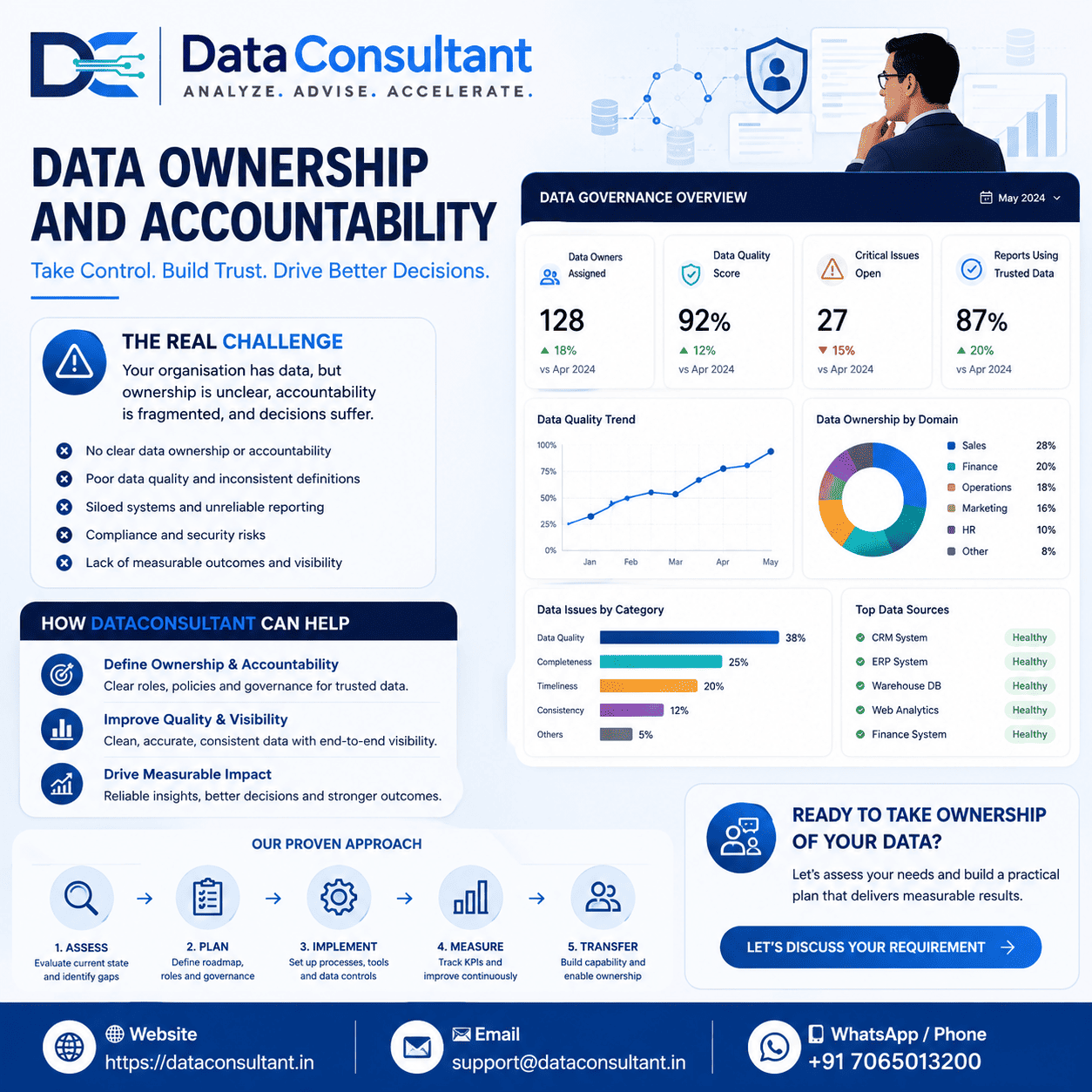
Quick Answer: Govern Decisions, Not Data in the Abstract
Start with three to five business decisions where inconsistent data creates material friction. Examples include revenue recognition, customer segmentation, regulatory reporting, supplier onboarding, product performance or model inputs. For each decision, identify the data domains involved, the accountable owner, the users, the critical definitions, the minimum quality threshold and the access or privacy constraints.
A lightweight governance model is enough when ownership is obvious and the data estate is small. A short diagnostic is useful when reports conflict or teams cannot agree on definitions and priorities. A defined project is justified when you need an operating model, standards, stewardship workflows, metadata requirements, quality controls and implementation support. Ongoing advisory or a managed data team is appropriate only when governance work recurs across many domains and systems.
The main caution is to avoid treating governance as an approval layer detached from delivery. If a policy cannot tell a team who decides, what evidence is required, how an issue is resolved and what happens next, it is unlikely to improve day-to-day data management.
Key Takeaways
- Start with blocked decisions: govern the data that materially affects reporting, operations, customers, risk or AI readiness.
- Match governance to maturity: weak definitions and ownership usually require diagnosis before tooling or automation.
- Keep business ownership explicit: technology teams can enable controls, but business owners must decide meaning and acceptable use.
- Scope the operating model: define domains, decision rights, stewardship, escalation, quality, metadata and access responsibilities.
- Expect usable deliverables: a roadmap, owner register, standards, workflows, quality rules, implementation backlog and handover are more useful than policy text alone.
- Integrate privacy and security: classification, access, retention and sensitive-data use belong inside governance decisions.
- Plan knowledge transfer: consultants should leave internal teams able to operate and improve the model.
Table of Contents
- Decide what genuinely needs governance
- Assess governance and data maturity
- Choose internal, tool or consulting support
- Define owners, controls and evidence
- Implement governance in phases
- Estimate cost and resource drivers
- Measure whether governance is working
- Apply the decision to real situations
- Use specialist support selectively
- Summary
Decide What Data Actually Needs Governance
Do not try to govern every field and dataset at the same level. Start with data that changes a meaningful decision, creates material risk or is reused across functions. A customer identifier used by sales, billing, support and analytics deserves more attention than a low-risk local spreadsheet that is never shared.
Separate governance problems from technology problems
A governance problem exists when ownership, definitions, decision rights, standards or acceptable use are unclear. A technology problem exists when the required decision is already clear but systems lack functionality, integration, metadata or workflow. Many organisations have both, but buying a catalogue, master-data platform or warehouse will not settle unresolved business meaning.
DAMA International describes data management as a set of practices for delivering, controlling, protecting and enhancing the value of data across its lifecycle, while its DMBOK framework places governance alongside disciplines such as quality, architecture, metadata and integration. The DAMA-DMBOK data management framework is useful as a vocabulary and coverage reference; the operating model still has to be adapted to your organisation.
Decision rule: if two responsible people can give different valid answers to “who decides this definition or access rule?”, clarify governance before automating the process.
Assess Governance and Data Maturity Before Scaling
Governance should be proportionate to data maturity. If teams do not know which systems are authoritative, quality issues are not logged, access is informal and no one owns core domains, a sophisticated council structure will add ceremony without control. Assess five foundations first: business clarity, data quality, access, governance rules and internal ownership.
For quality, the ISO 8000 data quality management overview is a useful reference for thinking about data-quality processes and maturity. It should not be read as a requirement to implement every possible control; choose measures that matter to the decisions being governed.
Choose the Smallest Governance Support That Fits
The best route depends on problem clarity, internal capability, urgency and continuity. A consultant is not automatically the right answer, and a tool is not automatically the cheaper answer once configuration, stewardship and change effort are included.
| Option | Best fit | Expected output | Internal requirement | Main risk |
|---|---|---|---|---|
| Internal team | Clear problem, capable owners and limited scope | Definitions, controls and workflows managed internally | Protected time and credible business ownership | Governance loses priority beside delivery work |
| Software tool | Definitions and processes are already clear | Catalogue, lineage, workflow, quality or access functionality | Owners to configure and operate the tool | Technology formalises unresolved ambiguity |
| Short data diagnostic | Conflicting reports, unclear ownership or uncertain maturity | Findings, priority domains, decision map and roadmap | Stakeholder access and evidence | Recommendations stall without an accountable sponsor |
| Defined consulting project | Operating model and implementation can be scoped | Governance design, standards, workflows, pilot and handover | Business, data, risk and technology participation | Scope expands across too many domains |
| Ongoing consultant support | Governance issues and use cases change continuously | Stewardship coaching, issue triage and governance maintenance | Regular prioritisation and internal owners | External dependency grows |
| Dedicated specialist or managed team | Substantial recurring workload across disciplines | Predictable capacity for governance, quality and implementation | Executive sponsorship and operating cadence | Capacity is wasted if decisions remain unowned |
A hybrid is often practical: external specialists help define the model and prove it in one or two domains, while internal owners retain decision rights and gradually take over stewardship, control monitoring and improvement.
Define Owners, Controls and Evidence Before Tools
A governance model becomes operational only when each important decision has an owner, a rule, an evidence source and an escalation route. Start with the minimum set needed for priority domains rather than a large policy library.
Clarify decision rights
- Name accountable business owners for priority data domains.
- Define stewards or operational custodians who maintain definitions and resolve issues.
- State which decisions belong to data, security, privacy, risk, architecture and business functions.
- Create a clear route for conflicts that cannot be resolved at working level.
- Record accepted exceptions, their rationale and review date.
Connect governance to privacy and security
Classification, access and retention decisions should follow the sensitivity and purpose of the data. The ISO/IEC 38505-3 data classification guidance provides governance-oriented considerations for classification. The NIST Privacy Framework provides a risk-based way to discuss privacy outcomes, while NIST Cybersecurity Framework 2.0 explicitly includes governance as part of cybersecurity risk management.
These frameworks are references, not substitutes for jurisdiction-specific legal advice or your organisation's security architecture. Governance should translate applicable obligations into ownership, controls and evidence that teams can actually use.
Implement Governance in a Narrow, Phased Path
Begin with one or two high-value domains and prove that the model can resolve real issues. A phased approach reduces policy work that never reaches operations and gives internal teams evidence about what should be standardised next.
Typical implementation deliverables include a governance charter, owner and steward register, domain model, business glossary, critical-data inventory, quality rules, issue workflow, access and classification decisions, metadata requirements, forum cadence, metrics, implementation backlog and knowledge-transfer materials. Not every organisation needs every artefact.
Data Quality and Scope Drive Governance Cost
Cost and timeline are driven less by the word “governance” than by the number of domains, systems, stakeholders, unresolved definitions and controls that must change. A well-scoped diagnostic with accessible evidence is very different from an enterprise programme spanning customer, product, finance and supplier data across many regions.
Budget for internal participation as well as external fees. Business owners must make decisions. Data engineers and architects may need to expose lineage or change pipelines. Security and privacy teams review classifications and access. Analysts validate metrics. Product or operations teams change source-system processes. Procurement and legal may review tooling and third-party data use.
Decision rule: if a proposal prices only workshops and documents but does not account for implementation, stakeholder time, data remediation and handover, it is not showing the full governance effort.
Measure Whether Governance Resolves Real Data Friction
Measure governance through decisions and operational behaviour, not committee activity. The useful question is whether teams can find accountable owners, agree definitions, resolve issues, manage access and deliver trusted data products with less ambiguity.
- Percentage of critical data elements with named owners and approved definitions.
- Time taken to resolve priority data-quality issues and definition disputes.
- Coverage and freshness of metadata for priority data products.
- Rate of recurring issues after corrective actions.
- Access reviews and exceptions completed against defined rules.
- Adoption of approved KPI definitions in material reports.
- Evidence that governance decisions are implemented in source systems, pipelines or workflows.
- Internal owner confidence to operate the model without external facilitation.
Avoid claiming that governance alone caused revenue, savings or compliance outcomes. Many factors influence business performance. Measure the capabilities and control improvements directly attributable to the governance work, then connect them cautiously to wider outcomes.
Practical Data Management Governance Decisions
Ecommerce revenue reports conflict
An ecommerce business sees different revenue and customer numbers in finance, marketing and operations dashboards. The mistaken assumption is that the BI tool needs replacement. The real problem is inconsistent definitions, source mappings and ownership. A short diagnostic is the better first step. Likely deliverables include an agreed metric dictionary, source-to-report lineage, owner register and prioritised remediation backlog. Finance, marketing, ecommerce operations and data engineering must participate before dashboard redesign.
Multi-location KPIs mean different things
A multi-location services business has regional managers using different definitions for active customer, completed job and margin. Management asks for a central data warehouse. The warehouse may help later, but the first problem is governance. A defined project can establish canonical KPI definitions, domain ownership, exception rules and a phased integration roadmap. Internal operations and finance leaders must own the final definitions.
Startup wants predictive analytics too early
A startup wants forecasting and AI before event tracking, customer identifiers and historical categories are stable. The mistaken assumption is that a model can compensate for unreliable collection. A readiness diagnostic should come first, followed by source-data improvements and a small governance model for critical product and customer data. Advanced modelling should wait until the business can explain what data is collected, who owns it and what quality is acceptable.
Enterprise migration exposes hidden ownership gaps
An enterprise planning a warehouse migration discovers that legacy tables have unclear owners and duplicated definitions across regions. The migration is therefore also a governance problem. A defined programme can pair architecture work with data-domain ownership, classification, metadata, quality controls and migration acceptance criteria. Ongoing specialist support may be justified during transition, but knowledge transfer should leave internal teams able to operate the model after cutover.
Use Specialist Governance Support Where It Adds Value
External support is most useful when teams need an independent maturity assessment, governance operating model, domain and owner design, data-quality framework, metadata requirements, policy-to-process translation or implementation roadmap. It can also help when the same issue crosses business, data, architecture, privacy and security boundaries and no internal team can coordinate the whole decision.
DataConsultant can support a focused data assessment or audit when the problem is still unclear, a defined data governance engagement when the operating model and controls need to be designed, and managed data and AI support when the workload is substantial and recurring. Where governance depends on architecture, integration or pipeline changes, a data engineering workstream may be relevant, but it should remain subordinate to the business decision being solved.
The right engagement should state scope, owners, evidence required, deliverables, milestones, acceptance criteria, security boundaries, documentation, knowledge transfer and handover. If internal ownership is absent, external delivery will not create durable governance by itself.
Summary
Data management governance is useful when important data decisions are blocked by unclear ownership, conflicting definitions, weak quality controls, fragmented access rules or unmanaged dependencies across teams and systems. Internal staff may be sufficient when the problem is clear, the data is accessible and capable owners have time to act. A software tool may be appropriate when definitions and processes are already settled and the main gap is execution functionality.
Use a short diagnostic when the organisation cannot yet agree on the problem, priority domains or maturity. Use a defined consulting project when you can scope an operating model, standards, workflows, quality controls, metadata requirements, implementation and handover. Choose ongoing support or a managed team only when governance work is recurring and substantial. In every case, validate business goals, data quality, access, privacy and security constraints, internal ownership, scope, budget and timeline before scaling.
Frequently Asked Questions
What is data management governance?
Data management governance is the decision-and-accountability layer that defines who can make data decisions, which policies and standards apply, how data quality and access are controlled, and how issues are escalated. It should connect business ownership with practical data management processes rather than operate as a policy-only committee. Start by identifying the few data domains and decisions that materially affect reporting, operations, risk or customer outcomes.
How is data management governance different from data governance?
The terms overlap, but data management governance is useful when you want to emphasise how governance directs day-to-day management disciplines such as data quality, metadata, architecture, integration, master data and lifecycle controls. The important distinction is not terminology; it is whether decision rights, ownership, standards and operating processes are connected. Document those links explicitly before creating more committees or tools.
Does every business need a formal data governance programme?
No. A small organisation with few systems and clear ownership may need lightweight controls rather than a formal programme. Formal governance becomes more useful as data sources, teams, regulatory obligations, reporting dependencies or AI use cases increase. Scale the operating model to the risk and complexity of the business, and avoid building bureaucracy that adds approvals without improving decisions.
Should we buy a data catalogue before fixing governance?
Usually not as the first step. A catalogue can support discovery, metadata and stewardship, but it cannot decide who owns a customer definition, which metric is authoritative or how exceptions should be handled. Define priority domains, ownership, critical data elements and workflow requirements first; then configure a tool around those decisions if the functionality gap is real.
What information should we prepare for a governance diagnostic?
Prepare a short list of business decisions blocked by data, critical reports and KPIs, major source systems, known quality issues, current owners, policy documents, access patterns, regulatory or contractual constraints, and examples of unresolved disputes. Include people who can explain how data is created and used, not only technology staff. Evidence of actual workflows is more valuable than a long policy inventory.
How long does a data management governance project take?
A focused diagnostic can often be scoped as a short engagement, while a defined governance project may run for several weeks or months depending on the number of domains, stakeholders, systems and controls involved. Enterprise implementation is normally phased because ownership, data-quality rules, metadata, access and change management cannot all be standardised at once. Timeline estimates should follow discovery rather than precede it.
What deliverables should a governance consultant provide?
Expected deliverables may include a current-state assessment, prioritised governance roadmap, decision-rights or RACI model, domain and owner register, critical-data inventory, policy and standard recommendations, data-quality rules, issue and escalation workflow, metadata requirements, KPI definitions, implementation backlog, training materials and handover documentation. Acceptance criteria should be agreed before delivery so that the work produces usable operating capability.
How should privacy and security fit into data governance?
Privacy and security should be integrated into ownership, classification, access, retention and change decisions rather than treated as separate end-stage reviews. Governance should clarify who approves sensitive-data use, what evidence is required, how access is reviewed and how exceptions are escalated. Apply the laws and standards relevant to your jurisdictions and sector; general frameworks should support, not replace, legal and security advice.
When is ongoing governance support appropriate?
Ongoing support is appropriate when new systems, domains, regulations, analytics products or AI use cases create recurring governance work and the organisation lacks enough internal capacity to maintain it. Support can include stewardship coaching, issue triage, metadata and quality reviews, policy updates, governance forums and implementation oversight. The arrangement should still build internal ownership and include knowledge transfer so that external dependency does not become the operating model.
Turn Governance Into an Operable Business Capability
Before committing to a large governance programme, choose one business problem where better ownership and data control would change a real decision. Confirm the people who can make those decisions, the evidence they need, the systems involved and the smallest governance intervention that can be tested. This keeps the work proportionate and makes implementation easier to evaluate.
If you need an independent diagnostic or a defined governance implementation, Discuss a Data Governance Requirement
At DataConsultant.in, we help organisations turn data and AI priorities into governed, reliable, and practical business capability.