
Data Management Examples for Better Business Decisions
Data management examples are practical controls, processes and ownership decisions that make business data reliable enough to use. They include defining one approved version of a KPI, validating customer records before they enter a system, assigning a named owner to critical fields, documenting lineage, controlling access, reconciling reports and monitoring quality exceptions. The central decision is not which tool looks most advanced. It is which business problem must be solved, who owns the outcome and what evidence will show that the data has become more usable.
A business should not hire a consultant merely because it wants a dashboard, data warehouse or AI initiative. First separate the operational problem from the technology request. Conflicting revenue reports may be caused by inconsistent definitions rather than weak visualisation. Duplicate customer records may reflect poor source-system processes rather than a missing master data platform. A short diagnostic is often the right starting point when the cause is unclear; a defined project fits a scoped outcome; ongoing support fits a genuinely recurring need.
This guide uses realistic examples to help founders, business leaders, data teams, finance, marketing, operations and procurement decide what good data management looks like, what internal readiness is required and when specialist support is appropriate.
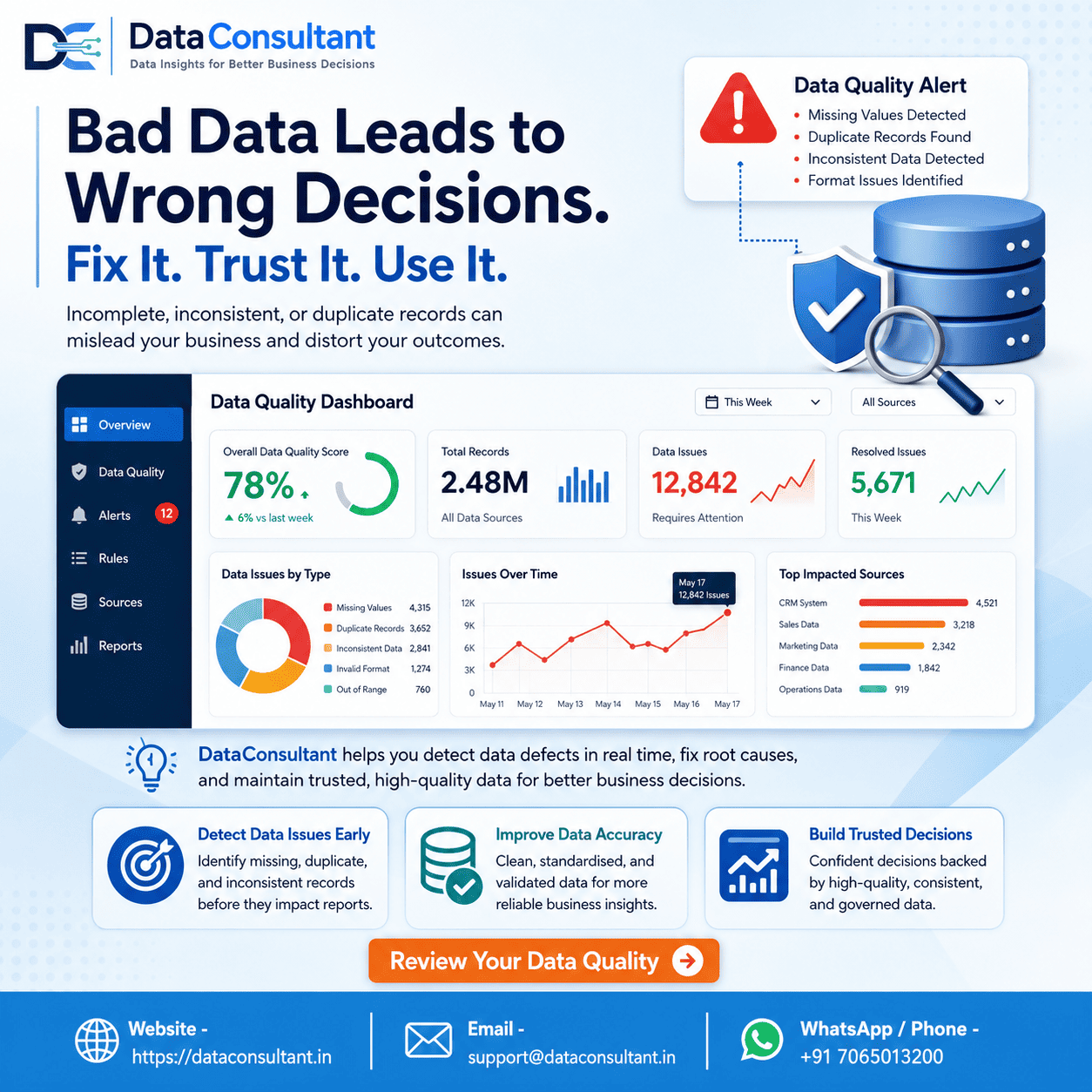
Quick Answer: Start with the Decision at Risk
The best data management example begins with a decision, workflow or obligation that unreliable data is affecting. Define the output that must improve, identify the source data and owners, then choose the smallest intervention that can create a controlled result.
Use internal staff when the problem is clear and capability is available. Buy or configure a tool when the operating process and requirements are already defined. Use a short diagnostic when reports conflict or root causes are uncertain. Use a defined consulting project for a scoped governance, quality, integration, architecture or analytics outcome. Choose ongoing support only when monitoring, stewardship and improvement are continuous.
The main caution is to avoid starting with technology. A catalogue cannot create ownership, a dashboard cannot repair inconsistent definitions and an AI system cannot make unsuitable data trustworthy.
Key Takeaways
- Connect every example to a business decision: data management is useful when it improves a report, process, service, control or regulatory obligation.
- Assign internal ownership: consultants and tools can support delivery, but the organisation must own definitions, priorities and approvals.
- Assess readiness: reliable access, stakeholder time, representative data and known constraints are necessary for meaningful work.
- Scope deliverables: distinguish assessment, design, implementation, testing, documentation and ongoing operations.
- Build in governance: privacy, security, retention, lineage and permitted use should be part of the solution rather than added later.
- Measure operational outcomes: monitor fewer conflicting reports, faster issue resolution, improved completeness or controlled access where evidence supports the claim.
- Require knowledge transfer: internal teams need the documentation and capability to maintain the result after external support ends.
Table of Contents
- Examples by business problem
- Check data-management readiness
- Choose internal, tool or consulting support
- Set access, governance and security needs
- Turn examples into an implementation plan
- Understand cost and timeline drivers
- Measure whether data management works
- Review realistic business examples
- Decide where specialist support fits
- Summary
Match Data Management Examples to the Business Problem
Data management should be designed around the failure mode that is blocking a decision or exposing the organisation to risk. The same control is not equally useful in every context.
| Business problem | Practical data management example | Likely deliverable | Internal owner |
|---|---|---|---|
| Conflicting revenue reports | Agree metric definitions, source hierarchy and reconciliation rules | KPI dictionary, lineage map and reconciled reporting logic | Finance or commercial leader |
| Duplicate customer records | Set matching rules, survivorship logic and source-entry controls | Data-quality rules and master-record process | Customer operations or CRM owner |
| Manual spreadsheet reporting | Document inputs, automate repeatable transformations and add checks | Controlled reporting workflow and exception log | Finance or operations team |
| Unclear data access | Classify datasets and assign role-based permissions with approval paths | Access matrix and review procedure | Data owner with security team |
| Untrusted marketing attribution | Define channel rules, identity assumptions and source limitations | Measurement framework and documented caveats | Marketing and analytics leaders |
| AI project with weak source data | Assess quality, rights, lineage, representativeness and permitted use | AI-readiness findings and remediation roadmap | Business sponsor, data and risk teams |
The practical rule is to define the control, the owner and the evidence together. A data-quality rule without an accountable response process may only create a longer list of unresolved issues.
Check Data Readiness Before Selecting a Solution
A project can start before every dataset is clean, but it needs enough business clarity and cooperation to produce a usable outcome. Assess readiness across five dimensions: decision clarity, data access, data quality, governance constraints and internal ownership.
Interview the people who create, change and use the data. Review representative records, reports, definitions and incident history. Record known limitations rather than treating them as hidden project risks. DAMA International’s Data Management Body of Knowledge provides a broad reference for data-management disciplines, while the exact operating model should reflect the organisation’s scale and obligations.
Choose the Smallest Support Model That Fits
The correct choice depends on problem clarity, internal capability, urgency, continuity and the breadth of disciplines involved. More external capacity is not automatically better.
| Option | Best fit | Expected output | Main risk |
|---|---|---|---|
| Internal team | Clear, limited problem with available capability | Targeted fixes owned and maintained internally | Competing priorities delay delivery |
| Software tool | Defined process and requirements with an operational owner | Configured catalogue, quality, integration or control capability | Technology is bought before ownership is resolved |
| Short diagnostic | Conflicting reports, uncertain causes or unclear priorities | Findings, risk assessment and prioritised roadmap | Recommendations stall without a sponsor |
| Defined consulting project | Scoped governance, quality, architecture, integration or reporting outcome | Designed and implemented deliverables with testing and handover | Scope expands without acceptance criteria |
| Ongoing consultant support | Recurring stewardship, quality monitoring or analytics demand | Continuous specialist input and improvement backlog | Dependency grows without knowledge transfer |
| Dedicated specialist or managed team | Substantial continuous workload across several data disciplines | Predictable delivery capacity and coordinated operations | Capacity is underused when priorities are unclear |
A hybrid model is often practical: internal leaders own decisions and standards, while external specialists provide temporary depth, independent assessment or implementation capacity.
Define Data Access, Governance and Security Up Front
Useful data management requires controlled access to evidence. Before work begins, specify which systems, reports, samples and documentation can be reviewed; who approves access; what information must be masked; and where project outputs may be stored.
Set minimum inputs and stakeholder roles
- Business objectives, affected decisions and current pain points.
- System and data-source inventory, including owners and interfaces.
- Representative records, reports and known exceptions.
- Existing definitions, policies, retention schedules and access rules.
- Named sponsor, data owners, technical contacts, security and privacy stakeholders.
- Acceptance criteria for assessment, design, implementation and handover.
Treat governance as an operating requirement
The OECD overview of data governance highlights the need to consider how data is accessed, shared and used across its lifecycle. Security controls can be structured using risk-based practices such as ISO/IEC 27001. Where AI use is relevant, the NIST AI Risk Management Framework can help teams discuss governance, measurement and risk treatment. These frameworks do not replace applicable law, contractual duties or sector-specific requirements.
Turn a Data Example into a Controlled Improvement
Implementation should move from evidence to a small, testable change before wider rollout. Begin with one decision or workflow, establish a baseline, define ownership and quality rules, implement the change, test it with users and document the operating process.
For example, do not automate a monthly report until teams agree the KPI definitions and source hierarchy. Do not merge customer records until matching thresholds and exception handling are approved. Do not publish a catalogue unless owners will maintain descriptions and access classifications.
Data Quality and Scope Drive Cost and Timeline
Cost is influenced less by the phrase “data management” than by the evidence and change required. A diagnostic involving five systems and a small stakeholder group differs substantially from an enterprise governance programme or data-platform migration.
- Scope breadth: number of domains, systems, reports and departments.
- Data condition: completeness, consistency, duplication, lineage and documentation.
- Access complexity: approvals, extraction effort, security controls and vendor dependencies.
- Change requirement: policy design, technology configuration, process redesign and training.
- Delivery standard: testing, audit evidence, documentation, quality assurance and handover.
- Continuity: one-off remediation versus recurring stewardship and monitoring.
Ask for assumptions, exclusions, milestones, acceptance criteria and internal resource requirements. A lower proposal can become expensive when it excludes data preparation, stakeholder workshops, testing or operational handover.
Measure Data Management Through Operational Evidence
Measure whether the control changed the quality and usability of data in the target workflow. Avoid claiming broad transformation from a single project.
- Percentage of critical fields meeting agreed completeness or validity rules.
- Number and age of unresolved quality issues by owner.
- Reduction in conflicting KPI definitions or duplicated reports.
- Time required to trace a reported figure to its source.
- Access reviews completed and inappropriate permissions resolved.
- Manual reconciliation effort before and after a controlled change.
- Use of approved documentation, definitions and operating procedures.
Establish a baseline, document the measurement method and record external factors. For example, fewer report discrepancies may result from both improved definitions and a source-system upgrade.
Realistic Data Management Examples in Practice
Ecommerce revenue reports do not agree
An ecommerce business sees different revenue totals in its finance, ecommerce and marketing systems. The mistaken assumption is that a new dashboard will create one truth. The actual problem is that refunds, taxes, shipping, order dates and attribution windows are treated differently. A short diagnostic should map definitions and lineage before any dashboard rebuild. Likely deliverables include an agreed KPI dictionary, source hierarchy, reconciliation rules and a prioritised reporting roadmap. Finance, ecommerce, marketing and technical owners must validate the decisions.
A professional-services firm relies on manual spreadsheets
A growing firm prepares utilisation and margin reports through copied spreadsheets. Management assumes automation alone will solve delays. The real issue includes undocumented transformations, inconsistent project codes and unclear ownership of corrections. A defined project can standardise reference data, document calculations, build controlled transformations and create exception checks. Internal finance and operations teams must agree the definitions and own the monthly process after handover.
A startup wants predictive analytics too early
A startup wants churn prediction, but customer events are missing, product identifiers change and outcomes are not consistently recorded. The better decision is to delay model development and establish reliable collection, definitions and quality monitoring first. A diagnostic or phased data-readiness project may produce an event taxonomy, instrumentation plan, quality checks, ownership model and later modelling criteria. Product, engineering and commercial leaders must agree what churn means and how predictions would be used.
Use Specialist Support When the Problem Crosses Disciplines
External support is most useful when the organisation needs an independent diagnostic, temporary specialist depth or coordinated delivery across strategy, governance, architecture, engineering and analytics. It is less useful when leaders have not defined the business decision or cannot assign internal owners.
DataConsultant.in can support a focused data assessment or audit, a defined data governance project, implementation through data engineering support, or recurring capacity through managed data and AI services. The appropriate starting point should match the problem, maturity, scope and internal ownership.
Need to clarify the right data-management intervention?
Begin with the business decision, affected data, known constraints and desired output. A focused discussion can determine whether internal action, a tool, a short diagnostic, a defined project or ongoing support is the most proportionate next step.
Discuss your data requirementSummary
Good data management examples show how a business definition, accountable owner, quality rule, access control and operating process work together. Internal teams are sufficient when the problem is clear and capability is available. A software tool is suitable when the process and requirements are already defined. A short diagnostic is useful when reports conflict, quality is uncertain or technology choices are being discussed too early.
A defined consulting project is justified when governance, quality, architecture, integration or reporting outputs can be scoped and accepted. Ongoing support or a managed team fits a substantial recurring workload. Before committing, validate business goals, data quality, access, governance, internal ownership, scope, budget, timeline, security, documentation, quality assurance, knowledge transfer and handover.
Frequently Asked Questions
What are practical data management examples?
Practical data management examples include agreeing one definition of customer or revenue, assigning owners to critical data fields, validating records at entry, documenting datasets in a catalogue, controlling access by role, reconciling reports, retaining data for defined periods and monitoring quality issues. The useful example is the one linked to a business decision, accountable owner and measurable control.
How do I know whether my business needs a data consultant?
Consider a data consultant when important decisions are delayed by conflicting reports, unclear ownership, unreliable data, fragmented systems or repeated manual work that internal teams cannot resolve within available time and capability. First define the decision or operational problem. A short diagnostic may be enough when the root cause is still uncertain.
Should we improve data management internally or use external support?
Use internal staff when the problem is clear, data is accessible and the team has the required governance, engineering or analytical skills. External support is more suitable when several disciplines are needed temporarily, an independent assessment is valuable or delivery is blocked by limited capacity. Keep an internal sponsor and named data owners in either model.
Can a software tool solve poor data management?
A tool can help when definitions, ownership, processes and controls are already clear. Catalogues, quality platforms and integration tools do not resolve disputed KPIs, weak source-system processes or absent accountability by themselves. Confirm the operating model and requirements before buying software, then test the tool against representative data and real workflows.
What information should we prepare for a data management project?
Prepare the business questions, affected reports and processes, system inventory, sample datasets, known quality issues, data owners, security classifications, access constraints, existing policies and current documentation. Also identify decision-makers and subject-matter experts who can validate definitions. Do not provide unrestricted production access before scope, controls and responsibilities are agreed.
How much does data management consulting cost?
Cost depends on the number of systems, data volume and complexity, quality problems, regulatory requirements, stakeholder availability, deliverables and whether implementation is included. A focused diagnostic is usually less resource-intensive than a governance rollout, migration or managed service. Compare scope, assumptions, internal effort, acceptance criteria and handover rather than day rates alone.
How long does a data management project take?
A focused assessment may take several weeks when stakeholders and evidence are available. A defined quality, governance, integration or reporting project may take several months, while enterprise-wide change is commonly phased. Timelines increase when access approvals, source-system remediation, procurement, security review or cross-department agreement is required.
What deliverables should a data management consultant provide?
Deliverables should match the problem and may include a current-state assessment, prioritised issue register, ownership model, data definitions, quality rules, architecture or integration design, governance procedures, implementation roadmap, test evidence, operating documentation and knowledge-transfer materials. Require clear acceptance criteria and distinguish recommendations from implemented outputs.
Can data management examples improve AI readiness?
Yes, when the examples strengthen the data foundation used by AI. Useful actions include tracing source lineage, checking training or retrieval data quality, defining permitted use, applying access controls, recording limitations and monitoring changes. Do not start an AI initiative merely because data exists; validate suitability, rights, representativeness, security and ownership first.
When is ongoing data management support appropriate?
Ongoing support is appropriate when data sources, reports, regulations and business priorities change continuously, or when recurring quality monitoring and governance coordination exceed internal capacity. It may include stewardship support, issue triage, catalogue maintenance, control reviews and improvement planning. A defined project is better when the need has a clear end state and internal owners can sustain it.
At DataConsultant.in, we help organisations turn data and AI priorities into governed, reliable, and practical business capability.