
Data Management and Data Governance Decision Guide
Data management and data governance should be treated as one connected business capability: governance sets ownership, decision rights and rules, while data management makes those rules operational across systems, pipelines, quality, metadata, access and use. The decision is not whether to “do governance” or buy a governance platform. It is which business decisions are being harmed by unreliable, inaccessible, poorly defined or weakly controlled data, and what minimum operating model will fix those problems. Start with a business outcome, identify the data it depends on, name the people who can make decisions about that data, and then assess quality, access, architecture and control gaps.
The main caution is to avoid solving an organisational problem with technology alone. A catalogue cannot create accountable data owners, a dashboard cannot reconcile conflicting KPI definitions, and an AI programme cannot compensate for missing lineage or inconsistent source data. Some organisations can improve these issues with existing staff; others benefit from a short diagnostic, a defined data project, ongoing specialist support or a managed team.
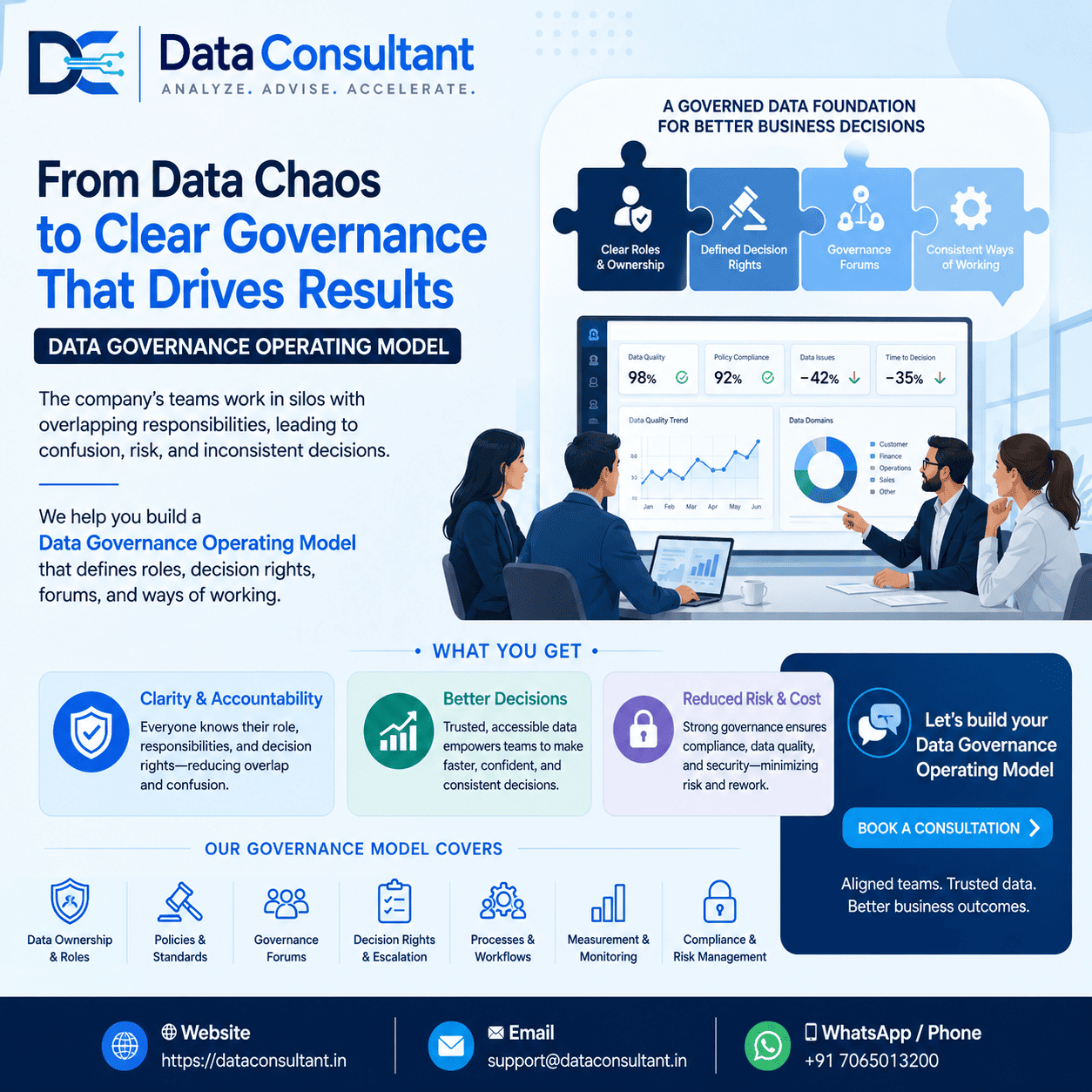
Quick Answer: Fix Ownership Before Adding Tools
Start with the decisions that matter most: management reporting, customer operations, finance controls, product analytics, regulatory evidence, AI use cases or another measurable business need. For each one, identify the authoritative data sources, accountable owner, agreed definitions, critical quality rules, access constraints and the teams that maintain the data. This reveals whether the immediate gap is governance, operational data management, technology, or a combination.
Use internal staff when the scope is contained and roles are clear. Buy or configure a tool when processes and definitions are already understood. Use a short diagnostic when reports conflict or teams disagree about the problem. Use a defined consulting project for a scoped operating model, data-quality programme, architecture, catalogue, integration or implementation. Choose ongoing support only when governance and data operations create recurring specialist work.
Decision rule: if nobody can say who owns a critical data definition, what “good enough” quality means, or who resolves an exception, technology is not yet the first decision.
Key Takeaways
- Governance is decision-making: define ownership, policy, standards, escalation and acceptable risk.
- Management is execution: operate data quality, metadata, architecture, integration, storage, access and lifecycle controls.
- Prioritise business-critical data: do not attempt enterprise-wide governance before proving value in a few important domains.
- Keep accountability internal: consultants can facilitate and implement, but business owners must retain decision rights.
- Do not buy software first: technology should support a defined operating model rather than substitute for one.
- Measure operational evidence: track agreed definitions, issue resolution, quality controls, lineage and adoption rather than policy volume.
- Phase the work: discovery, design, pilot, implementation, knowledge transfer and ongoing operation should be distinct decisions.
Table of Contents
- Separate governance from data management
- Diagnose readiness and failure points
- Choose the right intervention
- Define operating-model requirements
- Implement by priority data domain
- Estimate time, cost and internal effort
- Measure whether governance works
- Apply the decision to real cases
- Decide where specialist support fits
- Summary
Separate Governance from Data Management
Data governance decides who can make which data decisions; data management performs the work needed to create, maintain and use data reliably. This distinction matters because organisations often write governance policies without operational controls, or invest in engineering without resolving ownership and definitions.
DAMA International’s data management overview describes governance alongside quality, security, architecture, metadata and integration as connected knowledge areas. That is a useful mental model: governance is not a separate compliance layer placed above data work; it coordinates how the wider data-management system should behave.
Governance questions
- Who owns customer, product, supplier, employee or financial data?
- Who approves definitions for revenue, active customer, churn or service level?
- Which data is critical enough to require formal quality thresholds?
- Who may access sensitive data, for what purpose, and how are exceptions handled?
- Which forum resolves conflicts between business units?
Management questions
- How are source systems integrated and how is lineage recorded?
- How are duplicates, missing values and invalid records detected and corrected?
- Where are metadata, reference data and master data maintained?
- How are retention, access, backup and lifecycle controls implemented?
- How are governed data products made available for BI, analytics and AI?
When a problem crosses both lists, solve them together. For example, duplicate customer records are not only a data-cleansing issue. The organisation may also need an approved customer identity rule, a named owner and a process for resolving exceptions.
Diagnose the Real Data Failure Points
A governance programme is ready to start when you can name a business problem, the data involved and the stakeholders affected—even if the data itself is messy. Perfect maturity is not required. What matters is enough evidence to identify where decisions, controls or execution are failing.
Typical symptoms include executives receiving different numbers for the same KPI, analysts rebuilding the same extracts, teams keeping local spreadsheets because trusted data is unavailable, unclear data ownership, slow access approvals, recurring quality incidents, weak lineage for critical reports, or AI initiatives that cannot establish reliable source data.
Review readiness across five dimensions: business clarity, data quality, access, governance and internal ownership. If several are weak, a focused data assessment or audit may be more useful than immediately launching a large implementation.
| Dimension | Ready enough to proceed | Diagnostic first |
|---|---|---|
| Business problem | A critical decision or workflow is named | Teams ask for “better data” without a use case |
| Data | Priority systems and datasets are known | Sources, definitions or quality are disputed |
| Access | Evidence can be reviewed safely | Permissions prevent discovery or ownership is unclear |
| Governance | Decision-makers can be identified | No forum can resolve cross-functional conflicts |
| Ownership | Business and technology sponsors will participate | The initiative is delegated entirely to a tool or vendor |
Privacy and security should be part of discovery from the start. The NIST Privacy Framework provides a risk-management lens for privacy, while the developing NIST Data Governance and Management Profile specifically connects governance and management priorities across NIST resources.
Choose the Right Intervention
The right option depends on problem clarity, internal capability and whether the work is one-off or recurring. A consultant is not automatically the best answer, and a tool is not automatically the cheapest. Compare what each option assumes your organisation already knows.
| Option | Best fit | Expected output | Main risk |
|---|---|---|---|
| Internal team | Clear problem, capable people, limited scope | Policies, controls, data fixes and operating routines | Competing priorities slow progress |
| Software tool | Defined processes needing scale or workflow support | Catalogue, lineage, workflow, quality or policy automation | Automating unclear ownership and definitions |
| Short diagnostic | Conflicting reports, unclear ownership or uncertain maturity | Findings, priority gaps, target state and roadmap | Recommendations stall without an internal owner |
| Defined consulting project | Scoped governance, quality, architecture or implementation need | Operating model, artefacts, pilot, controls and handover | Scope expands without acceptance criteria |
| Ongoing support | Recurring governance, analytics or quality workload | Forums, issue management, optimisation and specialist advice | Dependency if knowledge transfer is weak |
| Dedicated specialist or managed team | Substantial continuous multi-discipline demand | Predictable delivery capacity and operating cadence | Capacity is wasted without prioritised work |
A hybrid model is often sensible: internal leaders retain ownership while external specialists provide temporary architecture, governance, quality or implementation depth. Delay advanced analytics or AI if the underlying data foundation is not ready.
Define the Governance Operating Model
A workable operating model must define decisions, roles, artefacts and escalation—not just committees. At minimum, specify the executive sponsor, data owners for priority domains, steward responsibilities, technical custodians, privacy and security participation, and how unresolved issues move to a decision-making forum.
Define what must be governed
Do not govern every field with the same intensity. Identify critical data elements and data products tied to important decisions, regulatory obligations, customer experience, financial reporting or operational continuity. Agree business definitions, authoritative sources, quality expectations and ownership for those items first.
Connect policy to technical controls
Policies should map to implementable controls: access roles, quality rules, lineage, metadata requirements, retention logic, master-data processes, pipeline monitoring and incident handling. For data quality, ISO 8000-8 concepts for information and data quality provide a standards-based reference for quality concepts and measurement prerequisites.
Clarify inputs before implementation
- Priority business decisions, reports and data products.
- Source-system inventory and available architecture diagrams.
- Known quality issues and manual reconciliation work.
- Existing policies, retention rules and access processes.
- Business definitions, data dictionaries and lineage where available.
- Named stakeholders from business, data, technology, security and privacy.
The absence of these artefacts should not block discovery. It should be recorded as part of the maturity finding and translated into a realistic implementation sequence.
Implement by Priority Data Domain
Implementation should prove the operating model on a small number of important data domains before broad rollout. A customer, product, supplier or management-reporting domain can provide enough complexity to test ownership, definitions, quality controls, lineage and issue management without trying to transform the whole enterprise at once.
- Discover: document the decision, systems, stakeholders, pain points and risk constraints.
- Design: define roles, decision rights, standards, critical data, quality rules and target controls.
- Pilot: apply the model to a priority domain or data product and collect evidence about what works.
- Implement: configure workflows, metadata, quality monitoring, integrations and reporting needed for the agreed model.
- Transfer: document procedures, train owners and stewards, and establish a sustainable review cadence.
If a catalogue, master-data platform, warehouse or lakehouse is part of the solution, architecture and integration requirements should be scoped after business rules are clear. DataConsultant’s data engineering service is relevant where governance decisions need to be translated into pipelines, integration, quality checks or platform controls.
Estimate Time, Cost and Internal Effort
Cost and timeline are driven more by scope and organisational complexity than by the word “governance”. A narrow diagnostic may require interviews, evidence review and a roadmap. A defined implementation may add data profiling, architecture, catalogue configuration, quality rules, stewardship workflows, policy updates, training and handover. Enterprise programmes add more domains, systems, jurisdictions and change-management work.
When comparing proposals, ask each provider to state assumptions about stakeholder availability, system access, data volumes, number of domains, deliverables, acceptance criteria, security review, tool licences, implementation responsibilities and change control.
Internal resource check: budget time from business data owners as well as technical teams. Governance cannot be outsourced to consultants if the people with authority to approve definitions, priorities and exceptions are unavailable.
Measure Whether Governance Works
Measure whether the organisation makes data decisions more consistently and resolves important data issues more predictably. Policy publication, meeting counts and catalogue entries are activity measures; they do not prove that data is more usable or controlled.
- Coverage of named owners for critical data and data products.
- Percentage of priority KPIs with approved definitions and source lineage.
- Performance of agreed quality rules and trend of recurring failures.
- Age, severity and closure rate of data issues.
- Access-review and exception outcomes for sensitive data.
- Adoption of approved data products instead of unmanaged extracts.
- Documented reduction in manual reconciliation where the evidence supports it.
Measurement should connect governance to the business problem that justified the work. If the original issue was inconsistent revenue reporting, the success test is not how many policies exist; it is whether the reporting chain has agreed definitions, traceable sources, controlled transformations and accountable owners.
Three Practical Governance Decisions
Ecommerce: conflicting customer and revenue reports
A growing ecommerce business sees different customer counts in marketing, finance and operations. The mistaken assumption is that a new dashboard will create a single truth. The actual problem is inconsistent customer identifiers, refund treatment and channel definitions across systems. A better first step is a diagnostic that maps definitions, source systems, ownership and data-quality rules. Deliverables may include a KPI dictionary, customer-data ownership model, quality checks and a prioritised integration roadmap. Finance, marketing, ecommerce and engineering leaders must participate.
Professional services: spreadsheet reporting bottleneck
A professional-service company spends days reconciling utilisation, pipeline and billing spreadsheets. Management initially asks for reporting automation. Discovery shows that project codes and client names are inconsistent and responsibility for master data is unclear. The better engagement is a defined data-management project combining reference-data rules, ownership, integration requirements and a controlled management-reporting model. Automation follows once the definitions and source processes are stable.
Startup: predictive analytics before data readiness
A startup wants predictive churn analytics but has changed event tracking several times and cannot explain which historical periods are comparable. The mistake is treating modelling as the immediate problem. The actual need is to stabilise data collection, document event definitions, validate quality and decide who owns changes. A short roadmap may be sufficient. Predictive work should wait until the team has enough reliable history and a governed process for future instrumentation.
Where Specialist Data Support Fits
External support is most valuable when the organisation needs independent diagnosis, cross-functional facilitation or temporary specialist depth. It can help when governance ownership is unclear, data quality needs structured assessment, architecture and integration decisions are linked to governance, or leaders need a phased roadmap with explicit deliverables and handover.
DataConsultant’s data governance service can support operating-model design, ownership, quality, metadata and governance implementation where those needs are genuinely present. For organisations with recurring requirements across several disciplines, managed data and AI support may be appropriate when the workload is continuous and internal hiring alone does not provide enough coverage.
Before engaging anyone, define the business decision, available evidence, internal sponsor, security constraints and expected handover. A professional engagement should state deliverables, client inputs, quality review and ownership after handover.
Frequently Asked Questions
What is the difference between data management and data governance?
Data management is the wider set of practices used to collect, store, integrate, protect, maintain and use data. Data governance defines the decision rights, ownership, policies, standards and oversight that make those practices consistent and accountable. In practice, governance tells teams who decides and what rules apply; data management turns those decisions into repeatable operational work. Treating either discipline in isolation usually creates gaps between policy and execution.
Does data management and data governance require a consultant?
Not always. Internal teams can lead data management and data governance when business priorities are clear, data owners are engaged and the organisation has enough architecture, quality, security and change capability. External consulting is most useful when ownership is disputed, reports conflict, requirements span several departments, a platform or migration decision is approaching, or leaders need an independent diagnostic and prioritised roadmap.
Should we buy a data governance tool before defining governance?
Usually no. A tool can support cataloguing, lineage, workflows, policy management or quality monitoring, but it cannot decide your business definitions, ownership model, escalation rules or acceptable risk. Define the operating model and priority use cases first, then configure technology around them. Buying software too early can automate unclear processes.
What information should we prepare for a governance assessment?
Prepare a short list of important business decisions, major reports and data products, key source systems, known quality issues, current policies, ownership documents, architecture diagrams, access rules and examples of conflicting definitions. Identify business, data, technology, security, privacy and compliance stakeholders who can explain how work is actually done. Gaps are useful discovery evidence.
How long does a data management and governance project take?
A focused diagnostic can often be completed in several weeks when stakeholders and evidence are available. A defined governance operating-model or priority data-domain project may take several months, while enterprise implementation is normally phased over a longer period. Timelines depend on scope, number of systems and domains, data quality, stakeholder availability, security review, technology configuration and change-management needs. A credible plan should separate discovery, design, pilot and scale.
How much do data management and governance services cost?
Cost depends on the problem, number of data domains, technical complexity, stakeholder count, required artefacts, implementation depth and whether support is project-based or ongoing. A short assessment has a different cost structure from a multi-domain operating model, catalogue implementation or managed data team. Compare proposals on assumptions, deliverables, acceptance criteria and internal effort, not headline price alone.
Who should own data governance inside the business?
Business accountability should remain internal. Executives set priorities and risk appetite; data owners make decisions for important domains; stewards coordinate definitions and quality; technology teams implement controls; privacy and security specialists define relevant safeguards. A central data office may coordinate the model, but it should not become the sole owner of every data decision. Consultants can design and facilitate the model, but durable governance requires named internal decision-makers.
Can governance fix poor data quality?
Governance can make data-quality improvement accountable, but it does not clean data by itself. It defines critical data, owners, rules, thresholds, issue workflows and escalation paths. Data management teams then profile sources, correct root causes, update pipelines, improve reference data and monitor results. The strongest approach connects quality controls to a business impact, such as unreliable customer reporting, duplicate supplier records or inconsistent management KPIs.
How should we measure whether governance is working?
Measure whether important decisions become more consistent and whether recurring data problems are resolved more predictably. Useful evidence can include ownership coverage for critical data, agreed definitions for priority metrics, quality-rule performance, issue ageing, lineage completeness for important reports, access-review outcomes, reduction in manual reconciliations where verified, and adoption of approved data products. Avoid vanity metrics such as policy counts if they do not change operational behaviour.
When is ongoing data governance support appropriate?
Ongoing support is appropriate when the organisation has recurring data-quality issues, new systems and data products, changing regulatory or privacy requirements, continuous analytics demand, or insufficient internal capacity to run governance forums and controls. It should include knowledge transfer and a clear operating cadence so external support strengthens internal capability rather than becoming permanent dependency. If needs are narrow and stable, a defined project with handover may be enough.
Summary
Data management and data governance work best when they are designed as one operating capability. Use governance to establish accountability, definitions, standards and decision rights; use data management to implement quality, metadata, architecture, integration, access and lifecycle controls. Internal staff may be sufficient when the problem and ownership are already clear. A software tool is suitable when processes are defined and need workflow or scale. A short diagnostic is useful when teams disagree about the problem, while a defined project is justified when outputs such as an operating model, quality controls, architecture changes or implementation can be scoped.
Ongoing support or a managed team becomes relevant when data issues and governance work are continuous. Whatever model you choose, validate the business goal, data quality, access, governance and internal ownership first. Then agree scope, budget, timeline, security, documentation, quality assurance, knowledge transfer and handover.
Need a structured starting point? DataConsultant can help assess data maturity, define a practical governance operating model and turn priority data problems into a phased implementation plan.
At DataConsultant.in, we help organisations turn data and AI priorities into governed, reliable, and practical business capability.