
Data Governance Solutions: A Practical Decision Guide
Data governance solutions should make business data easier to trust, understand, access and control without creating unnecessary bureaucracy. Start by identifying the decisions being damaged by unclear ownership, conflicting definitions, recurring quality issues, poor metadata or uncertain access. The main caution is not to hire a consultant or buy a governance platform before defining the business problem: a catalogue cannot resolve an ownership dispute by itself, and a policy document cannot repair a broken source process. The practical starting point is to choose the smallest governance intervention that can make a measurable decision, data domain or control more reliable.
For some organisations, internal staff can establish owners, definitions and issue workflows. Others need a short data maturity assessment to expose where the real gaps sit. A defined project is justified when operating models, metadata, quality rules, tooling or implementation need specialist design. Ongoing support is appropriate only when stewardship, change and control work are genuinely continuous.
This guide is for founders, business leaders, data and technology teams, finance and operations leaders, risk functions and procurement teams deciding what level of data governance is appropriate now. It covers readiness, roles, data quality, metadata, governance technology, privacy, cost, implementation, deliverables and handover.
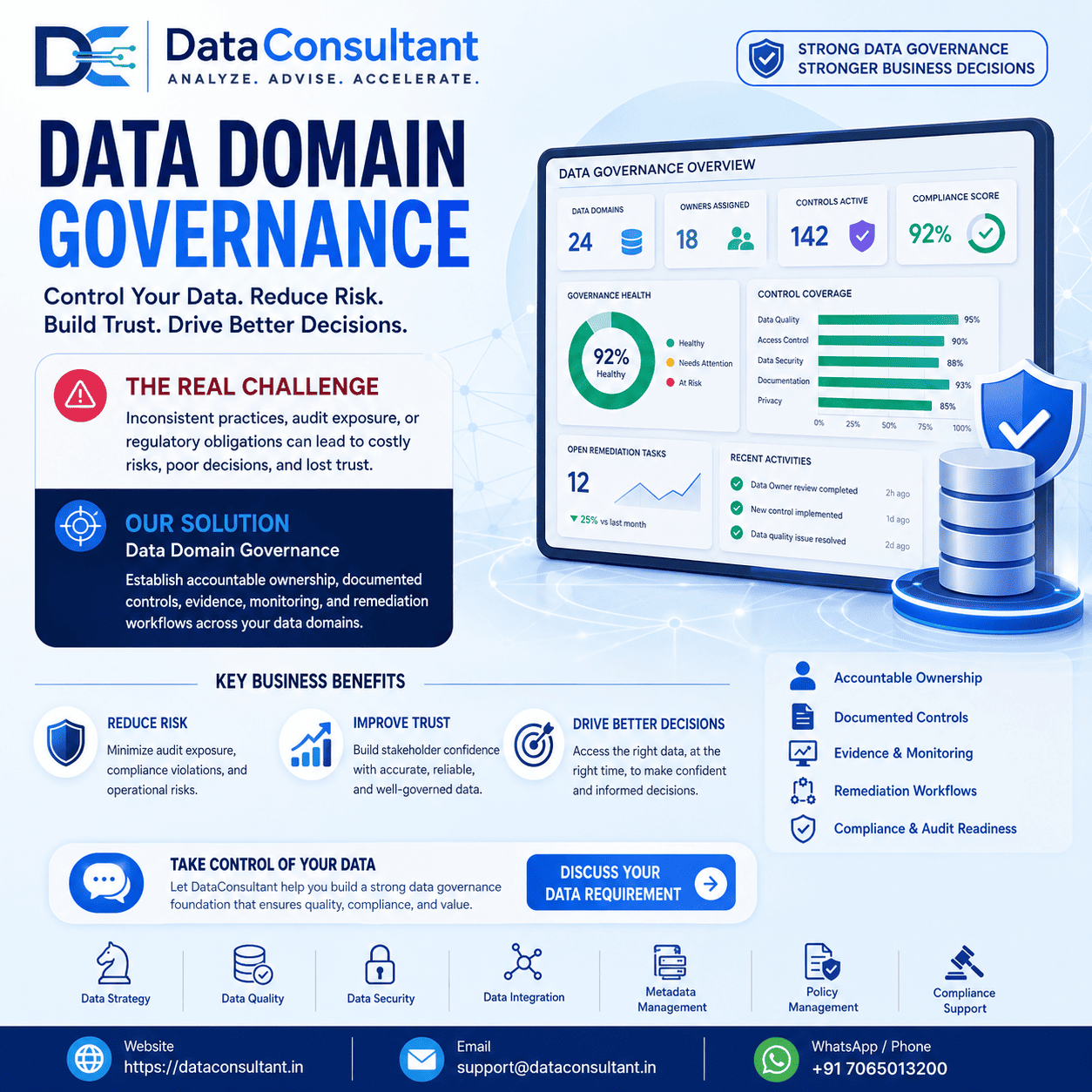
Quick Answer: Start with Decision Rights
The right data governance solution starts with accountability. Define which data matters, who can decide its meaning and acceptable use, how quality issues are detected and resolved, and what evidence is required. Then select technology only where it helps those operating rules scale.
Use a short diagnostic when reports conflict, ownership is disputed or the causes of poor data are unclear. Use a defined project when you can scope domains, roles, metadata, quality controls, tooling requirements and implementation outputs. Use ongoing support when stewardship, new use cases, regulatory change or platform evolution creates recurring work.
Do not mistake governance for central control of every dataset. Good governance places decisions with accountable people, sets escalation paths and makes the important rules visible enough for teams to work consistently.
Key Takeaways
- Govern decisions, not documents: focus on data that affects reporting, operations, risk, customers or AI use cases.
- Keep business ownership explicit: technology teams can enable controls, but business owners must define meaning and acceptable quality.
- Fix source problems where they originate: governance should not become a permanent manual correction layer.
- Scope deliverables: require named owners, decision rights, definitions, quality rules, issue workflows, implementation steps and handover.
- Use tools proportionately: catalogues, lineage and workflow platforms help only when operating roles and use cases are clear.
- Integrate privacy and security: access, retention and permitted use should be designed into governance rather than bolted on later.
- Plan knowledge transfer: external specialists should leave internal owners able to run the model.
Table of Contents
- Recognise when governance is the real problem
- Check governance readiness and ownership
- Compare governance solution options
- Design controls for quality, privacy and metadata
- Implement governance without slowing delivery
- Estimate cost and internal effort
- Apply the decision to practical cases
- Decide where specialist support fits
- Summary
Recognise When Governance Is the Real Problem
Data governance is the right lever when the problem is primarily about accountability, common meaning, acceptable quality, access or lifecycle control. It is not the first lever when a source application is capturing the wrong fields, an integration is broken, or nobody has agreed what business decision a dashboard is meant to support.
Look for repeated ownership and definition failures
Typical signals include two departments calculating “active customer” differently, financial and operational reports that cannot be reconciled, repeated manual corrections to the same fields, sensitive datasets shared without a clear approval route, or teams unable to tell where a critical metric originates. Those symptoms point beyond a one-off technical fix because the organisation lacks a stable decision rule.
Decision rule: if the same data disagreement returns after a technical fix, define the owner, rule and escalation path before adding more reporting or automation.
Separate governance gaps from platform gaps
A data catalogue, master-data tool or quality platform may be useful, but only after the organisation knows what it wants the tool to enforce or expose. The DAMA Data Management Body of Knowledge treats governance as part of a wider data-management discipline that also includes quality, metadata, architecture, security and integration. That is a useful reminder that governance has to coordinate with the technical environment rather than sit beside it.
Check Governance Readiness and Ownership
You do not need perfect data before beginning governance, but you do need enough organisational readiness to make decisions stick. Assess business priority, accountable ownership, data visibility, technical cooperation and the capacity to maintain the rules after the initial project.
The OECD overview of data governance describes governance across technical, policy and regulatory arrangements over the data value cycle. For businesses, that means governance cannot be reduced to a glossary: it must connect how data is created, accessed, shared, used, retained and retired.
Compare Data Governance Solution Options
The best option depends on problem clarity, internal capability, urgency and how much operating change is required. The comparison below helps distinguish when internal action, tooling or external specialist support is more proportionate.
| Option | Best fit | Expected output | Internal requirement | Main risk |
|---|---|---|---|---|
| Internal team | Clear issue, limited domain, capable owners | Owners, definitions, controls and workflow | Time and authority to make decisions | Work loses priority |
| Governance software | Operating model is clear and scale is the constraint | Catalogue, lineage, workflow or policy automation | Defined metadata, roles and administration | Tool becomes shelfware |
| Short diagnostic | Reports conflict or causes are unclear | Maturity findings and prioritised roadmap | Stakeholder interviews and evidence access | Recommendations have no owner |
| Defined consulting project | Operating model and implementation need specialist design | Roles, standards, controls, backlog, documentation | Business and technical participation | Scope expands across every dataset |
| Ongoing support | Governance work changes continuously | Stewardship support, reviews and improvement | Regular prioritisation and internal sponsor | Dependency without handover |
| Managed governance team | Substantial recurring workload across domains | Predictable multidisciplinary capacity | Executive sponsor and operating cadence | Cost without adoption |
A hybrid model is often practical: internal leaders own business decisions while external specialists establish the framework, accelerate implementation or provide temporary capacity.
Design Quality, Privacy and Metadata Controls
A workable governance model turns principles into operational controls. Prioritise the few data elements and decisions that matter most, then define ownership, metadata, acceptable quality, access and issue resolution around them.
Define critical data before governing everything
Start with a domain such as customer, product, supplier, employee or finance data and identify the critical elements that drive important reports, transactions, controls or AI use cases. For each element, record its business meaning, owner, source, permitted uses, important transformations, quality expectations and known dependencies. This creates a practical bridge between governance and data architecture.
Make data quality rules actionable
A statement that data should be “accurate” is too vague. A rule should identify the field or measure, condition, tolerance, monitoring method, owner and remediation route. If duplicate supplier records create payment risk, for example, the governance solution should specify how duplicates are detected, who can merge records and how downstream systems are updated.
Integrate privacy and security decisions
Governance should make access and permitted use explicit, particularly for personal or sensitive information. The NIST Privacy Framework provides a risk-based approach to identifying and managing privacy risk. Use relevant legal and regulatory requirements for your jurisdiction; a governance framework should support compliance work but should not be presented as a guarantee of compliance.
Implement Governance Without Slowing Delivery
Implement in a narrow, decision-led sequence rather than launching an enterprise-wide committee structure first. A useful sequence is: select a priority domain, confirm executive sponsorship, name owners and stewards, define critical data, agree standards and issue routes, configure only necessary tooling, then test the model through real decisions.
Pilot one domain and prove the operating model
Choose a domain where the pain is visible and stakeholders can participate. A customer domain may be suitable if duplicate identities damage marketing and service reporting; a product domain may be better if catalogue inconsistency affects ecommerce operations. Pilot outputs should include decisions actually made, issues actually resolved and evidence of how the governance workflow behaved.
Keep governance close to delivery teams
A central function can define standards, but stewardship needs to work where data is created and used. Embed responsibilities in product, engineering, analytics and operational routines. This reduces the risk that governance becomes a separate approval layer that teams bypass when deadlines tighten.
Where technical implementation spans metadata, pipelines or architecture, a data engineering service may be relevant alongside governance, but only when the governance decision requires changes to the data platform or integration layer.
Estimate Governance Cost and Internal Effort
Cost depends on the amount of organisational change and technical implementation, not simply the number of policies required. A small diagnostic may primarily consume stakeholder time. A multi-domain programme can involve data discovery, metadata capture, quality remediation, platform configuration, integration, training and ongoing stewardship.
- Scope: number of domains, systems and critical data elements.
- Decision complexity: how many teams must agree definitions, access and ownership.
- Data condition: whether quality issues can be monitored or require remediation in source systems.
- Technology: catalogue, lineage, workflow, quality and integration configuration.
- Control environment: privacy, security, retention, audit and regulatory review.
- Change effort: training, stewardship routines, communication and adoption.
Ask suppliers to separate discovery, design, implementation, licences and ongoing support so you can compare like with like. Also budget internal time: governance decisions cannot be outsourced completely because your organisation must own meaning, priorities and acceptable risk.
Apply the Decision to Practical Cases
Example 1: Conflicting revenue dashboards
Finance and sales report different revenue because they use different dates and treatment of credits. The first requirement is not a new BI tool. A short governance diagnostic should identify metric ownership, definitions, source lineage and decision rights. Once agreed, reporting logic can be standardised and documented.
Example 2: Customer data before an AI initiative
A retailer wants AI-driven personalisation, but customer identities are duplicated across ecommerce, CRM and support systems. Governance should clarify identity rules, permitted use, consent-related constraints where applicable, ownership and quality thresholds before model development. Integration or master-data work may then follow.
Example 3: Data catalogue purchased too early
An enterprise licenses a catalogue but has no agreed metadata owners or priority domains. Adoption stalls because teams do not know what they must document. The corrective action is to narrow the use case, define accountable owners and establish minimum metadata standards before expanding platform configuration.
Example 4: Continuous regulatory and domain change
A regulated organisation adds new products and data-sharing arrangements every quarter. A one-off framework is unlikely to be enough. Ongoing stewardship support may be justified if the recurring workload exceeds internal specialist capacity, provided decision ownership and knowledge remain inside the organisation.
Decide Where Specialist Governance Support Fits
External support is most useful when the organisation needs an independent diagnostic, faster operating-model design, specialist metadata or quality expertise, or temporary capacity to move from policy to implementation. It is less useful when leaders have not yet agreed which business decisions matter or are unwilling to assign accountable owners.
A focused assessment or audit engagement can help when maturity and priority are uncertain. A defined data governance service is more appropriate when roles, standards, controls and implementation need to be designed and delivered. If governance needs remain substantial and recurring across domains, managed data and AI support may provide continuity while internal leaders retain decision ownership.
Before engaging support: confirm the business outcome, priority domains, stakeholder availability, permitted data access, governance constraints, budget range and the handover expected at the end.
Summary
Choose data governance solutions according to the decision that needs to become more reliable. Internal staff may be enough when scope is narrow and ownership is strong. A tool purchase makes sense when operating rules are already clear and scale is the bottleneck. A short diagnostic is useful when the problem, maturity or ownership is uncertain. A defined project is justified when operating models, metadata, data quality, privacy controls or implementation need specialist design. Ongoing support or a managed team fits recurring multi-domain governance work.
Before committing, validate business goals, data quality, access, privacy and security constraints, stakeholder authority and internal ownership. Scope deliverables, timeline, budget, documentation, quality assurance, knowledge transfer and handover so the organisation can operate the model after external specialists leave.
Frequently Asked Questions
What are data governance solutions?
Data governance solutions are the operating rules, roles, controls and supporting tools used to make organisational data accountable, understandable, usable and appropriately protected. A practical solution normally covers decision rights, ownership, definitions, quality controls, metadata, access, issue management and evidence. Software can support these activities, but governance still requires named business owners and an operating process.
How do I know whether my business needs data governance solutions?
You probably need structured data governance when important reports disagree, teams use different definitions for the same metric, ownership is unclear, data access is inconsistent, quality issues recur, or audit and privacy questions are difficult to answer. Start with a focused diagnostic if the causes are uncertain rather than buying a large governance platform immediately.
Can a data catalogue replace a data governance programme?
No. A catalogue can improve discovery, metadata and lineage, but it does not by itself assign decision rights, resolve ownership disputes, define quality thresholds or create an escalation process. Buy or configure a catalogue when governance roles and use cases are sufficiently clear to make the metadata useful.
Should data governance be owned by IT or the business?
Ownership should be shared but not ambiguous. Business leaders normally own meaning, acceptable use and quality expectations for critical data, while technology teams manage platforms, controls, integration and implementation. A central governance function can coordinate standards and escalation, but it should not become the owner of every data decision.
What should we prepare before a data governance engagement?
Prepare a short list of business decisions that are being affected, representative reports or datasets, current policies, system and data-flow information, known quality issues, privacy or security constraints, and the names of business and technical stakeholders. Access does not need to be unrestricted; it should be proportionate to the diagnostic or implementation scope.
How long does a data governance project take?
A focused discovery or maturity assessment can often be scoped as a short engagement, while implementation across multiple domains, systems and business units usually requires phased delivery. Timeline depends on stakeholder availability, number of critical data elements, policy complexity, tooling, integration, remediation work and the speed of business decisions.
What deliverables should data governance consultants provide?
Expected outputs may include a current-state assessment, prioritised roadmap, governance operating model, role and decision-right definitions, data-domain map, critical-data inventory, glossary approach, quality rules, issue workflow, policy or standard drafts, tooling requirements, implementation backlog, documentation, training and handover materials. Deliverables should have owners and acceptance criteria.
How much do data governance solutions cost?
Cost is driven more by scope and organisational complexity than by the phrase data governance itself. Key drivers include number of domains and systems, stakeholder count, data-quality remediation, metadata and lineage requirements, privacy and security review, tool configuration, integration, training and ongoing stewardship. Compare total internal and external effort, not licence fees alone.
When is ongoing data governance support appropriate?
Ongoing support is appropriate when new data products, regulatory obligations, acquisitions, analytics use cases or AI initiatives keep creating governance work, and the organisation lacks enough specialist capacity to maintain standards, stewardship and issue resolution. A defined project is usually better when the operating model can be handed over to capable internal owners.
Can data governance solutions improve AI readiness?
They can improve the conditions needed for responsible AI by clarifying data ownership, provenance, quality, access, permitted use and retention. They do not guarantee model performance or compliance. AI readiness should also consider model risk, security, legal obligations, human oversight and whether the underlying business use case is appropriate.
Build Governance Capability You Can Sustain
A useful outcome is not the number of policies published; it is whether people can make recurring data decisions consistently. Look for evidence such as fewer unresolved definition disputes, visible ownership for critical data, faster issue routing, documented quality thresholds, clearer access decisions, usable metadata and reliable handover into normal business routines. Do not claim savings, compliance or performance improvements unless your own evidence supports them.
If your organisation needs help defining or implementing a proportionate governance model, DataConsultant can support a diagnostic, a defined implementation project or ongoing specialist capacity. The appropriate starting point should follow the maturity and workload rather than a predetermined service package.
Discuss data governance requirements
At DataConsultant.in, we help organisations turn data and AI priorities into governed, reliable, and practical business capability.