
Data Governance Defined for Business Decisions
Data governance defined in practical business terms is the system of decision rights, ownership, policies, controls and working routines used to make important data reliable, secure, understandable and appropriately used. The central decision is not whether your organisation needs more governance documentation; it is whether people can make accountable decisions about data across business, technology, privacy, security and analytics. If teams disagree about what a customer, revenue figure or product record means, cannot identify who can approve changes, or repeatedly discover quality and access problems late, governance is a business operating problem rather than a technology feature request.
A useful starting point is to identify one or two high-value data domains, the decisions that depend on them, the people accountable for those decisions and the controls already in place. Do not begin by buying a data catalogue or copying a large policy framework. Tools can support governance, but they cannot decide ownership or resolve conflicting business definitions. A short diagnostic may be enough when the problem is unclear; a defined project is appropriate when an operating model, roles, standards and implementation backlog can be scoped; ongoing support makes sense only when stewardship and control work is genuinely continuous.
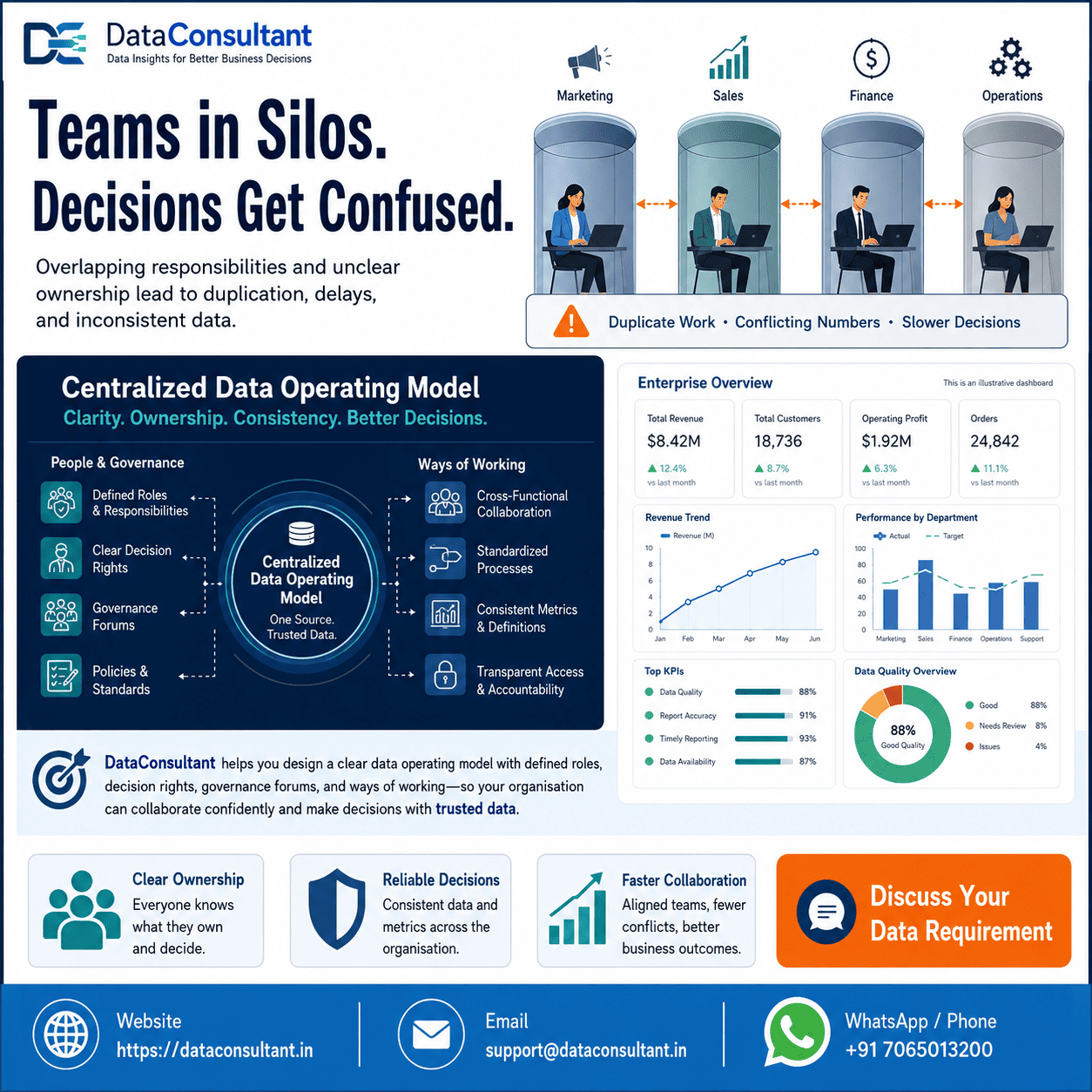
Quick Answer: Governance Makes Data Decisions Accountable
Data governance is the organisational mechanism for deciding who owns important data, which standards apply, what quality is acceptable, who may access or share it, how exceptions are approved and how problems are escalated. It turns broad intentions such as “improve data quality” or “protect customer data” into named responsibilities and repeatable decisions.
The smallest useful governance model is usually better than a large theoretical one. Start with critical data, clear ownership, a limited set of decision rights and a visible issue process. Expand only when the operating model proves useful. Where the current state is uncertain, use a diagnostic first; where scope and outcomes are clear, use a defined implementation project; where stewardship is recurring across domains, consider ongoing specialist support.
Key Takeaways
- Governance is decision-making: policies matter only when roles and decision rights are clear.
- Start with business-critical data: prioritise domains tied to revenue, customers, finance, operations, risk or regulatory obligations.
- Separate governance from management: governance sets accountability; operational teams execute data management.
- Data readiness shapes scope: poor metadata, unclear lineage and inconsistent definitions can increase implementation effort.
- Keep internal ownership: consultants and tools can accelerate the work, but business owners must make and sustain key decisions.
- Build privacy and security into the model: access, sharing, retention and sensitive-data controls should connect to normal governance workflows.
- Require handover and evidence: a useful programme leaves role definitions, standards, decisions, issue logs, measures and maintainable processes behind.
Table of Contents
- Define governance as decision rights
- Test whether governance is needed now
- Compare governance delivery options
- Set roles, controls and technical evidence
- Implement by critical data domain
- Estimate cost, time and internal effort
- Measure whether governance is working
- Apply governance to real business problems
- Use specialist support selectively
- Summary
Define Data Governance as Decision Rights
A governance framework becomes useful when it answers concrete questions: Who defines a metric? Who approves a new source? Who is accountable for quality? Who decides whether sensitive data can be shared? Who accepts a temporary exception? Who owns remediation when a control fails? These decisions should be explicit enough that teams do not need to rediscover them during every project.
Governance is broader than a policy library
The OECD overview of data governance describes governance across technical, policy and regulatory frameworks over the data value cycle. That breadth is useful: governance should connect creation, access, use, sharing, retention and deletion rather than treating data quality, privacy and security as isolated programmes.
For an organisation, that typically means an executive sponsor, domain owners, data stewards, a policy hierarchy, issue and exception workflows, quality expectations, classification and access rules, and a way to record decisions. It does not mean every decision must go to a central committee. Mature governance delegates routine decisions while reserving cross-domain, high-risk or disputed matters for escalation.
Separate governance from data management
Data management includes operational disciplines such as modelling, integration, metadata management, master data, quality monitoring and platform administration. Governance sets the authority and expectations within which those activities operate. For example, a data engineer may implement a validation rule, but a business owner should confirm what “valid” means for the business process. An analytics team may publish a dashboard, but governance should establish which KPI definition is authoritative.
Use Formal Governance When Data Decisions Keep Stalling
Formal governance is justified when the cost of ambiguity is becoming material. Common triggers include multiple versions of the same KPI, disputed customer or product records, recurring quality defects, unclear access approval, slow audit evidence, uncontrolled spreadsheet masters, duplicated definitions, regulatory obligations or AI projects using data whose provenance and permissions are unclear.
A startup with one core product and a small leadership team may need named ownership, a shared metric dictionary and sensible access rules rather than a formal council. A multi-country enterprise with regulated data, many systems and shared master data may need federated domain governance, documented forums and automated evidence. The correct level depends on business complexity and risk, not company size alone.
Compare the Smallest Governance Option That Can Work
The right option depends on problem clarity, internal capability, urgency and continuity. Governance work should not automatically become a large transformation programme.
| Option | Best fit | Expected output | Internal requirement | Main risk |
|---|---|---|---|---|
| Internal team | Problem and ownership are already clear | Roles, standards, issue process and domain controls | Available business and data leaders | Work is displaced by delivery priorities |
| Software tool | Processes are defined and evidence needs automation | Catalogue, lineage, workflow, quality or access evidence | Clear taxonomy, ownership and integration capability | Automating unclear governance |
| Short diagnostic | Symptoms are visible but root causes are disputed | Maturity findings, priority domains and roadmap | Stakeholder interviews and evidence access | Recommendations stall without sponsor ownership |
| Defined consulting project | Operating model and implementation can be scoped | Role model, policies, controls, pilot and handover | Business, data, security and privacy participation | Scope expands across too many domains |
| Ongoing specialist support | Stewardship and control work is recurring | Issue triage, domain reviews, policy and metric updates | Regular prioritisation and internal owners | External dependency without transfer |
| Dedicated specialist or managed team | Large, continuous multi-domain workload | Predictable governance capacity and coordination | Executive sponsor and operating cadence | Capacity exceeds actual adoption |
A common progression is diagnostic, focused operating-model design, domain pilot and then selective scaling. Buying a tool is most useful after roles, definitions and workflows are clear enough to configure.
Set Roles, Controls and Technical Evidence Together
Governance works when business accountability and technical evidence reinforce each other. Define who decides, then make those decisions observable in systems and workflows.
Assign business ownership and stewardship
- Executive sponsor: resolves priority and funding conflicts.
- Data domain owner: accountable for meaning, quality expectations and authorised use.
- Data steward: coordinates definitions, issues, metadata and day-to-day governance activity.
- Technology and architecture teams: implement platforms, integration, lineage and technical controls.
- Security and privacy teams: define risk, access, sharing, retention and sensitive-data requirements.
- Analytics and AI teams: apply approved definitions and document data provenance and limitations.
ISO 8000-150 addresses considerations for roles and responsibilities in data-quality management, while ISO 8000-51 on data governance policy statements shows how governance can extend into machine-processable policy evidence. Standards can inform design, but the organisation still has to decide which roles and controls fit its own context.
Connect privacy, security and AI governance
Governance should not duplicate separate control programmes. It should provide shared ownership, classification, lineage, issue and exception mechanisms that privacy, security and AI teams can use. The NIST Data Governance and Management Profile project explicitly explores complementary use of NIST frameworks for governance and management priorities. The NIST Privacy Framework is also a useful reference for connecting data handling to enterprise privacy risk management.
Implement Governance by Critical Data Domain
A domain-based implementation makes governance tangible. Select a business-critical domain such as customer, product, supplier, finance or workforce data. Define authoritative sources, ownership, key terms, quality rules, access expectations, lineage and issue routes. Pilot the operating model on real decisions before expanding to additional domains.
Expect concrete implementation deliverables
- Current-state maturity and problem assessment.
- Prioritised data-domain map and governance scope.
- Operating model with decision rights, forums and escalation routes.
- Owner and steward role descriptions.
- Business glossary and critical-data definitions.
- Data-quality rules, issue workflow and acceptance thresholds.
- Classification, access, sharing, retention and exception requirements.
- Metadata, lineage, catalogue or quality-tool requirements where justified.
- Implementation backlog, adoption plan and measures.
- Documentation, training and knowledge-transfer materials.
Do not start with advanced tooling if the organisation cannot yet agree who owns a domain or which definition is authoritative. Likewise, do not delay all progress until enterprise architecture is perfect. Governance can begin with simple evidence and improve as technical metadata and controls mature.
Data Quality and Scope Drive Governance Cost
The main cost drivers are the number of domains, stakeholder complexity, existing documentation, regulatory requirements, current metadata and lineage, data quality, platform landscape, integration needs and the amount of behaviour change required. A narrow domain diagnostic costs less than an enterprise operating-model rollout because it asks fewer people to make fewer decisions across fewer systems.
Timeline depends heavily on decision availability. Workshops are not the main constraint; unresolved ownership, slow approvals and incomplete evidence are. A focused assessment can move quickly when sponsors and artefacts are available. Implementing a federated model across multiple business units may take months because role changes, tool configuration, controls and adoption need iteration.
Decision rule: estimate internal effort as well as external fees. Domain owners, stewards, architects, engineers, security, privacy, compliance and analytics leaders all need time to review and make decisions. A proposal that treats governance as consultant-only documentation is incomplete.
Measure Governance Through Decisions and Evidence
Governance is working when important data decisions are faster, clearer and more consistently evidenced—not when committees meet more often. Measures should reflect the problems the operating model was created to solve.
- Percentage of critical data elements with named accountable owners.
- Coverage of approved business definitions for priority metrics and entities.
- Age and recurrence of high-priority data-quality issues.
- Time required to approve access, resolve ownership disputes or process exceptions.
- Coverage of lineage, classification and retention evidence for critical data.
- Adoption of authoritative data sources and governed KPIs.
- Number of repeated incidents caused by the same unresolved root issue.
- Completion of agreed remediation and control actions.
For data-quality measurement, the ISO 8000 family provides formal concepts and methods; for example, ISO 8000-8 addresses concepts and prerequisites for measuring information and data quality. Use standards as reference points, then select measures that map to actual business decisions and risks.
Practical Decisions Behind Data Governance
Ecommerce revenue does not reconcile
An ecommerce business has different revenue figures in finance, marketing and executive dashboards. The mistaken assumption is that a new BI tool will fix reporting. The real problem is conflicting definitions, source logic and ownership. A short diagnostic should identify calculation rules, source lineage and decision owners. Likely deliverables include an approved KPI definition, source mapping, issue backlog and governance route for future changes. Finance, marketing, data engineering and analytics leaders must participate.
Customer records differ across systems
A multi-location services company wants a master-data platform because CRM, billing and support systems disagree about customer identity. Technology may eventually help, but first the organisation needs ownership rules, matching logic, source-of-truth decisions and acceptable exception handling. A defined governance and master-data project can create those rules, pilot them on one region and specify technical requirements before a broader purchase.
AI initiative lacks approved data provenance
An enterprise team wants to deploy an internal AI assistant over policy, customer and operational documents. The key governance issue is not the model interface; it is whether sources are approved, classified, current and permitted for the intended use. A governance workstream should define data owners, access rules, retention, lineage and exception processes before scaling retrieval or agent workflows. Security, privacy, business and AI owners need shared decisions.
Use Specialist Governance Support Only Where Needed
External support is useful when internal teams need an independent maturity assessment, help designing decision rights, a domain governance pilot, data-quality and metadata controls, or a practical roadmap that connects governance with architecture, engineering, analytics, privacy and AI. It is less useful when leadership has not yet agreed the business problem or cannot provide accountable decision-makers.
DataConsultant can support a focused data assessment or audit, a defined data governance engagement, or related data advisory support when governance decisions need to connect to wider strategy and implementation. The scope should remain tied to the specific ownership, quality, control or operating-model problem.
Summary: Govern the Decisions That Matter Most
Data governance is appropriate when important data decisions require clearer ownership, common definitions, repeatable controls and evidence. Internal staff may be sufficient when the problem is narrow and ownership already exists. A software tool may help when workflows are clear and need automation. A short diagnostic is useful when symptoms are visible but root causes are disputed. A defined project is justified when an operating model, domain pilot and implementation backlog can be scoped. Ongoing support or a managed team fits only when stewardship and control work remains substantial and continuous.
Before committing budget, validate the business goals, critical data domains, current data quality, access constraints, privacy and security requirements, internal owners, implementation scope and handover expectations. The strongest governance model is not the largest; it is the smallest model that reliably improves the decisions and risks that matter.
Data Governance FAQs
What does “data governance defined” mean in practical business terms?
Data governance defined in practical business terms means an agreed system of decision rights, roles, policies, controls and routines for managing data across its lifecycle. It clarifies who can define, create, change, access, share, retain and retire important data, and how quality, security, privacy and accountability are checked. The next step is to identify a small set of critical data domains and assign accountable owners rather than beginning with a large policy library.
Is data governance the same as data management?
No. Data governance sets direction, decision rights, accountability and control expectations; data management performs much of the operational work, such as modelling, integration, quality monitoring, metadata maintenance and platform administration. The two must connect. Governance without operational execution becomes paperwork, while data management without governance can produce inconsistent priorities and unclear ownership.
How do I know whether my organisation needs formal data governance?
Formal governance becomes useful when conflicting metrics, unclear ownership, repeated data-quality incidents, sensitive-data risks, duplicated master data, difficult audits or cross-team access disputes are affecting decisions or delivery. A small organisation may only need lightweight ownership and standards. A larger or regulated organisation usually needs clearer forums, policies, controls and evidence. Start with the business problems that need accountability.
Who should own data governance?
Business leaders should own the meaning, priority and acceptable use of critical data, while data, technology, security, privacy and compliance teams provide enabling standards and controls. A central governance lead can coordinate the operating model, but should not become the owner of every data issue. Assign named domain owners and stewards with explicit decision rights and escalation routes.
What should a data governance framework include?
A workable framework should include scope, principles, data domains, ownership roles, decision rights, policy hierarchy, data-quality expectations, metadata and classification rules, access and sharing controls, issue management, exception handling, escalation, monitoring and evidence. It should also explain how governance connects to architecture, engineering, analytics, privacy, security and AI use.
How long does a data governance implementation take?
There is no universal duration. A focused diagnostic and operating-model design can be completed relatively quickly when stakeholders and evidence are available, while enterprise implementation can take many months because ownership, metadata, controls, technology integration and behaviour change must be embedded across teams. A phased rollout by critical data domain is usually more manageable than a single enterprise-wide launch.
How much does data governance consulting cost?
Cost depends on scope, number of data domains, organisational complexity, regulatory requirements, existing tooling, data quality, stakeholder availability and whether the work covers assessment, operating-model design, implementation or ongoing support. Compare proposals by deliverables, internal effort, handover and measurable scope rather than a headline day rate alone. A short diagnostic is often the lowest-risk starting point when the problem is still unclear.
Can software replace a data governance operating model?
No. Catalogue, lineage, quality, policy and access-governance tools can automate evidence and workflows, but they cannot decide business ownership, resolve conflicting definitions or create accountability by themselves. Buy or configure technology after governance decisions and operating processes are sufficiently clear. Otherwise the organisation may automate ambiguity.
What information should be prepared before a governance project starts?
Prepare the business objectives, known data incidents, key reports and metrics, major data sources, architecture diagrams, current policies, security and privacy requirements, organisational roles, existing catalogues or dictionaries, audit findings and a list of high-value data domains. Also identify executive sponsors and subject-matter experts who can make decisions rather than only attend workshops.
When is ongoing data governance support appropriate?
Ongoing support is appropriate when multiple domains require recurring stewardship, policies and controls evolve, regulatory or AI requirements change, data-quality issues need regular triage, or internal teams do not yet have enough capacity to operate the model. It should include knowledge transfer and clear internal ownership so external support strengthens capability rather than creating permanent dependency.
Need a governance starting point? If ownership, data quality, policy or implementation scope is unclear, a limited diagnostic can help identify the smallest practical next step before committing to a wider programme.
Discuss a Data Governance RequirementAt DataConsultant.in, we help organisations turn data and AI priorities into governed, reliable, and practical business capability.