
Data Governance Data: A Practical Decision Guide
What does data governance data mean for a business? In practical terms, data governance data is the combination of business data that needs governing and the evidence used to govern it: ownership, definitions, metadata, quality rules, lineage, access decisions, retention requirements, issue records and control outcomes. The business decision is not whether to create more governance documentation. It is whether inconsistent, inaccessible, poorly defined or weakly controlled data is now creating enough operational friction or risk to justify a formal governance model.
Start with a concrete problem. If finance and sales report different revenue, customer records are duplicated, teams cannot identify the owner of critical fields, AI projects cannot establish trustworthy source data, or compliance evidence is assembled manually each time, governance may be appropriate. If the issue is simply one broken report or one missing integration, fix that problem first rather than launching an enterprise governance programme.
This guide helps founders, business leaders, data and technology teams, risk and compliance functions, procurement teams and transformation leaders decide when governance support is appropriate, what internal readiness is required, what a professional engagement should deliver, how costs and timelines are shaped, and how to avoid implementing policy or tooling before the business use case is clear.
Quick Answer: Govern the Data That Drives Decisions
A practical governance programme begins by identifying the decisions, reports, regulatory obligations, customer journeys or AI use cases that depend on important data. It then names accountable owners, agrees definitions, classifies critical data, sets quality and access rules, records lineage where useful, and establishes an operating process for resolving exceptions.
Use a short diagnostic when teams disagree about the problem, ownership is unclear or you do not know whether policy, process, architecture, quality or tooling is the main constraint. Use a defined project when priority domains and outcomes are clear. Consider ongoing support only when stewardship, quality monitoring, catalogue maintenance, access workflows or governance forums create a continuing workload that internal teams cannot yet sustain.
Decision rule: if governance cannot be tied to a named business decision, dataset, owner and expected improvement, the scope is probably too broad.
Key Takeaways
- Start with business pain: governance should resolve recurring problems in reporting, operations, compliance, customer data or AI readiness.
- Separate policy from operating practice: a policy is useful only when owners, workflows, controls and evidence make it executable.
- Prioritise critical data: not every field needs the same level of definition, lineage, quality monitoring or approval.
- Keep accountability inside the organisation: consultants can design and accelerate the model, but data owners must remain internal.
- Do not lead with tooling: catalogues and governance platforms support a model; they do not create decision rights or business ownership.
- Plan for technical cooperation: governance often needs metadata, architecture, access, quality and integration support from technology teams.
- Measure operational adoption: track whether definitions, ownership, issue resolution and controls improve real work rather than counting policies.
Table of Contents
- Define the governance decision
- Check organisational and data readiness
- Design roles, metadata and controls
- Compare implementation options
- Plan deliverables and implementation
- Estimate cost, time and resources
- Apply governance to real situations
- Measure outcomes and continuity
- Decide where specialist support fits
- Summary
What Data Governance Data Actually Includes
The phrase can sound circular because “data governance” is a management discipline while “data” is also the object being managed. For decision-making purposes, it helps to separate two layers. The first is governed business data: customer, product, supplier, finance, operational, workforce, risk or analytical data that the organisation relies on. The second is governance evidence: the metadata and records that explain how this data should be used and whether agreed controls are working.
Business data that needs governing
Not every dataset requires the same governance intensity. Focus first on data that is material to business decisions, regulatory reporting, customer outcomes, financial control, operational continuity or machine-learning and AI use cases. A critical customer identifier may require stronger ownership and quality rules than a temporary analytical field used for one experiment.
Evidence that makes governance operational
Governance evidence can include business definitions, accountable owners, system-of-record decisions, classifications, lineage, quality tests, exceptions, approvals, access reviews, retention rules, policy mappings, issue logs and stewardship actions. This evidence should be proportionate. Capturing exhaustive lineage for low-value data while critical KPI definitions remain disputed is poor prioritisation.
The OECD’s work on data governance illustrates the broader importance of arrangements that support trustworthy data access and use. At organisational level, the practical task is to translate governance principles into decisions that teams can execute repeatedly.
When Is Formal Data Governance Worth It?
Formal governance becomes useful when the cost of ambiguity is recurring and cross-functional. One broken spreadsheet is not a governance programme. But repeated disagreements over customer, revenue, product or risk data—especially when they cross teams and systems—often indicate that local fixes are no longer enough.
Strong business signals
- Executives receive conflicting values for the same KPI from different teams.
- Important fields have no accepted business owner or definition.
- Data-quality defects reappear because nobody owns root-cause resolution.
- Access to sensitive information is granted inconsistently or reviewed manually.
- Regulatory, audit or customer evidence requires repeated one-off investigation.
- Mergers, cloud migration or platform modernisation expose incompatible definitions and master data.
- Analytics and AI teams spend excessive time finding, validating or explaining source data.
- Data products exist, but consumers cannot tell which version is approved for a decision.
When a smaller fix is better
If a single source system has a validation defect, engineering remediation may be sufficient. If one dashboard is poorly designed, BI work may solve the issue. If access is the only concern, identity and security controls may be the primary intervention. A consultant should help distinguish governance problems from engineering, architecture, reporting, process or change-management problems rather than labelling every data issue as governance.
Check Governance Readiness Before Scaling
You do not need mature governance to begin; the purpose of the work may be to create it. But implementation needs enough business sponsorship and technical cooperation to prevent the programme becoming a documentation exercise.
Inputs a consultant will usually need
- Priority business decisions, reports and pain points.
- System and data-source inventories, where available.
- Architecture, integration and data-flow documentation.
- Existing policies for privacy, security, retention and records.
- KPI dictionaries, data models, catalogues or glossaries already in use.
- Quality incidents, reconciliation problems and known manual workarounds.
- Access-control roles and examples of approval or exception processes.
- Stakeholder time from business, data, technology, risk, security and privacy teams.
Where personal data is involved, governance should align with applicable privacy obligations. In India, organisations may need to consider the Digital Personal Data Protection framework alongside sector-specific obligations and contractual requirements.
Design Roles, Metadata and Controls
Design Governance as an Operating Model
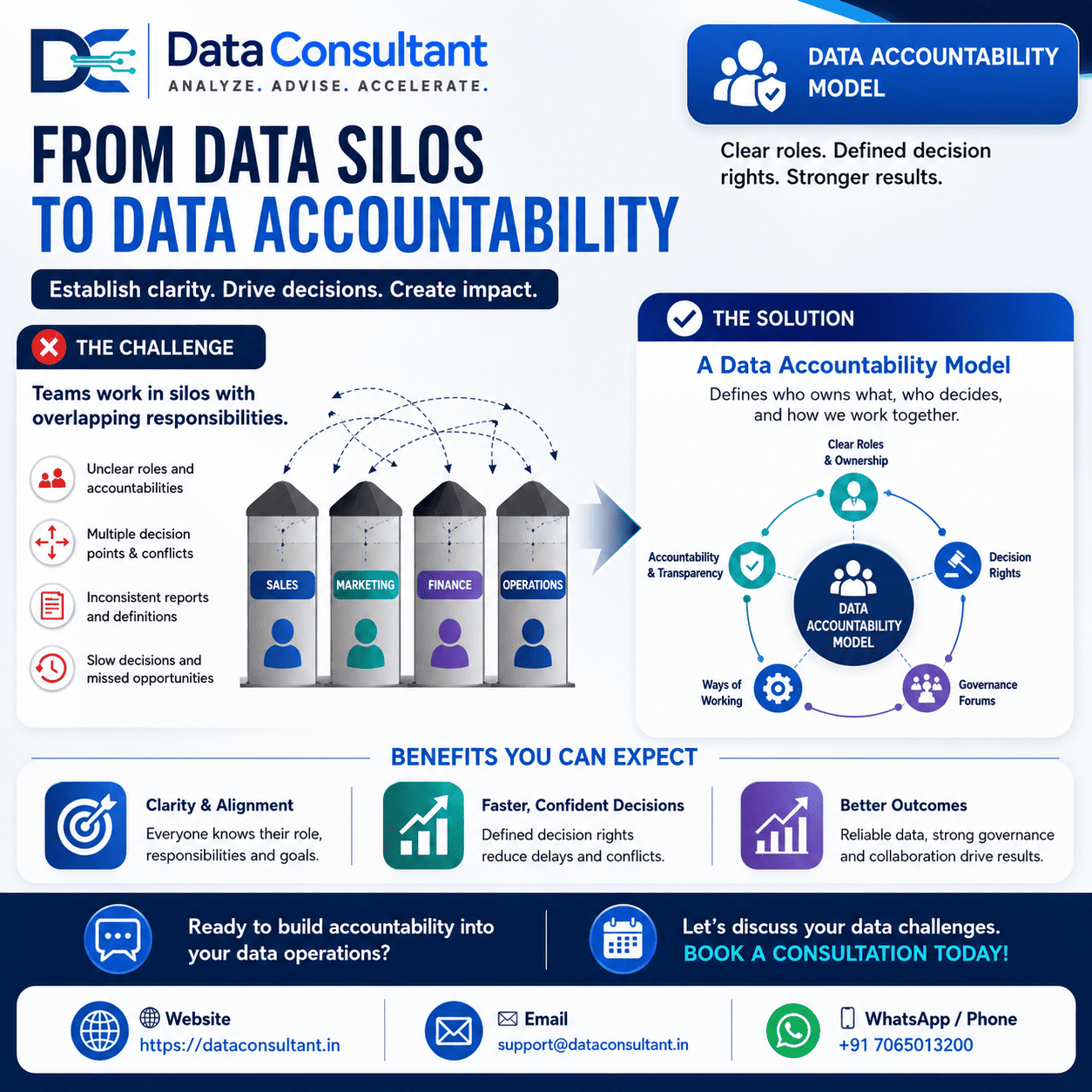
Governance fails when it is treated as a committee that reviews documents rather than a set of decision rights embedded in normal work. A useful operating model answers: who decides, who executes, what evidence is required, when escalation occurs and how outcomes are measured.
Define roles by decision rights
Executive sponsors resolve enterprise priorities and cross-functional conflicts. Data owners make business decisions about important domains. Data stewards maintain definitions, monitor quality and coordinate issues. Custodians and platform teams implement technical controls. Privacy, security, legal and risk teams define specialised requirements. The exact titles matter less than avoiding ambiguous accountability.
Choose domains that match the business
A domain should reflect how accountability is realistically organised. Customer, product, supplier, finance, employee or asset domains are common examples, but forcing a generic domain model onto the organisation can create more ambiguity. Start where business value and ownership are clearest, then extend the pattern.
Useful test: when a critical definition, quality exception or access conflict occurs, can the organisation identify one accountable person and a repeatable path to a decision? If not, the operating model is incomplete.
Connect Quality, Metadata and Access Controls
Data governance should not become an umbrella label for every technical discipline, but it must connect them. Governance decides which controls matter and who is accountable; technology implements and monitors many of those controls.
Data quality
For critical data elements, define dimensions such as completeness, validity, uniqueness, timeliness or consistency only where they support the use case. Agree thresholds, monitoring frequency, owners and escalation. A quality dashboard without an issue-resolution workflow merely makes defects more visible.
Metadata and catalogue
A catalogue can help teams discover definitions, owners, lineage and approved datasets. Start with the metadata that users actually need. Business definition, owner, source, sensitivity, refresh frequency and approved use can create more value than collecting hundreds of technical attributes that nobody maintains.
Access, privacy and security
Governance should define classification, approved use, access-review expectations and exception paths. Security teams remain responsible for technical protection, while privacy and legal teams interpret obligations. A framework such as ISO/IEC 27001 can provide a risk-based reference for information-security management, while internal controls must still be tailored to the organisation.
AI and advanced analytics
For AI readiness, document the provenance, ownership, sensitivity and intended use of source and retrieval data. Establish approval for sensitive fields, retention, training use and downstream sharing. The NIST AI Risk Management Framework can help organisations frame AI governance and risk, but data governance remains responsible for the quality and control context of underlying data.
Compare Governance Implementation Options
The right delivery model depends on clarity, urgency, internal capability and the size of the change. Buying a platform, hiring one specialist and commissioning a multi-disciplinary programme solve different problems.
| Option | Best fit | Expected outputs | Internal requirement | Main limitation |
|---|---|---|---|---|
| Internal working group | Narrow scope, clear owners and capable data team | Definitions, roles, issue process and local standards | Protected stakeholder time and executive support | May stall when cross-functional conflicts appear |
| Governance tool | Operating model is defined and metadata workflow needs scale | Catalogue, lineage, stewardship workflow and monitoring | Product owner, integration support and maintainers | Tool adoption fails if ownership is unresolved |
| Short diagnostic | Unclear maturity, scope or root causes | Findings, priority use cases, target model and roadmap | Evidence access and stakeholder interviews | Recommendations need a funded owner to continue |
| Defined consulting project | Operating model and controls must be designed and implemented | Roles, standards, domain model, workflows, controls and pilot | Business, data, technology, risk and privacy participation | Scope can expand if priorities are not constrained |
| Dedicated specialist | Organisation needs embedded governance capability | Stewardship coordination, standards and implementation support | Clear reporting line and executive backing | One specialist cannot substitute for business ownership |
| Managed governance support | Multiple domains create a continuing operational workload | Cadence, monitoring, issue coordination and continuous improvement | Internal owners retain decisions and accountability | Dependency grows if knowledge transfer is weak |
A common path is diagnostic first, one high-value domain pilot second, and only then broader tooling or managed support if the operating model proves useful.
What a Professional Engagement Should Deliver
Deliverables should be concrete enough for procurement and internal teams to verify completion. Avoid scopes that promise “enterprise governance transformation” without naming domains, decisions, controls or acceptance criteria.
- Current-state maturity and pain-point assessment.
- Prioritised governance use cases and phased roadmap.
- Governance principles and decision-rights model.
- Domain map and accountable owner register.
- Critical data element and KPI definition approach.
- Business glossary, metadata and catalogue requirements.
- Data-quality rules, thresholds, issue workflow and remediation backlog.
- Classification, access, privacy, retention and exception requirements.
- Governance forum cadence and escalation procedures.
- Tooling requirements or configuration plan where technology is justified.
- Measurement framework, implementation backlog and ownership handover.
- Training, playbooks, documentation and knowledge transfer.
Use a pilot to test the model
Choose one domain or use case where the problem is visible and owners are engaged. For example, standardise customer definitions for executive reporting, establish critical product-data quality rules for ecommerce operations, or govern finance master data before a warehouse migration. The pilot should test whether roles are workable, metadata can be maintained, quality issues can be resolved and stakeholders actually use the process.
Estimate Cost, Time and Internal Resources
There is no responsible fixed price for governance without scope. Cost is shaped by the number of domains and systems, stakeholder complexity, current documentation, regulatory requirements, data-quality remediation, tooling, integrations, migration activity and the level of implementation support required.
Typical timeline patterns
A focused diagnostic can often be completed in several weeks if evidence and stakeholders are available. A domain pilot may require additional weeks to define ownership, metadata, quality rules and workflows, configure enabling tools where needed and observe real operating behaviour. Multi-domain implementation may run for several months because governance changes responsibilities and must coordinate with architecture, engineering, security, privacy and change programmes.
Internal resource commitments
Budget for more than consultant time. Business owners must make decisions. Data engineers and architects may provide system evidence and implement controls. BI and analytics teams validate definitions. Security and privacy teams review classifications and access. Procurement and legal teams may review tooling or external data terms. Programme leaders need time to communicate changes and resolve resistance.
Commercial check: a low-cost governance engagement can become expensive if it produces policies that internal teams then have to translate into architecture, workflows, tooling and remediation without support.
Practical Data Governance Decisions
Conflicting revenue definitions
A growing ecommerce business has finance, marketing and sales reporting different revenue values. The immediate request is a new BI dashboard. Discovery shows the real problem is inconsistent recognition rules, returns treatment and channel mappings. A governance-first intervention should name the revenue owner, agree definitions, document source mappings, establish data-quality checks and define an approval path for changes. Dashboard redevelopment comes after the metric is governed.
Customer master data across systems
A professional-services company keeps customer records in CRM, billing and support platforms. Duplicate entities and inconsistent identifiers disrupt reporting and collections. Buying a catalogue alone will not fix the issue. The organisation needs master-data ownership, matching rules, source-of-truth decisions, remediation workflow and engineering changes. A defined project combining governance and master-data management is more appropriate than a policy-only engagement.
AI assistant with uncertain source data
An enterprise wants a retrieval-augmented AI assistant for internal procedures. Teams cannot confirm which documents are authoritative, current or permitted for broad employee access. The first requirement is not prompt engineering. Governance should classify source collections, identify owners, define freshness and retention rules, resolve access restrictions and establish evidence for approved content. AI implementation can then use a governed retrieval set.
Cloud migration exposing weak ownership
A finance and operations transformation is moving data into a cloud lakehouse. Migration teams discover that legacy fields have undocumented meanings and no business owners. Treating this solely as a technical mapping exercise risks carrying ambiguity into the new platform. A governance workstream can prioritise critical elements, assign owners, approve definitions, document lineage and connect unresolved issues to the migration backlog.
Regulated reporting evidence
A regulated organisation repeatedly assembles evidence manually for audit and compliance reporting. The requirement is traceability, accountability and repeatability. Governance may define approved data sources, owners, lineage expectations, validation checks, access controls and evidence retention. The outcome is not “compliance guaranteed”; it is a clearer, auditable operating process that can support the organisation’s obligations.
Measure Outcomes and Plan Ongoing Ownership
Good governance improves the reliability and usability of important data without adding unnecessary bureaucracy. Measurement should therefore focus on whether teams can make decisions and resolve data issues more consistently.
- Percentage of priority domains with accountable owners and active stewards.
- Coverage of approved definitions for critical KPIs and data elements.
- Time taken to resolve material data-quality issues and exceptions.
- Recurrence rate of previously resolved defects.
- Adoption of approved datasets or data products in reporting and analytics.
- Completion and evidence quality of access and retention reviews.
- Coverage of useful lineage for high-risk or high-value data flows.
- Stakeholder ability to find definitions, owners and approved sources without escalation.
- Reduction in duplicated governance work only where evidence supports the attribution.
Plan the maintenance model
Definitions change, systems are replaced, regulations evolve and new products create new data. Decide who maintains metadata, convenes governance forums, monitors critical quality rules, reviews access, trains new owners and updates policies. Ongoing external support may be useful during transition, but long-term accountability for business data should remain inside the organisation.
Where DataConsultant Support Can Fit
External support is most valuable when you need an independent maturity view, a practical governance operating model, a data-quality and metadata plan, help designing a domain pilot, tooling requirements, or implementation support across business and technical teams.
Relevant DataConsultant options include data governance consulting, data quality management, metadata management, data cataloguing and data assessments and audits. The engagement should stay limited to the problem you need to solve rather than expanding into unrelated services.
Summary: Build Governance Around Accountable Use
Data governance data is useful when it helps an organisation know what important data means, who owns it, which source is approved, how quality is controlled, who may use it and what happens when something goes wrong. The strongest programmes start with a visible business problem, not a policy library or platform purchase.
If ownership, definitions and priorities are unclear, begin with a focused diagnostic. If the use case and stakeholders are ready, implement one domain or workflow and test the operating model. Scale only after the organisation can demonstrate that governance decisions are being made, quality issues are being resolved, metadata is maintained and controls support normal work.
Next practical step: choose one business decision that currently depends on disputed, unreliable or poorly controlled data. List the datasets, systems, owners and recurring issues behind it. That evidence is enough to determine whether you need a local fix, a governance diagnostic or a defined implementation project.
Frequently Asked Questions
What does “data governance data” mean in practice?
It means the policies, ownership, metadata, quality rules, access controls and evidence used to govern business data, together with the operational data that shows whether those controls are working. A useful programme links governance rules to named data domains, systems, decisions and accountable owners rather than treating governance as a document-only exercise.
How do we know whether we need data governance consulting?
External support is most useful when ownership is disputed, definitions differ across teams, data quality issues repeatedly disrupt decisions, regulatory obligations are difficult to operationalise, or a transformation programme needs governance built into delivery. If the problem is narrow and ownership is already clear, an internal working group may be sufficient.
Should we buy a data governance tool before defining the operating model?
Usually no. Tools can support cataloguing, lineage, workflows, quality monitoring and access controls, but they do not decide who owns a data domain, which standards matter, or how exceptions are resolved. Define the operating model, priority use cases and minimum controls before committing to a large platform implementation.
What data is needed to start a governance assessment?
Useful inputs include system inventories, priority datasets, KPI definitions, data-quality issues, access roles, privacy and retention policies, incident records, architecture diagrams, reporting dependencies and examples of recurring business disputes. The assessment should use enough evidence to test how governance works in real workflows.
How long does a data governance project take?
A focused diagnostic can often be completed in a few weeks when stakeholders and evidence are available. A defined implementation covering multiple domains, cataloguing, quality controls, workflows and operating-model changes can take several months. Timelines depend mainly on scope, stakeholder availability, data complexity and the number of systems involved.
How much does data governance consulting cost?
Cost depends on the number of domains and systems, maturity, required workshops, policy work, technical configuration, tooling, data-quality remediation, regulatory requirements and implementation support. A useful proposal separates diagnostic, design, implementation and ongoing-support effort instead of presenting one undifferentiated programme fee.
Who should own data governance inside the business?
Executive accountability should sit with leaders who can resolve cross-functional trade-offs, while operational ownership should be distributed to named data owners and stewards close to the business domains. Data, technology, security, privacy and compliance teams enable the model, but governance should not be delegated entirely to IT.
How does data quality fit into data governance data?
Data quality turns governance into measurable operating practice. Critical data elements should have agreed definitions, validation rules, issue thresholds, owners, escalation paths and evidence of remediation. Governance determines which quality problems matter, who must act and how exceptions are managed.
Can data governance support AI readiness?
Yes. AI initiatives depend on reliable source data, lawful access, traceable provenance, documented definitions and accountable use. Governance can establish controls for training and retrieval data, sensitive fields, retention, lineage and approval. It does not guarantee model quality, but it reduces avoidable ambiguity and unmanaged data risk.
What should we expect as deliverables from a governance engagement?
Typical deliverables include a maturity assessment, prioritised use-case roadmap, governance principles, role and decision-rights model, domain map, critical-data inventory, glossary or metadata plan, data-quality controls, access and issue workflows, tooling requirements, implementation backlog, measurement framework, documentation and knowledge transfer.
How should data governance outcomes be measured?
Measure operational outcomes such as ownership coverage, critical-data definitions approved, recurring quality issues resolved, exception-response time, policy adherence, lineage coverage, access-review completion and adoption of governed data products. Avoid claiming success from policy publication or catalogue size alone.
What is the biggest mistake in a data governance programme?
The most common mistake is starting with enterprise-wide policy or tooling before choosing concrete business problems. Governance gains traction when it improves a visible decision or workflow—such as customer reporting, finance reconciliation, regulatory evidence, master-data consistency or AI-data readiness—and then scales from proven patterns.