
Data Governance: A Practical Business Decision Guide
Data governance is the practical system an organisation uses to decide who owns data, how definitions are agreed, how quality and access are controlled, and how data remains trustworthy over time. The central decision is not whether to create more policy or buy a catalogue. It is whether unreliable, poorly owned or inappropriately accessed data is blocking important business decisions—and what is the smallest governance response that can correct that problem.
Start with the business decision or operational risk, not a technology request. A conflicting revenue figure may require agreed metric ownership and source mapping; repeated customer-data errors may require source-process controls; an AI initiative may first require lawful access, documented lineage and quality thresholds. These are governance problems only when accountability, rules and decision rights are missing or ineffective.
A short diagnostic may be enough when teams disagree about the problem. A defined project is appropriate when ownership, policies, quality controls, metadata and workflows can be scoped. Ongoing support is justified when stewardship, access reviews, regulatory change and new data products create a continuing workload. In some cases, existing staff or a targeted tool configuration is sufficient—and the correct decision may be not to launch a formal programme yet.
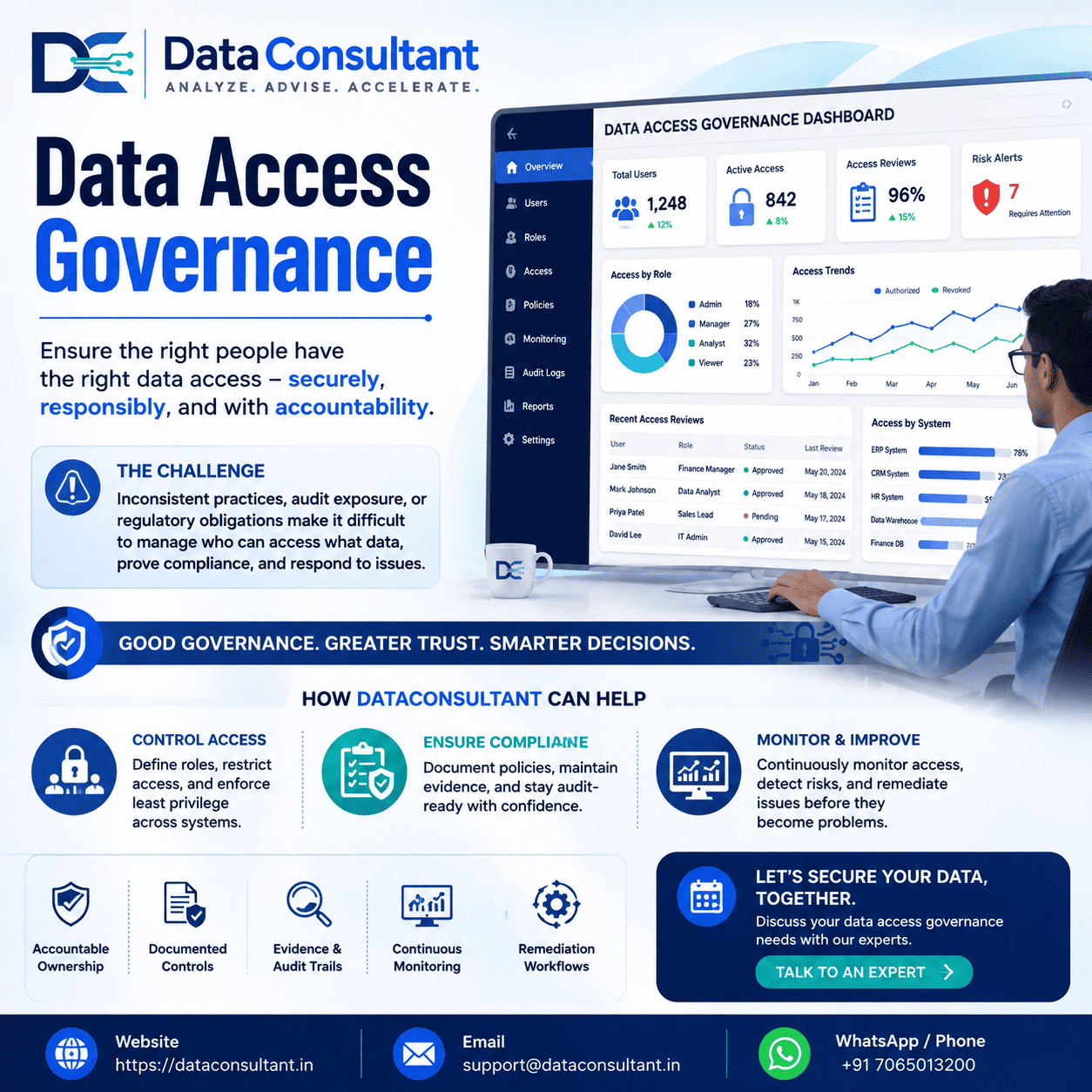
Quick Answer: Govern Decisions, Not Every Data Asset
Begin data governance with the decisions, obligations and data domains that matter most. Name an accountable business owner, agree what “good” data means, identify who may access or change it, and establish a practical route for resolving issues. Governance should reduce ambiguity and risk without making routine work unnecessarily slow.
Use a diagnostic when ownership, quality or priorities are unclear. Use a defined project when a target operating model, policies, stewardship roles, metadata, quality controls and implementation workflows can be specified. Choose ongoing support only when governance activity is genuinely continuous across multiple domains, systems or regulatory obligations.
The main caution is to avoid hiring consultants, forming committees or purchasing governance software before defining the affected business decision. Governance cannot compensate for unclear strategy, weak source-system processes or absent executive ownership.
Key Takeaways
- Start with critical decisions: govern the data that influences material operational, customer, financial, risk or regulatory outcomes.
- Keep business ownership visible: technology teams can implement controls, but business owners remain accountable for meaning and acceptable use.
- Assess data readiness: review definitions, quality, lineage, access, architecture and current issue-management practices before selecting tools.
- Scope deliverables precisely: require an operating model, role definitions, policies, controls, prioritised roadmap, documentation and acceptance criteria.
- Integrate privacy and security: access, classification, retention and permitted use belong inside governance workflows, not in disconnected policies.
- Measure resolved risk and improved trust: meetings, policies and catalogue entries are activity measures, not final outcomes.
- Plan knowledge transfer: internal owners and stewards must be able to operate the model after external specialists leave.
Table of Contents
- Identify the governance decision
- Assess data governance readiness
- Compare governance response options
- Define ownership, access and controls
- Implement governance in phases
- Estimate cost and internal effort
- Measure governance outcomes
- Apply governance to real situations
- Decide where specialist support fits
- Summary
Start Data Governance with a Blocked Decision
Data governance is justified when a material decision, obligation or process cannot be managed confidently because data meaning, ownership, quality, access or lineage is unclear. The first task is to state the affected decision in business language.
Separate governance gaps from technical faults
A broken pipeline is primarily an engineering issue. A duplicated customer record may be a source-process or master-data issue. It becomes a governance issue when nobody has authority to define the trusted record, approve matching rules or resolve cross-departmental disputes. Similarly, a dashboard discrepancy is not solved by a governance council unless owners can agree definitions and enforce them in systems and reporting logic.
Choose a narrow initial domain
Prioritise one or two domains—such as customer, product, supplier, employee or finance data—where ambiguity has visible consequences. Document the decisions that depend on the domain, the systems involved, known defects, applicable obligations and accountable leaders. This creates a boundary that can be assessed and implemented.
Decision rule: do not launch enterprise-wide governance because “data is messy”. Start where unclear accountability or controls are causing a specific decision, service, compliance or operational problem.
Assess Data Governance Readiness Before Tool Selection
An organisation is ready to implement governance when it can allocate accountable owners, provide evidence about current data flows and commit technical and operational time to change controls. Perfect data is not required, but the programme needs enough visibility to distinguish symptoms from causes.
- Business clarity: named decisions, risks, outcomes and priority data domains.
- Ownership: executives willing to sponsor and business leaders able to accept accountability.
- Evidence access: policies, data models, reports, lineage, incident records, access lists and representative samples.
- Technical cooperation: architecture, engineering, analytics and application teams available to validate and implement controls.
- Control participation: privacy, security, risk, legal and compliance stakeholders engaged where relevant.
- Change capacity: time for definitions, stewardship, training, issue resolution and adoption.
The DAMA Data Management Body of Knowledge provides a broad reference for governance and related data-management disciplines. The ISO/IEC 38505-1 governance-of-data standard frames data governance within organisational and IT governance. These references can inform a model, but neither replaces decisions about your organisation’s actual accountabilities and risks.
Compare the Smallest Effective Governance Response
The right response depends on problem clarity, internal capability, scale, urgency and continuity. A governance tool is useful when the operating model is sufficiently defined; it is not a substitute for ownership or agreed decisions.
| Option | Best fit | Expected outputs | Internal requirement | Main risk |
|---|---|---|---|---|
| Internal team | Clear problem, limited domain and experienced owners | Definitions, roles, controls and issue workflow | Available governance and technical capacity | Competing priorities weaken follow-through |
| Software tool | Operating model is clear; metadata or workflow capability is missing | Catalogue, lineage, access workflow or quality monitoring | Owners, integration skills and maintenance process | Tool adoption without accountable ownership |
| Short diagnostic | Conflicting definitions, unclear maturity or disputed priorities | Evidence-based findings, risk priorities and roadmap | Stakeholder interviews and system evidence | Recommendations stall without a sponsor |
| Defined consulting project | Target model and priority domains can be scoped | Operating model, policies, controls, pilot and handover | Cross-functional participation and acceptance decisions | Scope expands into every data problem |
| Ongoing consultant support | Stewardship and governance change continuously | Forums, quality oversight, policy updates and coaching | Regular prioritisation and internal owners | Dependency if knowledge transfer is weak |
| Dedicated specialist or managed team | Multiple domains and disciplines require sustained capacity | Coordinated governance operations and implementation support | Executive sponsor and stable operating cadence | High capacity is wasted without adoption |
A hybrid model is often appropriate: external specialists structure the diagnostic and implementation, while internal owners approve definitions, policies, controls and long-term operating responsibilities.
Define Data Ownership, Access and Quality Controls
A workable governance model translates principles into named decisions and repeatable workflows. Each priority domain should have an accountable owner, operational stewards, technical custodians and escalation routes. Responsibilities must be specific enough to answer who approves definitions, who accepts quality thresholds and who authorises access.
Specify the minimum governance artefacts
- Priority data-domain register and accountable owners.
- Business glossary and KPI definitions with approval status.
- Data classification and permitted-use rules.
- Access-request, review and revocation workflow.
- Data-quality rules, thresholds, monitoring and issue escalation.
- Lineage and metadata requirements for critical reports and data products.
- Retention, deletion and legal-hold coordination where applicable.
- Decision log, policy exception process and governance forum terms.
Connect privacy and security to daily decisions
Privacy and security controls should appear in access, sharing, retention and product-approval workflows. The NIST Privacy Framework offers a risk-based structure for managing privacy risk, while the ISO guidance on data classification can inform classification decisions. Apply relevant laws, contracts and internal policies for each jurisdiction; general frameworks are not legal advice.
The OECD data governance resources also illustrate how governance connects access, sharing, trust and policy choices. For an organisation, the practical requirement is to convert these principles into controls that people can follow and systems can enforce.
Implement Data Governance Through a Controlled Pilot
A pilot should prove that the governance model can resolve real issues without creating disproportionate bureaucracy. Select a priority domain, a small number of critical definitions or data products, accountable participants and measurable acceptance criteria.
Use a phased implementation path
- Diagnose: confirm affected decisions, owners, systems, data flows, risks and current controls.
- Design: define decision rights, roles, policies, quality thresholds, metadata and escalation routes.
- Pilot: apply the model to a limited domain, report, process or data product.
- Validate: test whether definitions are adopted, issues are resolved and controls work in operating systems.
- Scale: expand only after ownership, capacity, documentation and tool requirements are proven.
- Transfer: train owners and stewards, hand over artefacts and establish ongoing review.
Expected project deliverables may include a maturity assessment, prioritised roadmap, target operating model, role matrix, domain register, policy set, glossary, quality framework, metadata requirements, access-control workflow, pilot report, implementation backlog, training materials and handover pack. Acceptance criteria should be agreed before work begins.
Data Quality and Scope Drive Governance Cost
Data governance cost is shaped by scope and complexity rather than a standard licence or day rate. The largest drivers are the number of domains and systems, disputed definitions, undocumented lineage, poor source quality, regulatory obligations, integration effort, organisational change and the availability of internal owners.
A focused diagnostic may involve interviews, document review, system evidence and a small number of data samples. A defined pilot may take several weeks when stakeholders and access are ready. Multi-domain implementation can take months because policies, architecture, technical controls, training and adoption must be coordinated.
Budget for internal participation
Business owners must make decisions about meaning and acceptable quality. Stewards need time to document and resolve issues. Engineering and platform teams implement lineage, access, validation and workflow changes. Privacy, security, legal and risk teams review controls. Procurement and programme teams may manage contracts, milestones and acceptance. A proposal that excludes this internal effort is incomplete.
Measure Trusted Data and Faster Issue Resolution
Governance should be measured through evidence that important data is better owned, understood, controlled and corrected. Select indicators that connect to the initial business decision rather than creating a generic governance scorecard.
- Percentage of critical data elements with accountable owners and approved definitions.
- Adoption of agreed KPIs across priority reports and teams.
- Time to identify, assign and resolve critical data-quality issues.
- Coverage and review of access rights for sensitive domains.
- Availability of lineage for material reports, models and data products.
- Number and age of unresolved policy exceptions.
- Recurrence rate of known data incidents after corrective action.
- Internal owner and steward readiness to operate the model independently.
Policies published, meetings held and metadata records created are useful activity indicators, but they do not demonstrate that decisions are better supported. Review outcomes with the business owners who experience the original problem.
Practical Data Governance Decisions
Conflicting ecommerce revenue reports
An ecommerce company sees different revenue and customer figures in finance, marketing and operations. The mistaken assumption is that a new dashboard will create one answer. The actual problem is inconsistent definitions, source mappings and approval rights. A short diagnostic should identify authoritative sources, owners and reconciliation rules. Likely deliverables include a KPI dictionary, lineage map, issue backlog and prioritised control roadmap. Finance, marketing, product and data engineering must participate.
Customer access after rapid growth
A growing services business has accumulated CRM exports, shared spreadsheets and broad application access. Management initially considers buying a catalogue. The immediate problem is uncontrolled access and unclear retention, not discovery. A defined governance project should classify customer data, assign owners, review permissions and establish access and deletion workflows. Privacy, security, sales operations and system administrators must make and implement the decisions.
Multi-location KPI inconsistency
A multi-location operator cannot compare performance because sites interpret service, utilisation and margin measures differently. Training alone will not solve the dispute. The better engagement is a focused governance pilot covering metric ownership, calculation rules, source fields, approval and change control. Deliverables should include a glossary, decision log, report changes and steward procedures. Regional leaders must accept common definitions or document justified exceptions.
AI initiative before governed data
A startup plans predictive customer analytics but consent records, event definitions and data lineage are incomplete. The mistaken assumption is that model development can begin while governance is added later. A readiness diagnostic should clarify permitted use, data quality, representativeness and ownership before advanced modelling. The likely output is a phased roadmap that may prioritise collection and control improvements rather than immediate AI implementation.
Use Specialist Governance Support Where It Adds Value
External support is most useful when the organisation needs an independent data assessment or audit, help defining a target operating model, cross-functional facilitation, policy and control design, or a structured implementation roadmap. It can also help when governance must be coordinated with data architecture, quality, metadata, integration or AI readiness.
DataConsultant data governance support can be structured as a short diagnostic, a defined governance project or ongoing specialist support. Where substantial continuous capacity is required, a managed data and AI team may be considered. The engagement should remain limited to the priority governance problem and should leave accountable ownership inside the organisation.
Summary: Choose Governance Proportionate to the Risk
Data governance is useful when important decisions are blocked by unclear ownership, inconsistent definitions, unreliable quality, poor lineage or uncontrolled access. Internal staff may be sufficient when the scope is narrow and experienced owners have time to act. A software tool may be sufficient when the operating model is already defined and the main gap is metadata, monitoring or workflow functionality.
Use a short diagnostic when the problem, maturity or priorities are disputed. Use a defined project when ownership, policies, controls, pilot outcomes, documentation and handover can be scoped. Choose ongoing support or a managed team only when stewardship, quality, access and governance change create a sustained workload.
Before committing, validate business goals, data quality, evidence access, governance ownership, scope, budget, timeline, security, documentation, quality assurance, knowledge transfer and handover. The right model should make governance operable by internal teams rather than create permanent dependence.
FAQs on Data Governance Decisions
What is data governance in practical business terms?
Data governance is the system of decision rights, responsibilities, policies and controls used to make data reliable, appropriately accessible, secure and usable. In practice, it identifies who owns important data, who may change definitions, how quality issues are resolved, how sensitive information is handled and how evidence is maintained. Start with a small set of critical data domains rather than attempting to govern everything at once.
How do we know whether our organisation needs data governance now?
Data governance is usually needed when reports conflict, teams use different KPI definitions, ownership is unclear, access is inconsistent, data-quality issues recur or privacy and security decisions are handled informally. A formal programme may not yet be necessary when the scope is small and accountable owners already resolve issues effectively. Confirm the business decisions being affected before selecting tools or creating committees.
Should data governance be handled internally or by a consultant?
Use internal staff when ownership is clear, the organisation has governance experience and the work is limited. A consultant is useful when departments disagree, maturity is uncertain, a neutral diagnostic is needed or specialist policy, architecture and operating-model skills are temporarily required. External support should strengthen internal ownership, not replace it.
Can a data catalogue solve data governance problems?
A data catalogue can improve discovery, metadata, lineage and shared understanding, but it cannot create accountability by itself. It works best after ownership, definitions, access rules and stewardship processes are sufficiently clear. Buying a catalogue before agreeing the operating model may produce an expensive inventory that teams do not maintain or trust.
What should a data governance diagnostic include?
A useful diagnostic should review business priorities, critical data domains, decision rights, ownership, stewardship, data quality, metadata, access, privacy, security, architecture, issue management and current controls. It should produce evidence-based findings, prioritised risks, a target operating model and a phased roadmap. Stakeholder interviews should be supported by documents, system evidence and representative data samples.
How much does a data governance programme cost?
Cost depends on the number of data domains, systems, jurisdictions, stakeholders, controls, integrations and tools involved. A focused diagnostic is less resource-intensive than an enterprise operating-model implementation. Budget for internal subject-matter experts, data owners, technology teams, privacy and security review, change management, documentation and ongoing stewardship—not only external fees or software licences.
How long does data governance implementation take?
A focused assessment and roadmap may take several weeks when evidence and stakeholders are available. Implementing ownership, policies, metadata, quality controls and workflows across several domains commonly requires a phased programme over months. Timelines increase when definitions are disputed, systems are fragmented, access is difficult or approvals span multiple business units and jurisdictions.
Who should own data governance?
Executive leadership should sponsor the outcomes, while named business data owners remain accountable for important domains and decisions. Data stewards coordinate definitions and issue resolution; technology teams implement controls; privacy, security, risk and legal teams advise on obligations. A central governance function may coordinate the model, but ownership should not be transferred entirely away from the business.
How should data governance outcomes be measured?
Measure whether critical data has accountable owners, agreed definitions, controlled access, visible lineage, monitored quality and effective issue-resolution paths. Useful indicators include unresolved critical issues, definition adoption, access-review completion, policy exceptions, metadata coverage and time to resolve quality incidents. Avoid treating the number of policies, meetings or catalogue entries as proof of business value.
When is ongoing data governance support appropriate?
Ongoing support is appropriate when new systems, data products, regulations, acquisitions or analytics use cases continually change governance requirements. It may include stewardship coordination, quality monitoring, metadata maintenance, policy updates, access reviews and governance forums. A defined project may be enough when the organisation can absorb these responsibilities after implementation and knowledge transfer.
Need a Focused Data Governance Diagnostic?
Share the decisions being affected, priority data domains, current ownership, systems, quality concerns, access constraints and regulatory requirements. DataConsultant can help determine whether internal action, a tool configuration, a short diagnostic, a defined governance project or ongoing support is appropriate.
Discuss your requirementAt DataConsultant.in, we help organisations turn data and AI priorities into governed, reliable, and practical business capability.