
Data and Governance: What Your Business Needs
Data and governance should help a business make trusted decisions, control risk and assign clear responsibility for important information. The central decision is not whether to create more policies or buy a catalogue. It is whether inconsistent definitions, weak ownership, poor data quality, uncontrolled access or fragmented delivery are preventing the organisation from using data safely and effectively. Start with the business decisions and operational risks that matter, then identify the data, people and controls needed to support them.
Do not launch a governance programme before defining the business problem. A request for “better governance” may actually be a reporting dispute, a source-system weakness, an access bottleneck, an unclear KPI, a privacy concern or a data-platform design issue. A short diagnostic may be enough when the cause is uncertain. A defined project is appropriate when outputs can be scoped. Ongoing support is justified only when stewardship, quality, access and policy work will continue.
This guide helps business owners, data and technology leaders, finance, marketing, operations, risk, privacy, security and procurement teams decide what type of support is appropriate, what internal readiness is required and what practical outcomes a data governance engagement should produce.
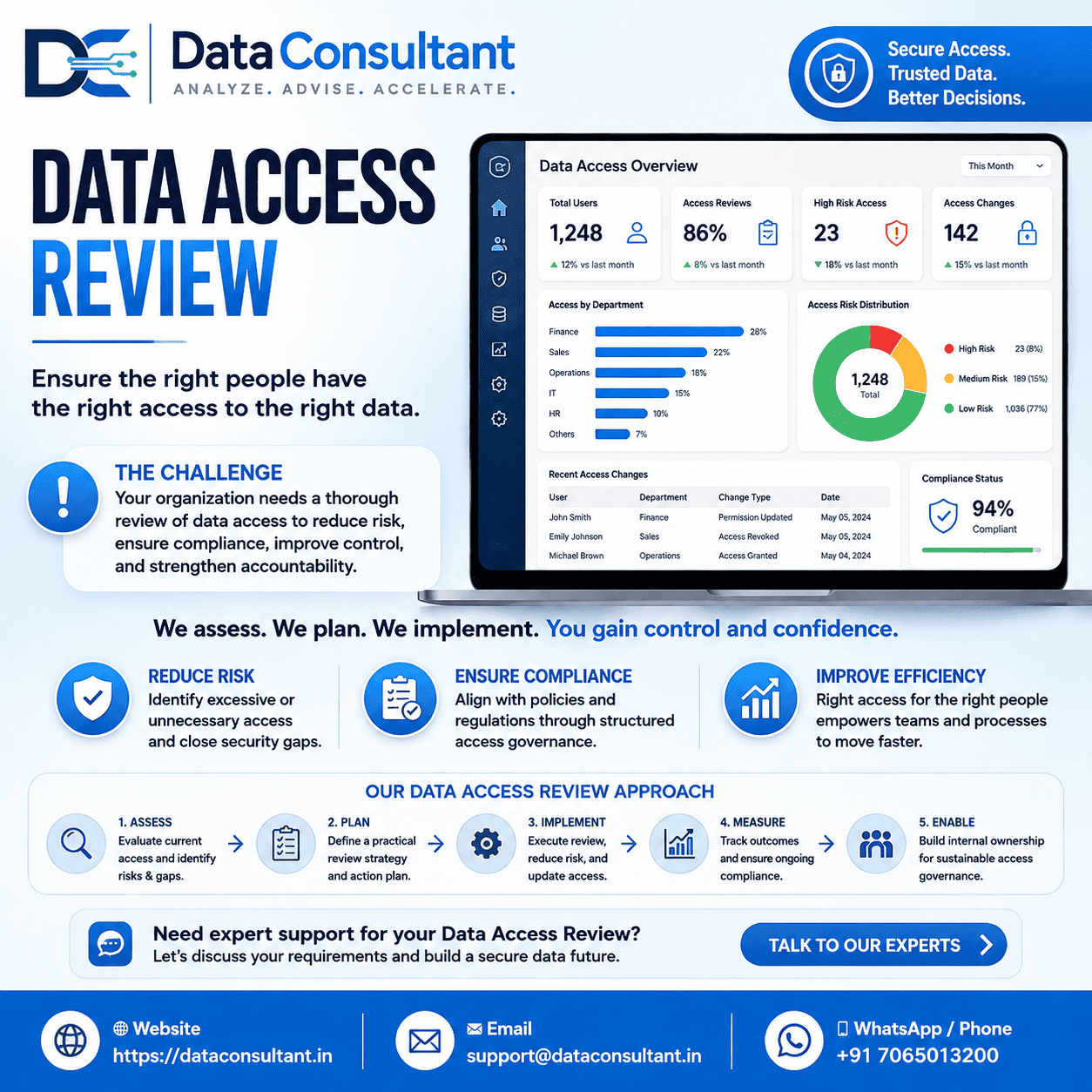
Quick Answer: Govern the Data That Drives Decisions
Data governance is useful when the organisation needs consistent definitions, accountable owners, reliable quality, controlled access and traceable decisions across important data. Begin with a small number of critical business outcomes or risks rather than trying to govern every dataset at once.
Use a short diagnostic when teams disagree about the problem, reports conflict or governance maturity is unknown. Use a defined project when you can scope deliverables such as ownership, policies, a critical-data inventory, quality controls, access workflows and a roadmap. Choose ongoing support when stewardship, monitoring, issue resolution and change are genuinely continuous.
The main caution is practical: governance cannot compensate for unclear strategy, neglected source-system processes or absent internal ownership. External advisers can facilitate decisions and provide specialist delivery, but accountable business and technology leaders must retain authority.
Key Takeaways
- Start with decisions and risks: govern the data that materially affects customers, operations, finance, compliance or strategy.
- Assess readiness honestly: unclear ownership, inaccessible evidence and weak sponsorship should be addressed before broad implementation.
- Keep accountability internal: consultants can design and support governance, but the organisation must own decisions and priorities.
- Scope concrete deliverables: require roles, decision rights, definitions, controls, workflows, measures, documentation and handover.
- Coordinate governance and architecture: policies must connect to systems, metadata, integrations, identity and access management.
- Measure operational use: count resolved issues, adopted definitions and effective controls rather than policy documents alone.
- Plan knowledge transfer: stewards, owners and technical teams need the capability to operate the model after external support ends.
Table of Contents
- Define the governance decision
- Check data governance readiness
- Compare internal, tool and consulting options
- Set ownership, quality and control requirements
- Implement governance through a focused pilot
- Estimate cost, time and resources
- Measure whether governance is working
- Apply the decision to real situations
- Decide where specialist support fits
- Summary
Start with the Data Decision, Not the Policy
The right governance scope begins with a decision, obligation or operational dependency. Ask which data must be trusted, who relies on it, what can go wrong and who has authority to resolve disagreement. This prevents governance from becoming a generic documentation exercise.
Separate governance symptoms from root causes
Conflicting dashboards may result from inconsistent definitions, duplicated pipelines or different timing rules. Slow access may reflect unclear approval authority rather than inadequate technology. Poor data quality may originate in sales, service or finance processes that fail to capture required fields. Governance should identify and assign the underlying decision, not merely record the symptom.
Choose critical data domains first
Most organisations should begin with a limited set of data domains linked to important outcomes: customer, product, supplier, employee, financial, operational or regulatory data. Prioritise where errors, delay or misuse have meaningful consequences. For each domain, identify an accountable owner, operational stewards, technical custodians, consumers and escalation routes.
Decision rule: if the organisation cannot name the business decision, accountable owner and consequence of poor data, the governance scope is not ready.
Check Whether Data Governance Is Ready to Start
Governance can begin in an imperfect environment, but it requires enough sponsorship, access and participation to make decisions. Assess readiness across five dimensions: business clarity, ownership, evidence, technical cooperation and change capacity.
| Dimension | Ready to proceed | Diagnostic needed first |
|---|---|---|
| Business clarity | Priority decisions, risks and data domains are named | Governance is requested without a defined problem |
| Ownership | Executives will assign decision rights and resolve conflict | No leader will accept accountability for data outcomes |
| Evidence | Reports, incidents, policies and data issues can be reviewed | Problems are anecdotal and source access is restricted |
| Technical cooperation | Architecture, engineering, security and platform teams can participate | Governance is treated as separate from systems and delivery |
| Change capacity | Teams can adopt new roles, workflows and controls | There is no time, communication plan or operational owner |
A low score does not mean governance should be postponed indefinitely. It means the first engagement should focus on discovery, sponsorship, evidence and prioritisation rather than promising enterprise implementation.
Compare Internal, Tool and Consulting Options
The correct approach depends on problem clarity, internal capability, urgency and continuity. Governance software can enable workflows and metadata, but it does not replace decisions. Consultants can accelerate design and remediation, but they should not become the permanent owner of business accountability.
| Option | Best fit | Expected outputs | Internal requirement | Main risk |
|---|---|---|---|---|
| Internal team | Clear problem, capable owners and limited scope | Policies, definitions, controls and issue resolution | Time, authority and cross-functional cooperation | Competing priorities stall decisions |
| Software tool | Operating model and workflows are already defined | Catalogue, lineage, quality monitoring or access workflow | Configuration, adoption and technical integration | Technology is deployed without ownership |
| Short diagnostic | Conflicting reports, unclear maturity or uncertain scope | Findings, priorities, risk register and roadmap | Evidence access and stakeholder interviews | Recommendations lack an implementation owner |
| Defined consulting project | Specific governance capabilities must be designed or implemented | Roles, policies, glossary, controls, pilot and handover | Sponsor decisions and operational participation | Scope expands without acceptance criteria |
| Ongoing consultant support | Recurring stewardship, quality or policy needs exceed current capacity | Governance operations, monitoring, coaching and updates | Regular prioritisation and retained accountability | Dependency grows without capability transfer |
| Dedicated specialist or managed team | Substantial, multi-domain and continuous workload | Predictable capacity across governance, quality and metadata | Executive sponsor and integrated operating cadence | Activity increases without measurable outcomes |
A hybrid is often appropriate: an internal governance lead owns decisions while external specialists support assessment, design, implementation and knowledge transfer.
Define Ownership, Quality and Control Requirements
A practical governance model connects business accountability to technical implementation. It should state who decides, who performs work, how evidence is recorded and how exceptions are handled.
Establish decision rights and stewardship
- Name accountable data owners for priority domains and decisions.
- Define steward responsibilities for definitions, quality, metadata and issue coordination.
- Separate business ownership from technical custody without creating gaps between them.
- Create escalation routes for unresolved definitions, access decisions and quality failures.
- Set realistic governance forums with clear agendas, evidence and decision logs.
Connect policy to systems and data flows
Policies should map to identity and access management, source systems, integration pipelines, data warehouses or lakehouses, analytics platforms, retention processes and monitoring. The NIST Privacy Framework provides a risk-based structure for managing privacy, while the ISO/IEC 27001 overview explains information-security management principles. Apply relevant laws and internal legal advice for each jurisdiction.
Define quality in business terms
Data quality rules should be linked to use. Completeness, validity, timeliness, uniqueness, consistency and accuracy matter differently for a payment, customer campaign, operational alert or board report. Define thresholds, owners, monitoring frequency, exception handling and remediation responsibility. A quality dashboard without a response process is only an observation tool.
Pilot Data Governance Before Enterprise Scale
A focused pilot should prove that governance decisions can be made and operated. Select one domain, one or two important use cases and a manageable set of systems. Test ownership, definitions, quality controls, access decisions, issue escalation and reporting before scaling.
Require implementation-ready deliverables
- Current-state assessment and prioritised risk register.
- Governance principles and decision-rights model.
- Domain, owner, steward and custodian definitions.
- Critical-data inventory and glossary approach.
- Quality-rule catalogue with thresholds and response ownership.
- Access, retention, issue and exception workflows.
- Pilot backlog, milestones, acceptance criteria and measures.
- Operating documentation, training and knowledge-transfer sessions.
Implementation should integrate with existing delivery and risk processes. The OECD overview of data governance highlights the broad policy, access and stewardship context across the data lifecycle. For data management terminology and professional practice, DAMA International’s body of knowledge is a useful reference, but frameworks should be adapted to the organisation rather than copied without prioritisation.
Estimate Governance Cost, Time and Resources
Cost is driven by scope and complexity: number of domains, systems, jurisdictions, stakeholders, quality issues, access models, integrations, control requirements and change effort. A short assessment is materially different from designing and implementing an enterprise operating model.
A focused diagnostic may take several weeks when stakeholders and evidence are available. A defined pilot may take several months where roles, policies, metadata, quality controls and technical workflows must be agreed. Enterprise scale usually requires phases because governance decisions interact with platform roadmaps, regulatory work, operating processes and organisational change.
Budget for internal participation
Executive sponsors must resolve priorities and ownership. Domain experts validate definitions and controls. Data engineering and architecture teams explain flows and implement changes. Security, privacy, legal, risk and compliance teams review requirements. Product, finance, marketing and operations leaders adopt new workflows. A proposal that excludes these commitments understates the real cost.
Decision rule: compare the total operating commitment, not only consulting fees or software licences. Governance succeeds through sustained decisions and behaviour, not purchased artefacts.
Measure Whether Governance Improves Data Use
Measure whether governance improves decisions, reliability and control. Avoid treating the number of policies, committee meetings or catalogue entries as evidence of value.
- Time required to resolve definition, ownership and access decisions.
- Adoption of approved KPI definitions and critical-data standards.
- Quality issues detected, assigned, remediated and prevented from recurring.
- Coverage of priority data with named owners, stewards and documented controls.
- Use of metadata, lineage and business glossaries in delivery and analysis.
- Reduction in duplicated or conflicting reports where evidence supports attribution.
- Control exceptions, access breaches or retention issues identified and addressed.
- Internal ability to operate governance without excessive external dependence.
Agree baseline evidence and measures before implementation. Where performance improves, test governance’s contribution alongside system upgrades, process redesign, staffing changes and management action.
Practical Data and Governance Decisions
Conflicting ecommerce revenue reports
An ecommerce business asks for a new executive dashboard because finance, marketing and operations report different revenue. The mistaken assumption is that visualisation will create a single truth. The actual problem is inconsistent order status, refund timing, channel attribution and ownership. A short diagnostic should map definitions, sources and decision rights. Likely deliverables include a KPI dictionary, lineage review, issue backlog and an agreed reporting control. Finance, commerce, marketing and data engineering must participate.
Manual spreadsheets in professional services
A professional-service company wants a governance tool because project, utilisation and margin reports rely on linked spreadsheets. The root issue is inconsistent source capture, undocumented transformations and unclear approval. A defined project can establish critical fields, owners, controlled templates, quality checks and a phased reporting roadmap. Tool selection should follow the operating design, not precede it.
Customer data access across regions
A multi-location business experiences long delays approving customer-data access. Teams believe security is blocking analytics, but approval authority, purpose definitions, retention rules and regional obligations are unclear. A governance pilot should define access roles, evidence, escalation, logging and review. Privacy, security, legal, customer operations and platform teams must share the decision.
AI plans before reliable data foundations
A startup wants predictive analytics and AI agents but lacks stable event definitions, consent records and model-input ownership. The better decision is to delay advanced use cases, improve data collection and run a limited readiness assessment. Deliverables may include a critical-data inventory, quality baseline, governance responsibilities and a phased implementation roadmap. Specialist support can clarify priorities without promising AI performance.
Use Specialist Governance Support Where It Adds Value
External specialists add value when the organisation needs an independent maturity assessment, rapid clarification of ownership and requirements, technical review, a governance operating model, quality-control design, a pilot or implementation roadmap. Support may also be appropriate where privacy, security, architecture, analytics and AI readiness must be coordinated.
DataConsultant.in can support a focused diagnostic, a defined data governance engagement, a data assessment or audit, or ongoing specialist capacity. The engagement should remain limited to the real business decision, data risk and operating requirement.
Summary: Choose Governance That Can Be Operated
Data governance is appropriate when important decisions are being blocked or exposed by inconsistent definitions, poor quality, unclear ownership, uncontrolled access or weak lifecycle controls. Internal staff may be sufficient when the problem is clear, capability exists and leaders can allocate authority and time. A software tool may be sufficient when workflows and ownership are already defined.
Use a short diagnostic when the real problem, maturity or priority is uncertain. Use a defined project when roles, policies, controls, metadata, quality and pilot outputs can be scoped. Choose ongoing support or a managed team only when the workload is substantial and continuous. Validate business goals, data quality, access, governance, internal ownership, scope, budget, timeline, security, documentation, quality assurance, knowledge transfer and handover before committing.
Next step: discuss a limited assessment or project only after identifying the decision, data domains, stakeholders and expected outputs. Discuss your data governance requirement
At DataConsultant.in, we help organisations turn data and AI priorities into governed, reliable, and practical business capability.
Frequently Asked Questions
What does data and governance mean in practical business terms?
Data and governance describes how an organisation creates, defines, accesses, protects, uses and accounts for data. In practice, it combines decision rights, ownership, quality rules, metadata, access controls, lifecycle policies and operational routines. The aim is not paperwork for its own sake; it is to make important data reliable, understandable and appropriately controlled.
How do I know whether my business needs external data governance support?
External support is useful when teams cannot agree on definitions or ownership, reports conflict, access decisions are slow, regulatory or security expectations are unclear, or a data platform programme lacks operating rules. Start with a short diagnostic when the problem is uncertain. Do not appoint a large programme before confirming the decisions, risks and data domains that matter.
Should we hire a data consultant or a full-time data governance lead?
Hire internally when the need is continuous, the mandate is clear and the organisation can support a permanent owner. Use a consultant for an independent assessment, time-bound design, specialist remediation or rapid mobilisation. A hybrid model often works well: an internal accountable lead retains authority while external specialists provide methods, capacity and knowledge transfer.
Can a software tool solve data governance problems?
A catalogue, quality platform or access-governance tool can support established processes, but it cannot decide who owns a customer definition, resolve conflicting incentives or create executive accountability. Buy or configure a tool when roles, policies, workflows and adoption responsibilities are already clear. Otherwise, clarify the operating model first and select technology against verified requirements.
What information should we prepare for a data and governance assessment?
Prepare business priorities, critical reports, major data sources, architecture diagrams, existing policies, data dictionaries, known quality issues, access workflows, incident history and relevant audit findings. Identify executive sponsors, data owners, technical custodians, security, privacy and operational stakeholders. Gaps are acceptable, but hiding them prevents an accurate scope and roadmap.
How much does a data governance consulting engagement cost?
Cost depends on the number of data domains, systems, jurisdictions, stakeholders, controls and deliverables. A focused diagnostic costs less than enterprise operating-model design or implementation support. Compare proposals by scope, assumptions, workshop effort, technical analysis, documentation, change support and handover—not by day rate alone. A credible provider should state exclusions and dependencies.
How long does a data and governance project take?
A narrow diagnostic may take several weeks when evidence and stakeholders are available. A defined project covering ownership, policies, glossary, quality controls and pilot workflows may take several months. Enterprise implementation is usually phased because approvals, system changes and behaviour change take time. Timelines should include internal review, security input, testing, training and acceptance.
What deliverables should a data governance consultant provide?
Expected deliverables may include a current-state assessment, prioritised risk and issue register, governance principles, decision-rights model, role definitions, domain map, critical-data inventory, glossary approach, quality-control design, access workflow, implementation roadmap, measures, documentation and knowledge-transfer materials. Deliverables should be usable by named internal owners after the engagement ends.
Who owns the policies, models, catalogues and documentation after the project?
Ownership should be stated in the contract and operating model. Your organisation should retain access to agreed policies, definitions, data models, control designs, configuration documentation, decision logs, training materials and implementation artefacts. Third-party software and proprietary methods may remain separately licensed. Confirm reuse rights, repositories, handover and exit support before work begins.
When is ongoing data governance support appropriate?
Ongoing support is appropriate when data domains, regulations, systems, access patterns and analytics needs change continuously, or when internal capability is still developing. It may include governance forums, issue triage, metadata and quality stewardship, policy updates, control monitoring and coaching. Avoid indefinite dependency by defining internal ownership, service measures and a capability-transfer plan.