
How to Choose AI Tools for Your Business
Which AI tools should your business use? Choose only the tools that support a clearly defined decision, workflow or customer outcome, and involve a data consultant when the real difficulty is not software selection but unclear requirements, poor data quality, fragmented systems, weak governance or limited internal capability. The practical starting point is to name the business problem, identify the data needed to solve it and decide how success will be measured before comparing vendors or launching an AI pilot.
Many organisations begin with a technology request—an AI assistant, forecasting tool, customer-service copilot or automated reporting platform—when the underlying problem is inconsistent processes, inaccessible data or disputed metrics. A tool can add functionality, but it cannot create reliable source data, settle ownership or define acceptable risk on its own.
This decision guide helps founders, business leaders, data teams, procurement functions and regulated organisations decide whether internal staff, a software tool, a short diagnostic, a defined consulting project, ongoing specialist support or a managed data and AI team is the most suitable next step.
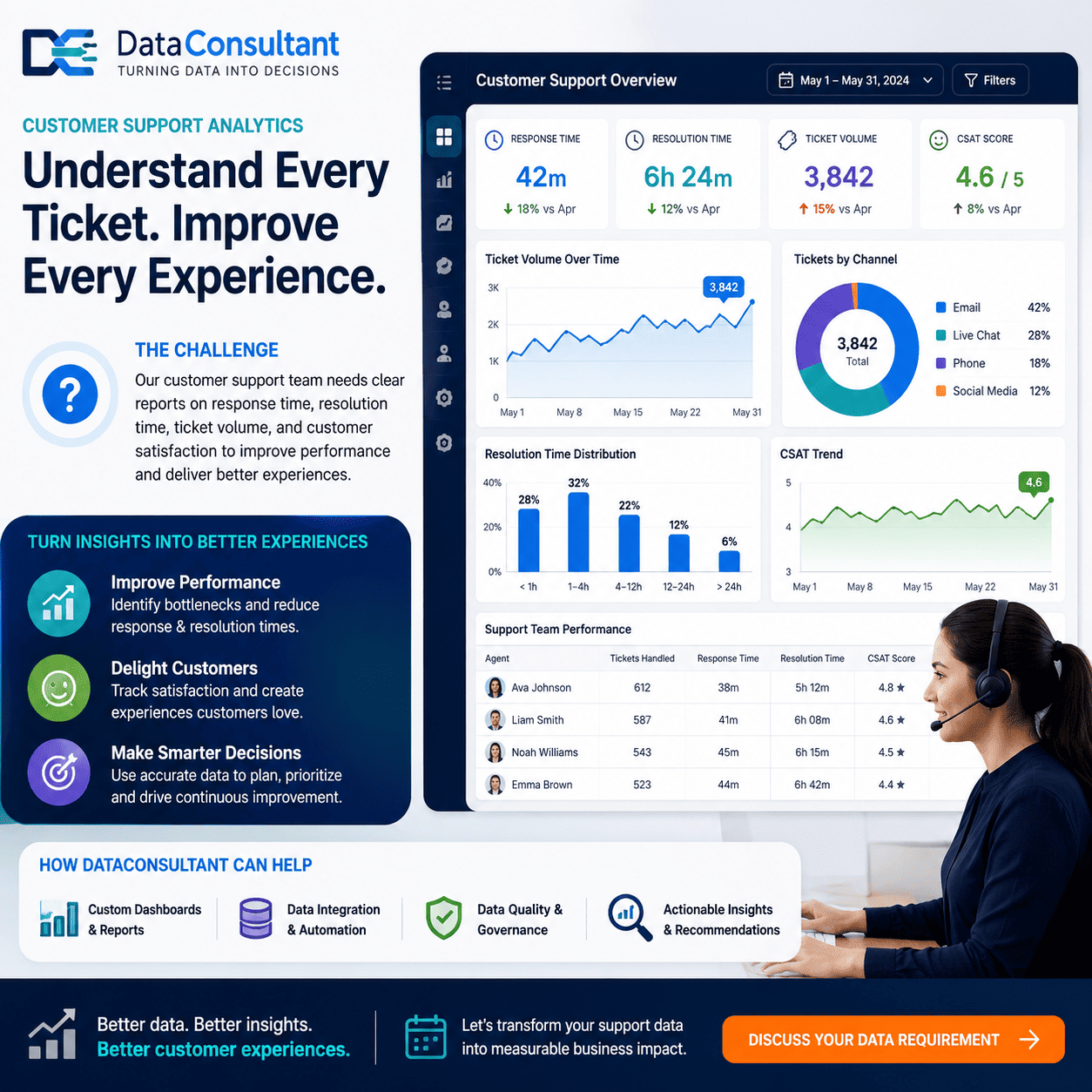
Quick Answer: Start with the Decision, Not the Tool
The right AI tool is the smallest, safest option that improves a specific business task using data your organisation can lawfully access and reasonably trust. Start with a defined use case, such as classifying support requests, drafting controlled internal content, reconciling reports or forecasting demand. Then confirm data access, integration, review controls and ownership.
Use internal staff when the problem is clear and capability already exists. Buy or configure a tool when the workflow and metrics are stable and the main gap is functionality. Use a short data and AI diagnostic when teams disagree about requirements or data readiness. Use a defined consulting project when architecture, integration, analytics, governance or implementation outputs can be scoped. Choose ongoing support only when use cases, controls and optimisation needs genuinely continue.
The main caution is simple: do not hire a consultant or buy an AI platform before defining the business decision or operational problem. Otherwise, the project may automate ambiguity rather than improve performance.
Key Takeaways
- Define the business task: specify what decision, output or workflow the AI tool must improve.
- Test data readiness: poor-quality, inaccessible or poorly governed data can make a capable tool ineffective.
- Keep internal ownership: business, data, technology, risk and process owners must approve priorities and adoption.
- Match support to uncertainty: use diagnostics for unclear problems and defined projects for scoped deliverables.
- Require practical outputs: expect requirements, architecture, controls, test results, documentation and handover where relevant.
- Build governance into delivery: privacy, security, human review, model risk and approved-use boundaries belong in the design.
- Plan knowledge transfer: internal teams should understand how the solution works, where it can fail and who maintains it.
Table of Contents
- Define the problem before comparing AI tools
- Check data and organisational readiness
- Compare internal, tool and consulting options
- Set technical and governance requirements
- Plan deliverables, timelines and resources
- Apply the decision to practical examples
- Decide where specialist support adds value
- Summary
Define the Problem Before Comparing AI Tools
AI tool selection becomes useful only after the business has described the task in operational terms. “We need generative AI” is not a requirement. “Customer-service agents need approved draft responses using current policy content, with citations and human review” is closer to one.
Separate capability gaps from technology gaps
A technology gap exists when the process, data and decision rules are understood but current systems cannot perform the required function. A capability gap exists when people lack analytical, technical or governance expertise. A process gap exists when ownership, inputs or approval steps are unclear. These gaps need different remedies.
Before selecting a tool, document the users, trigger, inputs, expected output, decision owner, unacceptable outcome and review step. This small requirements exercise often reveals whether the organisation needs software configuration, data engineering, process redesign, training or external consulting support.
Decision rule: if the business cannot explain how the output will be checked and used, it is not ready to choose an AI tool.
Check Data Readiness Before an AI Initiative
AI readiness depends on more than having data. The organisation needs sufficiently reliable data, lawful access, consistent definitions, suitable technical interfaces and people who can own the result. A limited pilot can begin with imperfect data, but the limitations must be visible and controlled.
For broader lifecycle considerations, the OECD overview of data governance is a useful reference for how organisations govern access, sharing and value creation. Where AI is involved, the NIST AI Risk Management Framework provides a practical structure for governance, measurement and risk treatment.
Compare Internal, Tool and Consulting Options
The correct option depends on problem clarity, internal capability, data readiness, urgency and continuity. A software licence may appear cheaper, but configuration, integration, data preparation, controls and adoption still require accountable work.
| Option | Best fit | Expected outputs | Internal requirement | Main risk |
|---|---|---|---|---|
| Internal team | Clear use case, accessible data and sufficient capability | Requirements, configuration, testing and operational ownership | Protected time and clear accountability | Competing priorities or missing specialist skills |
| Software tool | Stable workflow and a functionality gap | Configured features, licences and vendor support | Data integration, governance and adoption capability | Buying features without solving process or data issues |
| Short data diagnostic | Unclear problem, conflicting priorities or uncertain data readiness | Use-case shortlist, maturity findings, risks and prioritised roadmap | Stakeholder access and evidence | Recommendations stall without an internal owner |
| Defined consulting project | Scoped architecture, integration, analytics, governance or implementation need | Designs, configured solution, controls, tests, documentation and handover | Business, data, technology and risk participation | Scope expands without acceptance criteria |
| Ongoing consultant support | Recurring optimisation, reporting, governance or use-case demand | Advisory, backlog delivery, reviews and capability support | Regular prioritisation and governance cadence | Dependency if knowledge is not transferred |
| Dedicated specialist or managed team | Substantial continuous workload across several data disciplines | Predictable delivery capacity and coordinated operations | Executive sponsor and operating model | Cost is wasted if demand and ownership are weak |
A hybrid approach is often sensible: internal leaders own the business decision and controls, while external specialists provide temporary architecture, engineering, analytics or governance expertise.
Set Technical, Governance and Security Requirements
An AI tool should not enter production until the organisation has defined data sources, integration method, access roles, retention, logging, human review and incident handling. These requirements are part of the solution, not administrative work to add later.
Specify data and integration needs
- List approved data sources and identify which system is authoritative.
- Confirm whether APIs, ETL or ELT pipelines, a data warehouse, lakehouse or retrieval layer are required.
- Document KPI definitions, metadata and known data-quality limitations.
- Define test data, production access and restrictions on downloading or sharing information.
- Identify latency, volume, availability and audit-log requirements.
Design controls around the actual use case
Security and privacy controls should match the sensitivity of the inputs and the consequence of an incorrect output. The ISO/IEC 27001 information security framework offers a risk-based reference for information security management. For role-appropriate training and accountability, the ICO training and awareness guidance highlights senior support, oversight and relevant learning.
For high-impact use cases, require documented human review, fallback procedures, prompt or model change controls, testing against harmful or misleading outputs and a clear route to suspend the tool.
Plan Deliverables, Timelines and Internal Resources
A professional engagement should produce decision-ready artefacts, not only meetings and demonstrations. The exact outputs depend on the problem, but they should be agreed before work starts.
Typical deliverables
- Business requirements and prioritised use-case register.
- Data maturity, quality and access findings.
- Solution architecture and integration design.
- Data model, retrieval design, KPI framework or dashboard specification where relevant.
- Privacy, security, governance and human-review controls.
- Pilot configuration, test cases, evaluation results and improvement backlog.
- Implementation roadmap with milestones, dependencies and acceptance criteria.
- Documentation, ownership register, training and knowledge transfer.
What drives cost and duration
Cost is influenced by the number of use cases, data sources, systems, user groups and jurisdictions; the quality of existing documentation; integration complexity; security review; required customisation; testing depth; and the level of implementation support. A short diagnostic may take a small number of workshops and evidence reviews. A controlled pilot may take several weeks. Enterprise integration and operating-model changes can take several months.
Internal participation is essential. Business owners validate the decision and workflow. Data teams provide access and quality context. Technology teams support integration and environments. Risk, privacy and security teams approve controls. Procurement and legal teams review supplier and intellectual-property terms. Managers support adoption and review workplace outcomes.
Practical AI Tool and Consulting Decisions
Ecommerce reports do not agree
An ecommerce business wants an AI dashboard because finance, marketing and product teams report different revenue and customer figures. The mistaken assumption is that a smarter interface will reconcile the numbers. The actual problem is inconsistent definitions, source mappings and ownership. A short diagnostic should come first, with a KPI dictionary, data-lineage review, issue backlog and reporting roadmap. Finance, marketing, product analytics and data engineering must participate.
Manual management reporting
A professional-services company wants a generative AI assistant to automate monthly packs assembled from spreadsheets. The real issue is uncontrolled inputs, repeated manual adjustments and weak review evidence. A defined project may combine process redesign, reporting automation, data-quality controls and a limited assistant for narrative drafting. Finance reviewers and system owners must define approval rules and acceptable exceptions.
Predictive analytics before reliable collection
A startup wants predictive AI for demand forecasting, but product categories change frequently and historical data is incomplete. The better decision is to improve collection, define forecasting assumptions and run a limited readiness assessment. Advanced modelling should wait until a credible baseline exists. Specialist guidance may help create a phased roadmap without promising forecast accuracy.
Enterprise copilot across sensitive data
An enterprise wants a copilot that searches policy, customer and operational content across several repositories. The main challenge is not the chat interface; it is identity, permissions, metadata, document quality, retrieval design and monitoring. A defined consulting project or managed workstream may be appropriate, involving architecture, security, privacy, records, business owners and platform teams. Likely deliverables include access design, retrieval architecture, evaluation criteria, pilot results and operational controls.
Use Specialist Support Only Where It Adds Value
External support is most useful when business and data requirements need clarification, KPI definitions conflict, data quality or architecture needs assessment, sources require integration, governance ownership is unclear or an AI pilot needs controlled implementation.
Data and AI assessments can help when readiness and priorities are uncertain. A data advisory engagement can define strategy, requirements and a roadmap. Where the work is execution-focused, relevant support may include data engineering, data governance, analytics consulting or AI data services. Continuous demand may justify managed data and AI support.
The engagement should remain limited to the real problem. A consultant should be able to explain when internal delivery, a tool purchase, a smaller pilot or postponement is more appropriate.
Summary: Choose the Smallest Safe Option
AI tools are useful when the business can define the task, provide suitable data, set review controls and assign an accountable owner. Internal staff may be sufficient for a limited, well-understood need. A software tool may be sufficient when process and metric definitions are stable and the main gap is functionality.
Use a short diagnostic when the problem, data quality or technology requirements are uncertain. Use a defined consulting project when architecture, integration, analytics, governance, implementation, documentation and handover can be scoped. Choose ongoing support or a managed team only when the workload is substantial and continuous.
Before committing, validate business goals, data quality, access, governance, internal ownership, scope, budget, timeline, security, quality assurance, documentation, knowledge transfer and handover. The correct decision may be to improve source-system processes, launch a smaller reporting improvement, hire internally or delay advanced AI until the data foundation is ready.
FAQs on AI Tools and Data Consulting
What are AI tools for business?
AI tools are software products that use machine learning or generative models to support tasks such as classification, forecasting, search, content drafting, recommendations or automation. Their usefulness depends on the quality of the process, data and controls around them. Verify the use case and review method before selecting a product.
How do I choose between different a i tools?
Choose between a i tools by defining the business task, required data, users, integration, acceptable risk and success measure first. Compare tools only against those requirements. A short diagnostic may be appropriate when teams cannot agree on the problem or data readiness.
What does a data consultant do for an AI project?
A data consultant can clarify use cases, assess data maturity, define requirements, review architecture, improve data quality, design governance, support implementation and prepare documentation. The consultant should not replace accountable business ownership. Confirm deliverables, access and handover before starting.
Can software replace a data consultant?
Software can replace manual functions when the process and data are already well defined. It cannot independently resolve disputed metrics, redesign ownership, integrate incompatible systems or determine acceptable risk. Use a consultant only where specialist judgement or delivery capability is genuinely missing.
Should I hire a data consultant or a full-time analyst?
Hire internally when the workload is stable, continuous and can be covered by one role. Use a consultant for temporary specialist work, a diagnostic, a defined implementation or access to several disciplines. Compare the long-term workload, management capacity and speed required before deciding.
What information should I prepare before an engagement?
Prepare the business objective, current workflow, stakeholders, data sources, systems, known quality issues, security constraints, previous reports and desired outcomes. Identify who can approve access and decisions. Missing information can be discovered, but it may increase time and uncertainty.
How much do AI and data consulting services cost?
Cost depends on scope, specialist skills, data sources, integration complexity, security review, testing, customisation and ongoing support. Compare proposals using deliverables, assumptions, internal effort and acceptance criteria rather than day rates alone. Start with a diagnostic when scope is too uncertain to price responsibly.
How long does an AI tool implementation take?
A focused diagnostic or low-risk pilot may take several weeks when access and stakeholders are ready. A multi-system implementation can take several months because integration, controls, testing and change management must be coordinated. Confirm dependencies before accepting a timeline.
Who owns the models, code and documentation?
Ownership should be stated in the contract. Clarify rights to configured workflows, prompts, code, data models, dashboards, evaluation assets, documentation and learner outputs. Your organisation should retain the approved materials needed to operate and maintain the solution.
When is ongoing data-consulting support appropriate?
Ongoing support is appropriate when use cases, reporting needs, data-quality issues, governance requirements or optimisation work recur. It is not necessary when the scope is narrow and internal teams can maintain the solution. Review dependency and knowledge transfer regularly.
Need an AI and Data Readiness Diagnostic?
Share the business task, current tools, data sources, access constraints and expected outcome. DataConsultant can help determine whether you need internal delivery, a software tool, a short diagnostic, a defined project or ongoing specialist support.
Discuss your requirementAt DataConsultant.in, we help organisations turn data and AI priorities into governed, reliable, and practical business capability.