
Jio Cloud: A Business Decision Guide
Jio Cloud can be appropriate for a business, but only after you identify which Jio service and which data problem you are evaluating. The name may be used for personal JioAICloud storage, connectivity-linked business storage, or broader cloud infrastructure and enterprise services. Those options do not solve the same problem. Start by deciding whether you need file backup, team sharing, disaster recovery, application hosting, data integration, analytics infrastructure or a modern data platform.
The main caution is not to buy cloud capacity—or hire a consultant—before defining the business decision or operational constraint. A storage subscription will not resolve conflicting KPIs, poor source data, undocumented spreadsheet processes or unclear data ownership. Equally, a large cloud-modernisation project is unnecessary when the real need is controlled file sharing for a small team.
This guide helps founders, business owners, technology leaders, finance and operations teams, procurement functions and enterprise data leaders distinguish the available choices, assess readiness and decide between internal delivery, a software service, a short diagnostic, a defined consulting project or ongoing specialist support.
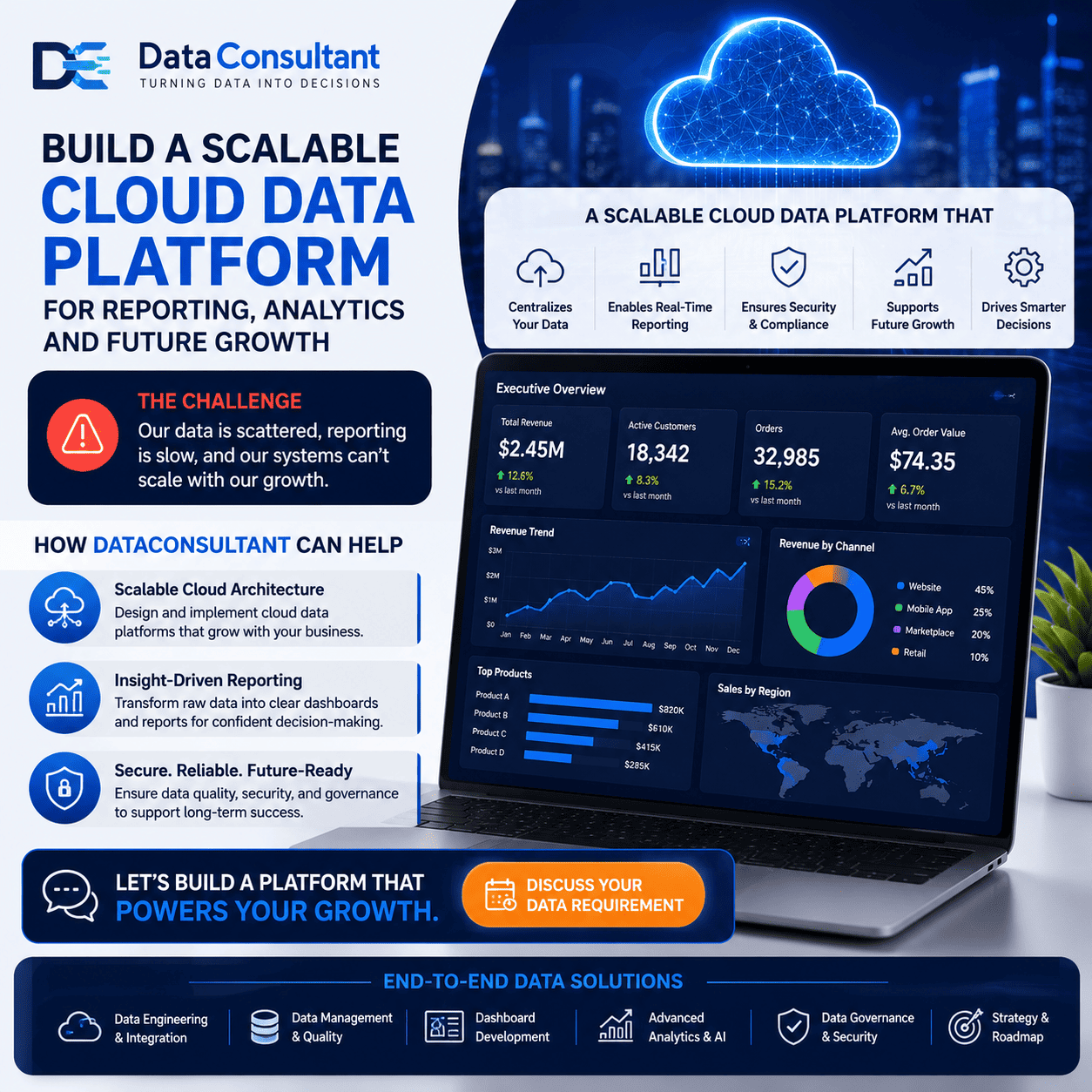
Quick Answer: Match Jio Cloud to the Real Need
Use JioAICloud when the requirement is primarily personal or end-user file backup and access. Consider JioBusiness storage when a smaller organisation needs connectivity-linked storage, managed sharing and basic administration. Evaluate broader JioCloud or enterprise-cloud services when the business needs infrastructure, applications, scalable storage, backup, integration, analytics or governed cloud operations.
Use internal staff when the requirement is clear and the team can configure, secure and operate the service. Use a short data diagnostic when stakeholders are unsure whether the problem is storage, reporting, integration, data quality or architecture. Use a defined consulting project for scoped migration, platform design, analytics enablement or governance implementation. Choose ongoing support only when cloud and data needs will remain continuous.
Before choosing, verify the current product scope, eligibility, pricing, service levels, data handling, security controls, support and exit terms directly with Jio. Product pages can guide discovery, but they do not replace technical, risk, commercial and legal assessment.
Key Takeaways
- Clarify the Jio product: personal storage, business file storage and enterprise cloud services have different capabilities.
- Define the business decision: begin with the workflow, report, application or risk that must improve.
- Check data readiness: cloud capacity cannot fix inconsistent definitions, poor capture or missing ownership by itself.
- Retain internal ownership: business, technology, data, security and procurement stakeholders must approve priorities and controls.
- Scope deliverables: require architecture, migration, testing, documentation, acceptance criteria and handover where relevant.
- Build governance in: identity, access, retention, recovery, data location, privacy and logging should be assessed before migration.
- Plan knowledge transfer: a successful engagement leaves the organisation able to operate and improve the environment.
Table of Contents
- Distinguish the Jio Cloud options
- Check business and data readiness
- Compare the delivery choices
- Define technical and governance needs
- Plan migration and implementation
- Estimate cost, time and resources
- Measure cloud and data outcomes
- Apply the decision to real situations
- Decide where specialist support fits
- Summary
Distinguish Storage from a Cloud Data Platform
The first decision is what “Jio Cloud” means in your situation. Jio’s current public information describes JioAICloud as intelligent storage and backup, while JioBusiness presents storage bundled with business connectivity and user administration. Jio also presents broader cloud services for organisations that need infrastructure, applications, compute, storage, analytics and managed capabilities.
Use personal cloud storage for personal content
Personal cloud storage is appropriate for backing up and accessing photos, videos, contacts and documents. It may help an owner or employee protect device content, but it is not automatically a controlled business repository. Before using any personal account for company data, check ownership, access, retention, offboarding, legal hold, privacy and acceptable-use requirements.
Use business file storage for controlled sharing
A business storage service can fit a small-team requirement where files need central access, public or private sharing and administrator control. Confirm user limits, storage entitlements, account administration, data retrieval after termination and support. The service may still require a separate records structure, permissions model, backup policy and operating procedure.
Use enterprise cloud for applications and data workloads
Application hosting, data engineering, warehouses, lakehouses, integration and business intelligence require more than file space. They need compute, networking, environments, identity, monitoring, data pipelines, structured storage, metadata, quality controls and support. The NIST definition of cloud computing is useful because it separates cloud characteristics and service models rather than treating every online storage product as equivalent.
Decision rule: if the requested outcome is “one safe place for files”, assess business storage. If the outcome is “trusted reporting, integrated systems or scalable analytics”, define a data-platform requirement before selecting a cloud service.
Check Data Readiness Before Choosing Jio Cloud
A cloud project can start before every data issue is fixed, but the organisation needs enough clarity to avoid moving confusion into a new environment. Assess five dimensions: business purpose, data quality, access, governance and internal ownership.
Ask whether critical reports already use agreed definitions, whether source systems capture required fields and whether data can be legally and technically moved. For broader governance, the OECD data-governance overview provides a useful policy context. The practical point is that responsibilities must cover creation, access, use, sharing, retention and deletion—not only storage.
Compare Jio Cloud Delivery Choices
The correct route depends on requirement clarity, internal capability, continuity and risk. The comparison below separates a product purchase from the work required to make data useful and governed.
| Option | Best fit | Expected outputs | Internal requirement | Main risk |
|---|---|---|---|---|
| Internal team | Clear scope, accessible data and adequate cloud skills | Configuration, migration, controls and operating documentation | Named owner, engineering time and security support | Delivery stalls behind other priorities |
| Software or storage service | Defined file, backup or collaboration requirement | Provisioned accounts, storage, sharing and administration | Permissions, records structure, user support and offboarding | A tool is mistaken for a data strategy |
| Short data diagnostic | Unclear need, conflicting reports or uncertain platform fit | Current-state findings, option assessment and prioritised roadmap | Stakeholder access, evidence and decision-maker participation | Recommendations lack an implementation owner |
| Defined consulting project | Scoped migration, architecture, integration, BI or governance work | Design, backlog, implementation, testing, documentation and handover | Business, data, technology, security and procurement involvement | Scope expands without acceptance criteria |
| Ongoing consultant support | Recurring optimisation, analytics, data quality or governance needs | Regular improvements, assurance, support and capability transfer | Prioritisation cadence and accountable service owner | Dependency grows without transfer |
| Dedicated specialist or managed team | Substantial continuous work across several data disciplines | Predictable capacity for architecture, engineering, analytics and governance | Executive sponsor, product ownership and operating governance | Capacity is wasted when demand is poorly defined |
A hybrid model is often practical: internal leaders own outcomes and controls, Jio supplies the selected service, and specialists support discovery or delivery where temporary capability is needed.
Define Cloud, Data and Governance Requirements
A credible evaluation turns a broad cloud request into testable requirements. For storage, define users, file types, capacity, sharing, versioning, recovery and offboarding. For a platform, add applications, data sources, ingestion patterns, processing, performance, environments, integration, analytics, monitoring and continuity.
Document inputs and stakeholder access
- Business objectives, target decisions and current pain points.
- Application, data-source and report inventory.
- Data volume, growth, sensitivity and retention requirements.
- User groups, administrator roles and approval responsibilities.
- Integration, network, identity and device constraints.
- Recovery objectives, service dependencies and support expectations.
- Budget range, procurement route and target milestones.
- Named business, data, technology, security and privacy owners.
Treat security claims as evidence requests
Ask for current evidence covering identity, encryption, logging, vulnerability management, backup, recovery, incident response, data handling, service continuity and deletion. Jio’s official pages describe business storage and broader JioCloud services for organisations, but the applicable controls depend on the exact ordered service and contract. Review those materials with your own requirements.
For a simple storage use case, Jio’s business cloud-storage information can help identify administration and entitlement questions. For enterprise workloads, the official enterprise storage and backup information can support technical discovery. Neither page should be read as legal, security or architecture approval.
Pilot Jio Cloud Before Broad Migration
A pilot should test the hardest assumptions, not merely prove that an account can be created. Select one representative workload, define success and failure criteria, configure controls, migrate a limited dataset, test operations and recovery, then decide whether to expand.
Use phased implementation deliverables
- Confirmed use case, scope, exclusions and acceptance criteria.
- Current-state inventory and dependency map.
- Target architecture and responsibility model.
- Security, privacy, retention and recovery requirements.
- Migration waves, rollback approach and data-validation rules.
- Pilot environment, test cases and issue register.
- Operating procedures, monitoring and escalation routes.
- Training, documentation, knowledge transfer and handover.
For a file-storage rollout, the pilot may focus on permissions, sharing, synchronisation, retrieval and user offboarding. For a data platform, test ingestion, transformation, reconciliation, performance, access segregation, monitoring and business-report outputs. Do not scale until users and control owners accept the results.
Estimate Total Cost, Time and Resources
The total cost is not just the advertised storage, connectivity, licence or cloud-consumption charge. Include discovery, architecture, migration, data cleansing, integration, security review, environments, testing, support, training, operational monitoring and eventual exit.
A basic file-storage deployment may require limited configuration and user support. A data-platform project can take several months where source systems, quality issues, access approvals and reporting changes are involved. Timelines depend less on the brand name than on scope clarity, data volume, dependencies, control requirements and stakeholder availability.
Budget for internal participation
Business owners must validate outcomes. Data owners approve use and definitions. Technology teams provide access and integration. Security, privacy, legal and procurement teams assess controls and terms. Finance validates the cost model. Operations teams prepare support and continuity. A proposal that omits this internal work understates both cost and delivery risk.
Decision rule: compare total operating cost over the intended period, including migration, governance, support and exit—not only the first subscription or promotional entitlement.
Measure Whether Jio Cloud Creates Useful Capability
Measure the outcome that justified the decision. Storage initiatives may track successful backup, retrieval, controlled sharing, user adoption and support incidents. Platform initiatives may track data freshness, reconciliation, pipeline reliability, report adoption, access compliance, recovery performance and cost against planned consumption.
- Percentage of in-scope data migrated and validated.
- Backup success and tested recovery against agreed objectives.
- Accuracy and consistency of priority reports after migration.
- Number and severity of unresolved access or data-quality issues.
- Service availability and operational incidents.
- Cloud consumption and support cost compared with the approved model.
- Adoption of governed workflows and retirement of duplicate processes.
- Internal ability to operate, document and improve the environment.
Do not claim that cloud adoption alone caused revenue, savings or faster decisions. Compare baseline and post-implementation evidence and account for process changes, staffing, seasonality and other technology initiatives.
Practical Jio Cloud Business Decisions
A small firm needs controlled file sharing
A professional-services firm stores client documents on individual laptops and assumes it needs a data warehouse. The actual problem is controlled storage, sharing, backup and offboarding. A business storage service may be sufficient if permissions, retention, retrieval and contractual requirements are met. The internal owner should define folders, user roles, sensitive-data rules and exit procedures; a large consulting project is unnecessary.
An ecommerce company has conflicting reports
An ecommerce team wants to move spreadsheets to Jio Cloud because finance and marketing report different revenue. The mistaken assumption is that cloud storage will reconcile the numbers. The actual problem is inconsistent definitions, source mappings and ownership. A short diagnostic should create a KPI dictionary, source-to-report lineage, issue backlog and target reporting architecture before any platform decision.
A growing business needs automated reporting
A multi-location company manually combines operational and finance files each month. A storage subscription can centralise files but will not design ingestion, transformations, controls and dashboards. A defined project may assess sources, create an integration pattern, implement a reporting pipeline, document controls and train internal owners. Jio Cloud can be evaluated as part of the target architecture, not assumed to be the complete solution.
An enterprise plans cloud data modernisation
An enterprise wants to migrate applications and analytics while improving resilience and governance. The workload is continuous and spans architecture, engineering, security, data quality and business intelligence. A phased programme or managed specialist team may be justified, with Jio and other feasible options assessed against workload, interoperability, data-location, support and operating-model requirements. Internal product ownership remains essential.
Use Specialist Support Only Where It Adds Value
External support is useful when the organisation cannot yet define whether Jio Cloud is a storage purchase, a migration project or a broader data-platform decision. It can also help where data quality, integration, architecture, reporting, governance or AI readiness must be assessed alongside cloud selection.
A DataConsultant data assessment can clarify the current state and prioritised roadmap. A scoped data engineering engagement may support integration, migration and platform implementation, while data governance support may be relevant where ownership, quality, metadata, access or retention controls are incomplete. Support should remain limited to the actual decision and capability gap.
Summary: Choose the Smallest Suitable Route
Jio Cloud is suitable when a specific Jio service matches a defined requirement and the organisation can govern and operate it. Internal staff or a software service may be sufficient for a clear, limited storage, backup or collaboration need. A tool purchase is not sufficient when the underlying problem is conflicting metrics, poor data quality, integration or unclear architecture.
Use a short diagnostic when the problem, product fit or data readiness is uncertain. Use a defined consulting project when migration, architecture, engineering, analytics or governance outputs can be scoped. Choose ongoing support or a managed team only when the workload is substantial and genuinely continuous.
Before committing, validate business goals, data quality, access, governance, internal ownership, scope, budget, timeline, security, documentation, quality assurance, knowledge transfer and handover. Require current service details from Jio and a practical exit path for your data and operations.
FAQs on Jio Cloud Decisions
What is Jio Cloud, and which version is relevant to a business?
Jio Cloud is an umbrella term that may refer to JioAICloud for personal file backup, JioBusiness cloud storage for smaller teams, or broader JioCloud and enterprise-cloud services for infrastructure, applications, storage, backup and governance. A business should first classify its need as file storage, collaboration, backup, application hosting, data-platform modernisation or analytics. Product names alone are not enough; verify the current service scope, commercial terms, administration model and technical fit with Jio before committing.
Is Jio Cloud suitable for a small business?
It may be suitable when a small business needs straightforward connectivity-linked storage, controlled file sharing or a limited cloud starting point. Suitability becomes less certain when the organisation needs complex data integration, a warehouse or lakehouse, advanced analytics, strict recovery objectives, multiple environments or detailed governance. Document the use case, user count, data volume, access model and exit requirements, then compare the specific Jio offering with internal capability and other feasible options.
Can JioAICloud replace a business data platform?
Usually not. JioAICloud is positioned as an intelligent cloud storage and backup service for files and personal content, whereas a business data platform normally requires ingestion pipelines, structured storage, transformation, metadata, quality controls, governed access, analytics workloads and operational monitoring. It can solve a storage or sharing need, but it should not be treated as a substitute for a warehouse, lakehouse or integrated analytics architecture without verified enterprise capabilities.
Should we buy Jio Cloud or hire a data consultant first?
Buy or configure a clearly matched service when requirements, data sources, controls, ownership and expected outputs are already defined. Use a short data-consulting diagnostic first when stakeholders disagree, reports conflict, migration scope is unclear or the team cannot distinguish storage from a broader platform requirement. The consultant should clarify the decision and produce evidence, requirements and a roadmap—not create unnecessary dependency.
What information should we prepare before evaluating Jio Cloud?
Prepare the business decisions to be supported, current systems, data types, volumes, growth, user groups, locations, integrations, recovery needs, security classifications, retention rules, budget boundaries and internal owners. Include sample reports, data-flow diagrams, pain points and known quality issues where available. Do not share sensitive production data during early discovery unless access is authorised and appropriately controlled.
How much does a Jio Cloud implementation cost?
Cost depends on the selected Jio service, storage or compute consumption, connectivity bundle, licences, migration effort, data preparation, integration, security, environments, support and internal participation. Public plan information may cover only part of the total operating cost. Request current commercial terms from Jio and estimate implementation, governance, training, support and exit costs separately before comparing options.
How long does a Jio Cloud project take?
A simple account setup or limited file-storage rollout can be relatively quick once eligibility, users and controls are confirmed. A business migration, backup programme, application deployment or data-platform initiative can take weeks or months because discovery, architecture, security review, data movement, testing and adoption must be coordinated. Use milestones and acceptance criteria rather than relying on a single headline date.
What security and governance checks are needed?
Confirm identity and access management, administrator roles, encryption, logging, backup, recovery, incident handling, data location, retention, deletion, subcontractors, service availability, support, audit evidence and contractual exit provisions. Map the service to the organisation’s own risk classification and legal obligations. Marketing descriptions are not a control assessment; obtain current documentation and involve security, privacy, legal, procurement and data owners.
What deliverables should a Jio Cloud consulting engagement provide?
Expected deliverables may include a use-case definition, current-state assessment, option comparison, data and application inventory, target architecture, migration waves, security and governance requirements, cost model, implementation backlog, test and acceptance criteria, operating model, documentation and knowledge-transfer plan. The exact set should match the problem. A small storage decision does not need an enterprise transformation pack.
When is ongoing support or a managed data team appropriate?
Ongoing support is appropriate when cloud usage, integrations, reporting, data quality, governance or optimisation create a continuing workload that internal staff cannot yet absorb. A managed team may be justified when several disciplines are needed consistently, such as architecture, engineering, analytics and governance. Use a defined project instead when the outcome is finite, and require knowledge transfer, ownership and an exit path in either model.
Need a Jio Cloud Data Diagnostic?
Share the business objective, current systems, reporting problems, data constraints, security needs and expected timeline. DataConsultant can help determine whether an internal configuration, a short diagnostic, a defined cloud data project or ongoing specialist support is the proportionate next step.
Discuss your requirementAt DataConsultant.in, we help organisations turn data and AI priorities into governed, reliable, and practical business capability.