
GCP Google: Is Google Cloud Right for Your Data?
GCP Google is a practical choice when your business needs a scalable, governed cloud platform for data integration, analytics, reporting or AI-ready workloads. The decision should begin with the business outcome and operating problem, not with a request to “move everything to Google Cloud”. A cloud platform cannot resolve conflicting KPI definitions, weak source-system processes, unclear data ownership or unreliable records by itself.
Start by identifying the decision that better data must support, the systems that supply it, the people who own it and the security boundaries that apply. Use internal staff when the workload is narrow and your team already has the required Google Cloud, data engineering and security capability. Use a short diagnostic when requirements, costs or data readiness are uncertain. Use a defined project when architecture, migration, integration, governance, testing and handover can be scoped. Choose ongoing support only when platform operations and analytics demand are genuinely continuous.
This decision guide explains what Google Cloud offers, where BigQuery and related services fit, what internal readiness is required, how alternatives compare, what costs and risks influence delivery, and when external data-platform support is justified.
Quick Answer: Use GCP for a Defined Data Need
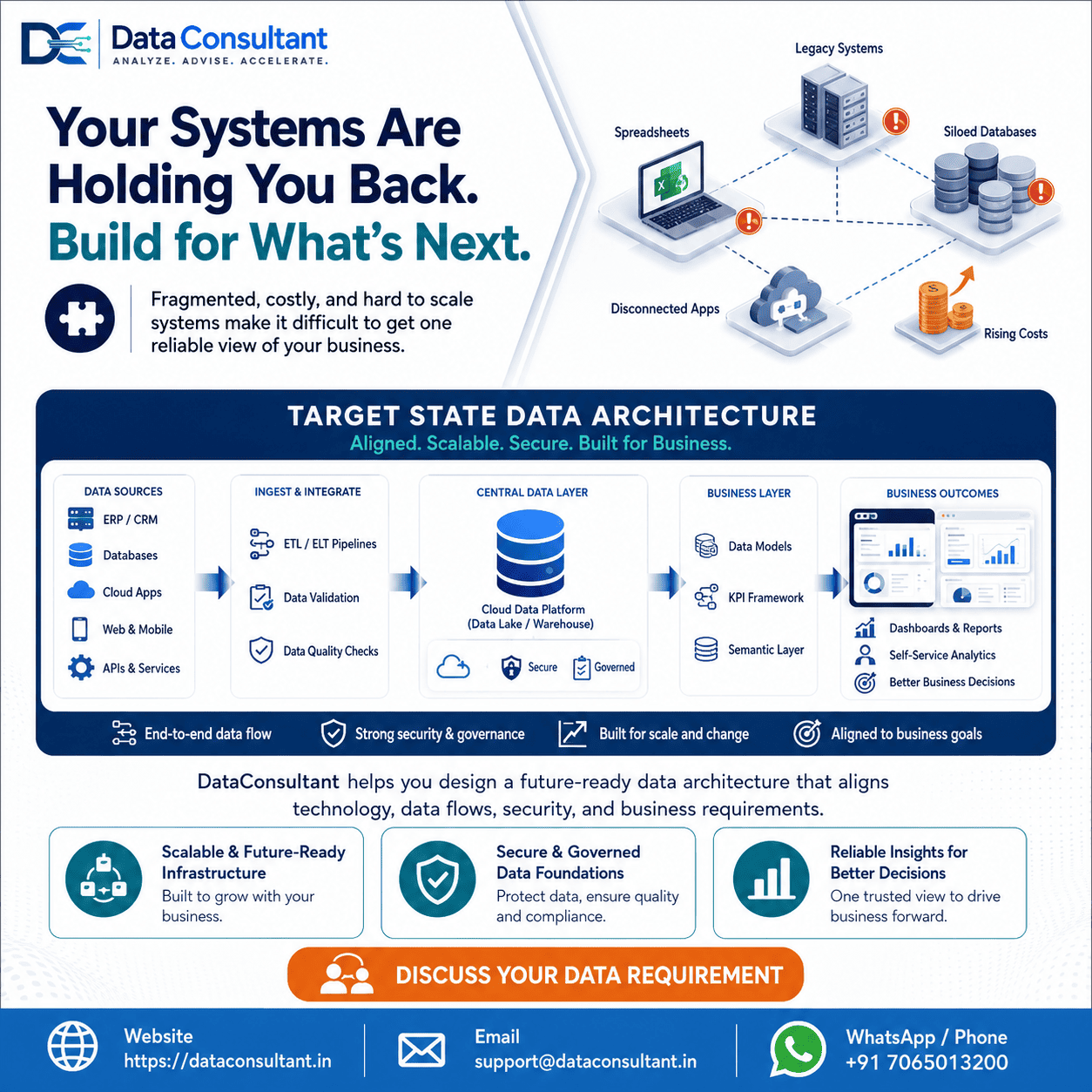
Google Cloud is suitable when you need managed infrastructure, scalable analytics, data processing, secure storage or machine-learning capability and can define the workload clearly. BigQuery is often the analytics centre, but a usable platform also needs ingestion, modelling, identity, monitoring, governance and cost controls.
Choose a short diagnostic when teams are still debating the problem, reports conflict or cloud costs cannot be estimated. Choose a defined implementation when the target outcomes, source systems and acceptance criteria can be scoped. Choose ongoing support when pipelines, governance, optimisation and analytics use cases require sustained specialist attention.
The main caution is to avoid treating a cloud account or software purchase as a data strategy. Clarify the business decision, data quality, access, ownership and operating model before committing to architecture or migration.
Key Takeaways
- Start with the workload: define the decisions, reports, data products or services Google Cloud must support.
- Check data readiness: source quality, definitions, lineage and access can determine more effort than cloud configuration.
- Keep internal ownership: business, data, security and platform leaders must own priorities and approvals.
- Scope complete deliverables: require architecture, pipelines, controls, tests, documentation, runbooks and handover.
- Design governance early: identity, classification, retention, logging and least privilege belong in the platform design.
- Model total cost: include consumption, engineering, migration, licences, operations and internal time.
- Plan knowledge transfer: internal teams need the access and capability to operate the platform after delivery.
Table of Contents
- Translate GCP Google into a business decision
- Check cloud data readiness
- Compare internal, tool and consulting options
- Define architecture and security requirements
- Pilot and implement in phases
- Estimate cost, time and resources
- Measure platform outcomes
- Apply the decision to real situations
- Decide where specialist support fits
- Summary
Translate GCP Google into a Business Decision
Google Cloud should be selected for a defined workload, not for a general ambition to become “cloud first”. Translate the technology request into a measurable business capability such as faster management reporting, consolidated customer analysis, reliable demand forecasting, governed data sharing or replacement of an ageing warehouse.
Understand where BigQuery fits
BigQuery is Google Cloud’s managed analytics data warehouse. Its storage and compute capabilities support large-scale SQL analysis, but it is one component of a broader platform. The official BigQuery overview explains its separation of storage and compute and its integration with Google Cloud identity controls.
A complete solution may also need source ingestion, transformation, orchestration, metadata, data-quality checks, reporting tools, observability and secure data exchange. The exact combination should follow workload requirements rather than a standard product list.
Separate a data problem from a cloud problem
If two finance reports show different revenue because teams use different definitions, moving both reports to BigQuery will preserve the disagreement. If customer records are incomplete at capture, a new pipeline will transport incomplete records more efficiently. Resolve business rules, ownership and source controls alongside the platform design.
Decision rule: before selecting services, write one sentence describing the business decision, the users, the required data, the required refresh time and the consequence of an incorrect result.
Check Cloud Data Readiness Before Migration
Readiness is sufficient when the organisation has a clear use case, accessible sources, known data limitations, security participation and accountable internal owners. Perfect data is not required, but unresolved fundamentals should be visible in the scope and plan.
Assess data volumes, update frequency, history, schema stability, sensitive fields, retention, consumers and service expectations. Identify dependencies on on-premises systems, SaaS applications, APIs and existing BI tools. Record which issues must be fixed before migration and which can be managed through a phased backlog.
Compare Internal, Tool and Consulting Options
The right route depends on problem clarity, internal capability, urgency and continuity. Buying cloud services is not equivalent to designing and operating a data platform, so compare the complete delivery model.
| Option | Best fit | Expected outputs | Internal requirement | Main risk |
|---|---|---|---|---|
| Internal team | Clear workload, capable cloud and data staff, limited scope | Architecture, build, testing and operations managed internally | Available engineering, security and product ownership | Delivery slows when specialists have competing priorities |
| Google Cloud services and tools | Requirements and architecture standards are already clear | Managed platform capabilities and configurable services | Internal design, integration, governance and operations | Services are adopted without a coherent operating model |
| Short data diagnostic | Unclear scope, conflicting reports, uncertain migration case | Current-state findings, options, risks and prioritised roadmap | Stakeholder interviews, evidence and system access | Recommendations stall without an accountable owner |
| Defined consulting project | Architecture, migration or analytics outcome can be scoped | Design, pipelines, controls, tests, documentation and handover | Business, data, security and technology participation | Scope expands without acceptance criteria |
| Ongoing consultant support | Recurring optimisation, governance and delivery demand | Backlog delivery, monitoring, reviews and specialist advice | Regular prioritisation and service governance | Dependency grows without knowledge transfer |
| Dedicated specialist or managed team | Substantial continuous workload across several disciplines | Predictable capacity for platform engineering and operations | Executive sponsor, product owner and operating cadence | Capacity is wasted if priorities and adoption are weak |
A hybrid model is often practical: external specialists establish the architecture and delivery controls while internal owners define priorities, approve access and take responsibility for long-term operation.
Define GCP Architecture and Security Requirements
A production design should specify organisation structure, projects, environments, identity, networking, data locations, encryption, logging, backup, recovery, deployment and support. Google Cloud’s Well-Architected Framework provides principles across security, reliability, performance, cost and operations that can inform design reviews.
Design identity and access deliberately
Map users and service identities to job responsibilities, use groups rather than unmanaged individual grants, apply least privilege and separate development from production duties. BigQuery access can be controlled through Google Cloud Identity and Access Management; the official BigQuery access-control guidance describes the available control model.
Treat security as shared responsibility
Google protects the underlying cloud infrastructure, but the customer remains responsible for identities, configurations, data handling and deployed workloads. The Google Cloud security overview explains this shared-responsibility relationship. Translate it into named internal owners, control evidence and incident procedures rather than assuming the provider manages every risk.
- Classify data and confirm permitted regions, transfers and retention periods.
- Define encryption, key-management and secret-management requirements.
- Enable central logging, alerting and review of privileged activity.
- Document recovery objectives, backup patterns and failure procedures.
- Set data-quality controls and reconciliation rules for critical outputs.
- Agree deployment, change approval and rollback procedures.
Pilot GCP Before a Full Data Migration
A pilot should prove an end-to-end business outcome, not merely show that a query can run. Select one valuable use case with representative data, measurable acceptance criteria and manageable dependencies.
The pilot should include ingestion, transformation, quality checks, access controls, a usable output, monitoring, cost observation and recovery testing. Compare results with the existing process, record limitations and decide whether to scale, redesign or stop. A technically successful pilot is not enough if users do not trust the output or no team can operate it.
Estimate GCP Cost, Time and Internal Effort
Total cost combines cloud consumption with implementation and operating effort. Important drivers include data volume, query behaviour, data movement, refresh frequency, storage retention, environments, integration complexity, security review, migration coexistence, support coverage and internal stakeholder time.
Use workload estimates and budgets, then monitor actual consumption. Google Cloud’s cost-optimisation guidance recommends ongoing visibility and adjustment rather than treating cost design as a one-off exercise.
Set realistic delivery expectations
A diagnostic may take weeks; a pilot can follow when data access and owners are ready. Production migration usually takes longer because profiling, reconciliation, security testing, user acceptance, cutover and decommissioning must be coordinated. Timelines extend when undocumented interfaces, poor-quality history or approval dependencies are discovered.
Require estimates to state assumptions, exclusions, internal responsibilities and change-control rules. A low implementation quote may omit data cleansing, report redevelopment, production support or knowledge transfer.
Measure a Google Cloud Data Platform by Outcomes
Measure whether the platform produces reliable, secure and usable data products at an acceptable cost. Service uptime alone does not prove that business users receive trusted information.
- Business use: adoption of the reports, data products or operational decisions in scope.
- Data quality: agreed measures for completeness, validity, timeliness and reconciliation.
- Reliability: pipeline success, recovery performance, incident volume and time to restore.
- Security: access-review completion, privileged activity, policy exceptions and control evidence.
- Delivery: lead time for approved changes and percentage of releases meeting acceptance criteria.
- Cost: consumption against workload, budget and unit-cost expectations.
- Capability: internal ability to operate, troubleshoot and extend the platform.
Establish baselines before migration where possible. Do not attribute revenue, savings or productivity changes solely to the platform without considering process changes, adoption and market conditions.
Use the GCP Decision in Real Business Situations
Ecommerce reports disagree about revenue
An ecommerce business wants BigQuery because marketing, finance and the storefront report different revenue. The mistaken assumption is that a warehouse will automatically create one truth. The real problem is inconsistent definitions, refund treatment and source timing. A short diagnostic should map definitions, owners and reconciliation rules before a defined BigQuery pipeline and reporting project. Finance, marketing and engineering must agree acceptance criteria.
A professional-services firm relies on spreadsheets
A growing firm wants to “put spreadsheets in the cloud”. The actual need is automated management reporting from project, time, billing and finance systems. A limited project may create governed ingestion, a shared data model and selected dashboards. Internal process owners must document exceptions and validate results. Buying a BI licence alone would not resolve fragmented source processes.
An enterprise plans a warehouse migration
An enterprise proposes a direct move from a legacy warehouse to BigQuery. The main risk is treating migration as a copy exercise while retaining obsolete models, duplicate reports and undocumented dependencies. A discovery and architecture phase should classify workloads, identify redesign opportunities, plan coexistence and define cutover evidence. Security, operations, business data owners and report consumers must participate.
A startup wants predictive analytics immediately
A startup wants forecasting and machine learning before its product events and customer records are stable. The better decision is to improve collection, identifiers and KPI definitions first, then build a small analytical foundation. A data-readiness assessment can prevent unnecessary model work and create a phased roadmap. Advanced AI should wait until the underlying data can support responsible evaluation.
Use Specialist Support Only Where Gaps Are Real
External support is useful when the organisation needs independent discovery, Google Cloud architecture, data engineering, security coordination, migration planning, governance design or a temporary delivery team. It is not a substitute for internal sponsorship, data ownership or timely access decisions.
A professional engagement should state the business outcome, in-scope sources, environments, deliverables, milestones, acceptance criteria, responsibilities, assumptions, quality assurance, security requirements, documentation, intellectual-property terms and handover. It should also identify what will remain with internal teams.
DataConsultant can support a focused data-platform assessment, a defined platform consulting engagement, or implementation through relevant data engineering support. The appropriate starting point depends on whether your immediate need is clarity, architecture, delivery or ongoing operation.
Clarify the Google Cloud Decision
Begin with a scoped review of business outcomes, source data, architecture, security, operating capability, costs and delivery risks.
Discuss a Data Platform AssessmentSummary
GCP Google is appropriate when the organisation has a meaningful data or analytics workload and is prepared to own the data, controls and operating model around it. Internal staff may be sufficient for a clear, limited requirement when the necessary skills and capacity already exist. A software or cloud-service purchase may be sufficient when process definitions, architecture and governance are already settled.
Use a short diagnostic when the business problem, data quality, access, platform choice or cost case is uncertain. Use a defined project when architecture, integration, migration, analytics, governance and handover can be scoped. Use ongoing support or a managed team when delivery and operational needs are substantial and continuous. Before proceeding, validate business goals, data quality, access, governance, internal ownership, scope, budget, timeline, security, documentation, quality assurance, knowledge transfer and handover.
Frequently Asked Questions
What does gcp google mean for a business data platform?
The phrase gcp google usually refers to Google Cloud, formerly called Google Cloud Platform, and the services businesses use to store, process, govern and analyse data. For a data initiative, the practical question is not whether Google Cloud has suitable products, but whether your organisation has a clear use case, reliable source data, secure access, accountable owners and the skills to operate the platform. Start by defining the business decision and workload before selecting services.
When should a business use Google Cloud for data and analytics?
Google Cloud is a strong option when an organisation needs scalable analytics, managed data services, cloud integration, machine-learning capability or a modern alternative to an ageing data warehouse. It is less suitable as a first step when KPI definitions, source-system ownership or data quality are unresolved. Validate the workload, data residency, security, integration and operating requirements before committing to a target architecture.
Do we need a consultant to implement GCP Google services?
Not always. An experienced internal cloud and data team can handle a limited, well-defined workload when architecture standards, security controls and ownership are already established. A short diagnostic is useful when teams disagree about requirements or platform choices. A defined consulting project is appropriate when you need architecture, migration, pipelines, governance, testing, documentation and handover across several disciplines.
Is BigQuery the same as Google Cloud?
No. BigQuery is an analytics data warehouse service within Google Cloud. Google Cloud also includes services for storage, databases, integration, data processing, security, monitoring, machine learning and application hosting. BigQuery may be central to an analytics platform, but the complete design still needs ingestion, data modelling, access controls, data quality, cost management and operational support.
What information should we prepare before a Google Cloud data project?
Prepare the business questions, priority use cases, source-system list, data volumes, refresh needs, current architecture, security classifications, regulatory constraints, user groups, service-level expectations and known data-quality issues. Identify executive, business, data, security and technology owners. The project will move faster when access approvals, sample data, interface documentation and acceptance criteria are available.
How much does a GCP Google data project cost?
Cost depends on discovery effort, data volume, query patterns, migration complexity, integration methods, security requirements, environments, testing, support and internal participation. Cloud consumption is only one part of the total cost; design, engineering, governance, change management and ongoing operations also matter. Use a scoped estimate with workload assumptions and cost controls rather than relying on a generic platform price.
How long does a Google Cloud data implementation take?
A focused diagnostic or proof of value may take several weeks when access and stakeholders are ready. A production platform or warehouse migration commonly takes longer because data profiling, security design, integration, reconciliation, testing and cutover must be completed. Use phased milestones and acceptance criteria; avoid committing to a fixed date before the source systems and data quality have been assessed.
How should security and governance be handled on Google Cloud?
Security and governance should be designed into the landing zone, identities, projects, networks, data classifications, encryption choices, logging, retention and approval processes. Google secures the underlying cloud infrastructure, while the customer remains responsible for configuration, identities, data use and workloads. Apply least privilege, separation of duties, monitored access and documented ownership, then test controls before production use.
Who owns the pipelines, models and documentation after delivery?
Ownership should be stated in the engagement and confirmed during handover. The organisation should receive the agreed source code, infrastructure configuration, data models, runbooks, test evidence, architecture decisions, data definitions and operational procedures, subject to any licensed components. Named internal owners must be able to maintain, approve and troubleshoot the platform after external specialists leave.
When is ongoing Google Cloud support appropriate?
Ongoing support is appropriate when workloads, integrations, security requirements, costs and analytics priorities change continuously, or when the organisation lacks enough internal platform capability. It can include monitoring, optimisation, pipeline support, governance administration and release management. Avoid permanent dependency by requiring documentation, knowledge transfer, service measures and a clear division of responsibilities.
At DataConsultant.in, we help organisations turn data and AI priorities into governed, reliable, and practical business capability.