
Explanation of Cloud Computing for Business Decisions
An explanation of cloud computing begins with a simple idea: a business rents computing capability over the internet instead of owning and operating every server, storage device, database and application itself. The practical decision is not whether “the cloud” is modern, but whether a specific workload will become easier to scale, secure, recover, integrate or manage when delivered as a service. Do not start with a vendor demonstration. Start with the business process, data, users, risks and outcomes that the technology must support.
Cloud computing can range from a complete software application used through a browser to configurable infrastructure and managed data services. It can reduce procurement delays and provide flexible capacity, but it does not remove responsibility. Your organisation still needs clear ownership, secure access, reliable data, cost controls, architecture decisions, continuity planning and internal capability.
This guide explains how cloud computing works, how service and deployment models differ, when cloud adoption is suitable, what readiness is required, what costs and risks to expect, and when a short diagnostic, defined consulting project or ongoing specialist support is justified.
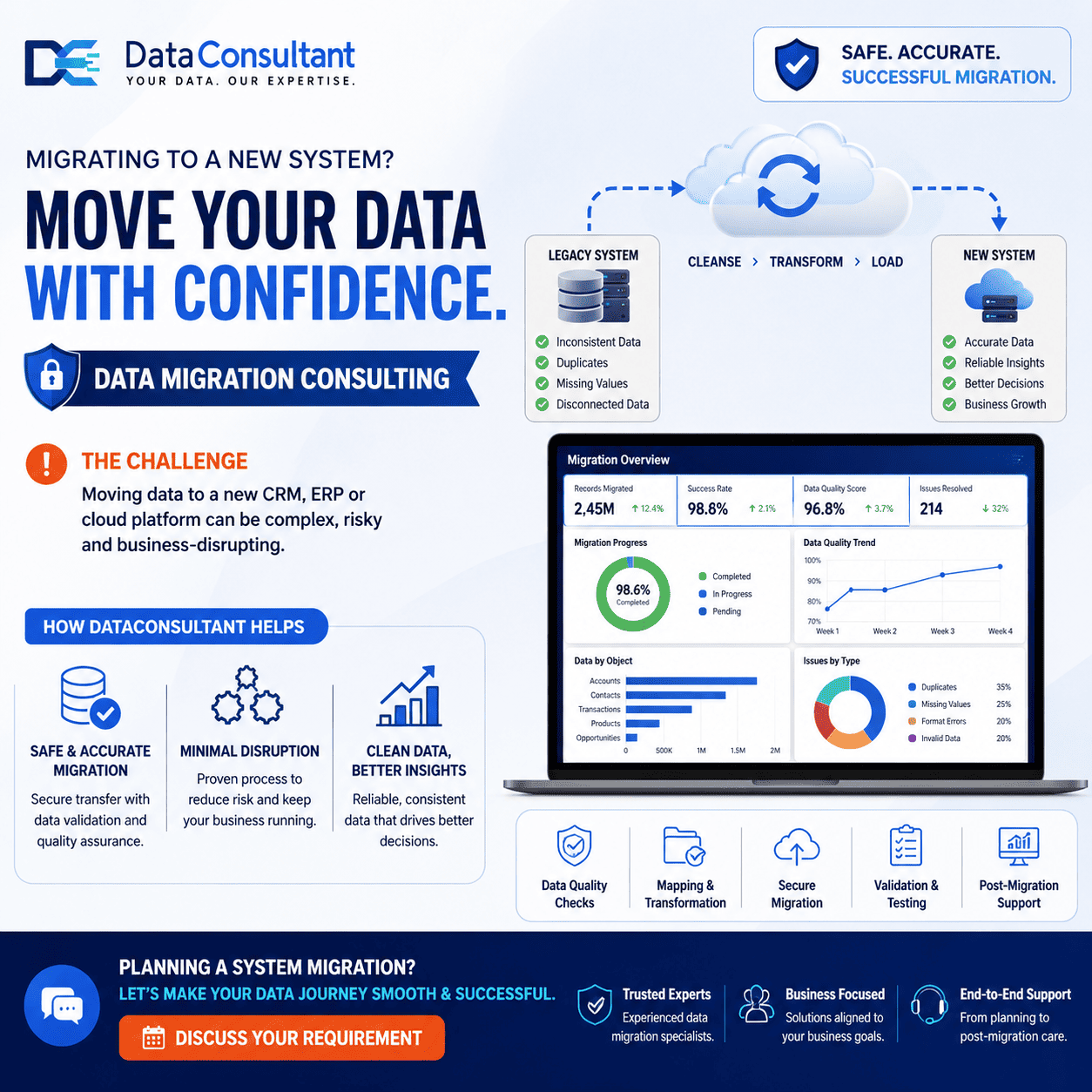
Quick Answer: Cloud Computing as an On-Demand Service
Cloud computing provides computing resources through a network on demand. Instead of purchasing and maintaining all infrastructure internally, an organisation uses services from a provider and typically pays according to subscription, capacity or consumption.
Use cloud services when they improve a defined workload’s flexibility, resilience, access or delivery speed and when the organisation can manage identity, data, configuration, cost and supplier risk. Keep a workload on premises when legal, latency, hardware, control or integration constraints make cloud use unsuitable. A hybrid approach combines both.
Use a short diagnostic when the business case, workload scope or data readiness is unclear. Use a defined project when migration, architecture, governance and acceptance criteria can be scoped. Choose ongoing support only when optimisation, operations, data governance or platform change creates a genuine recurring need.
Key Takeaways
- Cloud is a delivery model: it provides infrastructure, platforms or software as services rather than as assets the customer operates entirely alone.
- Assess workloads individually: one application may suit cloud hosting while another should remain on premises.
- Data readiness matters: unclear ownership, poor quality and undocumented integrations increase migration risk and cost.
- Responsibility remains shared: providers operate underlying services, while customers still manage access, data, configuration and lawful use.
- Scope determines cost: consumption, resilience, data movement, licensing, support and internal staffing all affect total cost.
- Define deliverables: expect an inventory, target architecture, migration plan, controls, testing evidence, documentation and handover.
- Plan knowledge transfer: internal teams must understand how to operate, monitor and govern the resulting environment.
Table of Contents
- Understand how cloud computing works
- Check cloud and data readiness
- Compare cloud, on-premises and hybrid
- Set technical and security requirements
- Plan a controlled cloud implementation
- Estimate cost and internal resources
- Measure useful cloud outcomes
- Apply the decision to real situations
- Decide where specialist support fits
- Summary
Understand What Cloud Computing Actually Changes
Cloud computing changes how technology capacity is acquired, configured, scaled and operated. The provider offers a pool of resources and standardised services; the customer selects, configures and governs what it uses. The NIST definition of cloud computing describes characteristics including on-demand self-service, broad network access, resource pooling, rapid elasticity and measured service.
Service models divide operational responsibility
Infrastructure as a service provides virtual machines, storage and networking. The customer controls operating systems, applications and data. Platform as a service adds managed runtimes, databases, integration and development services, reducing infrastructure administration. Software as a service provides a complete application, with the customer mainly responsible for configuration, users, data and business use.
The higher the service abstraction, the less infrastructure your team operates directly. The trade-off is less low-level control and greater dependence on provider features, pricing and contractual terms.
Deployment models describe where services run
A public cloud uses provider-operated shared infrastructure with logical separation between customers. A private cloud is dedicated to one organisation and may be hosted internally or externally. A hybrid environment combines cloud and on-premises systems. Multi-cloud means using services from more than one cloud provider, usually for specific capabilities or risk choices rather than as an end in itself.
Decision rule: choose the least complex model that meets the workload’s business, data, security, resilience and integration requirements.
Check Cloud Readiness Before Selecting Technology
Cloud readiness depends on more than technical compatibility. A workload is easier to move when its business owner, users, data flows, dependencies, service levels and risks are understood. Where those facts are missing, discovery should come before architecture.
Validate five readiness dimensions
- Business clarity: the organisation can state the process, decision or customer outcome the workload supports.
- Application and data knowledge: systems, interfaces, data classifications, quality issues and retention needs are documented.
- Access and security: identity roles, privileged access, encryption, logging and incident responsibilities can be defined.
- Operational capability: teams can monitor services, control releases, manage costs and respond to failures.
- Internal ownership: named owners approve requirements, risk acceptance, testing and post-implementation operation.
Poor data quality and undocumented dependencies often become the real migration work. Moving them unchanged may reproduce the same business problems on a different platform. A readiness assessment should therefore distinguish infrastructure limitations from process, data and governance weaknesses.
Compare Cloud, On-Premises and Hybrid Options
The right option depends on workload clarity, control needs, internal capability and the cost of change. The following comparison is a decision aid rather than a universal ranking.
| Option | Best fit | Internal requirement | Cost structure | Main risk |
|---|---|---|---|---|
| Internal on-premises team | Stable workloads needing direct hardware or location control | Infrastructure, security, continuity and upgrade capability | Capital investment plus operating cost | Slow capacity change and ageing technology |
| Cloud software service | Standard business capability with limited custom engineering | Configuration, identity, data and supplier management | Subscription, users and optional features | Data portability and vendor dependency |
| Cloud infrastructure or platform | Applications and data products needing flexible capacity | Architecture, engineering, security and cost management | Consumption, licences, support and operations | Complexity and uncontrolled usage |
| Hybrid environment | Mixed constraints, staged migration or local dependencies | Strong integration, network and operating-model discipline | Combined cloud and on-premises cost | Duplicated tools and fragmented accountability |
| Short cloud diagnostic | Unclear business case, readiness or migration sequence | Stakeholder access, inventories and evidence | Fixed discovery scope | Recommendations stall without an owner |
| Defined consulting project | Scoped architecture, migration or cloud data-platform delivery | Business, data, security and technology participation | Milestone or deliverable based | Scope expands without acceptance criteria |
| Ongoing or managed support | Continuous operations, optimisation and governance needs | Service owner, priorities and oversight cadence | Recurring capacity or service fee | Dependency if knowledge is not transferred |
A phased hybrid approach is often sensible when business continuity matters and dependencies are not yet fully understood. It allows the organisation to test controls, performance and operating capability before moving higher-risk workloads.
Define Cloud Architecture, Security and Data Controls
A cloud design should translate business requirements into explicit technical and control decisions. The architecture must show how users connect, where data is stored, how services integrate, what happens during failure and who can change each component.
Set technical requirements before procurement
- Workload capacity, peak demand, latency and availability expectations.
- Network connectivity, identity federation and access roles.
- Data locations, classifications, retention, backup and recovery objectives.
- Application interfaces, batch jobs, ETL or ELT pipelines and external dependencies.
- Monitoring, logging, alerting, vulnerability management and change control.
- Portability, exit requirements and the data formats needed for migration away from the service.
Treat security as a shared operating model
Cloud providers publish responsibility guidance for their services, but customers must still configure and operate controls correctly. The AWS shared responsibility model and equivalent provider documentation illustrate how the boundary changes by service type. Governance should specify owners for identity, encryption keys, security configuration, data use, monitoring, incident response and evidence retention.
Use recognised control frameworks where appropriate. ISO/IEC 27001 provides a risk-based information security management framework, while local privacy and sector requirements determine what data may be processed, where it may be stored and what contractual safeguards are required. General standards are not a substitute for jurisdiction-specific legal advice.
Plan a Controlled Cloud Implementation
A cloud project should move from evidence to design, then from a limited pilot to controlled scale. Migrating everything at once makes it difficult to separate architecture problems, data defects, user issues and control gaps.
Use a phased delivery path
- Discover: confirm workloads, business owners, dependencies, data and current cost.
- Assess: classify migration suitability, remediation needs and risk.
- Design: define target architecture, controls, operating model and acceptance criteria.
- Pilot: implement a representative low-to-medium-risk workload and test performance, security, recovery and support.
- Migrate: move workloads in prioritised waves with rollback plans and business validation.
- Stabilise: monitor incidents, usage, cost, data quality and user adoption.
- Transfer ownership: complete documentation, training, support procedures and formal handover.
Expected deliverables include a workload inventory, readiness findings, target architecture, migration roadmap, security design, responsibility matrix, test plan, cutover plan, cost model, operational runbooks and knowledge-transfer record. Quality assurance should test both technical behaviour and business outcomes.
Estimate Cloud Cost and Internal Resource Needs
Cloud pricing is often consumption based, but total cost includes far more than compute hours. Storage tiers, data transfer, backup, high availability, managed services, licences, observability, security tools, support plans, migration engineering and internal staffing all matter.
Identify the main cost drivers
- Baseline and peak computing demand.
- Volume, growth and retention of data.
- Network transfer between regions, providers and on-premises systems.
- Availability zones, replication, backup and disaster recovery.
- Managed database, analytics, integration and AI services.
- Software licensing and provider support.
- Engineering, testing, security review, training and change management.
- Ongoing monitoring, optimisation and governance.
Cloud can replace large upfront purchases with variable operating expenditure, but variable does not mean automatically lower. Budgets should include usage alerts, ownership tags, approval thresholds, rightsizing reviews and removal of unused resources. Compare the cost of the target service with the full cost and risk of the current environment.
Decision rule: approve a cloud business case only when workload assumptions, service levels, migration effort and ongoing ownership are visible enough to test.
Measure Whether Cloud Computing Created Capability
Success should be measured against the original business and operational objectives, not by the number of systems moved. A migration can be technically complete while users experience slower processes, costs rise or controls become harder to evidence.
- Service availability, response time and recovery performance.
- Time required to provision approved environments or release changes.
- Cost per workload, product or business transaction where allocation is credible.
- Security findings, configuration exceptions and access-review completion.
- Data-pipeline reliability, freshness and quality for cloud data platforms.
- User adoption and reduction of unsupported workarounds.
- Operational incidents, root causes and time to restore service.
- Internal team capability to run, govern and improve the environment.
Measure before and after implementation and document other changes that may influence the result. Cloud technology should not be credited automatically for revenue, productivity, resilience or compliance improvements without evidence.
Practical Cloud Computing Decisions
Ecommerce demand changes sharply
An ecommerce company wants more server capacity for seasonal campaigns. The mistaken assumption is that moving every system to the cloud is required. The actual need is elastic capacity for the customer-facing application and reliable integration with orders, inventory and payment services. A defined pilot can test autoscaling, monitoring, recovery and cost limits. Internal product, security, finance and engineering owners must validate the result.
Professional services reporting is manual
A professional-services company wants a cloud data warehouse because management reporting relies on spreadsheets. The real problem includes inconsistent project codes, incomplete timesheets and unclear KPI definitions. A short data and cloud diagnostic should precede platform implementation. Likely deliverables include a source assessment, KPI dictionary, target data model, integration plan and phased reporting roadmap.
Enterprise applications have local dependencies
An enterprise plans a rapid data-centre exit, but several applications depend on local equipment, fixed network addresses and undocumented batch processes. A direct migration would create avoidable risk. A hybrid transition is more appropriate, supported by dependency mapping, remediation waves, resilience testing and a clear exit sequence.
Startup wants AI before reliable data collection
A startup considers managed cloud AI services for predictive customer analytics. Historical data is sparse, consent records are incomplete and event definitions change regularly. The better decision is to improve data collection, governance and measurement first. A limited readiness assessment can define what evidence is needed before advanced modelling is justified.
Use Specialist Cloud Support Only Where It Adds Value
External support is useful when internal teams need independent discovery, a cloud data-platform architecture, migration planning, data integration design, governance controls or delivery capacity that is not available internally. It should not replace accountable business and technology ownership.
A short diagnostic can clarify workload suitability, data maturity, cost drivers and a prioritised roadmap. A defined project can deliver architecture, migration, data engineering, controls, testing and handover. Ongoing support or a managed team is appropriate only where cloud operations, optimisation, analytics or governance create sustained work.
DataConsultant can support a focused data and technology assessment, a cloud data-engineering project, data governance design or managed data and AI support. The engagement should remain proportional to the actual workload, risk and internal capability gap.
Summary: Choose Cloud for a Defined Workload
Cloud computing is appropriate when a defined workload benefits from flexible capacity, managed services, broader access, improved recovery or faster delivery and the organisation can manage the resulting data, security, cost and supplier responsibilities. Internal on-premises capability may be sufficient for stable workloads requiring direct control. A software service may be sufficient when the business process is standard and configuration needs are limited.
Use a short diagnostic when business goals, workload dependencies, data quality, access, governance or internal ownership are unclear. Use a defined project when architecture, migration, integration, security, quality assurance, documentation and handover can be scoped. Choose ongoing support or a managed team only when the need is continuous and knowledge transfer is built into the operating model.
Need a Clear Cloud and Data Decision?
Define the business outcome, validate readiness and compare realistic options before committing to a platform or migration programme.
At DataConsultant.in, we help organisations turn data and AI priorities into governed, reliable, and practical business capability.
Frequently Asked Questions
What is a simple explanation of cloud computing?
Cloud computing means using computing resources—such as servers, storage, databases, networking and software—over the internet instead of buying and operating all of them on your own premises. The provider supplies shared or dedicated capacity on demand, while the customer configures services, manages data and applies the controls that remain its responsibility. Start by identifying the business workload, data sensitivity and service-level needs rather than choosing a platform first.
What are the main types of cloud computing services?
The common service models are infrastructure as a service, platform as a service and software as a service. Infrastructure services provide configurable computing, storage and networking; platform services add managed development and data capabilities; software services provide complete applications. The right model depends on how much control, customisation and operational responsibility your organisation wants to retain.
Is cloud computing suitable for every business?
No. Cloud computing is suitable when it improves flexibility, access, resilience, delivery speed or cost transparency for a defined workload. It may be a poor immediate fit when legal restrictions, latency, specialist hardware, legacy dependencies or weak internal controls make migration unsafe or uneconomic. Assess each workload separately rather than adopting an all-or-nothing policy.
How does cloud computing differ from an on-premises system?
An on-premises system is operated on infrastructure the organisation owns or directly controls, while cloud computing uses provider-operated capacity delivered as a service. Cloud can reduce hardware procurement and increase scalability, but it also changes architecture, identity, cost management, security responsibilities and supplier dependency. A hybrid model is often practical when some workloads must remain on premises.
What information should we prepare before a cloud project?
Prepare a workload inventory, data classifications, user and integration requirements, current costs, performance expectations, recovery objectives, regulatory obligations, architecture diagrams and named business owners. Also document known data-quality and process issues. A cloud project cannot resolve unclear ownership or poor source processes automatically.
How much does cloud computing cost?
Cloud cost depends on consumption, service type, data storage, network transfer, availability design, licences, support, migration effort and ongoing management. Usage-based pricing can be efficient, but unmanaged resources and poorly designed data movement can create unexpected bills. Compare total operating cost and internal effort, not only advertised unit prices.
How long does a cloud implementation take?
A small, low-risk workload may be configured in weeks when requirements, access and controls are ready. A complex data platform or enterprise migration may take several months or longer because discovery, remediation, security review, integration, testing, cutover and training must be coordinated. A phased pilot provides better evidence than a fixed timeline based only on system count.
Who is responsible for cloud security and governance?
Responsibility is shared. The provider secures the underlying services according to the contracted model, while the customer remains responsible for areas such as identity, access, configuration, data classification, lawful use, retention, monitoring and incident response. The exact boundary varies by service, so it should be documented and tested rather than assumed.
When should a business use a cloud consultant?
Use a cloud or data consultant when the business case, target architecture, migration sequence, data governance, security controls or operating model requires specialist analysis that the internal team cannot provide quickly. A short diagnostic may be enough for an unclear decision; a defined project is appropriate for scoped delivery; ongoing support is justified only when optimisation, governance or platform operations create a continuing need.