
Database System Management: A Decision Guide
Database system management is the practical discipline of keeping business databases reliable, secure, usable and fit for change. The central decision is not simply which database product to buy. It is whether your organisation can define the business requirement, operate the current environment safely and assign accountable internal ownership—or whether it needs a diagnostic, a defined specialist project or ongoing support.
Start with the operational problem. Slow reporting, recurring outages, inconsistent customer records, failed integrations and difficult audits may look like technology issues, but the real cause can be unclear data ownership, poor source-system processes, undocumented changes or conflicting definitions. Do not hire a consultant before deciding which business decision, service or control must improve.
This guide helps founders, technology leaders, operations teams, finance teams, data leaders and procurement functions choose an appropriate response. It explains readiness, alternatives, access requirements, architecture, governance, costs, implementation, deliverables, handover and measurable outcomes.
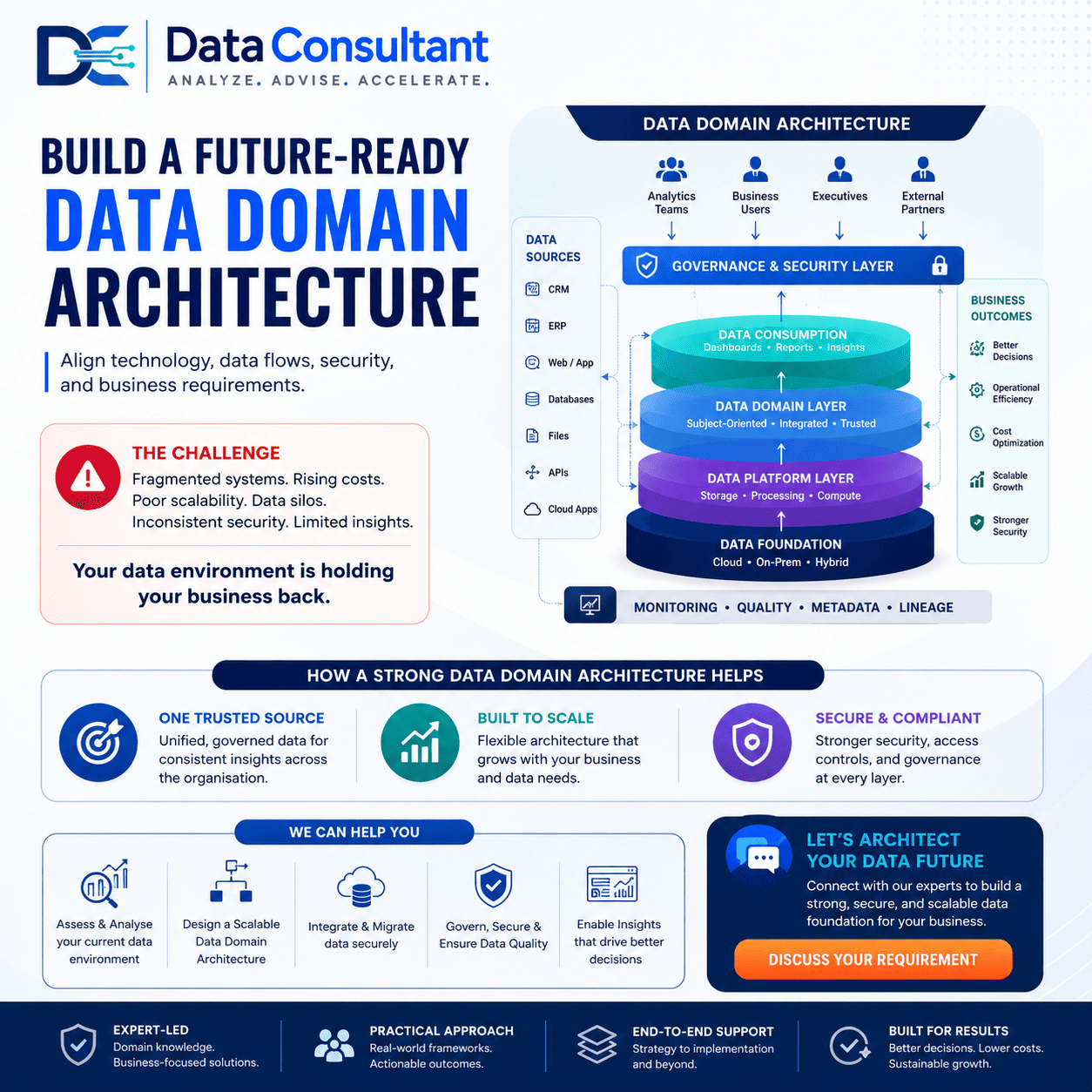
Quick Answer: Match Support to the Database Problem
Use internal staff when the issue is well understood, the data is accessible and the team has the required administration, engineering and governance capability. Buy or configure a tool when processes and ownership are already clear and the main gap is monitoring, backup, orchestration or administration functionality.
Use a short database diagnostic when teams disagree about root causes, incidents repeat, documentation is weak or a migration is being discussed before requirements are settled. Use a defined consulting project for scoped work such as performance optimisation, database design, data modelling, integration, migration, resilience or governance. Choose ongoing support only when the workload and need for specialist input are genuinely continuous.
The main caution is to avoid starting with a platform, dashboard or cloud migration before defining the service outcome and the current constraints. A new database cannot compensate for unclear ownership, poor data capture or uncontrolled change.
Key Takeaways
- Define the business service first: identify which application, report, decision or control depends on the database.
- Test data readiness: access, quality, lineage, documentation and ownership affect effort more than product choice alone.
- Keep internal accountability: business and technology owners must approve priorities, access, risk decisions and acceptance criteria.
- Choose the smallest suitable engagement: use internal action, a tool, a diagnostic, a defined project or ongoing support according to the problem.
- Specify deliverables: require findings, designs, configuration, tests, runbooks, documentation and handover where relevant.
- Build governance into delivery: security, privacy, backup, recovery, retention and change control are part of database management.
- Plan knowledge transfer: the organisation should understand how to operate and change the environment after external support ends.
Table of Contents
- Identify the real database decision
- Assess database and organisational readiness
- Compare management and support options
- Set architecture, access and governance needs
- Implement through controlled phases
- Estimate cost, time and resources
- Measure database service outcomes
- Apply the decision to real situations
- Decide where specialist support fits
- Summary
Start with the Database-Dependent Business Decision
The correct starting point is the business service that depends on the database. Name the users, transactions, reports or controls affected; the consequence of failure; and the decision that better data or reliability should support.
Separate symptoms from root causes
A slow dashboard may come from poor SQL, missing indexes, an unsuitable data model, overloaded infrastructure or a reporting design that repeatedly scans operational tables. Duplicate customer records may result from weak matching rules, disconnected applications or unclear master-data ownership. Recurring outages may reflect configuration, capacity, deployment or recovery weaknesses.
A useful diagnostic statement is: “This database must support this business service, at this service level, using these approved data sources and controls.” When that statement cannot be completed, discovery should precede a major implementation.
Know when the problem is not primarily technical
Database work will not resolve a disputed KPI, missing source fields, uncontrolled spreadsheet adjustments or an operating process that creates inconsistent records. In those cases, the better first action may be to clarify definitions, improve data capture or assign ownership before redesigning the platform.
Assess Database and Organisational Readiness
A database initiative can begin before every issue is solved, but it needs enough clarity to avoid unsafe access, uncontrolled scope and expensive rework. Assess five dimensions: business clarity, data quality, technical access, governance and internal ownership.
For governance, use recognised principles rather than informal conventions. The DAMA body of knowledge provides a broad data-management reference. Security and privacy requirements should be aligned to the laws, policies and risk frameworks that apply to your organisation.
Compare Database Management and Support Options
The best option depends on problem clarity, internal capability, urgency, continuity and risk. Compare the complete operating requirement, not only software licence fees or consulting day rates.
| Option | Best fit | Expected outputs | Internal requirement | Main risk |
|---|---|---|---|---|
| Internal team | Clear issue, accessible systems and sufficient capability | Configuration, fixes, monitoring and documentation | Time, technical depth and accountable ownership | Competing priorities delay remediation |
| Software tool | Defined processes with a functionality or automation gap | Monitoring, backup, administration or workflow capability | Configuration, integration and operating ownership | Tool purchase masks unclear processes |
| Short diagnostic | Unclear root cause, recurring incidents or uncertain readiness | Health findings, risk priorities and remediation roadmap | Interviews, evidence and controlled access | Recommendations stall without an owner |
| Defined consulting project | Scoped optimisation, migration, design, integration or governance work | Designs, implementation, tests, runbooks and handover | Decision-makers, technical cooperation and acceptance criteria | Scope expands across dependent systems |
| Ongoing consultant support | Continuous optimisation, governance or specialist demand | Regular review, improvements, advice and incident support | Prioritisation cadence and service ownership | Dependency grows without knowledge transfer |
| Dedicated specialist or managed team | Substantial, continuous, multi-technology workload | Predictable operational and improvement capacity | Executive sponsor, service model and vendor governance | Cost is wasted if demand and accountability are unclear |
A hybrid model is often practical: external specialists diagnose or implement complex work, while internal owners retain service decisions, access approvals, operational knowledge and long-term accountability.
Set Architecture, Access and Governance Requirements
Database management requires more than an administrator login. Define the target service, environment boundaries, data flows, workload, recovery objectives, access model, integration dependencies and change process before work begins.
Provide controlled technical access
- Supply a current database and application inventory.
- Document environments, interfaces, scheduled jobs and major data flows.
- Provide workload history, incident records, monitoring outputs and known constraints.
- Use least-privilege access and separate read, change and approval responsibilities where appropriate.
- Define backup, recovery, retention, encryption and audit requirements.
- Provide representative non-production data for testing where possible.
Make architecture decisions explicit
Clarify whether the database serves operational transactions, analytics, integration, master data or a combination. The design should address data modelling, workload separation, availability, scalability and interoperability. Official platform guidance, such as the Microsoft data-store overview, can help frame technology choices, but product documentation does not replace requirements analysis.
Embed security and recovery
Security, backup and recovery should be designed as operating controls, not added after build. The NIST SP 800-53 control catalogue provides a useful reference for access, audit, configuration and continuity controls. Apply relevant internal policy and legal requirements rather than treating any general framework as legal advice.
Implement Database Changes Through Controlled Phases
A safe implementation moves from evidence to design, testing, controlled release and handover. The exact sequence varies, but decisions should be documented and reversible where practical.
For migration or major redesign, establish reconciliation rules, fallback criteria and business sign-off before cutover. A technically successful move is not complete if users cannot reconcile critical reports or support teams do not understand the new operating procedures.
Estimate Database Cost, Time and Internal Resources
Database system management cost depends on estate size, technology diversity, workload criticality, data volume, data quality, availability, migration complexity, security review, documentation gaps and support coverage. Internal time is also material: application owners, infrastructure teams, security, data owners and business users may all need to participate.
A focused health check may take days or a few weeks. A defined optimisation or redesign may take several weeks. A migration or multi-system integration may take months. These are planning ranges, not promises; access delays, testing requirements and hidden dependencies can change the schedule.
Decision rule: compare the total cost of ownership and operational risk. A lower-cost tool or narrow technical fix may be poor value if the organisation still lacks ownership, documentation, recovery testing or the capability to maintain it.
Measure Database Reliability and Decision Outcomes
Success measures should follow the original business problem. Technical metrics are necessary, but they should connect to service, data and control outcomes.
- Reliability: availability, incident recurrence, failed jobs and recovery performance.
- Performance: query response, workload stability and capacity utilisation.
- Data quality: completeness, validity, duplication, reconciliation and exception resolution.
- Delivery: deployment success, rollback frequency, testing completion and documentation quality.
- Governance: access reviews, privileged activity, backup tests, change approvals and control evidence.
- Business use: reporting timeliness, operational continuity and decision confidence where evidence supports attribution.
Agree baselines and measurement periods before implementation. Avoid claiming that database work alone produced revenue, savings or compliance unless evidence separates its contribution from other changes.
Practical Database System Management Decisions
Ecommerce reports show different revenue totals
The mistaken assumption is that a new dashboard will solve the disagreement. The actual problem may be inconsistent order status rules, duplicate customer identifiers and separate refund logic across systems. A short diagnostic should map definitions and data flows first. Likely deliverables include reconciled metric rules, source-to-report lineage, data-quality checks and a phased integration plan. Finance, ecommerce, data and application owners must participate.
A professional-services firm relies on manual spreadsheets
The team may ask for a new database immediately, but the first need is to define project, client, time and billing records and decide who owns them. A defined project may then design a suitable data model, load process, access controls and management reporting layer. Internal process owners must validate definitions and adopt the new workflow.
An enterprise plans a database migration
The mistaken assumption is that migration is mainly a copy exercise. The real work includes compatibility, performance, dependencies, security, testing, reconciliation, cutover and recovery. A defined consulting project is appropriate when specialist platform and migration knowledge is temporary. Deliverables should include an inventory, target design, migration waves, test evidence, rollback criteria, runbooks and knowledge transfer.
A startup wants predictive analytics
The startup may not yet collect consistent product, customer and operational data. Buying modelling tools or hiring an AI specialist too early will not fix missing events and unstable definitions. The better decision may be a limited data-readiness diagnostic, improved data capture and a simple reporting foundation before advanced analytics.
Use Specialist Support Only Where It Adds Value
A database consultant can help when the organisation needs independent diagnosis, temporary expertise, architecture decisions, data modelling, integration design, performance tuning, migration planning, governance or controlled implementation. External support is less useful when the organisation has not assigned a business owner or cannot provide the necessary evidence and stakeholder time.
DataConsultant can support a short database and data-management diagnostic, a defined architecture or implementation project, ongoing advisory support or specialist capacity where the need is continuous. The appropriate model should be based on the problem, not on a preference for outsourcing.
Summary: Choose the Smallest Effective Database Response
Use internal staff when the objective is clear and capability is available. Configure a tool when ownership and processes are defined and functionality is the main gap. Use a short diagnostic when the root cause, data quality or readiness is uncertain. Use a defined project for scoped design, optimisation, integration, migration or governance work. Choose ongoing support or a managed team only when the workload is substantial and continuous.
The best next action may also be to clarify the business problem, improve source data, assign ownership, document the current estate or delay a major migration until controls and acceptance criteria are ready. Effective database system management is ultimately an operating capability, not a one-off technology purchase.
FAQs on Database System Management
What is database system management?
Database system management is the coordinated work of designing, operating, securing, monitoring and improving databases so that business applications and reporting can use reliable data. It covers architecture, access, backup and recovery, performance, data quality, change control, documentation and ongoing ownership.
When should a business use a database consultant?
Use a database consultant when performance, reliability, integration, migration, governance or security problems exceed the available internal capability, or when an important project needs temporary specialist knowledge. Start with a short diagnostic when the cause or scope is still unclear.
Can database software solve management problems by itself?
Software can automate monitoring, backup, security controls and administration, but it cannot define business priorities, resolve disputed ownership, repair weak source processes or create an operating model on its own. Tools work best when requirements, responsibilities and decision rules are already clear.
What information does a database consultant need?
A consultant normally needs the business objective, system inventory, data flows, workload patterns, incident history, service expectations, security requirements, existing documentation and access to relevant technical stakeholders. Production access should be controlled and limited to what the agreed work requires.
How long does a database management project take?
A focused health check may take days or a few weeks. A defined optimisation, migration, integration or governance project may take several weeks to several months. Timing depends on database count, complexity, data volume, access approvals, testing, downtime constraints and the quality of existing documentation.
What drives the cost of database system management?
Cost is driven by scope, database technologies, estate size, availability requirements, data quality, migration complexity, security controls, integration dependencies, documentation gaps, support hours and the amount of internal participation. Compare total delivery and operating cost rather than day rates or licence fees alone.
What deliverables should a database consulting project include?
Typical deliverables include findings, a prioritised remediation plan, target architecture, configuration recommendations, data models, migration or integration designs, test evidence, operational procedures, monitoring requirements, security and access controls, documentation, training and a clear handover.
How should database management success be measured?
Use measures linked to the original problem, such as service availability, query response, incident recurrence, recovery performance, data-quality exceptions, deployment reliability, reporting timeliness, control completion and reduced manual intervention where evidenced. Avoid claiming business outcomes that cannot be attributed to the work.
When is ongoing database support appropriate?
Ongoing support is appropriate when the database estate changes frequently, availability is critical, internal capacity is limited, optimisation is continuous or several teams need regular specialist input. A defined project is usually better when the objective is finite and the internal team can own the environment afterwards.
Need a Database Management Diagnostic?
Share the business service, current databases, recurring issues, access constraints and required outcomes. DataConsultant can help determine whether internal action, a tool, a short diagnostic, a defined project or ongoing specialist support is the best fit.
Discuss your requirement