
Cloud Explained for Business Leaders
Cloud explained in practical business terms: cloud computing means using computing capacity, storage, databases, software and data services over managed internet-connected infrastructure instead of owning and operating every system yourself. The real decision is not whether “the cloud” is modern, but which workloads, data and controls should move, what should remain where it is, and what business outcome the change must support.
Start with the operational problem rather than a provider or product. A cloud move may be appropriate when infrastructure is difficult to scale, reporting depends on disconnected systems, resilience is weak, deployment is slow or specialist data capabilities are unavailable internally. It may be inappropriate when the business case is vague, data ownership is unresolved, regulatory constraints are not understood or the organisation lacks people who can govern the environment after implementation.
This guide separates cloud concepts from sales language. It explains deployment models, cloud data platforms, readiness, cost, security, migration choices, engagement options and measurable outcomes so founders, finance leaders, operations teams, technology leaders and procurement teams can make a proportionate decision.
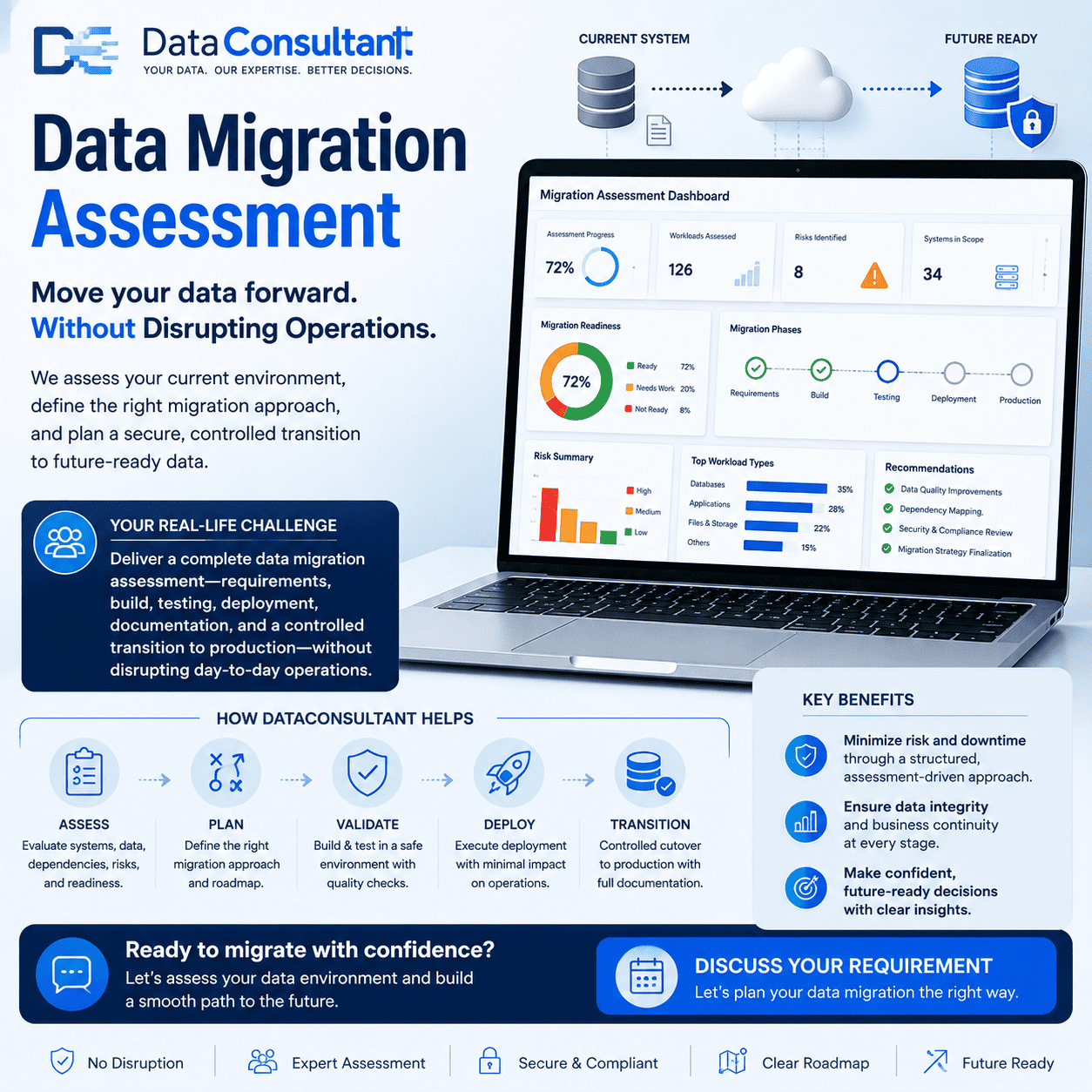
Quick Answer: Cloud Is a Delivery Model, Not a Destination
Cloud services let an organisation consume infrastructure and software on demand, usually with usage-based or subscription pricing. Public cloud uses shared provider infrastructure with logical separation. Private cloud dedicates an environment to one organisation. Hybrid cloud combines cloud services with on-premises systems, while multi-cloud uses services from more than one provider.
Use a short diagnostic when the problem, workload suitability, data quality or security requirements are unclear. Use a defined cloud project when scope, migration waves, acceptance criteria and target architecture can be agreed. Choose ongoing support only when optimisation, platform engineering, data operations, security monitoring or governance will remain a continuous need.
The main caution is simple: do not start with “move everything to the cloud”. First define the business decision, the systems and data involved, the constraints, the owner and the evidence that will show whether the change worked.
Key Takeaways
- Cloud is rented capability: infrastructure, platforms and software are consumed as services rather than fully owned and operated internally.
- Workload fit matters: not every application or dataset benefits from migration.
- Data readiness affects cost: poor quality, duplicated data and undocumented integrations increase migration effort.
- Security is shared: the provider secures underlying services, while the customer still owns identity, configuration, data protection and access decisions.
- Internal ownership remains essential: architecture, finance, security, risk and business teams must make and sustain key decisions.
- Scope deliverables precisely: expect architecture, migration plans, controls, testing evidence, documentation and handover.
- Measure business capability: evaluate resilience, delivery speed, data availability, service quality and controllable cost—not migration completion alone.
Table of Contents
- Understand what cloud changes
- Check cloud and data readiness
- Compare delivery and support options
- Set architecture and security requirements
- Plan migration in controlled phases
- Estimate cloud cost and resources
- Measure practical cloud outcomes
- Apply the decision to real situations
- Decide when specialist support helps
- Summary
- Frequently Asked Questions
Understand What Cloud Changes—and What It Does Not
Cloud changes how technology capability is provisioned, scaled and operated. It does not automatically fix weak processes, unreliable data or unclear accountability.
Infrastructure, platform and software services
Infrastructure as a Service provides configurable computing, networking and storage. Platform as a Service adds managed components for databases, integration, application deployment and analytics. Software as a Service provides a complete application accessed through a browser or interface. The further you move from infrastructure towards software, the more operational responsibility the provider carries—and the less technical control the customer usually retains.
Public, private, hybrid and multi-cloud
Public cloud is suitable when managed scale, broad service choice and rapid provisioning matter. Private cloud may suit workloads requiring dedicated environments or specific control models. Hybrid cloud is common when legacy systems, data residency, latency or phased migration prevent a complete move. Multi-cloud may reduce dependence on one provider or allow specialist services, but it also increases integration, skills, governance and cost-management complexity.
Decision rule: choose the simplest deployment model that meets business, security, resilience and regulatory requirements. Complexity should be justified by a real constraint, not by architecture fashion.
Cloud data platforms
A cloud data platform brings together storage, integration, processing, analytics and governance services. Depending on the need, it may include a data warehouse, data lake, lakehouse, ETL or ELT pipelines, metadata, data quality controls, business intelligence and machine-learning services. The platform is valuable only when it supports defined decisions, trusted data products and accountable ownership.
Check Cloud and Data Readiness Before Migration
Readiness is sufficient when the organisation understands why it is moving, which workloads are in scope, what data they use, who owns the decision and what controls apply. A perfect environment is not required, but an unmanaged one is a warning sign.
Business clarity
Document the outcome in operational terms: faster product releases, improved disaster recovery, scalable ecommerce capacity, consolidated reporting, reduced infrastructure risk or access to managed data services. “Modernisation” by itself is not an acceptance criterion.
Application and data inventory
Identify applications, databases, interfaces, reports, users, service levels, retention periods, licences and dependencies. Unknown dependencies are a common cause of migration delay. Data classifications and ownership should be agreed before sensitive information is copied into a new environment.
Operating capability
Cloud services still require architecture, identity management, configuration control, monitoring, incident response, backup, cost management and supplier oversight. Decide which responsibilities remain internal, which are automated and which require external support.
Compare Internal, Tool and Cloud Consulting Options
The right approach depends on problem clarity, available skills, urgency, workload continuity and the level of change. A cloud subscription is not a substitute for architecture, migration or governance work.
| Option | Best fit | Expected outputs | Internal requirement | Main risk |
|---|---|---|---|---|
| Internal team | Clear scope, capable staff and manageable workload | Architecture, configuration, migration and operations | Cloud, security, data and delivery capability | Competing priorities or skill gaps delay delivery |
| Software or managed cloud service | Requirements and operating model are already defined | Provisioned platform capability and vendor support | Configuration, integration, governance and adoption | Tool is purchased before the problem is solved |
| Short cloud diagnostic | Unclear business case, estate, risk or migration path | Current-state findings, options, risks and roadmap | Stakeholder access and technical evidence | Recommendations stall without an accountable owner |
| Defined cloud project | Scoped migration, platform build or modernisation | Target design, migration waves, testing and handover | Business, technology, security and vendor participation | Scope expands without acceptance criteria |
| Ongoing specialist support | Continuous optimisation, data operations or governance | Platform improvements, monitoring and advisory support | Regular prioritisation and service governance | Dependency develops without knowledge transfer |
| Dedicated specialist or managed team | Substantial, multi-disciplinary and recurring workload | Predictable engineering, security and operational capacity | Executive sponsor and clear operating cadence | Capacity is wasted when priorities remain unclear |
A hybrid model is often practical: internal leaders retain architecture, risk and business ownership while specialists provide temporary delivery capacity or niche expertise.
Set Cloud Architecture, Security and Governance Requirements
A secure cloud environment is designed through explicit responsibility, not assumed from the provider’s reputation. Major providers describe cloud security as a shared-responsibility model: the provider manages security of the underlying cloud, while customers remain responsible for areas such as identity, data, applications and configuration. Review the applicable provider documentation and contract for the service selected.
Identity and access
Use central identity, multi-factor authentication, least privilege, role-based access, privileged-access controls and regular access review. Separate production from development and restrict administrative access. Service accounts, keys and secrets need owners, rotation and monitoring.
Data protection and resilience
Define encryption, key management, backup, recovery, retention, deletion, data residency and incident-response requirements. Test recovery rather than relying on the existence of backups. The NIST Cybersecurity Framework provides a useful structure for identifying, protecting, detecting, responding and recovering, while ISO/IEC 27001 provides a risk-based information-security management framework.
Architecture and portability
Document network boundaries, integration patterns, data flows, service dependencies and exit considerations. Portability does not mean every service must be provider-neutral; it means the organisation understands switching cost, data extraction, contractual rights, replacement options and the business impact of dependency.
Governance and financial control
Apply policies through approved patterns, automated checks and accountable exceptions. Tag resources, assign cost owners, set budgets and review idle capacity. The FinOps Framework describes collaborative practices for managing the business value of cloud expenditure. Use it as operational guidance rather than a guarantee of savings.
Plan Cloud Migration in Controlled Phases
A phased migration reduces uncertainty and creates evidence before wider commitment. Begin with discovery, choose a representative but manageable workload, test the target controls and then expand only after the pilot meets agreed criteria.
Choose the right migration treatment
- Retain: keep the workload where it is when migration value is weak or constraints are unresolved.
- Retire: remove unused or duplicated applications before spending money moving them.
- Rehost: move with limited change when speed matters, while recognising that legacy cost or design issues may remain.
- Replatform: adopt selected managed services without redesigning the whole application.
- Refactor: redesign for cloud-native operation when the expected benefit justifies greater cost and risk.
- Replace: use a suitable software service when custom ownership is no longer valuable.
Define acceptance and rollback
Set performance, security, data reconciliation, availability, user acceptance and recovery criteria. Include a rollback or containment plan. For data migration, compare record counts, balances, critical fields and downstream reports—not only whether files transferred successfully.
Complete knowledge transfer
Handover should include architecture diagrams, configuration records, operating procedures, access models, monitoring, backup and recovery steps, known limitations, support contacts, runbooks and training. Documentation is part of the product, not an administrative extra.
Estimate Cloud Cost, Time and Internal Resources
Cloud cost depends on consumption and operating choices, not only advertised unit prices. Compute, storage, data transfer, managed services, licences, security tools, support plans, backup, monitoring and non-production environments all contribute.
Main cost drivers
- workload volume, variability and availability requirements;
- data storage, processing frequency and movement between locations;
- migration complexity and legacy integration;
- security, compliance, audit and resilience requirements;
- engineering, testing, change management and training;
- support, monitoring and continuous optimisation.
A low initial bill can grow when resources are over-sized, left running, duplicated across environments or poorly tagged. Conversely, aggressive cost reduction can damage resilience or performance. Use cost forecasts with assumptions and ranges, then compare them with actual usage after implementation.
Typical timeline logic
A focused assessment may take several weeks when evidence and stakeholders are available. A defined platform or migration project may take several months. Complex enterprise programmes can take longer because application dependencies, security approval, data remediation, testing and business cutover must be coordinated. A credible estimate states dependencies and confidence rather than offering a universal duration.
Measure Whether Cloud Created Useful Capability
Migration completion is an activity measure. Useful outcomes show whether the organisation can operate better with acceptable risk and cost.
- Reliability: availability, recovery performance, incident frequency and service degradation.
- Delivery: lead time for approved changes, deployment frequency and environment-provisioning time.
- Data: timeliness, reconciliation, quality exceptions and availability of decision-ready information.
- Security: identity coverage, configuration findings, remediation time and tested recovery.
- Financial control: forecast variance, unit cost, idle capacity and ownership of spend.
- Adoption: use of approved services, user experience and retirement of unnecessary legacy components.
Baseline the current state before migration. Attribute outcomes carefully: better performance may also reflect process changes, staff capability, application redesign or data-quality work completed alongside the cloud project.
Cloud Explained Through Practical Business Situations
Ecommerce growth with unstable peak performance
A retailer assumes that moving its website to the cloud will automatically prevent outages. The actual problem is a combination of fixed infrastructure, an untested application bottleneck and weak monitoring. A defined project is more suitable than a simple hosting change. Likely deliverables include workload testing, scalable architecture, monitoring, recovery design and a controlled cutover. Product, operations, security and customer-support teams must help define critical journeys and acceptable disruption.
Conflicting management reports across locations
A multi-location business wants a cloud dashboard. The deeper problem is inconsistent KPI definitions and duplicated customer and product data. A short diagnostic should precede the tool purchase. Deliverables may include a source inventory, metric definitions, data-quality findings, target data model and phased reporting roadmap. Finance and operational owners must agree definitions before engineering begins.
Startup considering predictive analytics
A startup expects cloud machine learning to improve forecasting, but historical data is incomplete and collection methods change frequently. The better decision is to strengthen data capture, ownership and basic reporting first. A limited data-readiness assessment can identify minimum viable data, governance controls and a later experimentation plan. Advanced services should be delayed until the evidence can support them.
Enterprise data warehouse modernisation
An enterprise has a costly legacy warehouse and slow release cycles. The initiative requires more than copying tables. A defined programme should address target architecture, workload treatment, data reconciliation, security, downstream reporting, cutover and retirement. Internal data owners, platform teams, risk, procurement and business users remain accountable for decisions even when specialists deliver the migration.
Decide When Cloud Specialist Support Is Appropriate
External support is useful when the organisation needs independent diagnosis, temporary specialist capability, delivery acceleration or a controlled handover. It is less useful when leaders have not agreed the business problem, cannot provide access to evidence or will not assign an internal owner.
Use a short diagnostic when uncertainty is high
A diagnostic can clarify business goals, workload suitability, security constraints, data readiness, cost assumptions and migration options. It should end with prioritised decisions and evidence, not a generic recommendation to move to cloud.
Use a defined project when outputs can be accepted
A project is justified when target architecture, migration scope, testing, documentation and handover can be described. Acceptance criteria protect both the organisation and the delivery team from open-ended expectations.
Choose ongoing support only for continuing work
Ongoing advisory or managed support may fit when platform engineering, data operations, security improvement, cost optimisation or governance creates a recurring workload. It should include service boundaries, decision rights, reporting, knowledge transfer and an exit path.
DataConsultant.in supports cloud data-platform assessment, architecture, migration planning, data engineering, governance, analytics and implementation roadmaps where those services directly match the business problem. A proportionate first step is often a focused discovery rather than a large transformation commitment.
Summary
Cloud computing provides on-demand infrastructure, platforms and software, but the right choice depends on the workload, data, risk and operating model. Internal staff may be sufficient when the objective is clear, capability exists and scope is manageable. A software service may be appropriate when requirements and governance are already defined. A short diagnostic is useful when the estate, data quality, security constraints or business case remain uncertain.
A defined cloud project is justified when architecture, migration, testing and handover can be scoped. Ongoing support or a managed team is appropriate only when the workload is substantial and continuous. Before committing, validate business goals, data quality, access, governance, internal ownership, scope, budget, timeline, security, quality assurance, documentation and knowledge transfer.
Practical next step: create a one-page decision brief listing the business outcome, workloads, data, constraints, owners and evidence of success. Use it to decide whether to proceed internally, buy a service, run a diagnostic or scope a project.
At DataConsultant.in, we help organisations turn data and AI priorities into governed, reliable, and practical business capability.
Frequently Asked Questions
What is cloud computing in simple terms?
Cloud computing is the use of computing resources—such as servers, storage, databases, applications and analytics—delivered as managed services over a network. The customer pays for access or consumption rather than owning and operating every component directly.
What does “cloud explained” mean for a business decision?
It means understanding cloud as an operating and sourcing choice. The business should decide which workloads and data are suitable, which outcomes matter, what controls apply, who owns the environment and whether internal delivery, a managed service or specialist support is the best fit.
What is the difference between public, private and hybrid cloud?
Public cloud uses provider-operated shared infrastructure with logical separation. Private cloud provides a dedicated environment for one organisation. Hybrid cloud combines cloud services with on-premises or private environments, often because of legacy, latency, residency or phased-migration requirements.
Is cloud always cheaper than on-premises infrastructure?
No. Cloud can change capital expenditure into variable operating expenditure and reduce some infrastructure tasks, but total cost depends on usage, architecture, data transfer, licences, support, security, skills and governance. Poorly controlled consumption can increase cost.
Is data safer in the cloud?
Cloud providers can offer strong security capabilities, but safety depends on correct identity, configuration, encryption, monitoring, backup and governance. Security responsibility is shared, and customers remain accountable for their data, access decisions and use of the service.
Which workloads should not move to the cloud?
A workload may be retained when migration value is weak, latency is critical, dependencies are poorly understood, contractual or regulatory constraints are unresolved, or the application is close to retirement. The decision should be evidence-based rather than ideological.
What is a cloud data platform?
A cloud data platform combines managed services for storing, integrating, processing, governing and analysing data. It may include a warehouse, lake or lakehouse, ETL or ELT pipelines, metadata, data quality, business intelligence and machine-learning services.
How long does a cloud migration take?
A focused assessment may take several weeks, while a scoped migration or platform build may take several months. Complex programmes take longer when application dependencies, data remediation, security approval, testing, procurement and business cutover require coordination.
When should a business use a cloud consultant?
Use a consultant when the business needs independent diagnosis, temporary specialist knowledge, architecture or migration capability, or structured delivery and handover. Do not engage one before defining the business problem, assigning internal ownership and agreeing access to evidence.
What deliverables should a cloud consulting project include?
Depending on scope, deliverables may include current-state findings, target architecture, workload treatment, migration waves, cost assumptions, security controls, test plans, reconciliation evidence, operating procedures, documentation, training and handover materials.