
Talk to an AI for Business: What to Ask and When to Escalate
If you want to talk to an AI about a business data problem, use the conversation to clarify the question, explore possible explanations and shape the next step—not to make an unverified operational, financial, compliance or customer decision. The practical starting point is to tell the AI what decision you are trying to make, what data you actually have, what constraints apply and what evidence would count as a satisfactory answer. A conversational AI can be useful for brainstorming, structuring requirements, drafting analysis steps and explaining unfamiliar concepts, but it does not automatically know whether your data is complete, whether two reports use the same metric definition or whether a suggested approach is safe in your environment.
The important distinction is between a conversation problem and a data problem. If you need help phrasing a question or comparing general options, an AI assistant may be enough. If the answer depends on source-system access, conflicting KPIs, data quality, integration, governance, model validation or implementation, you need evidence and accountable ownership. That may be handled internally, through a short data diagnostic, or through a defined consulting engagement.
This guide is for founders, business owners, data and technology leaders, finance, marketing and operations teams deciding how far an AI conversation can take them and when specialist data support becomes the safer and more efficient route.
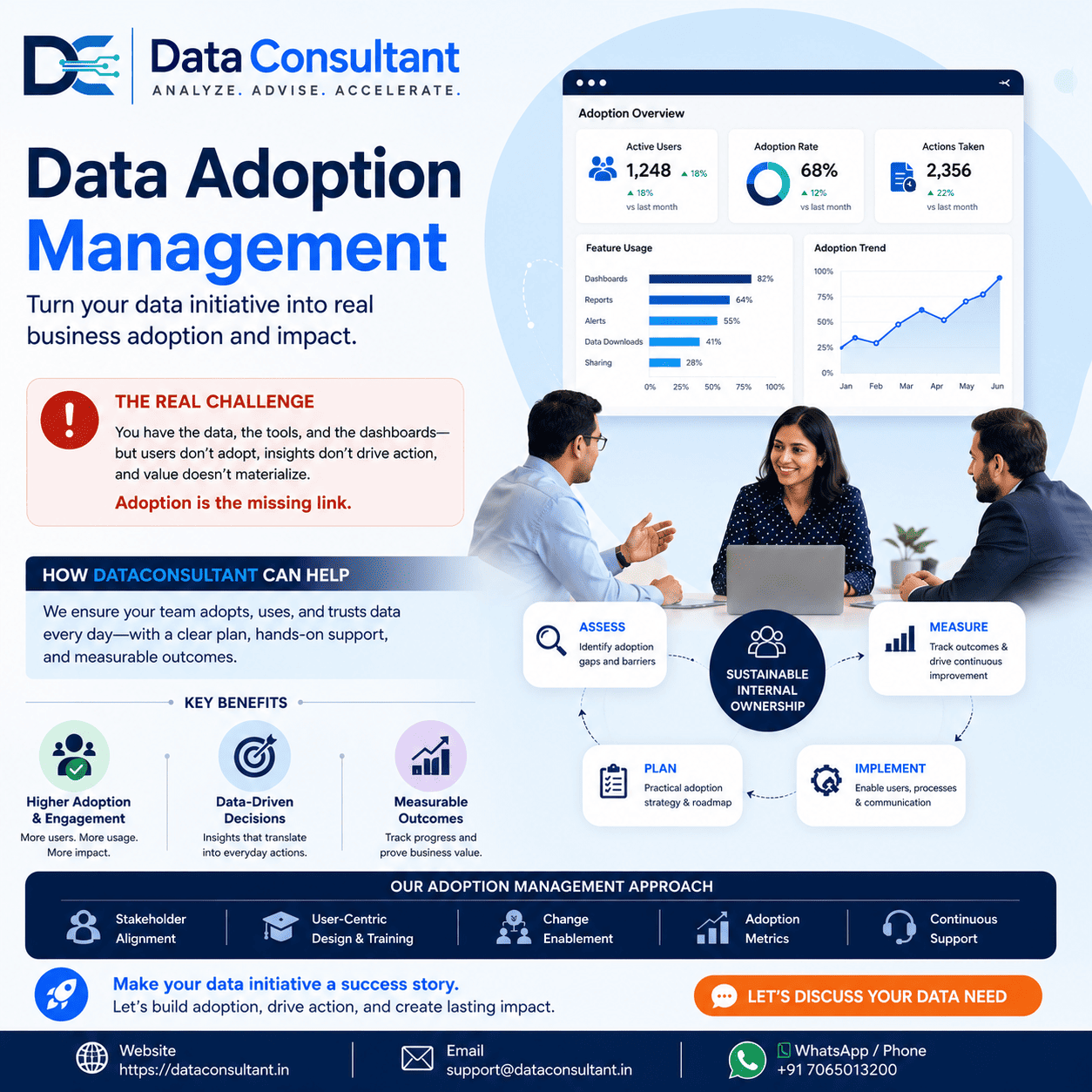
Quick Answer: Use AI for Clarity, Not Unchecked Authority
Talk to an AI when you need a fast way to organise a business question, generate hypotheses, draft requirements or understand which analyses might be relevant. Give it enough context to be useful, but minimise sensitive information and verify outputs against approved sources. The more material the decision is, the more important independent checking becomes.
Use internal staff when the question, data and method are already clear. Use a short data diagnostic when teams disagree about the problem or the evidence is unreliable. Use a defined consulting project when you need specialist delivery such as data architecture, integration, reporting, governance, forecasting or AI readiness. Choose ongoing support only when the need is genuinely recurring.
The main caution is simple: do not hire a consultant—or act on an AI answer—before defining the business decision or operational problem. Start with the smallest step that can establish what is true and what needs to change.
Key Takeaways
- Use AI to frame the problem: ask it to organise assumptions, questions and possible analyses before you commit resources.
- Check data readiness: an AI answer cannot repair missing events, inconsistent definitions or unreliable source-system processes.
- Keep internal ownership: accountable leaders must own the decision, access approvals, risk boundaries and adoption.
- Match scope to evidence: choose internal work, a tool, a diagnostic, a defined project or ongoing support according to what must actually be validated and delivered.
- Protect sensitive information: follow approved privacy, security and AI-use rules before sharing business or personal data.
- Demand clear deliverables: external work should state outputs, acceptance criteria, documentation, testing and handover.
- Plan knowledge transfer: AI prompts and consultant outputs are more valuable when internal teams can maintain the resulting process.
Table of Contents
- Decide what the AI conversation is for
- Prepare context and check data readiness
- Compare AI, internal and consulting options
- Protect data, privacy and decision quality
- Turn AI answers into verified action
- Estimate cost, time and resources
- Measure whether the decision improved
- Apply the decision to real situations
- Decide when a data consultant fits
- Summary
Decide What the AI Conversation Is For
An AI conversation is most useful when you can state the decision in plain business language. “Help us use AI” is not a decision. “Why do our ecommerce revenue reports disagree, and what evidence should we compare first?” is much better because it points to a measurable discrepancy, affected systems and a verification path.
Ask for structure before asking for conclusions
Start by asking the AI to identify assumptions, missing information, alternative explanations and the evidence needed to distinguish them. For example, if marketing and finance report different customer-acquisition figures, ask for a reconciliation checklist covering date windows, attribution rules, refunds, channel mapping, duplicate identities and source ownership. That produces a useful investigation frame without pretending the answer is already known.
Know what an AI cannot validate from a chat
A conversational AI cannot inspect systems it has not been given access to, confirm that a dashboard is calculated correctly, determine whether a dataset is complete or approve a governance exception on behalf of your organisation. NIST's Generative AI Profile for the AI Risk Management Framework is designed to help organisations identify and manage risks specific to generative AI. The practical implication is that important outputs need evaluation in context, not just fluent wording.
Decision rule: if a wrong answer would create material financial, legal, privacy, security, customer or operational consequences, treat the AI output as a hypothesis that requires human review and evidence.
Prepare Context and Check Data Readiness
Better prompts help, but business usefulness depends more on the quality of the underlying context. Before you talk to an AI about analytics, reporting or automation, identify what is known, what is uncertain and who can confirm it.
Prepare the minimum useful context
- The business decision or workflow that needs to improve.
- The users or stakeholders affected by the decision.
- The current KPI definitions and any known disagreements.
- The relevant source systems and the period covered.
- Known data-quality issues, exclusions and manual adjustments.
- The required output: explanation, diagnostic questions, requirements, analysis plan or implementation options.
- Constraints such as privacy, security, regulation, budget, timeline and approved technology.
You do not need to paste raw customer records or confidential datasets into a chat to get started. A summarised schema, synthetic example, redacted process description or list of field definitions may be enough to clarify the analysis. If the work later requires row-level evidence, access should move into an approved technical environment with appropriate controls.
Data maturity changes the right next step
If the business has agreed metrics, documented systems, reliable pipelines and named owners, internal staff may be able to validate an AI-generated analysis plan quickly. If reports conflict, data is manually patched or ownership is unclear, the first requirement is usually a data maturity or quality diagnostic rather than a more sophisticated prompt. Adding AI on top of unstable definitions can make the problem harder to see because the output may sound more certain than the evidence allows.
Compare AI, Internal Teams and Consulting Support
The correct option depends on problem clarity, internal capability, urgency, governance and whether the work ends with advice or requires technical delivery. An AI assistant is one tool in the decision process; it is not a substitute for every role around it.
| Option | Best fit | Expected outputs | Internal requirement | Main risk |
|---|---|---|---|---|
| Internal team | Question is clear and data is accessible and trusted | Analysis, validation, report or process change | Available skills, time and accountable owner | Competing priorities or capability gaps |
| AI assistant or software tool | Low-risk clarification, drafting, exploration or well-defined functionality gap | Ideas, structured questions, draft logic or configured features | Clear inputs and strong review discipline | Unverified output is mistaken for evidence |
| Short data diagnostic | Reports conflict, quality is uncertain or requirements are unclear | Findings, prioritised issues, decision criteria and roadmap | Stakeholder interviews and evidence access | Recommendations stall without an internal owner |
| Defined consulting project | Specialist design or implementation can be scoped | Requirements, architecture, integration, analytics, governance, testing and handover | Named stakeholders, access and acceptance criteria | Scope expands before priorities are agreed |
| Ongoing consultant support | Analytics, quality or governance needs recur | Regular advisory, optimisation, review and specialist delivery | Operating cadence and prioritisation | Dependency if knowledge is not transferred |
| Dedicated specialist or managed team | Substantial continuous workload across several disciplines | Predictable delivery capacity and coordinated data work | Executive sponsor and internal product ownership | Capacity is wasted when priorities are weak |
A hybrid is often sensible: use AI to accelerate question framing and documentation, keep business ownership internal, and bring in specialist support only for the evidence, design or implementation that genuinely requires it.
Protect Data, Privacy and Decision Quality
Before sharing business information with an AI service, decide what data is permitted, who is authorised to use the service and how outputs will be reviewed. Privacy and security are not prompt-engineering details; they are organisational controls.
The OECD AI Principles emphasise transparency, human oversight, robustness and accountability. The ICO AI and data protection risk toolkit provides practical support for organisations assessing risks to people's rights and freedoms. For organisations formalising enterprise AI governance, ISO/IEC 42001 sets requirements for establishing and continually improving an AI management system.
Use a controlled information boundary
- Do not share data merely because it may improve the answer.
- Minimise personal, regulated, confidential or commercially sensitive information.
- Use approved accounts, services and access configurations.
- Record material assumptions and source references separately from the chat transcript.
- Require a human owner for decisions that affect people, money, compliance, security or production systems.
If you cannot explain where the input came from, who owns it, whether it is permitted to be used and how the answer will be checked, the organisation is not ready to rely on that conversation for a material decision.
Turn AI Answers into Verified Business Action
The useful output from an AI conversation is often not the final answer but a better specification for what must be checked. Convert the chat into an evidence plan: list the claims, identify the required source, assign an owner and define what result would confirm or reject each claim.
For a short diagnostic
Expect a concise problem statement, stakeholder map, inventory of relevant data sources, known limitations, data-quality findings, risk notes and a prioritised roadmap. A diagnostic should narrow the decision rather than quietly become an implementation project.
For a defined project
Expect scoped requirements, architecture or data models where relevant, integration specifications, KPI logic, dashboards or analytical outputs, test criteria, issue logs, documentation and handover. If the work involves migration or automation, agree rollback, quality assurance and ownership before production changes begin.
For ongoing support
Define a prioritisation cadence, service boundaries, access controls, documentation standards and knowledge-transfer expectations. Ongoing support is justified by recurring work, not by the convenience of leaving ownership outside the organisation.
Estimate Cost, Time and Resources by Validation Effort
Do not compare an AI subscription with a consulting fee as though they buy the same outcome. The real cost is the effort required to establish reliable evidence, make technical changes and maintain the result. A low-cost AI conversation may still create substantial internal work if staff must reconcile data, secure access, test logic and document decisions.
Cost rises with unclear scope, poor data quality, multiple systems, complex integration, security review, stakeholder disagreement, custom modelling, production deployment and extensive knowledge transfer. A short diagnostic is usually the smallest external commitment because it focuses on discovery and prioritisation. A defined project costs more because it creates and tests deliverables. Ongoing support or a managed team creates continuing cost in exchange for recurring capacity.
Timeline follows the same pattern. Work moves faster when owners, definitions, access and acceptance criteria are ready. It slows when discovery reveals inconsistent KPIs, undocumented transformations or approval dependencies. Ask for milestones and decision gates so the organisation can stop, rescope or continue based on evidence.
Measure Whether the Decision Actually Improved
Measure the business capability created, not the volume of AI conversations or consulting activity. The relevant indicators depend on the problem: fewer conflicting KPI definitions, more reliable reconciliations, shorter reporting cycles where evidenced, reduced manual rework, clearer data ownership, improved traceability, better documented models or higher adoption of governed reports.
Separate contribution from attribution. If a forecasting process improves after an AI-assisted redesign, do not assume the AI caused the improvement; changes in data, process, staffing or market conditions may also matter. Keep a baseline, record what changed and review whether the new method remains reliable over time.
A practical close-out should answer three questions: can internal teams reproduce the result, can they explain its limitations, and do they know what to monitor next? If not, the work is not fully handed over.
Three Situations Where the Right Next Step Differs
Ecommerce reports disagree on revenue
A retailer asks an AI why finance, ecommerce and advertising dashboards show different revenue. The mistaken assumption is that the AI can identify the true number from descriptions alone. The actual problem may involve order timing, cancellations, returns, currency conversion or attribution windows. The better next step is a short diagnostic that reconciles definitions and traces selected transactions across systems. Likely deliverables include a metric dictionary, source-of-truth recommendation, discrepancy log and remediation roadmap. Finance, marketing and ecommerce owners must participate.
A services company wants automated management reporting
A growing professional-services firm uses spreadsheets and asks an AI to design an automated dashboard. If KPI definitions are already stable and the data can be exported cleanly, internal analysts may use the AI to accelerate requirements and formulas, then implement with existing tools. If data must be integrated from CRM, finance and project systems, a defined data project may be more appropriate. Deliverables could include a data model, automated pipeline, dashboard, test cases and documentation. Internal finance and operations leaders still own the measures.
A startup wants predictive AI before reliable data
A startup asks an AI which predictive model will improve retention. The mistaken assumption is that model choice is the main problem. In reality, product events may be inconsistent, customer identifiers may be unstable and retention may not yet have an agreed definition. The better decision is to delay advanced modelling, fix instrumentation and establish a KPI framework first. A consultant may help with a lightweight data maturity assessment and roadmap, but the internal product team must own event definitions and collection quality.
Use a Data Consultant When the Problem Needs Evidence
A data consultant is appropriate when the next step requires more than advice from a chat: real-system discovery, data-quality assessment, architecture, integration, analytics design, governance, forecasting, AI readiness, implementation planning or accountable handover. In practical terms, the consultant turns an ambiguous business concern into defined evidence, requirements and deliverables that can be tested.
For an unclear problem, a data assessment or audit can establish readiness and priorities. For requirements, operating models and roadmaps, a data advisory engagement may be the better fit. If the issue specifically concerns enterprise AI adoption, governance or implementation readiness, review the scope of AI data services rather than defaulting to a broad technology project.
Do not outsource the business decision itself. Internal leaders should still own priorities, data permissions, budget, risk acceptance and adoption. External support should make those decisions better informed and easier to execute, not less accountable.
Summary
Talk to an AI when you need clarity, structure, comparison or a first analytical plan. Use internal staff when the problem is well defined and the data and skills already exist. Buy or configure a tool when functionality—not strategy or evidence—is the main gap. Use a short diagnostic when the problem is unclear, reports conflict or data readiness is uncertain. Move to a defined consulting project when specialist design, integration, analytics, governance or implementation can be scoped, and choose ongoing support or a managed team only when the workload is genuinely continuous.
Before escalating, validate the business goal, data quality, access, governance and internal ownership. Then define scope, budget, timeline, security requirements, documentation, quality assurance, knowledge transfer and handover in proportion to the work. The objective is not to maximise AI use or consulting hours; it is to make a better decision with evidence the organisation can understand and maintain.
Frequently Asked Questions About Talking to AI
What does it mean to talk to an AI for a business data problem?
It means using a conversational AI system to clarify a question, explore possible explanations, structure requirements or draft an analysis plan. Treat the response as a working hypothesis rather than verified evidence. Check important claims against your source systems, approved documentation and accountable subject-matter owners before acting.
Should I talk to an AI or hire a data consultant?
Talk to an AI when the problem is low-risk, the data is already understood and you mainly need ideas, structure or a first draft. Use a data consultant when the issue depends on access to real systems, conflicting metrics, data quality, architecture, governance, integration, implementation or accountable delivery. A short diagnostic is often the right bridge when the problem itself is unclear.
Can I talk to an AI about confidential business data?
Only after your organisation has confirmed that the chosen AI service, account configuration, contractual terms and internal policy permit the information you plan to use. Minimise or anonymise sensitive data where possible, avoid unnecessary personal or regulated information, and follow approved security and data-protection controls. If the rules are unclear, resolve them before sharing the data.
What information should I prepare before talking to an AI?
Prepare the business decision, current process, agreed KPI definitions, known data limitations, relevant time period, intended audience and the output you need. You can often start with synthetic or summarised examples instead of raw confidential data. Good context improves usefulness, but it does not remove the need to verify the answer.
Can an AI assistant replace a data consultant?
Not when the work requires accountable discovery, source-system access, stakeholder alignment, data modelling, integration, governance decisions, testing, implementation or handover. An AI assistant can accelerate research, drafting and structured thinking, but a consultant is responsible for validating the situation and producing agreed deliverables within the organisation's technical and governance constraints.
When is a short data diagnostic enough?
Use a short diagnostic when teams disagree about the problem, reports conflict, data quality is uncertain or technology choices are being discussed before requirements are clear. The goal is to establish evidence, prioritise issues and define the smallest credible next step. If the diagnostic resolves the decision, a larger project may not be necessary.
How much does data consulting cost after an AI conversation?
Cost depends on scope, data access, system complexity, number of stakeholders, governance requirements, integration work, testing and the level of documentation or knowledge transfer required. A diagnostic is normally a smaller commitment than a defined implementation project, while ongoing support or a managed team creates continuing cost. Compare the total internal and external resource requirement, not only the quoted fee.
How long does a data-consulting project take?
The timeline depends on readiness and scope. A focused diagnostic can move relatively quickly when stakeholders and evidence are available, while architecture, integration, migration, analytics or governance implementation takes longer because it requires design, approvals, testing and adoption. Ask for milestones, dependencies, acceptance criteria and handover activities rather than relying on a single headline duration.
What deliverables should a data consultant provide?
Deliverables should match the problem. They may include a diagnostic, requirements, KPI definitions, data-quality findings, architecture or data models, integration specifications, dashboards, analytical models, governance roles, an implementation roadmap, test evidence, documentation, training and handover materials. Define acceptance criteria before work starts so both sides know what completion means.
When is ongoing support or a managed data team appropriate?
Ongoing support is appropriate when analytics, governance, data quality or optimisation needs recur and the organisation lacks enough internal specialist capacity. A dedicated specialist or managed team is more suitable when the workload is substantial, continuous and spans several data disciplines. Keep internal ownership of priorities, approvals, data access and business outcomes even when delivery capacity is external.
Talk to AI First—Then Escalate When Evidence Is Needed
An AI conversation can be an efficient first step when you are trying to frame a business data question, compare options or identify missing information. It is often enough when the task is low-risk and your internal team can verify the result. A software tool may also be sufficient when the process, metrics and data flows are already clear.
When uncertainty sits in the data itself, a short diagnostic can prevent premature investment. When the goal and outputs are defined, a scoped project can deliver architecture, integration, analytics, governance or implementation with clear acceptance criteria. When needs recur across departments or disciplines, ongoing support or a managed team may be justified. In every case, keep ownership of business goals, data access, governance and final decisions inside the organisation.
Need to turn an AI-assisted question into a governed data decision? Review DataConsultant services and choose only the support that matches the evidence or implementation gap you have identified.
At DataConsultant.in, we help organisations turn data and AI priorities into governed, reliable, and practical business capability.