
Online Master's in Data Science: Is It Right for You?
An online master's in data science is a good choice when you need rigorous, structured postgraduate learning and the credential supports a specific career or capability goal. It is not automatically the best route into data work. Before applying, decide what you need to become better at: statistical modelling, machine learning, data engineering, experimentation, business decision support, research, or a combination of these. Then compare programmes on curriculum depth, assessment quality, prerequisites, recognised institutional status, total cost, workload and the quality of practical projects—not on brand language or the number of software tools listed.
The main caution is to separate an education problem from a career-positioning problem. If you already have strong quantitative and programming foundations but lack work evidence, a project portfolio, internal transfer or targeted short course may be faster. If you lack core mathematics, statistics and coding, a demanding master's can expose those gaps rather than repair them automatically. A practical starting point is to write down your target role, current skill gaps, available weekly study time and maximum budget before comparing universities.
Quick Answer: Choose the Degree for the Outcome
Choose an online data science master's if you want a postgraduate credential plus a sustained programme of assessed learning across several data science disciplines. The strongest fit is usually a learner who can already handle basic quantitative reasoning, can devote regular time every week, and wants to build deeper capability rather than simply learn a single platform.
Do not assume the master's is required for every data scientist role. The U.S. Bureau of Labor Statistics lists a bachelor's degree as the typical entry-level education for data scientists, while also noting that some employers require or prefer a master's or doctoral degree. That makes the degree a differentiator in some situations, not a universal gatekeeper. Review the BLS Data Scientists occupational profile as one labour-market reference, then validate expectations in the country and sector where you intend to work.
Decision rule: if you cannot explain what the master's should enable you to do that you cannot credibly do today, postpone the application and define the outcome first.
Key Takeaways
- Start with a target role or capability: a master's is a means, not the career goal itself.
- Check prerequisites early: statistics, linear algebra, programming and analytical problem-solving often matter from the first term.
- Evaluate curriculum as a sequence: modules should build from foundations to modelling, data systems, evaluation and applied projects.
- Verify institutional legitimacy: use official higher-education or accreditation sources relevant to the institution's country.
- Calculate total cost: include fees, software, cloud resources, possible travel and the opportunity cost of study time.
- Inspect assessment quality: capstones, coding assignments, model evaluation and written interpretation matter more than passive content volume.
- Plan for work-study reality: flexible delivery is useful only if the weekly workload fits your job and personal commitments.
- Compare alternatives: a bootcamp, certificates, self-study, internal projects or employer-led capability building may be more appropriate.
Table of Contents
- Decide whether the master's solves your gap
- Check academic and study readiness
- Compare degree and non-degree routes
- Inspect curriculum and technical depth
- Compare total cost and return
- Plan the online study experience
- Measure learning and career progress
- Apply the choice to real situations
- Separate personal study from team needs
- Summary
Decide Whether the Master's Solves Your Gap
The first decision is not which university to choose; it is whether graduate study is the right intervention. A master's makes the most sense when your gap is broad enough to require sustained study across multiple disciplines and when formal assessment or a postgraduate credential has real value in your target market.
A strong reason to enrol
Good reasons include moving from adjacent quantitative work into advanced analytics, preparing for research-heavy or modelling roles, strengthening weak academic foundations in a structured setting, or gaining formal postgraduate evidence for employers that value it. The curriculum should connect to the work itself. Data scientists commonly identify useful data, analyse it, create and validate models, visualise findings and make recommendations to stakeholders; those responsibilities are reflected in the BLS description of data scientist duties.
A weak reason to enrol
“Data science is growing” is not enough. Neither is wanting a collection of fashionable tools. If your immediate gap is SQL, dashboarding, Python syntax or one cloud platform, a focused course and applied project may be more efficient. If your problem is lack of experience, create opportunities to work with ambiguous datasets and real stakeholders. If your problem is unclear career direction, interview practitioners in several roles before committing to a multi-year qualification.
Check Your Readiness Before Applying
Readiness has four parts: quantitative foundations, programming fluency, study capacity and financial resilience. You do not need to be an expert in all four, but gaps should be visible before the programme starts.
Before applying, complete a small diagnostic for yourself. Can you write and debug basic code without copying every step? Can you interpret a confidence interval, model assumption or evaluation metric? Can you explain why a dataset may be biased or incomplete? Can you protect fixed study blocks during a busy month at work? If several answers are no, preparation may improve both admission confidence and learning quality.
Compare the Master's with Faster Alternatives
The best route depends on depth, credential need, time and the type of evidence you need to produce. Compare options on what they require from you and what they can realistically deliver.
| Route | Best fit | Main strength | Main limitation |
|---|---|---|---|
| Online master's | Broad advanced capability and postgraduate credential | Structured depth, assessment and capstone work | Highest time and financial commitment |
| Bootcamp | Rapid transition with guided practice | Shorter, applied learning cycle | Depth and employer recognition vary widely |
| Professional certificates | Targeted platform or role skills | Modular and relatively flexible | May not integrate statistics, systems and research depth |
| Self-study plus projects | Disciplined learners with narrow goals | Low direct cost and high customisation | No built-in academic structure or credential |
| Internal project rotation | Employees who need real business evidence | Direct exposure to data, stakeholders and constraints | Depends on employer opportunity and mentoring |
A master's can still include certificates or self-study. The important choice is whether formal graduate study adds enough depth, structure or recognition to justify the extra commitment.
Inspect Curriculum, Assessment and Technical Depth
A credible programme should teach a connected way of solving data problems, not a disconnected list of tools. Look for statistical reasoning, programming, data management, modelling, evaluation, visualisation, communication and responsible use of data. The ACM Data Science Task Force provides a useful public reference for computing competencies in data science curricula, including data acquisition, management, analysis, privacy, security and professional practice.
Read module descriptions for verbs
Strong descriptions explain what students will analyse, design, implement, compare, validate or communicate. Be cautious when a curriculum mainly promises exposure to tools. Software changes quickly; the durable value is understanding why a method is appropriate, how assumptions fail, how data is prepared, and how conclusions should be communicated.
Check the capstone before the first term
The capstone is one of the best signals of programme philosophy. Ask whether you work with a real or realistic dataset, define a problem, document data limitations, build a reproducible workflow, compare methods, evaluate results and present recommendations. If generative AI is part of the curriculum, responsible use should include measurement, governance and risk. The NIST AI Risk Management Framework is one useful benchmark for the kinds of governance and evaluation concepts a modern programme may address.
Verify institutional status
Do not infer legitimacy from website design, ranking badges or partner logos. Use the official higher-education quality system for the institution's jurisdiction. For U.S. institutions, the U.S. Department of Education accreditation resources explain recognised accreditation and link to its database of accredited postsecondary institutions and programmes. Other countries use different regulatory or quality-assurance arrangements, so verify locally.
Compare Total Cost, Not Tuition Alone
Cost should be evaluated against your alternative path and expected use of the qualification. Create a simple budget covering tuition, mandatory fees, software or cloud resources, equipment upgrades, proctoring, textbooks, possible travel and the value of working hours you may need to give up.
Then test three scenarios: complete on schedule, extend by one or two terms, and pause or repeat a module. Ask the institution how fees change in each case. If your employer is sponsoring the programme, clarify reimbursement timing, grade requirements, service commitments and what happens if you change roles.
Value test: do not justify the degree using salary claims alone. Compare the capabilities, credential, network and project evidence you expect to gain with the realistic alternatives available to you.
Plan the Online Study Experience Before Enrolment
Online delivery removes commuting, not workload. Ask how lectures, labs, office hours, group projects, examinations and capstone supervision actually operate across time zones. A programme that is technically asynchronous may still require live teamwork or fixed assessment windows.
Ask for evidence of learner support
Clarify faculty contact, teaching-assistant support, feedback turnaround, technical help, accessibility accommodations, library access and career support. For group work, ask how teams are formed and how contribution is assessed. For coding environments, confirm whether cloud credits or specialist software are included and whether you can export your own project work after completion.
Measure Progress with Evidence, Not Completion
The degree is useful only if your capability changes. Define evidence before you start: a stronger portfolio, more advanced responsibilities, a successful internal transfer, better statistical reasoning, more independent coding, or the ability to lead an end-to-end analytical project.
- Keep selected assignments that demonstrate your own reasoning and implementation.
- Document how you framed the problem, not only the model score.
- Show data preparation, validation, error analysis and limitations.
- Practise explaining technical choices to non-technical stakeholders.
- Track which skills are transferable across tools and industries.
- Review your target role every term and adjust electives accordingly.
A postgraduate credential is a useful signal, but the strongest evidence combines the credential with work you can discuss deeply and decisions you can defend.
Four Situations and the Better Choice
Analyst moving into machine learning
A business analyst already uses SQL and dashboards and wants to move into modelling roles. The employer values postgraduate study, and the learner has strong quantitative foundations. An online master's is a reasonable fit if the curriculum includes probability, machine learning, model evaluation, data engineering and a substantial capstone. The learner should favour depth over introductory BI modules.
Software engineer seeking data context
A software engineer can code well but has limited statistics. A master's may be valuable, but only if the learner prepares the mathematical foundations before enrolment. A programme overloaded with basic programming would waste prior experience; one with statistical inference, experimental design, machine learning and data systems is more relevant.
Manager who needs better data decisions
A product or operations manager wants to become “more data driven” but does not intend to build models. A full data science master's may be excessive. A shorter programme in analytics, experimentation, KPI design and data interpretation, combined with real business projects, may provide a faster and more relevant return.
Employer with a team-wide capability gap
An organisation has inconsistent reporting, unclear data ownership and several teams asking for AI training. Sponsoring one employee's master's will not resolve the operating problem. The better first step is to diagnose data quality, governance, reporting and role capability, then decide which gaps need formal education, internal training, engineering work or specialist support.
Separate Personal Study from Organisational Needs
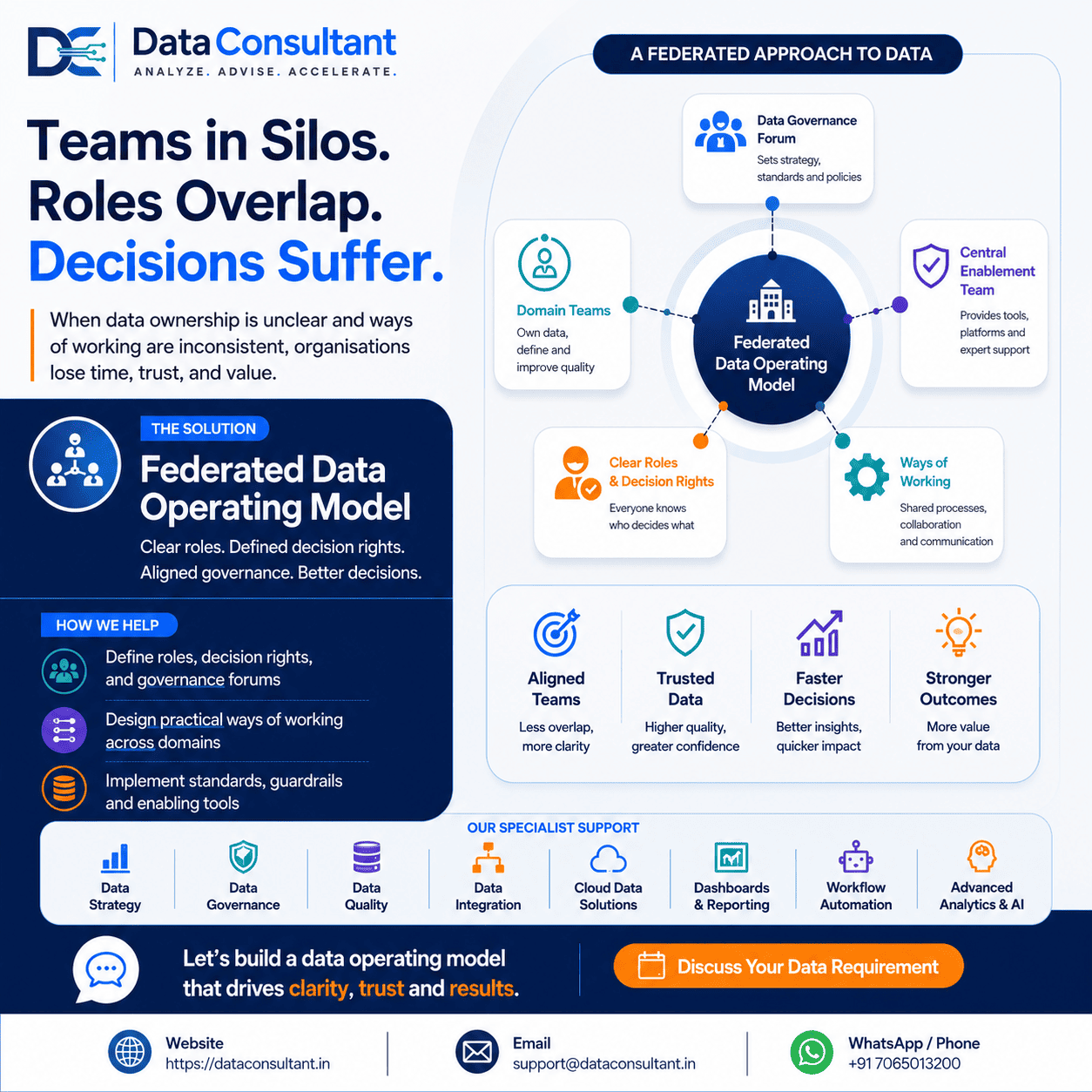
An online master's in data science develops an individual's capability. It is not a substitute for an organisation's data strategy, governance, architecture or implementation work. If you are a business leader considering degree sponsorship because reports conflict, data quality is weak, teams lack common definitions or AI projects are stalling, diagnose the organisational problem separately.
DataConsultant academy support can help organisations define role-based capability pathways, while a data assessment can clarify whether the underlying issue is skills, data quality, governance or implementation. Use external support only when the problem is broader than one person's education decision.
Summary: Make the Degree Earn Its Place
An online master's in data science is most defensible when it connects a clear target role to rigorous graduate study, assessed practical work and a credential that matters in your context. Before enrolling, validate prerequisites, curriculum depth, institutional status, total cost, online workload, project quality and the support available when you get stuck.
Choose a shorter route when the gap is narrow. Choose self-study when you can create structure and evidence independently. Choose the master's when you need sustained depth and formal progression. For employers, separate individual development from organisation-wide data problems; some gaps require data governance, engineering, analytics or capability design rather than another qualification.
FAQs About an Online Master's in Data Science
Is an online master's in data science worth it?
It can be worth it when you need structured advanced study, recognised postgraduate credentials, stronger statistical and computing foundations, and a portfolio of assessed projects. It is less compelling when you mainly need one tool, a short skills refresh, or employer-specific training. Judge the degree against your target role, prior background, total cost, weekly study capacity and the programme's evidence of rigorous assessment.
What should I look for in an online master's in data science?
Look for a coherent sequence across statistics, programming, data management, machine learning, visualisation, experimentation and responsible data use. Check faculty involvement, assessment methods, project depth, access to computing resources, student support, accreditation or institutional recognition where applicable, and whether the capstone resembles the work you want to do.
Do I need a computer science degree before starting?
Not necessarily. Many learners enter from mathematics, engineering, economics, business or other quantitative fields, but programmes differ. You should be comfortable with algebra, basic statistics and analytical problem-solving, and ideally have some programming exposure. If prerequisites are weak, complete preparatory work before enrolling rather than assuming the master's will teach every foundation from zero.
How much mathematics is needed for an online data science master's?
Expect more than dashboarding or business analytics alone. Strong programmes usually rely on probability, statistics, linear algebra and optimisation concepts, with the depth varying by curriculum. Review module descriptions and sample prerequisites. If mathematical notation or statistical reasoning is unfamiliar, plan a foundation period before the first assessed term.
Can an online master's in data science help me become a data scientist?
It can strengthen your qualifications and practical evidence, but a degree does not guarantee a job title. Employers also evaluate programming ability, statistical reasoning, domain knowledge, communication, project quality and experience working with imperfect data. Build a portfolio that shows how you frame questions, prepare data, validate models and explain limitations to stakeholders.
How do I verify whether an online master's is legitimate?
Verify the awarding institution and the status of the programme through the relevant national or regional higher-education authority. In the United States, the Department of Education provides a database of accredited postsecondary institutions and programmes. For other countries, use the applicable official regulator or recognised quality-assurance body rather than relying only on marketing claims.
How long does an online master's in data science take?
Duration depends on credit load, academic calendar and whether you study full time or part time. Instead of comparing advertised completion time alone, calculate the number of modules per term, expected weekly effort, project periods and any maximum completion window. A slower schedule may be the better choice when you are working full time.
What costs should I compare besides tuition?
Compare mandatory fees, software or cloud charges, textbooks, examination or proctoring costs, travel for any in-person requirement, currency and tax effects, and the opportunity cost of study time. Also ask what happens financially if you pause, repeat a module or withdraw. The cheapest headline tuition is not always the lowest total cost.
Should I choose a master's, bootcamp or self-study path?
Choose a master's when you want depth, assessed progression and a postgraduate credential. Choose a bootcamp when you need a shorter, guided skills transition and can validate its employer relevance. Choose self-study when your goals are narrow, you can design your own curriculum and you do not need formal academic recognition. Hybrid paths are common: foundations first, then a degree only if it adds clear value.
How can an employer decide whether to sponsor an online data science master's?
Start with the capability the organisation needs. Sponsorship makes sense when the employee will use advanced analytical, statistical, data engineering or machine-learning skills over time and the curriculum matches that role. If the real need is a team-wide data maturity, governance, reporting or implementation problem, a targeted academy, diagnostic or consulting project may create value faster than sponsoring a single degree.
Need to Build Data Capability at Work?
If your question is broader than choosing a degree, share the roles, data problems, current tools, governance constraints and outcomes your organisation needs. DataConsultant can help determine whether the right next step is a capability diagnostic, academy programme, defined data project or ongoing specialist support.
Discuss your requirementAt DataConsultant.in, we help organisations turn data and AI priorities into governed, reliable, and practical business capability.