
Enterprise AI: When, Where and How to Invest
Enterprise AI is appropriate when an organisation has a defined business decision or workflow to improve, suitable data, accountable owners and a realistic plan for governance and adoption. The starting point is not “Which AI model should we buy?” but “Which measurable business problem is important enough to justify change?” A customer-service team may need faster case triage, a finance function may need better exception analysis, and an operations team may need earlier warning of disruption. Each problem requires different data, controls, integration and human oversight.
The main caution is to avoid hiring an AI consultant or purchasing an enterprise AI platform before the business problem, decision rights and operational constraints are clear. A tool cannot repair missing ownership, inconsistent data definitions, inaccessible source systems or a process that nobody is prepared to redesign. Start with a short diagnostic when readiness is uncertain, use a defined project when the use case and deliverables can be scoped, and choose ongoing support only when models, data, controls and use cases will require continuous attention.
This guide helps business, technology, data, risk, compliance, finance, marketing and operations leaders decide whether enterprise AI is suitable now, what internal preparation is required, how delivery options compare, which outputs to expect and when specialist support adds genuine value.
Quick Answer: Start with a Governed Business Use Case
Enterprise AI is a coordinated way to use machine learning, generative AI, automation, copilots or intelligent decision support across business processes. It is justified when the organisation can identify a valuable use case, provide reliable and lawful data, integrate outputs into real work and assign people who remain accountable for decisions.
Use a short AI readiness diagnostic when teams disagree about the problem, data quality is uncertain or governance expectations are unclear. Use a defined project when one use case can be piloted with named stakeholders, acceptance criteria and handover. Use ongoing support or a managed team only when use cases, models, monitoring and data pipelines create a continuing workload.
Do not begin with enterprise-wide deployment. Select a narrow, consequential but controllable problem, establish a baseline, test the proposed AI contribution and confirm that the benefit remains meaningful after security, privacy, integration, change and operating costs are included.
Key Takeaways
- Define the decision first: enterprise AI should improve a specific workflow, judgement or customer outcome.
- Check data readiness: useful models depend on accessible, representative and sufficiently reliable data.
- Keep internal accountability: business owners remain responsible for outcomes even when specialists or vendors support delivery.
- Scope measurable deliverables: require a use-case definition, data assessment, architecture, controls, pilot results, documentation and handover.
- Design governance into delivery: privacy, security, model risk, human oversight and incident handling cannot be added at the end.
- Plan for operational ownership: models, prompts, retrieval sources, integrations and monitoring need named maintainers.
- Transfer knowledge: internal teams should understand limitations, approval boundaries and how to validate outputs after launch.
Table of Contents
- Decide whether enterprise AI solves the right problem
- Check business, data and governance readiness
- Compare internal, tool and consulting options
- Set technical, security and access requirements
- Pilot enterprise AI before scaling
- Estimate cost, time and internal resources
- Measure outcomes and model performance
- Apply the decision to practical examples
- Use specialist support where it adds value
- Summary
Decide Whether Enterprise AI Solves the Right Problem
Enterprise AI is suitable when it improves an identifiable decision or workflow and when a non-AI alternative would not solve the problem more simply. A clear use-case statement should name the user, the current process, the decision being improved, the information required, the expected output, the acceptable level of error and the person who remains accountable.
Separate business need from technology enthusiasm
“We need a chatbot” is a technology request. “Service agents spend too much time searching five approved knowledge sources, causing long handling times and inconsistent answers” is a business problem. The second statement can be tested. It suggests retrieval, workflow integration, access control, quality checks and escalation rules. It also leaves open the possibility that better search, content management or process redesign may be enough.
Choose AI only when uncertainty can be managed
AI is most useful where rules alone are insufficient but patterns, language, images or historical outcomes provide decision support. It is less suitable when every output must be perfectly deterministic, the consequences of error are intolerable, the data cannot be used lawfully or the process owner cannot provide meaningful review. Human oversight must be designed around the actual risk, not added as a vague statement in policy.
Decision rule: do not approve an enterprise AI initiative until the sponsor can explain why AI is needed, what safer alternatives were considered, how success will be measured and who can stop or correct the system.
Check Business, Data and Governance Readiness
Enterprise AI readiness is not a single maturity score. A business may have strong cloud infrastructure but weak data ownership, or excellent data governance but no operational team able to adopt the output. Assess readiness across five connected dimensions: business clarity, data suitability, technical access, governance and internal ownership.
Data suitability includes quality, representativeness, lineage, rights of use, retention and the ability to correct errors. Governance should align to the risk and lifecycle of the use case. The NIST AI Risk Management Framework offers a practical structure for governing, mapping, measuring and managing AI risk. The ISO/IEC 42001 AI management system standard provides a management-system approach for organisational responsibilities and continual improvement.
Compare Internal, Tool and Consulting Options
The correct route depends on problem clarity, internal capability, urgency, risk and the need for continuity. Buying an enterprise AI platform is not the same as establishing an enterprise AI capability. Platforms provide functions; organisations still need use-case design, data preparation, integration, governance, testing, adoption and ongoing ownership.
| Option | Best fit | Expected outputs | Internal requirement | Main risk |
|---|---|---|---|---|
| Internal team | Clear use case, accessible data and sufficient AI capability | Prototype, controls, integration and operating documentation | Dedicated product, data, engineering, risk and business ownership | Competing priorities or missing specialist depth |
| Software tool | Requirements, workflows and governance are already defined | Configured features, access controls and usage reporting | Internal configuration, data preparation, testing and adoption | Tool purchase is mistaken for implementation |
| Short data diagnostic | Unclear value, conflicting priorities or uncertain readiness | Use-case shortlist, maturity findings, risks and roadmap | Stakeholder interviews, evidence and data access | Recommendations stall without an accountable sponsor |
| Defined consulting project | One or more use cases can be scoped with acceptance criteria | Architecture, pilot, controls, evaluation, documentation and handover | Business, data, technology, security, legal and risk participation | Scope expands before evidence of value |
| Ongoing consultant support | Models, data, prompts or use cases change regularly | Monitoring, optimisation, governance updates and new releases | Regular prioritisation and internal product ownership | Long-term dependency without knowledge transfer |
| Dedicated specialist or managed team | Substantial, continuous multi-disciplinary AI workload | Predictable delivery across engineering, governance and operations | Executive sponsor, operating cadence and portfolio controls | Capacity is wasted if adoption and prioritisation are weak |
A hybrid model is often appropriate: internal leaders own the business decision and risk, while external specialists provide temporary depth in data engineering, model evaluation, architecture, governance or implementation.
Set Technical, Security and Access Requirements
A credible enterprise AI plan defines how data enters the system, how models or services process it, where outputs are stored, who can use them and how failures are detected. The architecture should be proportionate to the use case rather than built as a generic platform before demand exists.
Specify the minimum technical foundation
- Identify source systems, data owners, refresh frequency and known quality limitations.
- Define whether the use case needs batch processing, real-time integration, retrieval-augmented generation, predictive modelling or workflow automation.
- Document identity, access, encryption, logging, retention, environment separation and recovery requirements.
- Set evaluation datasets, quality thresholds, prohibited behaviours and fallback procedures.
- Define how prompts, models, reference content, features and business rules will be versioned and approved.
- Establish monitoring for reliability, drift, unsafe outputs, unauthorised access, cost and user behaviour.
Treat governance as an operating process
Governance should assign decision rights from idea intake through retirement. The OECD AI Principles provide a useful public reference for trustworthy AI themes, while the NIST Privacy Framework can help teams consider privacy risk within organisational systems. These frameworks do not replace applicable law, sector obligations or internal policy.
Require evidence that data use is authorised, affected stakeholders have been considered, security testing is complete, outputs can be challenged and incidents can be escalated. High-impact use cases may need independent validation, stricter change control and stronger human review than low-risk productivity assistance.
Pilot Enterprise AI Before Scaling
A pilot should test business usefulness, technical feasibility, operational adoption and risk controls together. A model demonstration is not a pilot if it uses cleaned sample data, bypasses the real workflow or excludes the people who will own the outcome.
Require implementation deliverables
- Use-case charter with baseline, users, scope and exclusions.
- Data-readiness and risk assessment.
- Target architecture, integration design and control requirements.
- Evaluation plan with business, technical and responsible-AI criteria.
- Pilot build, test evidence, issue log and go-live recommendation.
- Operating model covering ownership, monitoring, incident response and change.
- Documentation, code or configuration repository, training and knowledge transfer.
Estimate Cost, Time and Internal Resources
Enterprise AI cost is driven by more than model or software fees. Important factors include data preparation, integration, cloud consumption, security, evaluation, licensing, specialist skills, user adoption, monitoring, support and the cost of internal stakeholder time.
A short readiness diagnostic may be completed through focused interviews, evidence review and limited data analysis. A defined pilot commonly requires several coordinated workstreams and may take weeks or months depending on data access, integration, risk review and procurement. Portfolio-scale adoption takes longer because reusable architecture, governance, prioritisation and operating support must mature together.
Budget for internal participation
Business owners must define the outcome and validate usefulness. Data teams prepare and explain source data. Technology teams support environments and integration. Security, privacy, legal, risk and compliance functions set boundaries and review evidence. Procurement and finance evaluate commercial terms. Front-line users test whether the solution fits real work. A proposal that excludes these commitments understates the true resource requirement.
Decision rule: compare the total cost of a dependable operating capability, not the price of a model endpoint or software licence.
Measure Outcomes and Model Performance
Measure enterprise AI at three levels: business outcomes, system performance and operational control. A use case may produce technically accurate outputs but still fail because users do not trust it, the workflow adds effort or exceptions cannot be resolved.
- Business baseline and target, such as decision time, error rate, service quality or backlog.
- Model or output quality using representative evaluation data and defined thresholds.
- Human acceptance, override and escalation patterns.
- Data freshness, lineage, missingness and change.
- Reliability, latency, availability and integration failures.
- Security, privacy, unsafe-output and policy incidents.
- Usage, abandonment, workarounds and adoption by intended roles.
- Operating cost per transaction, case, user or outcome.
- Knowledge-transfer and internal support readiness.
Agree metrics and stop conditions before the pilot. Where outcomes improve, test whether AI contributed alongside process changes, staffing, seasonality, policy changes and management action. Avoid attributing all improvement to the model.
Practical Enterprise AI Decisions
Customer-service knowledge assistant
A service team wants a generative AI chatbot because agents take too long to answer queries. The mistaken assumption is that a model alone will solve the problem. The actual issues are fragmented knowledge, outdated documents and inconsistent access permissions. A short diagnostic should identify authoritative sources, ownership and high-risk query types. A defined pilot may then deliver a governed retrieval assistant, evaluation set, access controls, escalation rules and user guidance. Service, knowledge, security, privacy and technology owners must participate.
Finance anomaly detection
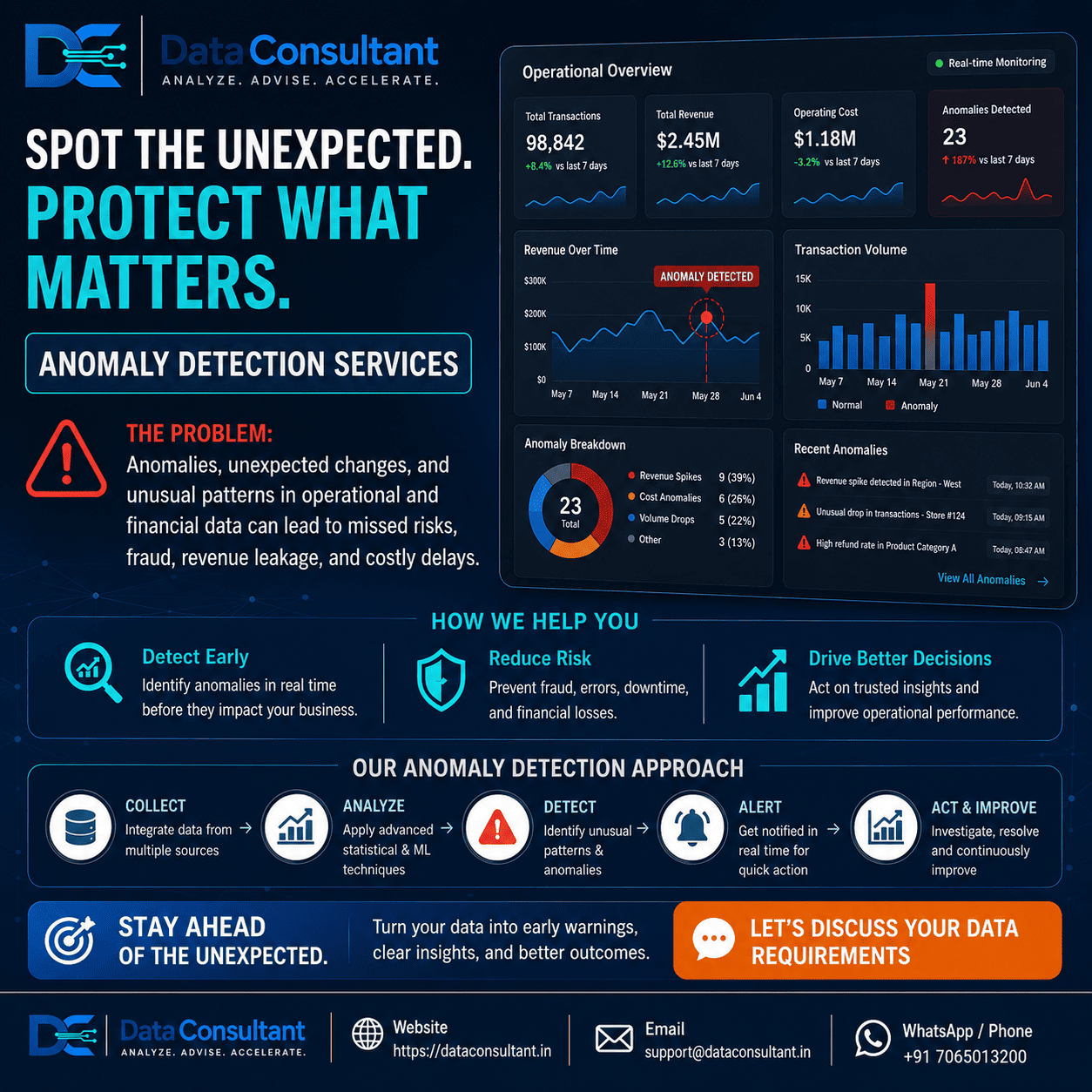
A finance function wants AI to find suspicious transactions. Historical labels are incomplete and teams disagree about which exceptions matter. The better decision is to establish risk definitions, improve investigation data and test a limited decision-support model rather than automate case closure. Deliverables may include a data-quality assessment, feature design, model evaluation, investigator workflow and monitoring plan. Finance control owners remain accountable for decisions.
Marketing content automation
A marketing team plans enterprise-wide content generation to increase campaign speed. The real constraints are brand approval, intellectual-property risk, personal-data handling and inconsistent product claims. A controlled pilot for low-risk drafts may be appropriate, with approved sources, prohibited content, review steps and traceability. Broad autonomous publishing should be delayed until quality and accountability are demonstrated.
Predictive maintenance across sites
A multi-location operator wants predictive maintenance but equipment identifiers, maintenance codes and sensor coverage vary by site. Purchasing an AI platform would not resolve the foundation problem. A phased data and AI roadmap should first standardise critical asset data, identify a high-value equipment class and test whether failure signals are sufficiently reliable. A managed team may become appropriate only if data engineering, modelling and monitoring form a continuous programme.
Use Specialist Support Where It Adds Value
External support is most useful when an organisation needs an independent AI readiness assessment, use-case prioritisation, data and architecture review, responsible-AI controls, a defined pilot or temporary access to specialist delivery capability. It is not a substitute for an internal sponsor, business owner or accountable risk decisions.
DataConsultant AI and data support can be used for readiness assessment, use-case definition, architecture, data preparation, governance and implementation planning. Where the primary issue is data foundations, a data engineering engagement, data governance support or assessment and audit may be more appropriate than an AI build.
Summary: Invest After Readiness Is Evident
Enterprise AI is appropriate when a valuable business problem is clear, suitable data is available, governance is proportionate and internal owners can operate the capability. Internal staff may be sufficient for a limited use case when the organisation already has the required expertise and capacity. A software tool may be sufficient when requirements, data, workflow and controls are already defined.
Use a short diagnostic when value, data quality, access, architecture or risk is uncertain. Use a defined project when objectives, deliverables, budget, timeline, security, quality assurance, documentation and handover can be agreed. Choose ongoing support or a managed team when data pipelines, models, prompts, monitoring, controls and use cases create a sustained workload.
Before proceeding, validate the business goal, data quality, stakeholder access, governance boundaries, internal ownership and knowledge-transfer plan. Scale only when evidence shows that the solution is useful, controllable and supportable.
Enterprise AI FAQs
What is enterprise AI?
Enterprise AI is the organised use of machine learning, generative AI, automation and intelligent decision support within business processes. It includes data, architecture, controls, integration, people and operating ownership—not only a model or software licence. Verify that each proposed use case has a named business owner and measurable outcome.
How do I know whether my organisation is ready for enterprise AI?
Your organisation is ready to pilot when the business problem is clear, relevant data can be accessed lawfully, technical integration is feasible, risks can be controlled and internal owners can support the workflow. Where any of these areas is uncertain, begin with an AI readiness diagnostic rather than a large implementation.
Should we build internally or use an AI consultant?
Build internally when the use case is clear and your team has enough product, data, engineering, evaluation and governance capability. Use a consultant when specialist depth is needed temporarily, an independent assessment is valuable or the pilot requires coordinated architecture and controls. Keep business accountability and long-term ownership inside the organisation.
Can an enterprise AI platform replace strategy and governance?
No. A platform may provide models, orchestration, security features and monitoring, but it cannot define your business priorities, data rights, risk tolerance, approval process or operating ownership. Establish these requirements before selecting or configuring a tool.
What information should we prepare before an AI engagement?
Prepare the business objective, current workflow, baseline measures, stakeholder list, relevant policies, source-system details, data samples, known quality issues, access constraints, security requirements and expected decision rights. Do not share sensitive production data until access and handling arrangements are approved.
How much does enterprise AI implementation cost?
Cost depends on data preparation, integration, model or platform fees, cloud usage, security, evaluation, specialist skills, adoption and ongoing monitoring. A narrow diagnostic costs less than a production pilot, while a portfolio capability requires reusable governance and operations. Compare total lifecycle cost rather than licence price alone.
How long does an enterprise AI project take?
A readiness assessment may be relatively short when evidence and stakeholders are available. A production pilot can take weeks or months depending on data access, integration, security review, evaluation and procurement. Enterprise-scale adoption usually proceeds in phases because operating controls and reusable foundations must mature alongside delivery.
What deliverables should an AI consultant provide?
Expect a use-case definition, readiness and risk findings, data requirements, target architecture, evaluation plan, pilot evidence, control design, operating model, documentation and handover. Deliverables should include assumptions, limitations, unresolved issues and acceptance criteria—not only a demonstration.
Who owns the models, prompts, code and documentation?
Ownership and usage rights should be explicit in the contract. Clarify rights to custom code, configurations, prompts, evaluation datasets, documentation, model outputs and third-party components. Your organisation should retain the materials and access needed to operate, audit and change the solution after handover.
When is ongoing enterprise AI support appropriate?
Ongoing support is appropriate when models, prompts, data pipelines, regulations, business rules or use cases change continuously. It may include monitoring, evaluation, retraining, optimisation, incident response and governance updates. Avoid indefinite dependency by defining internal ownership and knowledge-transfer milestones.
Need a Practical Enterprise AI Decision?
Use a focused assessment to confirm the business case, data readiness, technical path, governance requirements and the smallest viable pilot before committing to a wider programme.
Discuss an Enterprise AI Assessment“At DataConsultant.in, we help organisations turn data and AI priorities into governed, reliable, and practical business capability.”