
Data Science: When Your Business Needs Expert Support
Data science is worth investing in when a business has a decision that can improve through prediction, segmentation, optimisation, experimentation or pattern detection—and when the data is sufficiently usable to test that idea. The first decision is not which algorithm, platform or consultant to buy. It is whether the problem genuinely needs data science at all.
Many organisations approach data science too early. They may actually need cleaner data, agreed KPI definitions, simpler business intelligence, better integration or a clearer operating process. Others wait too long even though they already have repeatable decisions, useful historical data and a measurable opportunity that conventional reporting cannot address. A practical assessment separates these situations before money is committed to modelling.
This guide helps business owners, founders, technology leaders, operations teams, finance leaders, marketing teams and enterprise functions decide when data science is appropriate, what inputs and internal support it needs, how consulting compares with internal hiring or software, what a professional engagement should deliver, and how to judge whether the resulting capability is useful.
Quick Answer: Start with the Decision, Not the Model
Use data science when the business needs an evidence-based estimate of what is likely to happen, which cases deserve attention, which action is likely to work best, or how a complex process can be optimised. Typical examples include demand forecasting, churn risk, fraud prioritisation, pricing analysis, customer segmentation, maintenance prediction and operational optimisation.
Do not start with data science when the real constraint is missing source data, inconsistent metrics, unclear ownership, inaccessible systems or a process that nobody has agreed how to run. In those cases, a data maturity assessment, data engineering, governance or business intelligence work may create more value than a predictive model.
A short diagnostic is usually the right first step when feasibility is uncertain. A defined project is suitable when the use case, data and decision owners are clear. Ongoing support or a managed data team is justified only when models, experiments, data pipelines and new use cases require continuous specialist attention.
Key Takeaways
- Define the decision first: the use case should state who will use the output, what action it changes and how success will be measured.
- Check whether data science is necessary: descriptive reporting or process redesign may solve the problem more simply.
- Assess data readiness early: modelling effort is often dominated by data quality, access, integration and definition issues.
- Keep business ownership internal: a consultant can provide specialist delivery, but priorities, risk decisions and adoption cannot be outsourced.
- Compare alternatives fairly: internal hiring, existing analysts, software and consulting each suit different levels of urgency, continuity and complexity.
- Require reproducibility and handover: code, assumptions, evaluation logic, documentation and operating responsibilities should be clear.
- Plan for governance: privacy, security, bias, explainability and monitoring should be designed into the work rather than added after modelling.
- Measure operational use: model accuracy alone does not prove business value if the output is ignored or cannot be acted on.
Table of Contents
- Decide whether data science is the right method
- Check business and data readiness
- Compare internal, software and consulting options
- Prepare access, stakeholders and controls
- Move from discovery to implementation
- Understand cost and resource drivers
- Measure outcomes and maintain the capability
- Apply the decision to practical examples
- Use specialist support where it adds value
- Summary
First Decide Whether You Need Data Science
The strongest data science projects begin with a decision statement, not a request to “build AI”. A decision statement names the business action, the person responsible for it, the information needed and the consequence of being wrong. That framing makes it possible to test whether predictive or statistical methods are actually necessary.
Problems that are a good fit
Data science is a reasonable candidate when historical patterns can inform a future or uncertain decision. For example, a retention team may need to prioritise customers most likely to leave, a supply chain team may need a better demand forecast, or an operations team may need to identify cases with a high probability of delay. These problems are different from simply asking what happened last month.
It is also useful when an organisation needs controlled experimentation or optimisation. Marketing teams may want to compare campaign treatments, product teams may want to estimate the effect of a feature change, and logistics teams may want to optimise inventory or routing under multiple constraints. The method should follow the decision rather than the other way around.
Problems that may need something simpler
If teams cannot agree on revenue, customer, product or operational definitions, the immediate need is usually a KPI framework or governance work. If analysts spend most of their time manually combining files, data integration and reporting automation may be the priority. If leaders lack visibility into performance, a well-designed dashboard may answer the question without machine learning.
A useful test is: Would the business still benefit if the answer were a clear rule, reliable report or simple statistical baseline rather than a complex model? If yes, start with the simpler option. Complexity should be earned by the problem.
Check Business and Data Readiness
Readiness is not the same as having a large data warehouse or a modern cloud platform. A smaller business can be ready with a well-defined problem and clean operational data, while an enterprise with many systems may still be unready because definitions, access and ownership are fragmented.
Business readiness
- There is a named decision, workflow or customer outcome to improve.
- A business owner can explain how the output will change an action.
- There is a baseline against which improvement can be compared.
- Stakeholders can agree what false positives, false negatives or forecast errors would mean operationally.
- Someone has authority to change the process if the evidence supports it.
Data readiness
- Relevant historical data exists for the period and population being studied.
- Important fields are sufficiently complete, consistently defined and traceable to source systems.
- Data access can be approved without bypassing security or privacy controls.
- The team can identify changes in systems, policies or business conditions that may make older data misleading.
- There is a practical way to obtain fresh data if the model is eventually operated in production.
The OECD overview of data governance is a useful reminder that data value depends on how data is managed, accessed and governed across its lifecycle. For AI-enabled or predictive use cases, the NIST AI Risk Management Framework provides a structured way to consider governance, measurement and risk management rather than focusing only on technical performance.
Readiness warning: a model can be technically accurate and still be commercially useless if the business cannot act on its output, the target variable is poorly defined, or the data available at training time will not exist when the model is used.
Compare the Main Ways to Build Capability
Once the problem is suitable, decide how the capability should be delivered. The best choice depends on urgency, continuity, internal skill, technical complexity and whether the organisation is still discovering what it needs.
| Option | Best fit | What it can deliver | Internal requirement | Main limitation |
|---|---|---|---|---|
| Existing analyst or BI team | Well-defined analysis, reporting or simple statistical work | Exploration, baselines, segmentation and decision support | Protected delivery time and access to the right data | May lack advanced modelling or production engineering depth |
| Software or AI platform | Standard use case with ready data and capable internal users | Automated modelling, experimentation or managed tooling | Strong problem framing, validation and governance | Tools do not resolve weak data or unclear decision ownership |
| Full-time data scientist | Continuous roadmap and enough work for an enduring role | Ongoing modelling, experiments and internal capability | Technical leadership, career path and engineering support | Hiring too early can create an isolated role without usable infrastructure |
| Short consulting diagnostic | Feasibility, data readiness or scope is uncertain | Use-case definition, data assessment, risks and roadmap | Stakeholder interviews and evidence access | Findings still need an owner and delivery decision |
| Defined consulting project | Bounded use case requiring specialist delivery and handover | Model, pipelines, evaluation, documentation and implementation support | Business owner, technical cooperation and acceptance criteria | Scope can expand if use cases and deployment responsibilities are vague |
| Ongoing specialist or managed team | Multiple use cases, model operations or persistent skill gaps | Predictable capacity, monitoring, retraining and new analyses | Operating cadence, priorities and internal accountability | Dependency can grow without deliberate knowledge transfer |
A hybrid model is often practical: use external specialists for discovery, architecture or an initial use case, then transfer repeatable work to internal data, product and operational teams.
Prepare Access, Stakeholders and Controls
Data science depends on more than data scientists. A credible engagement usually needs a business sponsor, subject-matter expert, data owner, data engineer or system owner, security or privacy input where required, and the team that will operate or consume the output. Missing any of these roles can slow delivery more than modelling complexity.
Information to prepare
- The business problem, current process and decision that should improve.
- Existing KPIs, reports, spreadsheets, models and known pain points.
- A source-system inventory showing where relevant data is created and stored.
- Known data-quality issues, historic process changes and exceptional periods.
- Access approval routes, retention requirements and restrictions on personal or confidential data.
- Current technology constraints, including databases, cloud services, BI tools, APIs and deployment environments.
- Expected users, decision frequency and the operational cost of errors.
Security, privacy and governance
A professional project should use only the data required for the agreed purpose and should define access, storage, transfer, retention and deletion expectations. Security architecture should match the sensitivity of the data and the deployment environment. The ISO/IEC 27001 information security framework offers a risk-based reference for managing information security, while privacy obligations should be interpreted against the law and regulator applicable to the organisation.
Governance should also cover model assumptions, data lineage, evaluation criteria, explainability where needed, human review, change approval and monitoring. These controls become more important when a model influences customers, employees, financial decisions, safety, eligibility or other high-impact outcomes.
Move from Discovery to Production Deliberately
A useful engagement is usually staged. The goal is to retire uncertainty early instead of building a polished solution before feasibility is understood.
1. Frame the use case
Define the decision, user, target outcome, operational constraints, current baseline and the evidence required to proceed. Agree what the project will not do. A narrowly framed first use case is easier to evaluate and hand over than a broad “enterprise AI” initiative.
2. Assess the data
Profile the relevant datasets, confirm definitions, inspect missingness and bias, identify integration requirements and test whether the outcome can be measured. This phase often changes the scope because data that appears available on paper may be unusable, delayed or inconsistent in practice.
3. Establish a baseline
Compare any advanced model with a simple rule, historical average or conventional statistical method. Without a baseline, teams can mistake technical sophistication for improvement. The baseline also helps explain whether added complexity is justified.
4. Build and validate the solution
Development should separate training and validation appropriately, document assumptions, test performance across relevant segments, and evaluate the operational consequences of errors. For sensitive or high-impact use cases, risk, legal, privacy and security review should be integrated before production approval.
5. Integrate with the real workflow
A model only creates value when its output reaches the people or systems that need it at the right time. Integration may involve an API, dashboard, alert, batch process or decision interface. The delivery design should specify who reviews the output and what action follows.
6. Handover and operate
Handover should include reproducible code, data definitions, model documentation, dependencies, operating procedures, monitoring metrics, retraining triggers, known limitations and ownership. If the internal team cannot run or challenge the solution after delivery, the engagement has not created durable capability.
Understand Cost, Timeline and Resource Drivers
Data science consulting has no single meaningful price because the effort is shaped by uncertainty. A clean dataset and a bounded forecasting question may require far less work than a customer-risk use case spread across legacy systems with sensitive data, complex approvals and real-time deployment.
| Driver | Lower-effort condition | Higher-effort condition | Why it matters |
|---|---|---|---|
| Problem clarity | One decision and measurable outcome | Multiple goals or uncertain ownership | Ambiguity creates discovery and rework |
| Data readiness | Accessible, defined and reasonably clean | Fragmented, missing, inconsistent or poorly documented | Preparation often dominates modelling effort |
| Integration | Offline analysis or existing data platform | New pipelines, APIs or real-time workflows | Production engineering increases scope |
| Risk and governance | Low-impact internal decision support | Sensitive data or high-impact decisions | Review, controls and evidence requirements increase |
| Deployment | Prototype or analyst-operated output | High-availability production service | Testing, observability and support requirements grow |
| Change and adoption | Experienced users and stable process | New workflow, training and behavioural change | Value depends on operational adoption |
When comparing proposals, ask for assumptions, deliverables, exclusions, acceptance criteria, dependencies and the expected commitment from internal teams. A low external fee can still be expensive if business experts, engineers and control functions must contribute heavily without that effort being planned.
Timelines should be treated in phases rather than as one promise. Discovery and feasibility should have an early decision point. Production implementation should proceed only when data, value, risk and operating ownership are credible. This reduces the chance of funding a long build for a use case that should have been stopped or simplified earlier.
Measure Business Use, Not Just Model Accuracy
Technical metrics matter, but they are only one layer of success. A model may improve precision, recall or forecast error and still fail because users do not trust it, the output arrives too late, or there is no operational action attached to it.
Measure at four levels
- Data quality: are the required inputs complete, timely and stable enough for operation?
- Model performance: does the model outperform an agreed baseline on relevant data and segments?
- Workflow adoption: are intended users receiving, understanding and acting on the output?
- Business outcome: is there evidence that the changed decision contributes to the intended result, after considering other factors?
Production models also need monitoring. Watch for changes in data definitions, population behaviour, source systems and business rules that can make historical relationships less reliable. Define who reviews alerts, who can approve retraining or model changes, and when the model should be paused or retired.
Four Practical Data Science Decisions
Customer churn at a subscription business
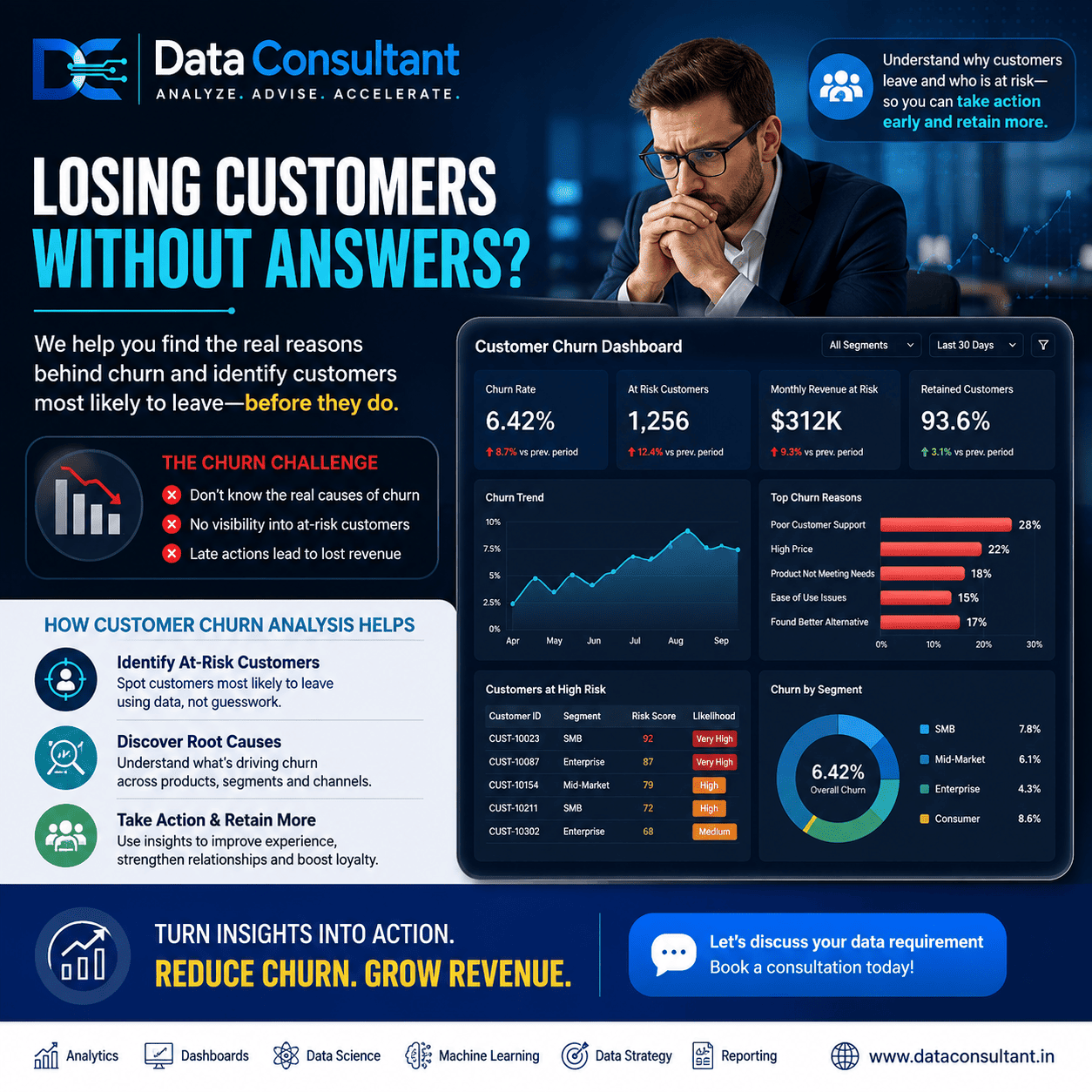
A subscription company wants an AI model to identify customers likely to cancel. It already tracks tenure, product usage, support contacts and cancellation outcomes. The retention team has limited outreach capacity and can define what intervention follows a high-risk score. This is a credible data science use case. Start with a baseline, test whether prediction changes retention prioritisation, and monitor whether interventions help rather than assuming a score alone creates value.
Executive reporting with conflicting KPIs
A growing business asks for predictive analytics because leaders do not trust monthly performance reports. Customer counts differ across systems, revenue classifications are inconsistent and teams manually reconcile spreadsheets. The immediate need is not data science. A KPI framework, data-quality assessment and reporting pipeline should come first. Predictive work can be reconsidered after the underlying definitions and data flow are reliable.
Demand forecasting for inventory planning
An ecommerce company has several years of order history and wants to improve replenishment. The business can identify promotions, stockouts and seasonal events, and planners already use a basic moving average. A defined data science project can compare stronger forecasting approaches with the current baseline, quantify uncertainty and test whether the new forecast improves planning decisions. The project should also account for missing demand caused by out-of-stock periods.
Enterprise AI idea without a decision owner
An enterprise team wants a machine-learning programme but has not selected a business process or decision. Multiple functions suggest unrelated use cases, data access is unclear and no team has agreed to own production outcomes. A short diagnostic and use-case prioritisation exercise is more appropriate than building models. The output should be a small number of feasible opportunities, readiness findings, risks and a phased implementation roadmap.
Where a Data Consultant Can Add Value
External data consulting is most useful where the organisation needs independent feasibility assessment, specialist architecture or modelling expertise, a defined implementation project, governance support, or temporary capacity while internal capability is being built. It can also help when the business is unsure whether its problem belongs in data science, analytics, data engineering or governance.
For an uncertain opportunity, DataConsultant data advisory support can help frame the decision, assess maturity and define a practical roadmap. Where the underlying challenge is analytical delivery, data analytics consulting can support analysis, modelling and decision products. If the main barrier is fragmented pipelines or inaccessible sources, data engineering support may be more appropriate than a modelling-first engagement.
The consultant should not become the permanent owner of business priorities. Internal leaders still need to approve the use case, provide subject-matter knowledge, make risk decisions, support access and own adoption. A good engagement leaves behind clearer capability, documentation and operating responsibility.
Summary: Use Data Science When the Decision Supports It
Data science is appropriate when there is a material decision that benefits from prediction, experimentation, segmentation or optimisation; the organisation has data that can credibly support the analysis; and someone is prepared to act on the result. Internal analysts or a software tool may be sufficient when the problem is standard, data is ready and the required capability already exists.
Use a short diagnostic when the problem, data or feasibility is uncertain. Use a defined project when the use case, deliverables, acceptance criteria and handover can be scoped. Ongoing support or a managed team makes sense when models, pipelines, experiments and new use cases create a continuing workload that internal teams cannot yet absorb.
Before committing, validate business goals, data quality, access, governance, privacy, security and internal ownership. Then agree scope, budget, timeline, quality assurance, documentation, knowledge transfer, monitoring and handover in proportion to the risk and complexity of the use case.
FAQs About Data Science and Consulting
What does data science do for a business?
Data science uses data, statistics, experimentation and machine learning to answer business questions, predict likely outcomes or improve decisions. It is most useful when the organisation has a clearly defined decision, suitable data and someone accountable for acting on the result. It should not be treated as a substitute for process clarity or reliable source data.
How do I know whether my business needs data science?
Consider data science when a recurring decision could materially improve with better prediction, segmentation, optimisation or experimentation and when historical data exists to test the idea. If the main issue is inconsistent reporting, missing definitions or inaccessible data, start with data quality, business intelligence or data engineering rather than a predictive model.
Should I hire a data consultant or a full-time data scientist?
Hire internally when the work is continuous, the roadmap is stable and you can provide technical leadership, data access and career development. A consultant is often more suitable for a bounded diagnostic, an urgent proof of value, specialist architecture or governance work, or when you need to define the role before recruiting. Some organisations use a consultant first and build an internal team after the operating model is clearer.
Can software or an AI platform replace a data scientist or consultant?
Software can automate parts of data preparation, modelling, visualisation and model deployment, but it does not remove the need to define the business objective, validate data, choose appropriate assumptions, manage privacy and security, test results and plan adoption. A tool is sufficient when the use case is standard, the data is ready and capable internal staff can govern the work.
What should we prepare before a data science engagement?
Prepare a clear business problem, the decision or workflow to be improved, relevant data sources, known data-quality issues, system owners, privacy or security constraints, current reports or models, and an internal sponsor. Also identify who can approve access and who will use the output. Good preparation shortens discovery and makes feasibility easier to assess.
How much do data science consulting services cost?
Cost depends on scope, data complexity, integration effort, specialist skills, security requirements, deployment expectations and the amount of change or training needed. A diagnostic is usually less resource-intensive than a production implementation, while ongoing support or a managed team creates a continuing commitment. Compare proposals using deliverables, assumptions, acceptance criteria and internal effort rather than a headline day rate alone.
How long does a data science project take?
A focused feasibility assessment can often be scoped as a short engagement, while production-grade work takes longer because data preparation, integration, validation, security review, user testing, monitoring and handover must be completed. Timelines depend far more on data access and decision complexity than on the modelling algorithm itself. Treat any timeline given before discovery as provisional.
What deliverables should a data science consultant provide?
Deliverables should match the decision being solved. Typical outputs may include a problem definition, data assessment, feasibility findings, modelling approach, reproducible code, evaluation results, documented assumptions, dashboards or decision interfaces, deployment guidance, governance controls, monitoring requirements, training and handover materials. Ownership and acceptance criteria should be agreed before delivery begins.
Can data science help if our data quality is poor?
Yes, but poor data quality may change the first phase from modelling to diagnosis. A consultant can identify missing fields, inconsistent definitions, leakage, bias, duplicate records or weak source processes and show how those issues affect the proposed use case. If the defects are material, fixing data capture, ownership and pipelines should come before advanced modelling.
When is ongoing data science support appropriate?
Ongoing support is appropriate when models require monitoring and retraining, new use cases arrive regularly, data sources change, teams need continuing experimentation or the organisation lacks enough internal specialist capacity. A one-off project is usually better when the objective is bounded and internal owners can operate the resulting capability after handover.
Need a Data Science Feasibility Check?
Share the business decision, available data, current reporting or models, key constraints and the outcome you want to improve. DataConsultant can help determine whether you need a short diagnostic, analytics work, data engineering, a defined data science project or ongoing specialist support.
Discuss your requirementAt DataConsultant.in, we help organisations turn data and AI priorities into governed, reliable, and practical business capability.