
Data Robot: Choose Automation, a Consultant, or Both
If you are searching for a data robot, first decide whether you actually need automation software, better data foundations, or specialist data consulting. A tool can automate a well-defined process, but it will not resolve conflicting KPI definitions, inaccessible source data, weak ownership, poor data quality or unclear business priorities. The practical starting point is to write down the decision or workflow that must improve, identify the data needed to support it, and test whether your current team and systems can deliver a reliable result.
A business problem and a technology request are not the same thing. “We need an AI dashboard” is a technology request; “regional managers cannot agree on weekly margin because finance and sales use different definitions” is a business and data problem. When the problem is clear and internal capability is sufficient, use internal staff or configure a tool. When the problem is unclear, use a short diagnostic. When specialist architecture, integration, analytics or governance work is temporarily required, use a defined consulting project. Choose ongoing support only when the need is genuinely recurring.
This guide is for founders, operations leaders, finance teams, technology leaders, marketing teams, ecommerce businesses and enterprise functions deciding how to turn a data-automation ambition into governed, reliable business capability.
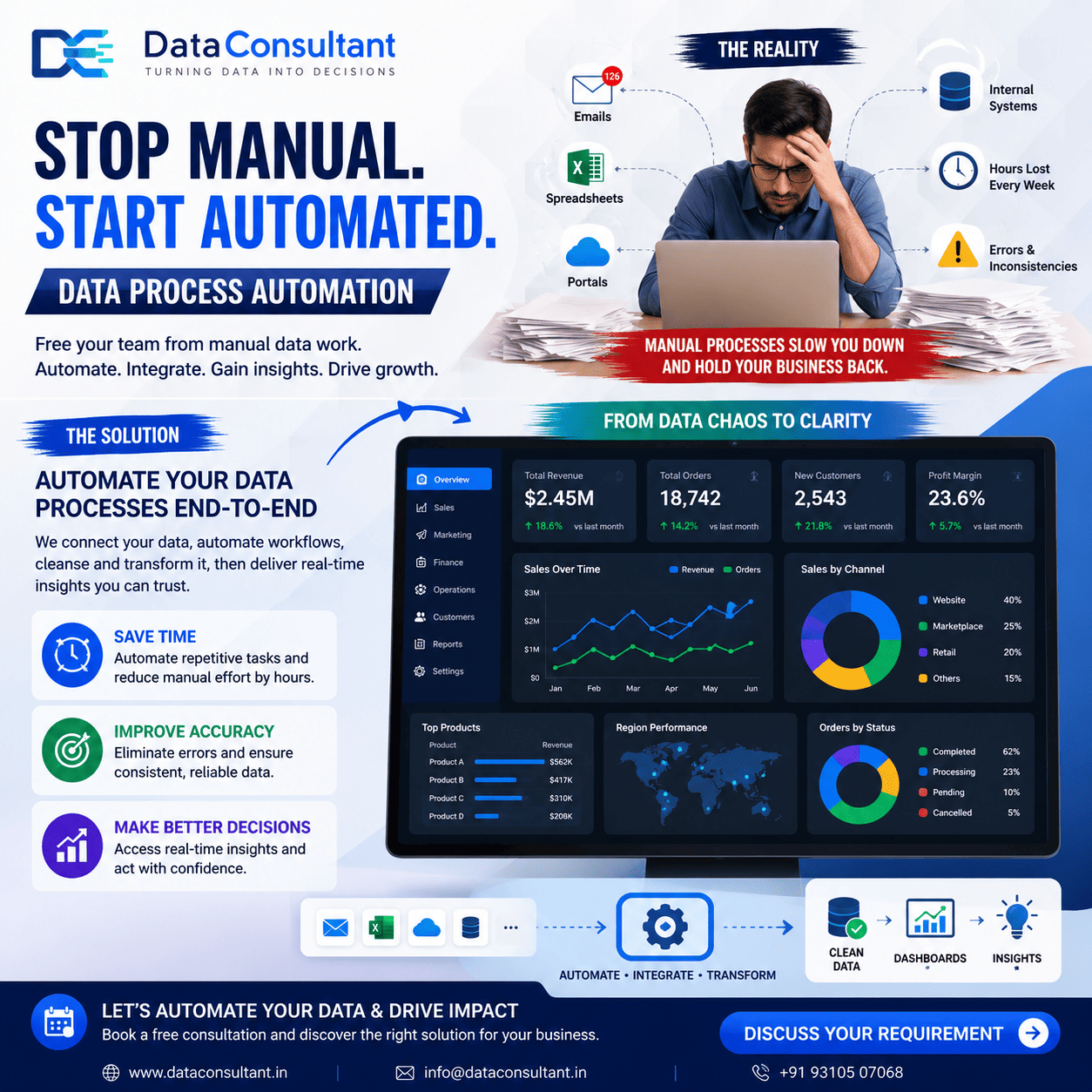
Quick Answer: Treat Data Robot as a Decision, Not a Tool
A data robot is useful only when the underlying work is sufficiently defined to automate. If inputs, rules, ownership and expected outputs are stable, software or workflow automation may be the right answer. If teams still disagree about definitions, data sources or priorities, automation will usually reproduce the confusion faster.
Use a short data diagnostic when you need to identify the real problem and prioritise a roadmap. Use a defined consulting project when deliverables such as a data model, integration, reporting layer, governance framework or migration plan can be scoped. Use ongoing support when specialist data work continues month after month and does not yet justify a complete internal team.
The main caution is simple: do not hire a consultant—or buy a platform—before defining the business decision or operational problem. Start with the outcome, then choose the smallest intervention capable of producing reliable evidence.
Key Takeaways
- Define the decision before the technology: automation is valuable only when the process and desired output are clear.
- Check data readiness early: quality, access, lineage and KPI consistency can determine whether a data robot is feasible.
- Keep internal ownership: business owners must approve priorities, definitions and adoption even when external specialists deliver the work.
- Match scope to uncertainty: use a diagnostic for ambiguity, a defined project for bounded outcomes and ongoing support for recurring needs.
- Specify deliverables: require decision-ready outputs, documentation, testing evidence, handover and clear acceptance criteria.
- Build governance into delivery: privacy, security, access and data ownership should shape the solution from discovery onward.
- Plan knowledge transfer: the organisation should retain the information and capability needed to operate the solution after external support ends.
Table of Contents
- Decide what should actually be automated
- Compare internal, tool and consulting choices
- Check whether your data is ready
- Prepare stakeholders, access and controls
- Scope deliverables and implementation
- Estimate cost, time and internal effort
- Apply the decision to real business cases
- Measure capability, not activity
- Use specialist support where it adds value
- Summary
Decide What the Data Robot Should Actually Do
The first decision is whether the target is a repeatable task, a data foundation problem or a management decision that needs better evidence. Automation is strongest when rules are explicit; consulting adds more value when the problem itself must be clarified.
Translate a technology request into a business question
Replace “build a data robot” with a statement that identifies the user, decision, data and required output. For example: “Every Monday, operations managers need a reconciled view of orders, cancellations and fulfilment exceptions by region before the planning meeting.” That statement exposes the systems, definitions, refresh cadence and ownership that must exist before automation can be trusted.
Separate automation gaps from data-management gaps
If the logic is stable but execution is manual, workflow automation or reporting automation may be enough. If customer IDs do not match across systems, revenue measures conflict, source data is incomplete or nobody owns a critical definition, the work is primarily data integration, data quality or data governance. A consultant can help assess those foundations, but internal owners still need to make business decisions.
Decision rule: if you cannot explain the desired output, responsible owner, source data and acceptance test in plain language, start with discovery rather than implementation.
Compare Internal, Tool and Consulting Choices
The right option depends on problem clarity, internal capability, continuity and how much specialist judgement is required. The cheapest-looking option can become expensive when requirements, data remediation or handover are ignored.
| Option | Best fit | Expected output | Internal requirement | Main risk |
|---|---|---|---|---|
| Internal team | Clear question, accessible data and sufficient skills | Report, model, pipeline or process improvement | Protected delivery time and accountable owner | Competing priorities delay completion |
| Software tool | Stable process and definitions; functionality is the main gap | Configured automation, workflow or analytics capability | Requirements, integration and governance capability | Tool is bought before the process is ready |
| Short data diagnostic | Conflicting reports, uncertain quality or unclear requirements | Current-state findings, priorities and roadmap | Stakeholder interviews and evidence access | Recommendations stall without an owner |
| Defined consulting project | Bounded objective requiring temporary specialist expertise | Architecture, integration, analytics, governance or migration deliverables | Business, data and technology participation | Scope expands without acceptance criteria |
| Ongoing consultant support | Recurring analytics, data quality or governance demand | Prioritised delivery, advisory support and continuous improvement | Operating cadence and regular prioritisation | Dependency grows without knowledge transfer |
| Dedicated specialist or managed team | Substantial continuous workload across several data disciplines | Predictable delivery capacity and coordinated support | Executive sponsor and clear service governance | Capacity is wasted if demand and ownership are weak |
A hybrid approach is often practical: internal leaders own the business problem and definitions, while external specialists provide temporary depth in architecture, engineering, analytics or governance.
Check Whether Your Data Is Ready for Automation
Data readiness determines whether automation can produce a dependable output. You do not need a perfect environment, but you need enough business clarity, data quality, access and ownership to test the solution safely.
For broader governance principles, the OECD overview of data governance provides useful context on managing data as an organisational asset. If readiness is low, prioritise source-system fixes, metric definitions and ownership before advanced automation.
Prepare Stakeholders, Access and Data Controls
A data consultant cannot work effectively in isolation. The organisation should provide a decision owner, subject-matter experts, technical contacts and governed access to the evidence needed for discovery and testing.
Define the minimum working group
- A business sponsor who can prioritise outcomes and resolve trade-offs.
- Process owners who understand how work is performed today.
- Data or system owners who can explain sources, access and known limitations.
- Security, privacy or risk stakeholders where sensitive or regulated data is involved.
- Internal delivery owners who will operate or maintain the result after handover.
Set access and security boundaries before build work
Use least-privilege access, approved environments and representative test data where possible. The ISO/IEC 27001 information security management standard is a useful reference for risk-based security management, while the NIST AI Risk Management Framework can help structure governance when AI is part of the solution. These frameworks do not replace local legal or policy requirements.
Scope Deliverables Before Building the Data Robot
A professional engagement should define outputs, acceptance criteria, dependencies and handover before implementation begins. The deliverable is not “consulting hours”; it is a set of usable decisions, artefacts or working capabilities.
Match deliverables to the problem type
| Problem | Useful deliverables | What internal teams must own |
|---|---|---|
| Data strategy | Current-state assessment, target capabilities, prioritised roadmap | Business priorities, funding decisions and sequencing |
| Reporting and BI | KPI definitions, requirements, semantic model, dashboard designs, test evidence | Metric approval and adoption |
| Data quality | Profiling results, critical-data rules, issue priorities, ownership model | Source-process remediation and ongoing monitoring |
| Integration | Source mapping, interface design, pipeline logic, monitoring and documentation | System access, operational support and change control |
| Governance | Roles, decision rights, metadata requirements, control procedures | Accountability and policy enforcement |
| AI readiness | Use-case screen, data readiness findings, risk considerations, phased roadmap | Risk appetite, business value tests and responsible-use decisions |
For data quality vocabulary and quality-management concepts, ISO 8000-61 data quality management guidance provides a standards-based reference point. Use only the parts relevant to your context and applicable obligations.
Implement in phases when uncertainty is high
Begin with discovery, validate a small set of requirements, then pilot one workflow or reporting outcome before scaling. This reduces the cost of discovering late that a metric, integration or control assumption was wrong. Documentation, testing, operational monitoring and knowledge transfer should be planned as deliverables rather than left to the end.
Estimate Cost, Time and Internal Effort Together
Consulting cost is driven less by the phrase “data robot” than by scope, data complexity, number of systems, specialist seniority, access constraints and how much implementation is included. Internal effort is part of the cost even when it does not appear on the supplier invoice.
A short diagnostic is usually easier to bound because its deliverables are evidence, priorities and a roadmap. A defined project costs more when it includes engineering, migration, dashboard development, testing or operating-model changes. Ongoing support may be efficient for fluctuating demand, but it should have a prioritisation cadence and service boundaries.
Ask for assumptions about stakeholder availability, environments, data access, third-party dependencies, travel, licences and change requests. Compare options on total resource commitment and expected deliverables, not day rate alone.
Apply the Decision to Real Business Cases
These examples show why the same “data robot” request can lead to different decisions.
Ecommerce revenue reports do not reconcile
An ecommerce team wants an automated executive dashboard because finance, marketing and the commerce platform report different revenue figures. The mistaken assumption is that dashboard software will create one correct number. The actual problem is inconsistent definitions, timing rules and source reconciliation. A short diagnostic followed by a defined reporting project is more appropriate. Deliverables may include metric definitions, source mapping, reconciliation rules, a semantic model and dashboard acceptance tests. Finance, marketing and technology owners must agree the business definitions.
Professional services relies on manual spreadsheets
A growing services company wants a “robot” to produce weekly utilisation and pipeline reporting. The logic is mostly stable, but data is copied manually from finance, CRM and resource-planning tools. Here the problem is primarily integration and reporting automation. A defined data engineering and BI project may be sufficient, with source mapping, pipelines, quality checks, a governed KPI layer and handover documentation. Internal system owners must provide access and validate exceptions.
Startup wants predictive analytics too early
A startup wants machine-learning forecasts before customer events and product usage are captured consistently. The actual problem is weak data collection and unclear KPI ownership. The better decision is to delay advanced predictive analytics, improve instrumentation and data quality, and build a phased analytics roadmap. Specialist guidance may help prioritise the minimum data foundation, but the product and business teams must own event definitions and success measures.
Measure Reliable Capability, Not Automation Activity
A successful engagement should improve the organisation’s ability to make or execute a defined decision reliably. Counting dashboards, pipelines or consultant hours does not demonstrate that the capability is useful.
- Check whether agreed reports reconcile to controlled sources within defined tolerances.
- Measure whether critical data-quality issues are identified, owned and monitored.
- Confirm whether users can explain KPI definitions and known limitations.
- Track whether automated workflows run reliably and exceptions are visible.
- Review whether documentation, code, models and operating procedures were handed over.
- Confirm that internal owners can maintain or escalate the capability after the project.
Where outcomes such as reduced rework or faster reporting are claimed, compare against a baseline and consider other causes. Do not attribute business performance to consulting without evidence.
Use Specialist Data Support Where It Adds Value
External support is most useful when the organisation needs temporary specialist depth, an independent diagnostic, cross-functional structure or delivery capacity that is not available internally. It should strengthen internal ownership rather than replace it.
DataConsultant can support a focused data assessment or diagnostic, a defined data engineering engagement, data governance work, or managed data and AI support when those options directly match the problem. A sensible first conversation should clarify the business decision, evidence available, ownership and whether external help is needed at all.
Summary
If “data robot” is your starting point, do not assume the answer is a particular automation product. Use internal staff when the business question is clear, the data is accessible and the team has capacity. Buy or configure a tool when process rules and metric definitions are already stable and the main gap is functionality. Use a short diagnostic when the problem, data quality or requirements are uncertain. Use a defined consulting project when specialist data strategy, architecture, integration, analytics, governance or implementation work can be scoped. Choose ongoing support or a managed team only when the workload is continuous enough to justify sustained external capacity.
Before committing, validate the business goal, data quality, access, governance, internal ownership, scope, budget, timeline and security boundaries. Require appropriate documentation, quality assurance, knowledge transfer and handover so the organisation retains control of the capability.
Frequently Asked Questions
What does data robot mean for a business evaluating data support?
In this context, data robot is best treated as a business search for automating or improving data work, not as a guarantee that one software product will solve the problem. Start by identifying the decision, workflow or reporting issue, then determine whether the gap is tooling, data quality, integration, governance or specialist capability. A short diagnostic is useful when that distinction is unclear.
How do I know whether my business needs a data consultant?
A data consultant is useful when important decisions are blocked by unreliable reports, unclear KPI definitions, fragmented data, weak data quality, uncertain architecture or a lack of specialist capability. If the business question is already clear and the internal team has time and skills, internal delivery may be sufficient. Verify the need by documenting the decision, current evidence, data sources, owners and expected output.
Should I hire a data consultant or a full-time data analyst?
Choose a full-time analyst when the workload is continuous, the role is stable and the organisation can support ongoing ownership. Use a consultant when specialist capability is needed temporarily, the problem spans several disciplines, or the scope needs to be discovered before hiring. A hybrid model can work when internal ownership is required but specialist architecture, governance or engineering support is temporary.
Can software replace a data consultant?
Software can replace manual steps when the process, data definitions and governance are already understood. It cannot by itself resolve disputed metrics, unclear ownership, poor source data or ambiguous business requirements. Before buying a tool, confirm what must improve, which systems will supply data, who owns the outputs and what evidence will show that the change worked.
What information should I prepare before a data-consulting engagement?
Prepare the business question, priority use cases, current reports, KPI definitions, system and data-source inventory, known quality issues, access constraints, security requirements and key stakeholders. Also identify an internal decision owner. The consultant can help structure gaps, but progress is slower when evidence access and ownership are unresolved.
How much do data consulting services cost?
Cost depends on scope, seniority, data complexity, number of systems, security review, implementation depth, documentation and the amount of internal support available. A short diagnostic usually has a clearer bounded cost than an open-ended transformation programme. Ask for assumptions, milestones, deliverables, acceptance criteria and change-control rules rather than comparing day rates alone.
How long does a data-consulting project take?
A focused diagnostic may take a few weeks when stakeholders and evidence are available, while architecture, integration, governance or analytics implementation can take several months. Timelines expand when access approvals, data remediation, vendor dependencies or stakeholder decisions are slow. Use phased milestones so discovery findings can change later scope without hiding the impact.
What deliverables should a data consultant provide?
Deliverables should match the problem and may include a current-state assessment, data-quality findings, KPI definitions, architecture diagrams, requirements, prioritised roadmap, data models, pipelines, dashboards, governance controls, test evidence, operating procedures and handover materials. Require decision-ready outputs and clear ownership, not only presentation slides.
Can a data consultant help with poor data quality and AI readiness?
Yes, when the engagement starts with evidence. A consultant can profile critical data, trace defects to source processes, define ownership and remediation priorities, then assess whether the data is reliable enough for analytics or AI use cases. Advanced AI should be delayed when data lineage, access, quality or governance is too weak to support responsible use.
When is ongoing data-consulting support appropriate?
Ongoing support fits organisations with recurring analytics demand, changing data sources, continuing governance work or insufficient internal specialist capacity. It should have a regular prioritisation process, measurable service outputs and knowledge-transfer expectations. If the workload becomes stable and substantial, a dedicated internal hire or managed data team may be more appropriate.
Need to clarify the right next step? If your organisation is deciding between automation software, a short diagnostic, a defined data project or ongoing specialist support, review DataConsultant services and scope only the support that matches the problem.
At DataConsultant.in, we help organisations turn data and AI priorities into governed, reliable, and practical business capability.