
Artificial Intelligence Website: A Practical Decision Guide
An artificial intelligence website is worth building when AI improves a specific user or business decision and the underlying data, controls and ownership can support it. The practical starting point is not choosing a chatbot, model or website builder. It is defining what the visitor or employee should be able to do better, which trusted information the feature must use, and what must happen when the AI is uncertain. If the real problem is inconsistent data, unclear metrics, inaccessible source systems or a poorly defined customer journey, adding AI can make the experience more complex without solving the underlying issue.
For some organisations, an internal developer can add a narrow AI feature to an existing site. Others need a short data and AI diagnostic before they know whether retrieval, recommendation, forecasting, document intelligence or an AI assistant is technically and commercially sensible. A defined consulting project is more appropriate when architecture, integration, governance and implementation must be designed together. Ongoing specialist support is justified only when the website's data, models, content and controls genuinely need continuous attention.
This guide helps founders, business owners, digital teams, data leaders and technology leaders decide which route fits their situation, what inputs and stakeholders are required, what deliverables to expect, and where a data consultant can add value without turning the project into unnecessary technology work.
Quick Answer: Build AI Only Around a Clear User Decision
An AI-enabled website is suitable when it can perform a defined task better than a conventional interface: answer questions from governed content, personalise relevant choices, classify requests, extract information, support forecasting, or assist a workflow. The smallest useful solution is usually preferable to a broad “AI transformation” brief.
Use internal staff when requirements, data access and architecture are already clear. Buy or configure a product when the workflow is standard and the main gap is functionality. Use a short diagnostic when teams disagree about the problem, data quality or technical feasibility. Use a defined consulting project when specialist architecture, integration, analytics or governance work must be delivered. Choose ongoing support only when monitoring, model evaluation, data quality and content maintenance are recurring needs.
The main caution is simple: do not hire a consultant—or buy an AI website platform—before defining the business decision or operational problem. A website cannot be made trustworthy by interface design alone if the information behind it is contradictory, sensitive or poorly owned.
Key Takeaways
- Start with the user outcome: define the question, decision or task the AI website must improve.
- Check data readiness early: source quality, permissions and freshness determine what the AI can reliably use.
- Keep internal ownership: business, data, technology and risk stakeholders must own decisions that consultants cannot make for them.
- Match scope to uncertainty: choose internal delivery, a tool, a diagnostic, a defined project or ongoing support based on what is genuinely unclear.
- Require concrete deliverables: architecture, requirements, test criteria, controls, documentation and handover should be explicit where relevant.
- Design governance into the feature: privacy, security, model risk, logging, human review and fallback behaviour belong in the implementation.
- Plan knowledge transfer: the organisation should understand how to operate, evaluate and change the AI website after external support ends.
Table of Contents
- Decide what the AI website must do
- Check data and organisational readiness
- Compare delivery and consulting options
- Set architecture and governance requirements
- Define deliverables and implementation
- Estimate cost, time and internal effort
- Apply the decision to practical examples
- Decide where specialist support fits
- Summary
Define the AI Website Decision Before the Technology
The most important design choice is what the AI is allowed to decide, recommend or generate. “Add AI to our website” is not a usable requirement. “Help customers compare suitable service options using approved product information” or “let employees ask questions across current policy documents and show sources” is much closer to an implementable use case.
Separate interface ideas from data problems
A conversational interface can look impressive while hiding unresolved data issues. If product names differ across systems, customer records are duplicated, policy documents contradict one another or marketing attribution is unreliable, an AI layer may reproduce those inconsistencies. The better first action may be data-quality remediation, KPI definition, integration work or a controlled discovery phase.
Choose tasks that have a verifiable answer or outcome
Prioritise use cases where quality can be evaluated. Retrieval can be tested against approved documents. Recommendations can be checked for relevance and policy constraints. Classification can be measured against labelled examples. Forecasting can be evaluated against historical outcomes. Open-ended “make the website intelligent” objectives are difficult to govern because success and failure are undefined.
Decision rule: if the team cannot describe the intended user action, authoritative data source, quality test and fallback path, run discovery before committing to production implementation.
Check Data Readiness Before Adding AI to the Website
An AI website can start with imperfect data, but it needs enough clarity to distinguish trusted inputs from unknowns. Assess five areas: business ownership, source quality, access, governance and operating capacity. The OECD's data governance overview describes governance as spanning technical, policy and regulatory arrangements across the data lifecycle, which is a useful reminder that website AI is not only a front-end concern.
Identify authoritative sources and known limitations
List the systems, documents, databases or APIs the AI may use. Record owners, update frequency, quality issues and any fields that must not be exposed. For a retrieval-based assistant, content authority and freshness matter as much as model capability. For recommendation or predictive features, data coverage, bias, missing values and historical relevance can materially affect results.
Confirm internal stakeholders can participate
Most projects need a business owner, product or website owner, data owner, technical lead and someone accountable for privacy, security or risk decisions. Procurement and legal teams may also be involved. External specialists can structure options and implement agreed designs, but they cannot legitimately decide business policy, risk tolerance or data ownership on behalf of the organisation.
Compare Internal, Tool and Data Consulting Options
The right delivery model depends on problem clarity, internal capability, urgency, integration complexity and continuity. The table below compares the operating choices rather than treating consulting as the default.
| Option | Best fit | Expected outputs | Internal requirement | Main risk |
|---|---|---|---|---|
| Internal team | Clear use case, accessible data and capable product/engineering staff | Configured feature, code, tests and operating procedures | Strong AI, data and governance ownership | Competing priorities or capability gaps remain hidden |
| Software tool | Standard chatbot, search, recommendation or automation need | Configured product, integrations and vendor controls | Clear requirements, data mapping and vendor oversight | Tool limitations are discovered after commitment |
| Short data and AI diagnostic | Unclear use case, conflicting sources or uncertain feasibility | Readiness findings, target use case, risks and prioritised roadmap | Stakeholder interviews and evidence access | Recommendations stall without an accountable owner |
| Defined consulting project | Architecture, integration, AI experience and governance must be delivered together | Requirements, design, prototype, implementation, testing and handover | Business, data, technology and risk participation | Scope expands if acceptance criteria are vague |
| Ongoing consultant support | Models, content, analytics and controls change regularly | Monitoring, tuning, new use cases and governance updates | Regular prioritisation and performance review | Dependency grows if knowledge is not transferred |
| Dedicated specialist or managed team | Substantial recurring workload across several data and AI disciplines | Predictable delivery capacity across data, AI and analytics | Executive sponsor and operating cadence | Capacity is wasted without a prioritised backlog |
A hybrid model is often practical: internal teams retain product and risk ownership while external specialists provide temporary expertise in data architecture, AI readiness, retrieval, analytics, governance or implementation.
Set AI Architecture, Privacy and Control Requirements
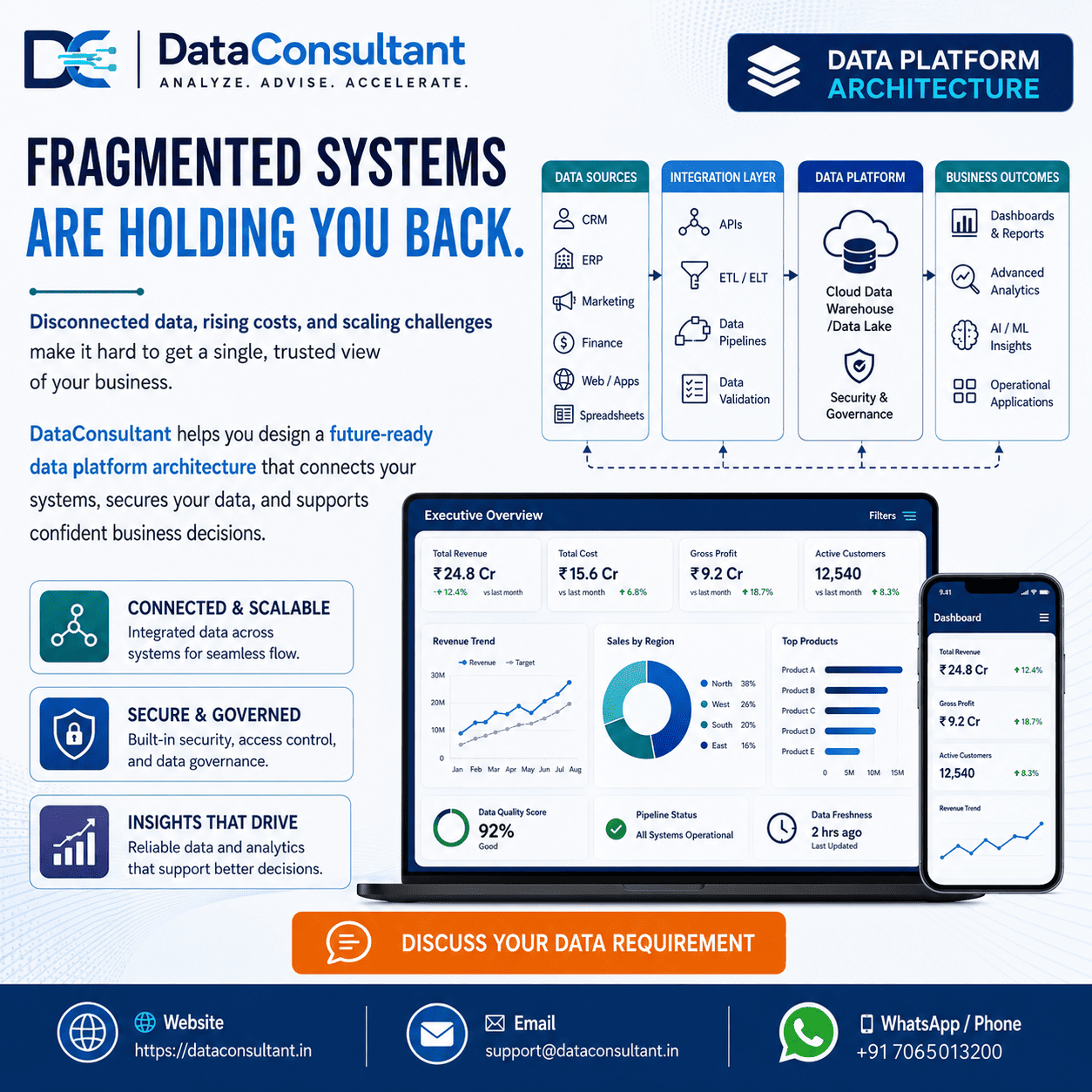
Architecture should follow the use case. A small website feature may need a secure model API, analytics and a limited content source. A customer-facing assistant connected to internal knowledge may also require retrieval, identity controls, vector search, data pipelines, logging, evaluation and fallback behaviour. Do not adopt components merely because they are common in AI diagrams.
Define the data and model boundary
- Specify which content and fields the model may receive.
- Decide whether the feature uses retrieval, fine-tuning, rules, tools or a combination.
- Document where prompts, context, outputs, logs and user feedback are stored.
- Separate public information from confidential, personal or regulated data.
- Define what happens when retrieval fails, confidence is low or the model produces an unsafe answer.
The NIST AI Risk Management Framework is designed to help organisations manage AI risks across design, development, use and evaluation. ISO/IEC 42001 provides requirements for an AI management system. These are useful governance references, but they do not replace legal, privacy, sector or contractual analysis specific to your website.
Treat evaluation as a product requirement
Define test cases before launch: answer correctness, source attribution, refusal behaviour, relevance, latency, accessibility, cost per interaction and escalation paths where appropriate. Website analytics should also show whether users complete the intended task. A high conversation count is not evidence that the AI is useful.
Expect Decision-Ready Deliverables and Handover
A professional engagement should leave the organisation with usable capability, not just a demonstration. Deliverables vary by problem type, but they should make ownership, acceptance criteria and next actions clear.
| Problem | Useful deliverables | Internal participation |
|---|---|---|
| Unclear opportunity | Use-case assessment, decision criteria, feasibility findings and prioritised roadmap | Business owner, product lead, data owner |
| Fragmented website data | Source inventory, quality findings, integration design and ownership map | Data and system owners |
| AI assistant or search | Content model, retrieval design, prototype, evaluation set and fallback rules | Content owners, security, product team |
| Personalisation or prediction | Data model, feature definitions, evaluation method, monitoring and governance controls | Analytics, marketing/product, privacy and risk |
| Production implementation | Architecture, code/configuration, tests, runbook, documentation and handover | Engineering, operations and service owner |
For implementation, use phased acceptance: discovery, prototype, controlled pilot, production hardening and handover. Each phase should answer a different uncertainty. This prevents the team from treating a convincing prototype as evidence that data access, security, cost, reliability and maintenance are production-ready.
Estimate AI Website Cost from Scope and Data Complexity
Cost is driven less by the phrase “AI website” than by the number of systems, quality of source data, model usage, security requirements, interface complexity and operating expectations. A narrow assistant using a curated public knowledge base has a different cost structure from a personalised customer experience connected to CRM, transactions and proprietary models.
Budget for internal work as well as supplier fees
Include stakeholder workshops, data preparation, API work, content review, privacy and security review, evaluation, user testing, analytics, documentation and training. Model and infrastructure charges can also continue after launch. If internal owners do not have time to make decisions or review outputs, the project can slow down even when the external technical team is available.
Timelines should be estimated after discovery. Weeks may be sufficient for a focused prototype using ready data and standard APIs. Production projects can extend into months when identity, integration, governance, content remediation and operating controls are substantial. Avoid fixed promises before dependencies have been mapped.
Use Real Website Problems to Choose the Right Engagement
Ecommerce: conflicting product and customer information
An ecommerce company wants an AI shopping assistant because customers struggle to compare products. The initial assumption is that a stronger model will solve the experience. Discovery finds inconsistent product attributes and different stock information across systems. The better decision is a short diagnostic followed by data-quality and integration work, then a limited assistant pilot. Likely deliverables include a source map, product-data rules, retrieval design, evaluation questions and a controlled implementation. Merchandising, technology and data owners must participate.
Professional services: internal knowledge assistant
A professional-service firm wants a website-style internal assistant for policies and delivery guidance. Documents are numerous, but access controls and version ownership are inconsistent. Buying a generic chatbot first would leave the main risk unresolved. A defined project can establish authoritative content, permission-aware retrieval, test cases, audit logging and handover procedures. Legal, information security, content owners and the internal platform team need to agree the operating boundaries.
Startup: predictive recommendations before reliable data
A startup wants predictive recommendations on its website but has only a short history of inconsistent event tracking. The actual need is not predictive analytics yet; it is a reliable measurement foundation. An internal analytics improvement or small data-engineering project may be the better first investment. Once events, identifiers and outcome definitions are stable, the team can test whether prediction adds value beyond rules or segmentation.
Use Specialist Support Where Data and AI Decisions Intersect
External support is most relevant when the business needs to connect website experience, data architecture, analytics and governance rather than solve only a front-end development task. For example, DataConsultant can support an assessment or readiness review when the use case and data foundation are uncertain, or a defined AI data engagement when architecture, implementation and governance need to be designed together.
Specialist involvement should still be proportionate. If a standard website tool meets the requirement and your team can configure, secure and operate it, a consulting project may add little value. If the workload becomes continuous across AI, analytics, data quality and governance, ongoing support or a managed team can be considered—but only with explicit ownership and knowledge-transfer expectations.
Summary: Choose the Smallest Credible AI Website Path
An artificial intelligence website is useful when AI supports a defined task and the organisation can provide trustworthy data, clear controls and accountable ownership. Internal staff may be sufficient for a narrow, well-understood feature. A software tool may be best when the workflow is standard and integration is straightforward. A short diagnostic is valuable when the use case, data quality or feasibility is uncertain. A defined consulting project is justified when specialist data architecture, integration, analytics, AI governance or implementation must be delivered with measurable acceptance criteria.
Use ongoing support or a managed team only when monitoring, content, data, models and governance create a recurring workload. Before committing, validate the business goal, data quality, access, privacy and security boundaries, internal owners, scope, budget, timeline, documentation, quality assurance and handover expectations. The right outcome may also be to improve source data, simplify the website problem or delay advanced AI until the foundation is ready.
FAQs on Artificial Intelligence Websites
What is an artificial intelligence website?
An artificial intelligence website is a website that uses AI to support a defined user or business task, such as conversational search, recommendations, document retrieval, forecasting, classification or workflow assistance. The useful distinction is between a site that merely mentions AI and a site whose user experience depends on models, data, prompts, retrieval or automated decisions. Before building one, define the user outcome, the data needed and the acceptable level of automation.
Does my business need a data consultant for an artificial intelligence website?
Not always. Internal teams may be sufficient when the use case, data, architecture, security controls and success measures are already clear. A data consultant becomes more useful when data sources conflict, retrieval quality is uncertain, customer information is sensitive, AI requirements are vague, or the website needs reliable analytics and governance across several systems. A short diagnostic is often a better first step than committing to a large project.
Should we buy an AI website tool or build a custom solution?
Buy or configure a tool when your workflow is standard, integrations are straightforward and the vendor's controls meet your requirements. Consider a custom or consulting-led build when the experience depends on proprietary data, complex integrations, distinctive decision logic or stronger governance. Test the smallest viable solution first; custom development is not automatically better simply because AI is involved.
What data should be ready before building an AI-enabled website?
Prepare the source systems, data owners, definitions, access methods, quality issues and retention rules that relate to the use case. For retrieval or recommendation features, also identify which content is authoritative, current and permitted for use. Do not assume a model can compensate for missing, contradictory or poorly governed source data.
What technical components can an AI website require?
Depending on the use case, an AI website may require application APIs, authentication, analytics, a data store, vector search or retrieval, model access, prompt and context management, monitoring, logging and fallback behaviour. Some websites need only a small model integration; others need a governed data platform behind the interface. Architecture should follow the user task rather than a fashionable technology stack.
How should privacy and AI governance be handled on the website?
Map what personal or confidential data enters the system, where it is processed, who can access it and what is retained. Define human review, acceptable use, testing, incident handling and change control for AI features. NIST's AI Risk Management Framework and ISO/IEC 42001 provide useful structures for responsible AI risk management, but your legal and sector obligations must still be assessed separately.
How much does an artificial intelligence website cost?
There is no responsible single price because cost depends on scope, data readiness, model usage, integrations, security, interface complexity, testing and ongoing monitoring. A narrow proof of concept can be materially smaller than a production website connected to multiple internal systems. Compare total cost of ownership, including data preparation, governance, model usage and maintenance, rather than only the initial build fee.
How long does an AI website project take?
A focused prototype may be feasible in weeks when the use case, content and APIs are already clear. A production implementation can take several months where data integration, privacy review, identity controls, testing and change management are substantial. The most reliable way to estimate time is to complete discovery, identify dependencies and agree acceptance criteria before committing to a fixed delivery plan.
What deliverables should a consultant provide for an AI website?
Deliverables should match the problem but may include a use-case brief, data and architecture assessment, requirements, solution design, data-quality findings, prototype, evaluation plan, governance controls, implementation roadmap, test evidence, documentation and handover materials. Require clear ownership and acceptance criteria so the organisation can operate the website after external support ends.
When is ongoing AI and data support appropriate?
Ongoing support is appropriate when the website's models, content, data sources, integrations or governance requirements change continuously. It can cover monitoring, prompt and retrieval tuning, analytics, data-quality checks, model evaluation, incident review and new use cases. If the feature is stable and internal owners can maintain it, a defined project with strong knowledge transfer is usually more economical.
Need an AI Website Readiness Review?
If your team is unsure whether the main issue is the website experience, underlying data, AI architecture or governance, start by defining the decision and evidence required. DataConsultant can help assess readiness, clarify requirements and scope the smallest appropriate next step.
Discuss your requirementAt DataConsultant.in, we help organisations turn data and AI priorities into governed, reliable, and practical business capability.