
Choosing an AI Tool: When You Need a Data Consultant
An AI tool is useful when it solves a clearly defined business task with suitable data, controlled access and an accountable owner. The central decision is not simply which product has the most features. It is whether your organisation has a specific operational problem, reliable enough information and the internal capability to implement the tool safely. Start with the business decision or workflow, then determine whether software alone is sufficient, a short diagnostic is needed, or a data consultant should help shape and deliver the work.
A technology request can hide a different problem. A team asking for an AI assistant may actually have inconsistent documents, weak search, unclear permissions or no agreed process. A forecasting request may be constrained by missing history and changing definitions. A dashboard copilot may add little value when the underlying metrics are disputed. In these situations, buying an AI tool before clarifying the data and operating model can create additional cost without improving the decision.
This guide helps founders, business leaders, technology teams, procurement functions and risk owners compare an internal solution, packaged software, a diagnostic, a defined consulting project, ongoing specialist support and a managed team. It also explains readiness, data access, integration, governance, cost, implementation, measurement and handover.
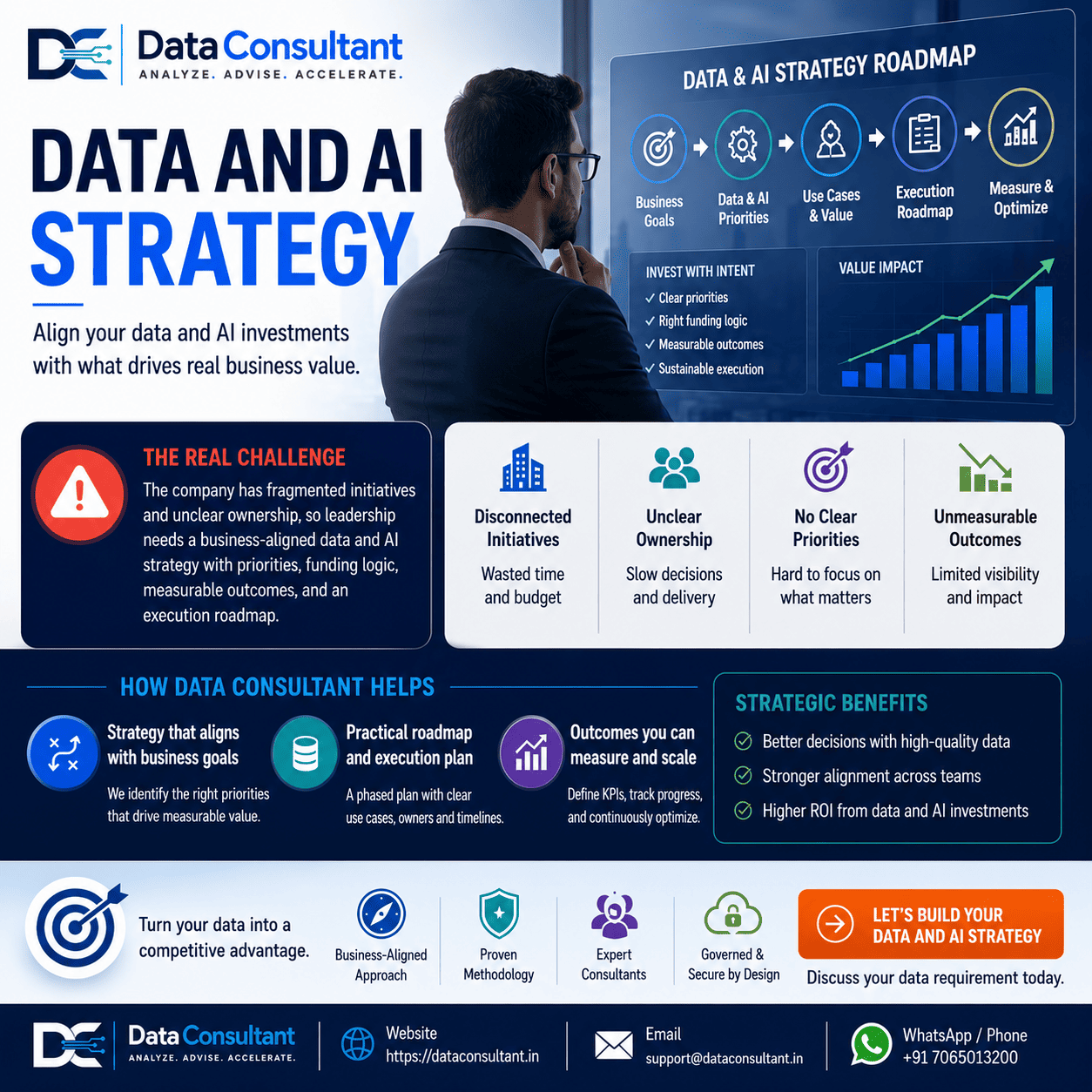
Quick Answer: Choose the Problem Before the AI Tool
Use an AI tool without external support when the process, users, data, security boundaries and success criteria are already clear, and your team can configure, integrate, test and maintain the solution. This is most realistic for a limited, common use case such as drafting approved content, classifying low-risk records or improving search over a governed document set.
Use a short diagnostic when teams disagree about the problem, data quality is uncertain, vendors are being compared before requirements exist, or management needs a prioritised roadmap. Use a defined consulting project when architecture, data integration, governance, workflow design, testing or knowledge transfer must be delivered to agreed milestones. Choose ongoing support only when the workload and governance needs are genuinely continuous.
The main caution is to avoid hiring a consultant or buying software before defining the business decision or operational problem. AI cannot compensate for inaccessible data, inconsistent processes, missing ownership or unresolved privacy and security controls.
Key Takeaways
- Define the decision first: specify the user, workflow, desired output and action that follows.
- Test data readiness: useful AI depends on accessible, representative and sufficiently reliable data.
- Keep internal ownership: business, technology and risk owners must approve priorities and remain accountable.
- Choose the smallest engagement: software, a diagnostic, a defined project or ongoing support should match the actual gap.
- Demand clear deliverables: include requirements, controls, test evidence, documentation, training and handover.
- Build governance into delivery: address privacy, security, accuracy, human review and monitoring before scale.
- Plan knowledge transfer: internal teams should understand how to operate, challenge and improve the solution.
Table of Contents
- Define the AI decision and workflow
- Check data and organisational readiness
- Compare tool, team and consulting options
- Set technical and governance requirements
- Pilot the AI tool before scaling
- Estimate cost, time and resources
- Measure business and control outcomes
- Apply the decision to realistic cases
- Decide where specialist support fits
- Summary
Start with the Decision the AI Tool Must Improve
The correct starting point is a decision statement: who needs to do what differently, using which information, within which risk boundaries? A useful statement is more precise than “we need generative AI”. It might be “customer-support advisers need approved answers from current policy documents, with source citations and escalation when confidence is low”.
Separate a business problem from a technology request
Ask what is slow, inconsistent, expensive, risky or difficult to scale today. Then identify the root cause. If the cause is missing data, disputed definitions, poor process discipline or inaccessible systems, an AI product may be only a surface-level remedy. Fixing source processes or data governance may create more value than adding another interface.
Define acceptance criteria before comparing products
Set measurable conditions for usefulness and safety. These may include answer relevance, processing time, manual effort, error tolerance, citation quality, escalation rate, user adoption and control compliance. Avoid a single accuracy percentage without defining the dataset, task and acceptable error types.
Decision rule: if the team cannot describe the user, input, output, action, risk and success measure in plain language, the next step is discovery rather than procurement.
Check Data Readiness Before Selecting an AI Tool
AI readiness is not the same as having a large volume of data. The organisation needs enough business clarity, data quality, access, governance and ownership to test the use case credibly. Weakness in one area does not always stop a pilot, but it should shape scope and controls.
Review representative data rather than relying only on stakeholder descriptions. Check completeness, timeliness, consistency, bias, permitted use and whether the data reflects the conditions the tool will encounter. A data maturity assessment can also reveal whether the organisation needs stronger metadata, data quality management or ownership before advanced automation.
Compare an AI Tool, Internal Team and Consultant
The best option depends on problem clarity, internal skills, urgency, risk and continuity. Software can be the right answer, but the subscription is only one part of the operating model. The table below compares the choices by the work they actually require.
| Option | Best fit | Expected outputs | Internal requirement | Main risk |
|---|---|---|---|---|
| Internal team | Clear, limited use case with available technical and business capability | Configuration, testing and operating procedures | Protected delivery time and accountable owners | Competing priorities slow or weaken delivery |
| Packaged AI tool | Common workflow with compatible data and standard controls | Configured product, user access and vendor support | Requirements, integration, governance and adoption | Feature-led purchase does not solve the real problem |
| Short diagnostic | Unclear problem, conflicting priorities or uncertain data readiness | Findings, use-case priorities, risk view and roadmap | Stakeholder access and evidence | Recommendations stall without an internal owner |
| Defined consulting project | Scoped architecture, integration, analytics or governance work | Design, implementation, testing, documentation and handover | Business, technology and risk participation | Scope expands without acceptance criteria |
| Ongoing specialist support | Recurring optimisation, monitoring or changing use cases | Backlog delivery, reviews, improvements and coaching | Regular prioritisation and governance cadence | Dependency grows without knowledge transfer |
| Dedicated specialist or managed team | Substantial continuous work across several data and AI disciplines | Predictable multi-skilled capacity and coordinated delivery | Executive sponsor and clear operating model | Capacity is wasted when demand and ownership are weak |
A hybrid model is often practical: external specialists support discovery and initial delivery, while internal owners define the business context, approve controls and take responsibility for operation.
Set AI Data, Integration and Governance Requirements
A credible selection process defines what the tool must connect to, which information it may process, how outputs are reviewed and who is responsible when the result is wrong. These requirements should be written before contract signature and refined during a controlled pilot.
Specify data and technical access
- List source systems, document repositories, APIs and identity-management requirements.
- Provide representative sample inputs, known data limitations and expected output formats.
- Define latency, availability, scalability, logging and integration constraints.
- Separate development, test and production access, with least-privilege permissions.
- Confirm portability of prompts, configurations, embeddings, models and generated records.
Make responsible AI operational
Governance should cover purpose, permitted users, data classification, human review, quality thresholds, escalation, monitoring and retirement. The NIST AI Risk Management Framework provides a practical structure for managing AI risks. The OECD AI Principles provide broader guidance on trustworthy and human-centred AI, while ISO/IEC 42001 describes an AI management-system approach.
These frameworks are not substitutes for the laws, contracts and internal policies that apply to your organisation. Confirm vendor data use, retention, model training, subprocessors, incident handling, audit rights and exit arrangements with relevant legal, privacy and security specialists.
Pilot the AI Tool Before Committing to Scale
A pilot should test business usefulness, technical feasibility and control effectiveness in a narrow scenario. Select one user group, one process, representative data and a clear comparison with the current method. Avoid a showcase built only from clean examples supplied by the vendor.
Use phased delivery with decision gates
- Discover: confirm the problem, stakeholders, current process and constraints.
- Assess: review data quality, integration, privacy, security and operating readiness.
- Pilot: configure the smallest viable workflow and test realistic cases.
- Evaluate: compare outcomes with baseline measures and review failures.
- Scale or stop: expand only when benefits, controls, ownership and support are credible.
Include quality assurance from the beginning. Test normal cases, difficult edge cases, incomplete inputs, harmful or misleading outputs, access violations and service failure. Record who can approve changes and how the organisation will monitor performance after release.
Estimate the Full Cost of the AI Tool
The total cost includes more than licensing. Data preparation, integration, security review, configuration, testing, user training, change management, monitoring, support and vendor management may require more effort than the initial setup. Usage-based pricing can also change materially as adoption grows.
Cost and timeline drivers
- Number and complexity of data sources and business systems.
- Quality, sensitivity and permitted use of the required data.
- Need for retrieval, custom models, agents, orchestration or human approval.
- Volume of users, requests, documents and generated content.
- Security, privacy, legal and procurement review requirements.
- Testing depth, documentation, training and support expectations.
A narrow pilot may take several weeks when access and decisions are ready. A multi-system implementation may take several months. Ask suppliers and consultants to state assumptions, exclusions, internal resource needs, acceptance criteria and change-control arrangements so proposals can be compared fairly.
Measure Whether the AI Tool Improves the Decision
Measure the business workflow, not only model activity. Usage, tokens, prompts and response time are operational indicators; they do not prove that the organisation made better decisions or reduced risk. Establish a baseline before the pilot and compare like-for-like work.
| Area | Useful measures | Important caution |
|---|---|---|
| Business outcome | Cycle time, throughput, service quality or decision consistency | Check other changes that may have influenced the result |
| Output quality | Task success, grounded answers, error type and escalation rate | Use representative cases and expert review |
| User adoption | Active users, completion rate, override rate and feedback | High usage can reflect novelty rather than value |
| Risk and control | Policy exceptions, sensitive-data events, access failures and incidents | Absence of reported incidents may indicate weak detection |
| Economics | Total operating cost, cost per completed task and support demand | Include internal time and future maintenance |
Agree who reviews the measures, how often the tool is re-tested and what thresholds trigger correction, restriction or retirement. Outcomes should be attributed cautiously; AI implementation does not guarantee savings, growth, compliance or improved accuracy.
Match the AI Tool Decision to the Real Problem
Ecommerce reporting conflicts
An ecommerce business wants an AI assistant to explain revenue and customer trends. The mistaken assumption is that conversational access will resolve disagreements. The actual problem is inconsistent definitions across finance, marketing and commerce platforms. A short diagnostic should reconcile metrics, ownership and source data before any assistant is built. Likely deliverables include a KPI framework, data-quality findings, integration priorities and a pilot specification. Finance, marketing and technology owners must participate.
Professional services and spreadsheet reporting
A professional-services company wants an AI tool to automate monthly management packs. Its real constraint is a fragile spreadsheet process with undocumented adjustments. A defined project is more suitable than a stand-alone writing assistant: map the workflow, improve data extraction, define controls, automate repeatable calculations and then use AI only where narrative support is useful. Deliverables should include the target process, automated pipeline, report logic, control evidence and handover.
Startup considering predictive AI
A startup wants predictive analytics for customer churn but has limited historical data and changing product definitions. The better decision may be to improve event collection, customer identifiers and outcome labels before modelling. A data consultant can help design a phased data roadmap, but a complex AI platform should be delayed until the evidence base is credible. Product, engineering and commercial owners need to agree what churn means and how interventions will be measured.
Enterprise knowledge assistant
An enterprise team wants employees to search policies and procedures through an AI assistant. The actual challenge includes document ownership, version control and permissions. A controlled project can combine content governance, secure retrieval, citations, identity-based access, testing and monitoring. Legal, security, records, technology and business owners must agree permitted content, escalation paths and operational support.
Use Specialist Support Only Where It Adds Value
External support is most useful when the organisation needs an independent diagnostic, stakeholder alignment, data-quality assessment, architecture, integration planning, governance design, a scoped implementation or temporary specialist skills. It is less useful when the task is small, the internal team already has the capability and the work can be prioritised without outside help.
DataConsultant can support a focused AI and data readiness assessment, a defined AI data project, or managed data and AI support where the need is continuous. The appropriate starting point should remain the smallest engagement that resolves the decision.
Summary
An AI tool is appropriate when a specific workflow can be improved with suitable data, clear ownership and controlled implementation. Internal staff may be sufficient when requirements and capability are already strong. A packaged product may be enough when the process is standard and integration is manageable. A short diagnostic is useful when the problem, data maturity or priorities are uncertain. A defined consulting project is justified when architecture, integration, governance, testing and handover must be delivered. Ongoing support or a managed team is appropriate only when the work is substantial and continuous.
Before committing, validate the business goal, data quality, access, governance and internal ownership. Compare scope, budget, timeline, security, documentation, quality assurance, knowledge transfer and handover in proportion to the risk and complexity of the use case.
FAQs About Choosing and Implementing an AI Tool
What does an AI tool do for a business?
An AI tool performs a defined task such as generating text, classifying records, forecasting demand, answering questions or automating a workflow. Its value depends on a clear use case, suitable data, secure integration and accountable human review. Verify the tool against a limited business scenario before wider adoption.
How do I know which AI tool my business needs?
Start with the decision or workflow you want to improve, not with a product category. Define the user, input data, expected output, risk level and success measure, then compare tools against those requirements. If stakeholders cannot agree on the problem, run a short discovery or AI-readiness diagnostic first.
Can an AI tool replace a data consultant?
A tool can replace some manual tasks, but it does not usually define business priorities, repair poor data, settle KPI ownership or design governance. Use software alone when requirements, data and controls are already clear. Use a data consultant when the organisation needs diagnosis, architecture, integration, quality improvement or implementation support.
Should we buy an AI tool or build an internal solution?
Buy when the use case is common, configuration is sufficient and vendor controls meet your needs. Build when the workflow is strategically distinctive, integration is complex or proprietary logic matters. Compare total ownership cost, security, maintenance, model dependency and the internal skills required for both options.
What information should we prepare before selecting an AI tool?
Prepare the business objective, current process, users, data sources, sample inputs, expected outputs, system interfaces, privacy classification, approval requirements, budget and success measures. Also identify an executive sponsor, business owner, technical owner and risk or security contact. Missing inputs should be resolved during discovery rather than hidden in the implementation phase.
How much does an AI tool implementation cost?
Cost depends on licence or usage fees, data preparation, integration, security review, workflow redesign, testing, training, monitoring and ongoing support. A small controlled pilot may require limited investment, while enterprise deployment can involve substantial platform and change costs. Compare total cost of ownership rather than the headline subscription price.
How long does AI tool implementation take?
A narrow pilot can often be prepared in several weeks when the use case, data access and approvals are ready. Multi-system deployment may take months because integration, data quality, security, testing and adoption require more work. Use phased milestones and do not treat a vendor demonstration as evidence of production readiness.
How should privacy, security and AI governance be handled?
Classify the data, minimise sensitive inputs, define permitted use, confirm retention and training practices, control access, test outputs and assign human accountability. Record the model, purpose, limitations and monitoring approach. Apply the laws, contractual requirements and internal policies relevant to your organisation and jurisdiction.
What deliverables should an AI tool project produce?
Expect a requirements record, prioritised use case, data and integration assessment, solution design, risk controls, pilot results, test evidence, operating procedures, training materials, monitoring measures and handover documentation. The exact package should match the risk and complexity of the use case. Ownership of code, prompts, configurations and documentation should be agreed in writing.
When is ongoing AI and data support appropriate?
Ongoing support is appropriate when use cases change frequently, models or prompts require monitoring, new data sources are added, governance obligations evolve or internal capability remains limited. A one-off project is usually sufficient for a stable, well-owned workflow. Continued support should include knowledge transfer so the organisation does not create avoidable dependency.
Need an AI Tool Readiness Diagnostic?
Share the business problem, users, current process, data sources, systems, risk constraints and desired outcome. DataConsultant can help determine whether software alone is sufficient or whether you need discovery, a defined data and AI project, or ongoing specialist support.
Discuss Your AI and Data Requirement“At DataConsultant.in, we help organisations turn data and AI priorities into governed, reliable, and practical business capability.”