
AI's Business Value: When a Data Consultant Can Help
AI's business value is not created by the model alone. It comes from connecting a useful business decision to reliable data, workable architecture, accountable ownership and controls that allow people to act on the output. A data consultant can help when the organisation knows the outcome it wants—such as faster reporting, better forecasting, more consistent customer decisions or safer automation—but is unsure whether its data, systems and governance are ready.
The decision is not simply whether to “do AI”. First establish whether the issue is data, process, capability or technology. Internal teams may solve a narrow issue; a platform may be enough when requirements and data foundations are mature. Use a short diagnostic when reports conflict, access is unclear or stakeholders disagree about readiness, and a defined project when implementation work can be scoped and handed over.
This guide is for leaders evaluating the practical role of a data consultant in an AI initiative. It covers readiness, governance, implementation and outcomes.
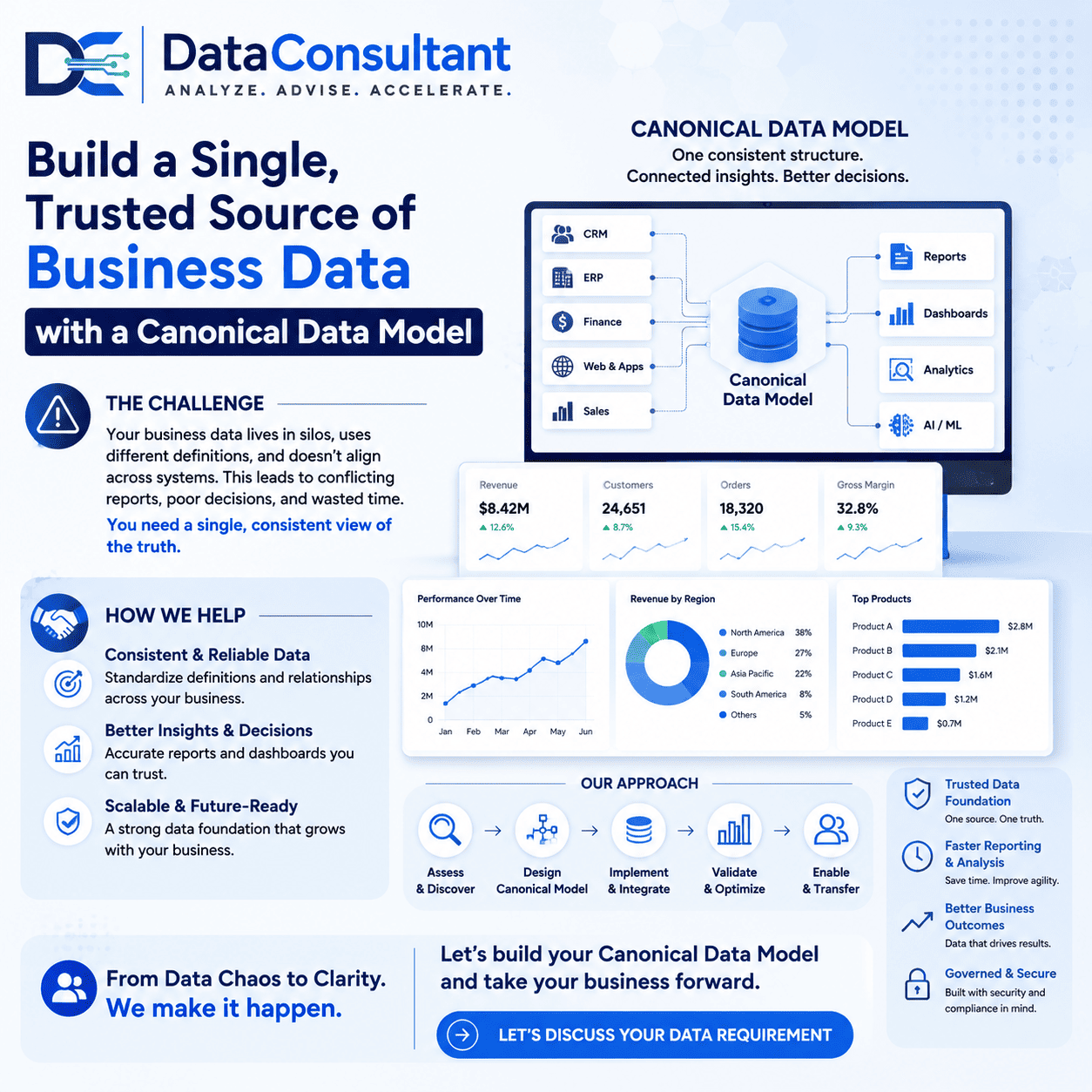
Quick Answer: Fix the Data Decision Before Scaling AI
Use a data consultant when an AI use case is commercially important but the path from business objective to dependable data and controlled implementation is uncertain. The consultant should help clarify the decision, assess data quality and access, map systems and ownership, identify governance constraints, define target architecture and produce a prioritised plan that internal teams can execute or commission.
Do not start with a large AI build when the organisation cannot explain which decision will improve, which source data is authoritative or who will own the output. If the issue is narrow and internal teams have the skills and capacity, solve it internally. If the main requirement is a well-defined software capability and the data is already fit for purpose, a platform may be enough. If uncertainty is high, buy clarity first through a bounded diagnostic.
Key Takeaways
- Start with a decision: define the business action, user and measurable outcome before selecting an AI model or platform.
- Test data readiness: AI cannot compensate for missing ownership, inconsistent definitions, poor lineage or inaccessible source data.
- Match support to uncertainty: use internal staff for well-understood work, a diagnostic for uncertainty, and a defined project for implementation.
- Design governance with delivery: privacy, security, model risk, human oversight and data controls should shape the solution from the start.
- Account for internal effort: stakeholders, system owners and risk teams must provide evidence, decisions, access and approvals.
- Require handover: architecture, code, models, prompts, rules, documentation and monitoring responsibilities need named owners.
- Measure capability: judge success by better decisions and sustainable operating capability, not by deployment alone.
Table of Contents
- Decide whether AI is solving the right problem
- Check data and organisational readiness
- Compare internal, platform and consulting options
- Define technical and governance requirements
- Move from diagnostic to controlled delivery
- Estimate cost, time and internal effort
- Measure useful business capability
- Apply the decision to practical situations
- Choose specialist support where it adds value
- Summary
Decide Whether AI Is Solving the Right Problem
The first consulting task should be problem definition. “We need AI” is not a business requirement. A stronger statement identifies the decision or workflow, the user, the constraint and the valuable change: faster reconciliation, more consistent support answers, earlier data-quality detection or better prioritisation using governed data.
Separate the symptoms from the underlying constraint
An AI assistant request may actually be a knowledge-management problem; forecasting may be blocked by inconsistent history; a dashboard may mask missing KPI ownership. A consultant adds value by tracing the symptom through data, process, architecture and ownership instead of treating every request as a model-development project.
Decision rule: if the organisation cannot name the business decision, authoritative data, accountable owner and acceptable failure mode, it is not ready to scale the AI solution. A short discovery exercise should come first.
Know when internal staff are enough
Use internal teams when the problem is familiar, the data sources and controls are known, the skills exist and there is enough delivery capacity. External support is less valuable when it merely duplicates an established internal function. A consultant becomes more useful when the issue crosses business units, ownership is contested, architecture choices need independent challenge or specialist data and AI skills are temporarily required.
Check Data and Organisational Readiness
AI readiness is the combined condition of the use case, data, technology, governance and operating ownership. A business can pilot with imperfect data, but it must understand material limitations before the system turns them into apparently confident outputs.
Assess the wider data lifecycle, not only the dataset supplied to the model. The OECD overview of data governance is useful context for thinking about access, sharing and stewardship. For AI-specific risk, the NIST AI Risk Management Framework provides a structured way to consider governance, mapping, measurement and risk management.
Evidence a minimum readiness baseline
- A named business sponsor and operational owner.
- Defined users, decisions and acceptance criteria.
- Known source systems and data owners.
- A view of data quality, lineage and material limitations.
- An access path for discovery and testing.
- Privacy, security and retention requirements.
- A technical owner for environments, integrations and monitoring.
- A plan for adoption, support and escalation after launch.
Compare Internal, Platform and Consulting Options
The right delivery model depends on uncertainty, continuity and the amount of cross-functional work. Buying a platform can be efficient when requirements are already clear. Hiring internally can be better when the workload is permanent. Consulting is strongest when the organisation needs bounded specialist work, independent assessment or acceleration across multiple data disciplines.
| Option | Best fit | Typical outputs | Internal requirement | Main caution |
|---|---|---|---|---|
| Internal team | Known problem, established data ownership and sufficient skills | Analysis, engineering, controls and operating changes | Protected delivery capacity and decision authority | Priority conflicts can delay work |
| AI or analytics platform | Clear use case with fit-for-purpose data and controls | Configured software capability and user workflows | Requirements, integration, governance and adoption ownership | Technology may expose unresolved data problems |
| Short diagnostic | Unclear readiness, conflicting data or uncertain architecture | Findings, risk view, target state and prioritised roadmap | Evidence access and stakeholder participation | Recommendations stall without an owner |
| Defined consulting project | Bounded architecture, engineering, governance or implementation scope | Designs, pipelines, controls, pilot, documentation and handover | Timely access, approvals and product ownership | Scope expands if acceptance criteria are vague |
| Ongoing specialist support | Recurring use cases, changing models or sustained capability gaps | Advisory, delivery support, monitoring and improvement backlog | Regular prioritisation and governance cadence | Dependency if knowledge transfer is weak |
| Dedicated specialist or managed team | Continuous multi-role workload across data and AI | Predictable capacity across architecture, engineering, governance and analytics | Executive sponsor and clear operating model | Capacity is wasted without a prioritised pipeline |
A hybrid model is often practical: internal leaders own decisions and risk, a platform supplies technical capability, and external specialists fill defined gaps in assessment, architecture, engineering or governance.
Define Technical and Governance Requirements
A credible engagement needs enough technical evidence to understand how information is created, transformed, consumed and controlled: system documentation, schemas, sample records, data models, pipelines, dashboards, APIs, access roles and relevant logs. Unrestricted production access is not the default; access should be proportionate to the task.
Design the data path before the model path
For many AI initiatives, the difficult work is identifying authoritative sources, resolving duplicate definitions, creating stable pipelines and making outputs observable. Architecture should show where data is transformed, where sensitive fields are protected, how errors are detected and how challenged outputs can be reproduced.
Treat security and governance as delivery requirements
Security controls should be designed around the actual data flow and operating environment. The ISO/IEC 27001 information security management standard is a useful reference for risk-based security management. For personal data, apply the laws and regulator guidance relevant to the organisation's jurisdictions; governance should define lawful access, minimisation, retention, human oversight and incident handling rather than assuming an AI vendor's controls cover the complete business process.
- Define data owners and business-rule owners.
- Document approved environments, models and external services.
- Apply least-privilege access and segregate production from experimentation where appropriate.
- Record material data limitations and known bias or coverage gaps.
- Specify human review for decisions where errors could materially affect customers, staff or regulated outcomes.
- Define monitoring, quality checks, change approval and rollback procedures.
Move from Diagnostic to Controlled Delivery
A useful engagement narrows uncertainty in stages: discovery establishes the decision, assessment identifies gaps, prioritisation separates blockers from later improvements, and a pilot tests the smallest valuable workflow. Implementation then strengthens the data path, integrates the solution and prepares the owner for handover.
Expect concrete deliverables
- Problem statement, scope and decision criteria.
- Data-source, ownership and quality findings.
- Architecture diagrams and integration requirements.
- Prioritised remediation and implementation roadmap.
- Governance, security and responsible-AI control requirements.
- Pilot outputs, test results and quality-assurance evidence.
- Code, configuration, prompts or model artefacts where included in scope.
- Runbooks, monitoring requirements, documentation and knowledge-transfer sessions.
Estimate Cost, Time and Internal Effort
Cost and timeline are driven by system count, documentation quality, integration complexity, data remediation, security review, model requirements and decision speed. A short assessment should be simpler than building production pipelines, retrieval systems or monitoring controls across several business units.
Internal participation is part of the real cost. Business owners must define what “good” looks like. Data owners need to explain sources and quality issues. Engineers may provide environments and access. Security, privacy and risk teams may review controls. Procurement and legal teams may assess third-party terms. If those people are unavailable, an external team cannot compensate by guessing.
Commercial check: compare proposals by decisions, deliverables, dependencies, acceptance criteria and handover. A low headline price is not a saving if the scope excludes the data remediation, integration or governance work required for the solution to operate.
Measure Useful Business Capability
AI success should connect technical metrics to workflow performance and business decisions. A retrieval assistant may need measures for grounded answers and refusal behaviour while the business tracks adoption, escalation, rework and task reliability.
- Quality and reliability of the underlying data products.
- Model or application performance against defined acceptance tests.
- Use of approved data, models and governed workflows.
- Time, rework or error changes where causation can be reasonably evidenced.
- User adoption and ability to challenge or escalate questionable outputs.
- Control performance, incidents and unresolved risk issues.
- Operational readiness of internal owners after handover.
- Ability to maintain documentation, pipelines, prompts, models and monitoring without avoidable external dependency.
Agree the baseline before implementation. Where outcomes improve, distinguish the contribution of AI from concurrent changes in process, staffing, pricing, systems or management action.
Practical AI and Data Consulting Decisions
Customer support wants a generative assistant
A growing ecommerce business wants an AI assistant because agents spend time searching policies and product information. Discovery shows that the main problem is fragmented content, duplicated documents and no authoritative publishing process. The correct first project is knowledge governance and retrieval readiness, not model customisation. A bounded engagement can define source ownership, content standards, ingestion rules, access controls, evaluation tests and a pilot retrieval workflow.
Finance wants AI forecasting
A finance team wants machine-learning forecasts, but historical categories changed repeatedly and management adjustments are stored outside the planning system. The model would learn from inconsistent history. A short diagnostic should map definitions, reconcile history and identify which manual adjustments need structured capture. Only then is it sensible to compare forecasting approaches. The deliverable is a readiness and remediation plan, followed by a pilot if the data becomes fit for purpose.
Enterprise teams are building separate copilots
An enterprise has several departments experimenting with copilots using different data stores, prompts and access models. The business needs an operating model more than another prototype. A defined programme can establish approved patterns for identity, retrieval, data classification, logging, evaluation, change control and product ownership. Ongoing specialist support may be justified during rollout, but the target state should transfer architecture, governance and operational ownership to internal teams.
Choose Specialist Support Where It Adds Value
External data consulting is most useful when the organisation needs an independent view of readiness, a target data architecture, governance design, data engineering, analytics or an implementation roadmap that cuts across teams. DataConsultant data advisory support can help with problem framing, maturity assessment and roadmap definition. Where the main gap is the data foundation, a data engineering engagement or data governance support may be more relevant than a broad AI project.
If the requirement is specifically to assess and implement AI use cases on governed data, AI data services can be scoped as a diagnostic, defined project or ongoing support model. The engagement should remain limited to the actual problem and should include explicit responsibilities for internal ownership, security review, documentation and handover.
Summary: Use AI Only Where the Data Can Support It
A data consultant is appropriate when the organisation has a meaningful AI or analytics objective but needs specialist help to determine whether its data, architecture and governance can support that objective. Internal staff may be sufficient for a known problem with clear ownership and available capacity. A software platform may be sufficient when requirements, data and controls are already mature.
Use a short diagnostic when business goals, data quality, access or ownership are uncertain. Use a defined project when architecture, engineering, governance, pilot delivery, quality assurance, documentation and handover can be scoped. Choose ongoing support or a managed team only when there is a continuing pipeline of work that cannot yet be sustained internally.
Before committing budget, validate the business decision, data quality, access, governance, internal ownership, scope, timeline, security requirements and acceptance criteria. The strongest engagement leaves the organisation with a reliable data path, understood controls, maintainable artefacts and people who can own the capability after external specialists step away.
FAQs on AI's Data and Consulting Decisions
What does AI's business value depend on?
AI's business value depends on a clear business decision, usable data, appropriate technical architecture, accountable owners and controls that match the risk. A model or tool can be technically impressive and still produce little value if the source data is unreliable, the workflow is undefined or users cannot act on the output. Verify the use case, data quality, access, governance and adoption plan before scaling.
How do I know whether my business needs a data consultant for AI?
A data consultant is useful when the AI objective is clear enough to investigate but the data foundations, architecture, governance or implementation path are uncertain. Internal teams may be sufficient when they already understand the data, controls and delivery work. Start with a short diagnostic when stakeholders disagree about readiness or when an AI tool is being considered before the underlying data problem is understood.
Should I hire a data consultant or a full-time data professional?
Choose a full-time hire when the workload is enduring, the role is well defined and the organisation can support the person with data access, tooling and decision authority. A consultant is better suited to bounded discovery, architecture, governance design, remediation planning or implementation acceleration. If the work will continue across many functions, a dedicated specialist or managed team may be more appropriate than repeated short projects.
Can an AI platform replace a data consultant?
An AI platform can provide model, automation, search or analytics capability, but it does not automatically define the right business problem, repair source data, resolve ownership, design controls or manage change. A platform may be enough when requirements and data foundations are already mature. Where they are not, buying technology first can move the bottleneck rather than remove it.
What should we prepare before a data and AI consulting engagement?
Prepare the business objective, current process, key decisions, data sources, system owners, known data-quality issues, access constraints, security requirements and examples of the outputs people use today. Identify an executive sponsor and day-to-day owner. You do not need perfect documentation, but the consultant needs enough evidence and stakeholder access to distinguish assumptions from facts.
How much does data consulting for AI cost?
Cost depends on scope, data complexity, number of systems, access constraints, security review, stakeholder availability and whether the work stops at recommendations or includes implementation. A short diagnostic should cost less than a multi-system engineering or governance programme, but a reliable estimate requires a defined problem and acceptance criteria. Compare proposals by deliverables, dependencies and internal effort, not only the headline day rate.
How long does an AI data-readiness project take?
A focused assessment can often be completed faster than a build because it concentrates on evidence, decisions and a prioritised roadmap. Implementation takes longer when data must be cleaned, integrated, governed or migrated before the AI use case can be tested safely. Timelines should be based on system access, decision speed and scope rather than a generic promise.
Who owns the models, dashboards, code and documentation after the project?
Ownership should be agreed in the statement of work and reflected in repositories, access rights and handover materials. The organisation should know who owns business rules, source data, models, prompts, pipelines, dashboards, controls and ongoing monitoring. Require documentation, knowledge transfer and operational ownership so the capability does not depend on one external person or supplier.
When is ongoing data and AI consulting support appropriate?
Ongoing support is appropriate when the organisation has a continuing pipeline of use cases, regular model or data changes, evolving governance requirements or insufficient internal specialist capacity. It is less suitable when there is only one bounded issue that can be resolved and handed over. Review the arrangement periodically to ensure external support is transferring knowledge and not creating avoidable dependency.
Need a Data and AI Readiness Diagnostic?
Share the business objective, current data sources, known quality issues, system constraints and governance requirements. DataConsultant can help determine whether internal delivery, a short diagnostic, a defined project or ongoing specialist support is the most proportionate next step.
Discuss your requirementAt DataConsultant.in, we help organisations turn data and AI priorities into governed, reliable, and practical business capability.