
From Data to Analytics: A Practical Decision Guide
Moving from data to analytics means turning raw, fragmented or underused information into reliable evidence for a defined business decision. The practical starting point is not a dashboard, an AI model or a new platform. It is a clear operational question: which decision, process or customer outcome needs better evidence, and what data is required to support it?
A business may need only internal analysis when the question is clear, the data is accessible and the team has the skills and time to act. A short diagnostic is more appropriate when reports conflict, metric definitions differ or the organisation does not know whether the real issue is data quality, integration, governance or analytical capability. A defined consulting project becomes useful when the work requires architecture, engineering, business intelligence, forecasting, governance or implementation support. Ongoing support is justified only when analytical demand is continuous.
This guide helps founders, business leaders, finance, marketing, operations, technology, risk and procurement teams decide how to progress from data to analytics without buying technology before the business problem is understood.
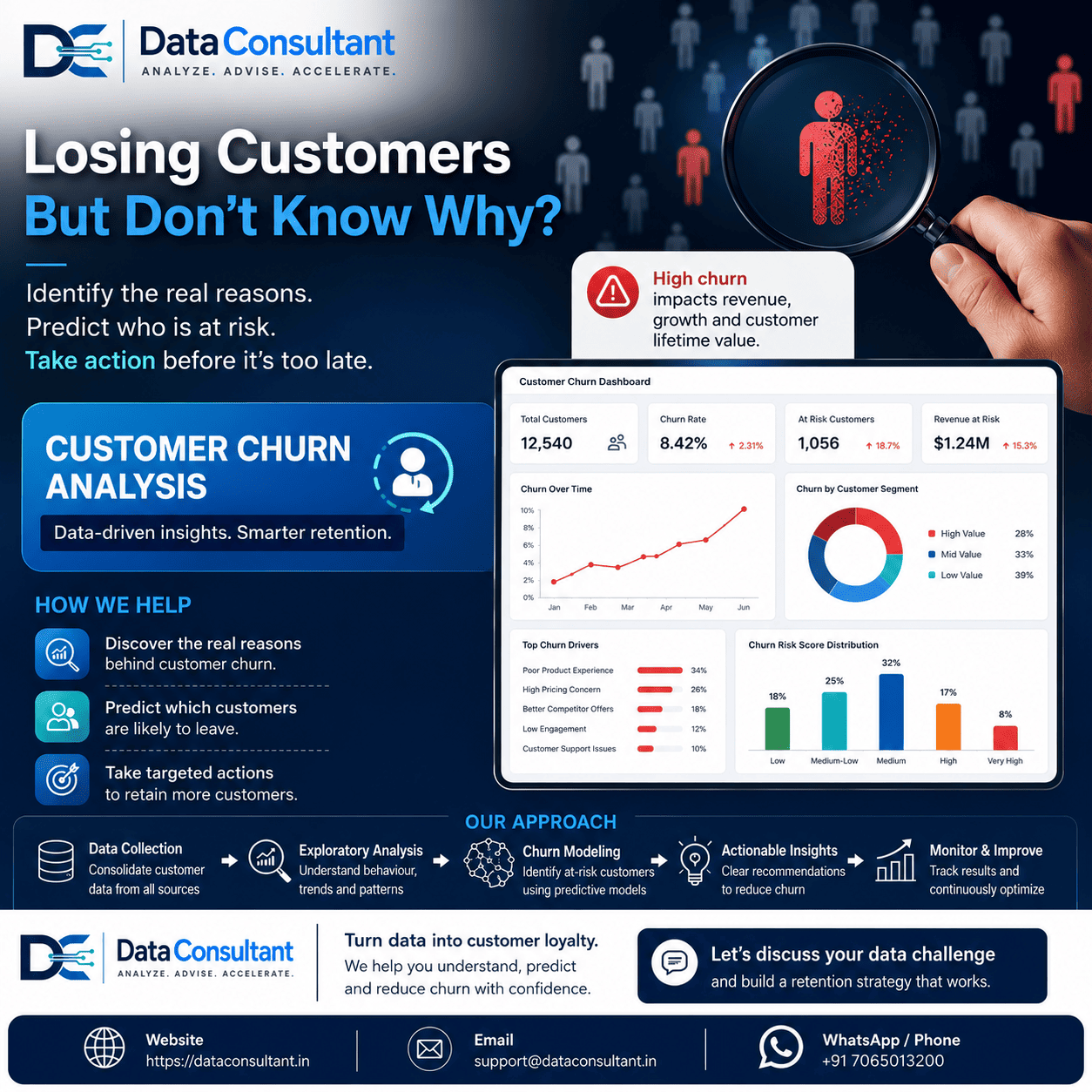
Quick Answer: Start with the Decision, Not the Tool
To move from data to analytics, first define the decision that must improve, then confirm the data sources, ownership, quality, access and analytical method required. This prevents a common failure: producing attractive reports that do not answer a real business question.
Use internal staff when the scope is narrow and capability already exists. Use a short diagnostic when the problem or data readiness is unclear. Use a defined project when specific deliverables can be agreed, such as a KPI framework, data model, pipeline, dashboard, forecast or governance process. Choose ongoing support or a managed team only when the workload is recurring and multi-disciplinary.
The main caution is simple: do not hire a consultant, purchase a platform or begin AI development before defining the business decision or operational problem.
Key Takeaways
- Define the decision first: analytics should improve a named decision, workflow or outcome.
- Check data readiness: source quality, access, lineage and definitions often determine cost and feasibility.
- Retain internal ownership: business leaders and data owners must approve priorities, metrics and trade-offs.
- Scope tangible deliverables: require documented models, dashboards, pipelines, controls, roadmaps and acceptance criteria where relevant.
- Build governance into delivery: privacy, security, quality and responsible use are part of analytics, not later additions.
- Measure decision usefulness: adoption and decision quality matter more than the number of dashboards produced.
- Plan knowledge transfer: internal teams need documentation, training and ownership after external support ends.
Table of Contents
- Define the business decision
- Assess data and analytics readiness
- Compare delivery options
- Set data, technical and governance requirements
- Plan a phased analytics implementation
- Estimate cost, time and resources
- Measure useful analytics outcomes
- Apply the decision to practical examples
- Decide where specialist support fits
- Summary
Define the Business Decision Before Analysing Data
Analytics is useful only when it reduces uncertainty around a decision. Begin by stating who will use the output, what they must decide, how frequently they decide it and what action will change because of the analysis.
Separate business questions from reporting requests
“Build a sales dashboard” is a reporting request. “Which customer segments are declining, why, and what should sales leaders do next?” is a decision question. The second statement clarifies the user, the outcome and the evidence required. It also exposes whether the organisation needs descriptive reporting, diagnostic analysis, forecasting or experimentation.
Confirm whether analytics is the right remedy
Some apparent analytics problems are process problems. Missing fields, inconsistent product codes, manual approvals or unclear accountabilities cannot be repaired by visualisation alone. Where source processes are weak, the better first action may be to improve data capture, ownership and controls before developing advanced analytics.
Decision rule: if the intended user cannot explain what action will follow from the analysis, the requirement is not ready for implementation.
Assess Data and Analytics Readiness
A business does not need perfect data before starting, but it needs enough clarity to avoid building on unstable foundations. Assess readiness across five dimensions: business clarity, data quality, access, governance and internal ownership.
A maturity assessment should review source systems, data definitions, duplication, completeness, timeliness, lineage, access controls, analytical skills and decision processes. The OECD overview of data governance provides a useful reference for thinking about data stewardship and responsible use across the lifecycle.
Compare Ways to Move from Data to Analytics
The correct delivery model depends on problem clarity, internal capability, urgency, scope and continuity. A software purchase is not a substitute for agreed metrics, usable data or accountable business ownership.
| Option | Best fit | Expected outputs | Internal requirement | Main risk |
|---|---|---|---|---|
| Internal team | Clear question, accessible data and available skills | Analysis, report, model or dashboard | Time, ownership and technical capability | Work stalls behind operational priorities |
| Software tool | Defined metrics and a functionality gap | Configured reporting or analytics capability | Data integration, governance and adoption | Tool is bought before requirements are stable |
| Short data diagnostic | Conflicting reports, uncertain quality or unclear scope | Findings, priority issues and phased roadmap | Stakeholder access and evidence | Recommendations lack an implementation owner |
| Defined consulting project | Specific architecture, integration, BI, governance or forecasting need | Designs, builds, controls, documentation and handover | Business, data and technology participation | Scope expands without acceptance criteria |
| Ongoing consultant support | Recurring analytical demand and changing priorities | Continuous backlog delivery and advisory support | Regular prioritisation and governance | Dependency grows without knowledge transfer |
| Dedicated specialist or managed team | Substantial, continuous, multi-disciplinary workload | Predictable delivery capacity across data disciplines | Executive sponsor and operating cadence | Capacity is underused if demand is not managed |
A hybrid model is often practical: internal leaders own business priorities and decisions, while external specialists provide temporary architecture, engineering, governance or analytical capability.
Set Data, Technical and Governance Requirements
A credible analytics initiative defines inputs, access, stakeholders and controls before build work begins. The minimum requirement is a shared understanding of the business question, source systems, metric definitions, security boundaries and acceptance criteria.
Prepare the right inputs and stakeholders
- Business sponsor and named decision owner.
- Current reports, spreadsheets, models and KPI definitions.
- Source-system list, sample data and known quality issues.
- Data owners, subject-matter experts and technical contacts.
- Access procedures, privacy classifications and retention rules.
- Existing architecture, integration patterns and platform constraints.
- Expected users, decision frequency and acceptance criteria.
Treat security and privacy as design constraints
Analytics may combine personal, commercial or regulated information. Access should follow least-privilege principles, and development environments should use minimised, anonymised or synthetic data where feasible. The ISO/IEC 27001 information security management standard offers a recognised risk-based framework. Where machine learning or generative AI is involved, the NIST AI Risk Management Framework can support governance and risk discussions.
Define deliverables before delivery starts
Depending on the problem, deliverables may include a data maturity assessment, KPI dictionary, data model, source-to-target mapping, ETL or ELT pipeline, architecture design, dashboard, forecast, data-quality rules, governance roles, testing evidence, operating procedures, training and handover documentation. Every output should have an owner and acceptance criterion.
Plan a Phased Analytics Implementation
A phased approach reduces risk because it tests the business question, data and user adoption before committing to a large platform or programme. Start with discovery, prioritise one valuable use case, build a controlled pilot, validate the output and then scale only where evidence supports it.
Implementation should include requirements, architecture, data preparation, build, testing, user validation, security review, documentation, training and transition to an internal owner. Advanced analytics and AI should be delayed when historical data is inconsistent, labels are unreliable or outcomes cannot be measured.
Estimate Analytics Cost, Time and Resources
Cost depends on scope, data quality, source-system complexity, integration effort, platform choices, security review, user numbers, required disciplines and the level of documentation and support. Poor data quality often creates more effort than the analytical method itself.
A short diagnostic may involve several interviews, document reviews and data samples. A focused dashboard or reporting project may take weeks when definitions and access are ready. A data warehouse, multi-source integration or enterprise analytics programme may take months and require staged releases. Timelines increase when stakeholders cannot agree metrics, approvals are slow or source systems need remediation.
Budget for internal participation
Business experts must define decisions and validate outputs. Data owners approve access and definitions. Technology teams support environments and integration. Risk, privacy and security teams review controls. Users test whether the analytics fits real workflows. A proposal that ignores these commitments understates the true resource requirement.
Decision rule: compare the complete delivery effort, not only licence fees or consultant day rates. Include internal time, data remediation, testing, adoption and ongoing maintenance.
Measure Whether Analytics Improves Decisions
Successful analytics produces trusted, used and decision-relevant outputs. Measure whether intended users adopt the solution, understand its limitations and take better-informed action. Do not assume that more dashboards, queries or model outputs automatically create value.
- Adoption by the intended users and decision owners.
- Consistency of KPI definitions across teams and reports.
- Timeliness, completeness and traceability of source data.
- Reduction in manual rework where evidence supports the connection.
- Quality of decisions, explanations and follow-up actions.
- Model or forecast performance using agreed evaluation methods.
- Compliance with access, privacy, security and retention controls.
- Internal ability to operate, maintain and improve the solution.
Agree baseline measures before implementation. Business outcomes may also be affected by pricing, market conditions, staffing, process changes and management action, so attribution should be tested rather than assumed.
Practical Data-to-Analytics Decisions
Ecommerce reports show different revenue
An ecommerce business wants a new executive dashboard because finance, marketing and operations report different revenue totals. The mistaken assumption is that visualisation will reconcile the numbers. The actual problem is inconsistent definitions, refund treatment, channel mappings and ownership. A short diagnostic is the better first step. Likely deliverables include a KPI dictionary, lineage review, issue register and a prioritised reporting roadmap. Finance, marketing, ecommerce and data owners must participate.
Professional services rely on spreadsheets
A professional-services company wants to purchase a large BI platform to replace manual management reporting. The real issue is fragmented source data, inconsistent project codes and undocumented spreadsheet logic. A defined project should first standardise inputs, design a controlled data model and automate one priority report. Internal finance and operations owners must validate definitions and workflow changes before broader rollout.
Marketing cannot reconcile attribution
A marketing team wants predictive analytics because channel reports disagree. The underlying issue is incomplete campaign tagging, identity matching and different attribution windows. A data-quality and measurement diagnostic should precede modelling. Deliverables may include a tracking specification, source assessment, governed metric framework and a phased analytics plan. Marketing, product, privacy and engineering teams need shared ownership.
Startup considers AI before reliable data capture
A startup wants an AI model to predict customer churn, but product events are inconsistent and cancellation reasons are not captured reliably. The correct decision is to improve event collection, define churn and establish baseline descriptive analytics. A limited readiness assessment can identify the minimum data foundation. Advanced modelling should wait until labels and outcomes are sufficiently trustworthy.
Use Specialist Support Where It Adds Value
External support is most useful when the organisation needs an independent diagnostic, a data strategy, architecture, integration, governance, analytics design or temporary specialist capability. It may also help when leadership needs a phased roadmap that connects data foundations to measurable business decisions.
DataConsultant can support a focused data assessment, data advisory engagement, data engineering project, data governance initiative or analytics consulting engagement. Ongoing or managed support should be selected only when the workload and continuity genuinely justify it.
Summary: Choose the Smallest Effective Analytics Path
Moving from data to analytics is not primarily a technology purchase. It is a sequence of decisions about the business question, data quality, access, governance, analytical method and internal ownership.
Internal staff may be sufficient when the question is clear, data is reliable and skills are available. A software tool may be sufficient when metrics, processes and integration requirements are already defined. A short diagnostic is useful when reports conflict or the organisation is uncertain about readiness. A defined project is justified when architecture, engineering, governance, BI, forecasting or implementation outputs can be scoped. Ongoing support or a managed team is appropriate only for substantial recurring demand.
Before committing, validate goals, scope, budget, timeline, security, documentation, quality assurance, knowledge transfer and handover. The best next step is often a limited assessment or pilot rather than a large transformation programme.
Frequently Asked Questions
What does moving from data to analytics involve?
It involves converting raw or fragmented data into trusted evidence for a defined business decision. The work may include data assessment, cleaning, integration, modelling, KPI design, visualisation, governance and user adoption. Start by confirming the decision and available data before choosing tools.
How do I know whether my business needs a data consultant?
A data consultant may be useful when reports conflict, data quality is uncertain, systems do not integrate, analytical skills are missing or leadership needs an independent roadmap. Internal staff may be sufficient when the problem is clear and the team has capacity. Begin with a limited diagnostic when uncertainty is high.
Should I hire a data consultant or a full-time analyst?
Hire internally when the workload is continuous, the role is well defined and the organisation can support the person. Use a consultant for temporary specialist needs, diagnostics, architecture, governance or a defined project. A hybrid model can provide continuity while transferring capability to an internal team.
Can software move a business from data to analytics?
Software can provide storage, integration, modelling or visualisation capability, but it cannot define business priorities, resolve ownership disputes or repair weak source processes by itself. Buy or configure a tool only after requirements, metrics, data compatibility and governance responsibilities are clear.
What information should we prepare before an analytics engagement?
Prepare the business question, current reports, KPI definitions, source-system list, sample data, known quality issues, architecture information, access rules, relevant stakeholders and expected outputs. Sensitive data should be shared through approved secure methods. Confirm who can make decisions and accept deliverables.
How much do data consulting services cost?
Cost varies with scope, data quality, source complexity, integration, security requirements, platform choices, specialist skills and support needs. A short diagnostic costs less than a multi-source implementation or managed team. Compare total effort, including internal participation and data remediation, rather than day rates alone.
How long does a data-to-analytics project take?
A focused diagnostic or pilot may take several weeks when access and stakeholders are ready. A data platform, warehouse or enterprise analytics programme may take several months and should be phased. Timelines increase when definitions are disputed, data is poor or security approvals are complex.
What deliverables should a data consultant provide?
Deliverables should match the problem and may include assessment findings, a roadmap, data models, architecture, source mappings, pipelines, KPI definitions, dashboards, quality rules, testing evidence, governance roles, documentation, training and handover. Each deliverable should have an owner and acceptance criterion.
Can a data consultant help prepare a business for AI?
Yes, a consultant can assess data availability, quality, governance, use-case suitability, security and operating readiness before AI investment. The result may be a readiness report, prioritised use cases and a phased roadmap. AI should be delayed when labels, outcomes or ownership are unreliable.
Who owns the dashboards, models, code and documentation?
Ownership and usage rights should be stated in the contract. Clarify rights to source code, models, dashboards, configurations, documentation, data and third-party components. The organisation should receive the materials and knowledge needed for continuity, subject to agreed licensing and security restrictions.
Clarify Your Data-to-Analytics Path
When the business question is important but the right sequence is unclear, a focused diagnostic can identify the data gaps, delivery options, risks and practical next step.
Discuss a data advisory engagementAt DataConsultant.in, we help organisations turn data and AI priorities into governed, reliable, and practical business capability.