
What Business Intelligence Means for Your Organisation
Business intelligence means turning business data into reliable information that people can use to make decisions. It is not simply a dashboard, a reporting tool or a collection of charts. Effective business intelligence connects a clear business question with trusted data, agreed KPI definitions, suitable data architecture and a repeatable way to interpret results. The central decision is therefore not “Which BI platform should we buy?” but “Which decisions are currently blocked, delayed or disputed because our information is incomplete, inconsistent or difficult to access?”
Start with the operational or management problem. A sales team may need one trusted revenue view; finance may need faster management reporting; operations may need consistent service metrics; marketing may need reconciled attribution data. Do not hire a consultant before defining that decision well enough to test whether the problem is strategic, process-related, data-related or mainly technical.
A short diagnostic is appropriate when the problem, data quality or technology choice is unclear. A defined consulting project is appropriate when deliverables such as a KPI framework, data model, integration pipeline, dashboard set or reporting automation can be scoped. Ongoing support is appropriate only when analytics, governance and optimisation needs are genuinely continuous.
Quick Answer: BI Turns Data into Decisions
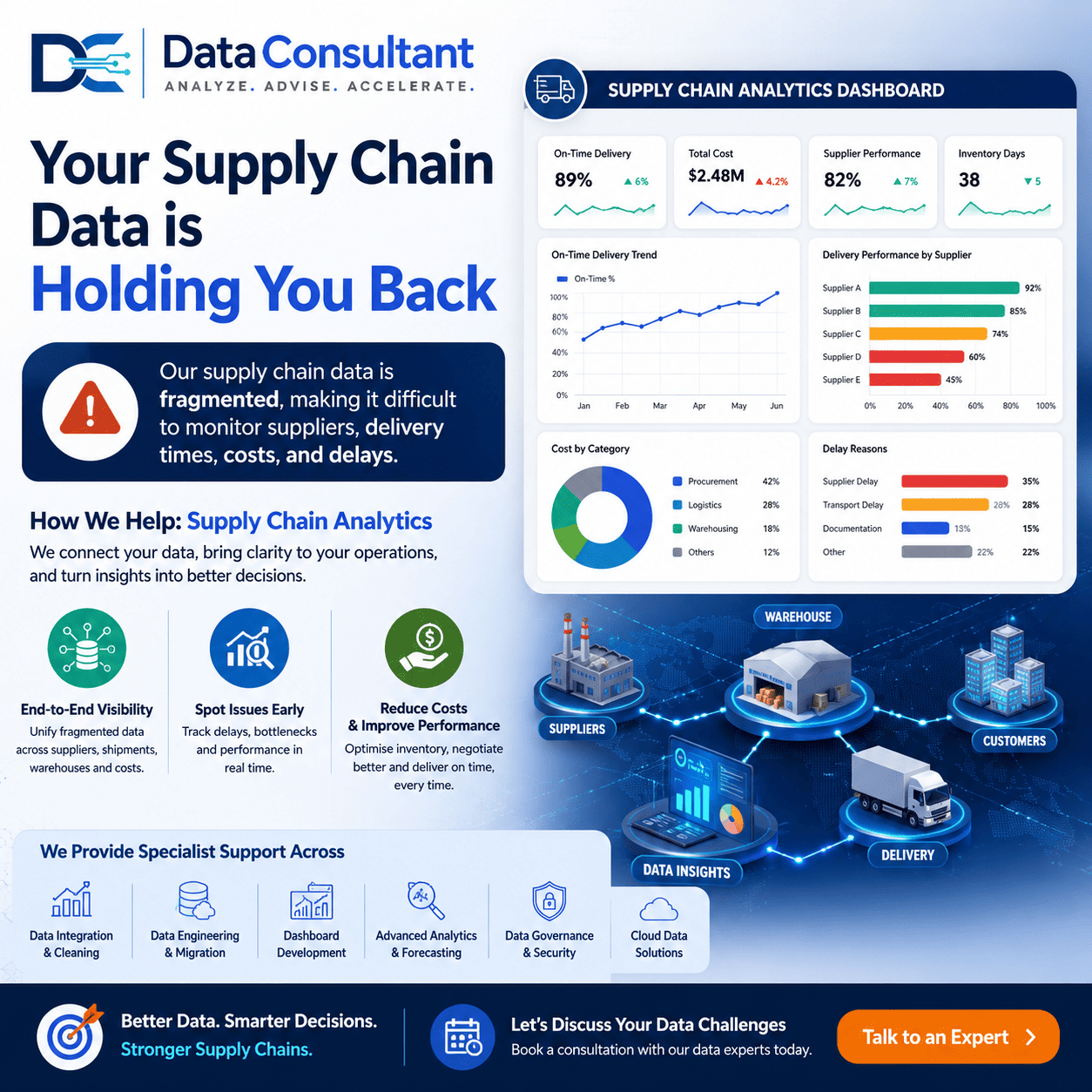
Business intelligence combines data collection, integration, modelling, analysis and visual reporting so that leaders and teams can understand what happened, why it happened and what requires attention. It becomes useful only when measures are clearly defined, source data is sufficiently reliable and someone owns the resulting decisions.
Use internal staff when the question is well defined and the team can access, model and interpret the data. Buy or configure a tool when processes and metrics are already clear and the main gap is functionality. Use a short diagnostic when reports conflict or requirements are uncertain. Use a defined project when specialist delivery is needed, and choose ongoing support only when the workload remains recurring.
The main caution is simple: do not begin with a dashboard, automation or AI request before defining the business decision or operational problem. Better presentation cannot compensate for poor data capture, conflicting KPI definitions or unclear ownership.
Key Takeaways
- Business intelligence starts with a decision: define who needs to decide what, how often and using which measures.
- Data readiness shapes feasibility: accessible, sufficiently reliable and well-understood source data matters more than dashboard appearance.
- Internal ownership is essential: business leaders must own KPI definitions, priorities, approvals and adoption.
- Scope should be deliverable-led: require named outputs such as a data model, KPI dictionary, dashboards, test evidence, documentation and handover.
- Governance belongs inside BI: access control, privacy, lineage, retention and quality rules should be designed with the solution.
- Measure decision usefulness: adoption, consistency, timeliness and reduced rework are more informative than the number of charts produced.
- Knowledge transfer reduces dependency: internal teams need the skills and documentation to operate and improve the solution.
Table of Contents
- Define the BI decision before choosing technology
- Check whether your data is ready for BI
- Compare internal, tool and consulting options
- Prepare access, stakeholders and controls
- Expect practical BI deliverables and handover
- Understand cost, timelines and resource drivers
- Measure whether BI improves decision support
- Apply the decision to realistic situations
- Use specialist support only where it adds value
- Summary
Define the BI Decision Before Choosing Technology
The first task is to state the decision that better information should support. “We need Power BI” or “we want an executive dashboard” describes a possible tool or output, not the business requirement. A useful requirement identifies the user, decision, frequency, measures, threshold for action and consequence of getting it wrong.
Separate a business problem from a reporting request
Suppose a chief operating officer asks for a daily performance dashboard. Discovery may show that regional teams use different definitions for completed orders, service failures and backlog. The visible request is a dashboard; the underlying problem is inconsistent metric ownership. Building first would make disagreement faster and more attractive, but not more accurate.
Ask: which decision is delayed, which reports disagree, which manual work is repeated and which action should follow when a number changes? The answers determine whether the priority is KPI design, data-quality improvement, process correction, integration, reporting automation or analytical modelling.
Understand what BI includes
A practical BI capability may include source-system extraction, ETL or ELT pipelines, a data warehouse or lakehouse, semantic or dimensional modelling, a KPI framework, dashboard development, scheduled reporting, access controls, quality checks and user training. Not every organisation needs every component. The right design is the smallest governed capability that answers the required questions reliably.
Check Whether Your Data Is Ready for BI
Data does not need to be perfect, but it must be understood well enough to support the intended decision. A data maturity assessment should examine business clarity, source coverage, quality, accessibility, architecture, governance and internal ownership.
| Readiness area | Question to answer | Warning sign | Practical response |
|---|---|---|---|
| Business clarity | Which decision and user are in scope? | Requests focus only on dashboard appearance. | Run a short requirements workshop. |
| Data quality | Are important fields complete, consistent and timely? | Teams reconcile numbers manually every month. | Profile data and prioritise root causes. |
| Access | Can approved users and delivery teams reach representative data? | Access depends on one person or informal extracts. | Define controlled access and environments. |
| Architecture | Can sources be integrated at the required frequency? | Identifiers, formats or time periods do not align. | Design mappings, models and pipeline controls. |
| Governance | Who owns metrics, quality rules and permissions? | Definitions change without approval. | Create ownership and change-control records. |
| Internal ownership | Who will accept, use and maintain the outputs? | The project is treated as an IT-only task. | Name business, data and technical owners. |
When several warning signs are present, a diagnostic is usually more valuable than immediate dashboard development.
For recognised data-management concepts and professional practice, the DAMA Data Management Body of Knowledge provides a useful reference. It should be adapted to the organisation’s scale and regulatory context rather than applied as a checklist without judgement.
Compare Internal, Tool and Consulting Options
The right delivery choice depends on problem clarity, internal capability, urgency, continuity and the number of disciplines involved. The table below compares the main options a business may realistically consider.
| Option | Best fit | Expected outputs | Internal requirement | Main risk |
|---|---|---|---|---|
| Internal team | Question is clear, data is accessible and capability already exists | Analysis, reports, dashboards and incremental improvements | Protected delivery time and clear ownership | Competing priorities slow delivery |
| Software tool | Metrics and processes are settled; functionality is the main gap | Configured reporting, visualisation and user access | Internal configuration, modelling and governance skills | Tool is purchased before requirements are ready |
| Short data diagnostic | Reports conflict, quality is uncertain or teams disagree on scope | Findings, maturity view, priority use cases and roadmap | Stakeholder interviews, sample data and documentation | Recommendations stall without an accountable owner |
| Defined consulting project | Objective and outputs can be scoped; specialist skills are temporary | Architecture, pipelines, models, dashboards, controls and handover | Business, data, technology and security participation | Scope expands without acceptance criteria |
| Ongoing consultant support | Analytics and governance needs change continuously | Regular enhancements, analysis, quality review and advisory support | Prioritisation cadence and internal product ownership | Dependency if knowledge is not transferred |
| Dedicated specialist or managed team | Workload is substantial, recurring and multidisciplinary | Predictable capacity across engineering, BI, governance and support | Executive sponsor, service governance and demand planning | Capacity is wasted when demand is poorly prioritised |
A hybrid model is often sensible: internal leaders own decisions and KPI definitions while external specialists address temporary capability gaps or accelerate a defined implementation.
Prepare Access, Stakeholders and Controls
A professional BI engagement requires more than a tool login. The consultant or delivery team needs enough evidence and access to understand the current state, test assumptions and build safely.
Provide the right business and technical inputs
- Named decisions, users, reports and pain points.
- Current KPI definitions, calculations and approval owners.
- Source-system inventory, interfaces, data volumes and refresh expectations.
- Representative data, known quality issues and reconciliation examples.
- Existing architecture diagrams, data models, report catalogues and backlog items.
- Security classification, privacy constraints, retention rules and access procedures.
- Target timeline, budget boundaries, dependencies and success measures.
Allocate stakeholders who can decide
Business owners must confirm meaning and priority. Data owners must approve use and quality expectations. Technology teams support access, integration and deployment. Privacy, security, risk and compliance specialists should review controls where sensitive or regulated data is involved. Procurement and legal teams may need to settle intellectual property, confidentiality, support and exit terms.
The ISO/IEC 27001 information security management standard is a useful reference for risk-based controls. For privacy engineering, the NIST Privacy Framework offers a structured way to consider privacy risk. Apply the laws and policies relevant to your jurisdictions and data categories.
Expect Practical BI Deliverables and Handover
A good engagement leaves decision-ready outputs and an operating capability, not only presentation slides. Deliverables should be linked to the actual problem and have acceptance criteria.
| Problem type | Useful deliverables | Internal participation |
|---|---|---|
| Unclear direction | Current-state assessment, prioritised use cases, target operating model and implementation roadmap | Executive sponsor, business owners and technology leads |
| Conflicting reporting | KPI dictionary, lineage review, semantic model and reconciliation rules | Finance, operations, sales or marketing metric owners |
| Manual reporting | Process map, automated pipeline, scheduled reports, controls and runbook | Report producers, reviewers and source-system owners |
| Fragmented data | Integration design, mappings, ETL or ELT pipelines, data model and test evidence | Application owners, architects and data engineers |
| Weak governance | Ownership model, access matrix, quality rules, metadata and change controls | Data owners, risk, privacy and security teams |
| Advanced analytics request | Readiness assessment, baseline analysis, feature requirements and phased roadmap | Domain experts, data scientists and operational users |
Implementation should normally include discovery, design, iterative build, validation, user acceptance testing, deployment, training and knowledge transfer. Quality assurance should test calculations, refresh behaviour, permissions, performance, error handling and reconciliation to agreed sources.
Decision rule: do not accept a project plan that ends at “dashboard delivered”. Require documentation, ownership, support procedures and a clear handover of models, code, credentials and known limitations.
Understand Cost, Timelines and Resource Drivers
BI cost is driven mainly by uncertainty and complexity. The number of dashboards matters less than the condition of the underlying data, the number of source systems, the complexity of calculations, security requirements, deployment environments and the amount of organisational change required.
A short diagnostic may take a few weeks and focus on interviews, evidence review, data profiling and a roadmap. A defined project may take several weeks to several months depending on source access, modelling, integration, testing and adoption. A multi-department data platform or reporting transformation may require phased delivery over a longer period.
Budget for internal work as well as fees
Internal teams must provide source knowledge, validate definitions, approve access, review prototypes, test results and own adoption. Delays often arise because these people are not available, not because the BI technology is difficult. Ask any provider to state the expected stakeholder time, decision cadence, dependencies, assumptions and exclusions.
Commercial models may include fixed-price diagnostics, milestone-based project fees, time-and-materials delivery, retained advisory support or dedicated capacity. Choose the model that matches scope certainty. Fixed pricing works best when outputs and acceptance criteria are stable; flexible models suit discovery or evolving backlogs but require stronger prioritisation and cost control.
Measure Whether BI Improves Decision Support
Success should be measured by whether the organisation can make the intended decisions more consistently, quickly and transparently. Dashboard usage alone is not sufficient.
- Agreement and adoption of KPI definitions.
- Timeliness and reliability of scheduled reporting.
- Reduction in manual reconciliation or duplicate report preparation where evidenced.
- Traceability from displayed metrics to source data and transformation logic.
- User ability to interpret limits, exceptions and confidence levels.
- Performance of data-quality rules and issue-resolution processes.
- Use of approved access controls and governed data products.
- Internal ability to maintain, test and enhance the capability after handover.
Agree a baseline before work begins. When outcomes improve, consider other contributing factors such as process changes, staffing, market conditions or system upgrades. BI supports better decisions; it does not guarantee a particular commercial result.
Apply the Decision to Realistic Situations
Ecommerce reports show different revenue
An ecommerce business sees different revenue and customer totals in finance, marketing and the commerce platform. The mistaken assumption is that one new dashboard will create a single truth. The actual problem is inconsistent order-status rules, refunds, time zones and customer identifiers. A short diagnostic is the better first step. Deliverables may include a KPI dictionary, source mapping, reconciliation rules and a prioritised data-quality backlog. Finance, marketing, ecommerce operations and data engineering must participate.
Professional services depend on spreadsheets
A professional-service company produces monthly management reports through linked spreadsheets maintained by one analyst. Management assumes a BI licence will remove the dependency. The deeper problem is an undocumented process, inconsistent project codes and no controlled data model. A defined project could map the process, standardise inputs, automate selected transformations, build governed reports and produce a runbook. Internal finance and project-management owners must validate definitions and controls.
A startup wants predictive analytics too early
A startup wants predictive analytics for customer churn, but event tracking changes frequently and customer outcomes are not consistently labelled. The mistaken assumption is that a model can compensate for incomplete measurement. The better decision is to improve data collection, define the target outcome and establish a reliable analytical baseline. A readiness assessment and phased roadmap are more appropriate than immediate machine learning development.
An enterprise is migrating its data warehouse
An enterprise is modernising a data warehouse while business units request new dashboards. Treating migration and reporting as separate programmes could reproduce old inconsistencies on a new platform. A defined consulting workstream or managed team may be justified to coordinate target architecture, model design, data lineage, KPI governance, testing and phased report migration. Internal architecture, security, data owners and business product teams must share accountability.
Use Specialist Support Only Where It Adds Value
External support is most useful when the organisation needs an independent data maturity assessment, a clear business intelligence roadmap, specialist architecture or engineering capability, consistent KPI design, data-quality remediation, governance controls or a defined implementation with documentation and handover.
DataConsultant data advisory support can help clarify business questions, assess readiness and prioritise a practical roadmap. Where delivery is required, relevant support may include data engineering, data analytics consulting or data governance. Use only the capability that matches the diagnosed problem.
For recurring, multidisciplinary demand that does not justify immediate internal hiring, a managed data and AI team may provide predictable capacity. The arrangement should still include prioritisation, transparent service measures, knowledge transfer and an exit path.
Summary
Business intelligence is useful when an organisation has a decision that can be improved through clearer, more reliable and more timely information. Internal staff may be sufficient when the question is well defined, data is accessible and the required skills already exist. A software tool may be sufficient when metric definitions, processes, integration and governance are settled.
Use a short diagnostic when teams disagree about the problem, reports conflict or data readiness is uncertain. Use a defined consulting project when architecture, integration, modelling, reporting, governance or automation can be scoped into deliverables with milestones and acceptance criteria. Choose ongoing support or a managed team when the workload is substantial and continuous.
Before committing, validate business goals, data quality, access, governance, privacy, security and internal ownership. Confirm scope, budget, timeline, stakeholder effort, documentation, quality assurance, knowledge transfer and handover. The correct decision may be to fix source processes, clarify KPI ownership, run a limited discovery phase, hire internally or delay advanced analytics until the foundation is ready.
FAQs About Business Intelligence and Data Consulting
What does business intelligence means for a business?
Business intelligence means using governed data, agreed metrics and analytical tools to understand performance and support decisions. In practice, it combines source data, data integration, modelling, reporting and dashboards. The caution is that a BI tool cannot fix unclear business questions or unreliable source data. Begin by naming the decisions and KPIs that matter.
What does a data consultant do in a business intelligence project?
A data consultant clarifies business questions, assesses data maturity, defines KPI logic, reviews architecture, plans integrations and helps deliver reporting or dashboards. They may also establish governance, testing, documentation and handover. The exact role should be scoped around a decision problem rather than a general request for more analytics.
How do I know whether my business needs a data consultant?
Consider external support when reports conflict, teams cannot agree on KPI definitions, data is spread across systems, internal capability is limited or management needs a prioritised roadmap. Do not engage a consultant merely because a new BI platform is available. First confirm the operational or management decision that is currently blocked.
Should we hire a data consultant or a full-time data analyst?
Hire internally when the workload is continuous, the role is well defined and the organisation can recruit, manage and retain the capability. Use a consultant when specialist knowledge is needed temporarily, the problem is still being diagnosed or a defined project needs rapid delivery. A hybrid model can combine internal ownership with external expertise.
Can software replace a data consultant?
Software can be sufficient when data sources are compatible, KPI definitions are settled, governance is clear and the internal team can configure and maintain the solution. It cannot independently resolve disputed metrics, weak data quality, unclear ownership or fragmented processes. Validate those foundations before treating a tool purchase as the answer.
What information should we prepare before a BI engagement?
Prepare the business decisions to support, current reports, KPI definitions, source-system list, known data-quality issues, user groups, security constraints, target timelines and named business and technical owners. Access to representative data and relevant documentation will make discovery more reliable. Sensitive information should be shared through approved channels only.
How much do business intelligence consulting services cost?
Cost depends on scope clarity, number and complexity of sources, data quality, integration effort, dashboard requirements, governance needs, user groups, testing and support. A short diagnostic is usually structured differently from a full implementation or ongoing service. Ask for assumptions, exclusions, milestones, acceptance criteria and internal resource requirements rather than comparing day rates alone.
How long does a business intelligence project take?
A focused diagnostic or single reporting improvement may take a few weeks when data and stakeholders are ready. A multi-source BI implementation can take several months because data modelling, security, integration, testing, adoption and handover must be coordinated. Timelines extend when access approvals, source-system changes or metric disputes remain unresolved.
Can a data consultant help with poor data quality?
Yes. A consultant can profile data, identify root causes, define quality rules, assign ownership and create a prioritised remediation plan. However, sustainable improvement normally requires source-system process changes and accountable internal owners. A dashboard should not conceal unreliable data with more polished presentation.
Who owns the dashboards, models, code and documentation?
Ownership should be stated in the contract and confirmed before delivery. Clarify rights to data models, ETL or ELT code, dashboard files, semantic definitions, test evidence, runbooks and training materials. Your organisation should receive sufficient documentation, access and knowledge transfer to operate the solution without avoidable dependency.
Need a Clear Business Intelligence Roadmap?
Share the decisions you need to improve, the reports that currently conflict, your source systems, data constraints and internal capability. DataConsultant can help determine whether internal delivery, a short diagnostic, a defined BI project or ongoing specialist support is the appropriate next step.
Discuss your requirementAt DataConsultant.in, we help organisations turn data and AI priorities into governed, reliable, and practical business capability.