
Free Online Course Certification: What Businesses Should Know
Is an online course certification free option enough to build useful business capability? It can be a sensible starting point when the skill gap is narrow, the learner can practise safely, and a manager or subject-matter expert can verify whether learning transfers into real work. Free certification is less useful when the underlying problem is unclear data, inconsistent metrics, fragmented reporting, weak governance or a need for coordinated capability across several roles.
The important distinction is between course completion and workplace capability. A certificate may show that someone completed a syllabus or passed an assessment, but it does not automatically show that they can work with your organisation’s data, tools, controls, stakeholders and business decisions. For employers, the decision should therefore begin with the outcome that needs to improve—not with the fact that a course is free.
This guide helps founders, business leaders, data teams, learning teams and department heads decide where free online certification fits, what to check before recommending a course, how to account for hidden costs, how to measure practical outcomes, and when a structured academy or specialist data consultant is more appropriate.
Quick Answer: Free Can Work, but Verify the Outcome
Free certification is a good fit for exploration, baseline literacy, onboarding or a clearly bounded skill when learners can practise using non-sensitive data and managers can review the result. It is also useful before paying for a broader programme because it can reveal who needs deeper support and which topics generate real workplace value.
Do not use the certificate itself as the main success measure. Check the syllabus, assessment method, certificate conditions, data-use requirements and practical relevance. Then ask learners to complete a comparable workplace task, explain their reasoning and document limitations.
If teams cannot agree on the problem, data is unreliable, access is restricted or multiple functions need coordinated learning, first run a diagnostic. Training will not repair source-system defects, unclear KPI ownership or missing governance.
Key Takeaways
- Start with a work outcome: define what the learner should be able to produce, explain or decide after the course.
- Verify the certificate: check the issuer, assessment, identity requirements and whether the certificate itself is genuinely free.
- Count internal effort: learner time, manager review, practice environments and support can cost more than the course.
- Protect business data: do not upload sensitive company information to a learning platform without approval.
- Test transfer: use practical tasks or portfolio evidence rather than completion rates alone.
- Escalate only when needed: use a structured academy or consultant when the challenge spans roles, systems, data quality or governance.
Table of Contents
- Decide what the certificate must prove
- Check whether free learning fits the team
- Compare free courses with other options
- Verify quality, access and governance
- Pilot free certification before scaling
- Estimate the real cost of free training
- Measure workplace capability
- Apply the choice to real situations
- Know when specialist support helps
- Summary
Decide What the Certificate Must Prove
Before searching for a course, describe the observable capability you need. “Learn data analytics” is too broad. “Build a monthly sales variance view from approved data, explain the largest drivers and document assumptions” is testable. So is “use a governed prompt pattern to summarise customer feedback without exposing personal information”.
Match learning to the role
A founder may need enough analytics literacy to challenge a dashboard. A marketing manager may need to interpret attribution limits. An operations analyst may need spreadsheet modelling or SQL. A data engineer may need a deeper technical pathway. The same free course will rarely be equally useful for all four roles.
Separate a skills gap from a data problem
If employees lack knowledge or confidence, training may help. If they are working from contradictory reports, missing fields, inaccessible systems or disputed definitions, the priority is not another certificate. Those conditions point to data quality, governance, architecture or process problems that must be addressed alongside learning.
Check Whether Free Learning Fits the Team
Free certification works best when the organisation can provide a clear use case, approved tools, safe practice data and an internal owner who can review application. The data environment does not need to be perfect, but learners should know which definitions and sources are trusted.
For broader programmes, learning sits inside data and governance responsibilities. The OECD overview of data governance is a useful reminder that data practices depend on rules, responsibilities and lifecycle controls, not skills alone.
Compare Free Courses with Other Learning Options
The right choice depends on problem clarity, role diversity, urgency, the need for customisation and how much internal support is available. A zero-price course can be efficient for one learner while becoming fragmented when dozens of employees select unrelated certifications.
| Option | Best fit | What it can prove | Internal requirement | Main limitation |
|---|---|---|---|---|
| Free online course | Exploration or narrow baseline skills | Completion or provider assessment | Learner time and manager review | May be generic or lightly assessed |
| Paid certification | Recognised curriculum or deeper assessment is required | Provider-defined competence or exam performance | Budget, study time and relevance check | Credential may still not prove workplace application |
| Internal learning pathway | Company-specific tools, metrics and processes | Application against internal standards | Subject experts, learning design and maintenance | Requires sustained internal capacity |
| Structured academy programme | Multiple roles need coordinated progression | Consistent role-based capability evidence | Programme ownership, practice data and governance | Higher design and operating effort |
| Short diagnostic | The real skill or data problem is uncertain | Prioritised needs and readiness findings | Stakeholder access and evidence | Does not itself build capability |
| Consulting-led project | Training must connect to data, reporting, governance or implementation | Defined deliverables, pilot and handover | Business and technical participation | Scope must be tightly controlled |
A practical sequence is often free exploration first, then targeted investment only where the business can show a continuing capability gap.
Verify Quality, Access and Governance
A course is not automatically suitable because the price is zero. Before recommending it to staff, review the course content and the conditions under which learners access, practise and receive certification.
Check the learning and certificate
- Confirm what the syllabus covers and when it was last updated.
- Check whether practical exercises or only knowledge quizzes are used.
- Verify whether the certificate is free or whether completion, assessment or identity verification carries a fee.
- Review prerequisites so learners are not pushed into content above or below their level.
- Check whether the course teaches concepts that match your approved tools and methods.
Protect data and accounts
Employees should not copy customer, employee, financial or commercially sensitive information into uncontrolled learning environments. Use synthetic, anonymised or approved practice data where possible. The ISO/IEC 27001 information security framework provides a risk-based reference for information-security management. If AI tools are part of the course, the NIST AI Risk Management Framework can support governance discussions about safe use, measurement and risk treatment.
Training governance matters as well. The ICO training and awareness guidance emphasises programme oversight, senior support and role-appropriate learning. Apply the laws and internal policies relevant to your own jurisdictions and data.
Pilot Free Certification Before Scaling
Start with a small learner group and one role-specific outcome. Record a baseline task, assign the course, provide safe practice data, and ask learners to complete a comparable post-learning task. Managers or subject experts should review not only whether the answer is correct, but whether the process is repeatable and appropriately governed.
A simple 30-day pilot
- Week 1: define the capability, choose the course and record a baseline.
- Weeks 1–2: complete the learning and capture questions or content gaps.
- Week 3: apply the skill to an approved practical exercise.
- Week 4: review quality, adoption, governance and whether further support is justified.
Decision rule: scale only when the pilot shows that the course improves a useful work outcome and the organisation can sustain review, access and governance.
Estimate the Real Cost of Free Training
Free normally describes the course price, not the total cost to the organisation. Include paid working time, manager review, technical support, practice-environment setup, data preparation, assessment, learner support and any fees attached to the certificate or proctored exam.
For a single employee, those costs may still be very low. At scale, however, unmanaged self-selection can create duplicated learning, inconsistent methods and little evidence of capability. A small amount of curation and review often matters more than adding more courses.
Compare cost with the alternative
If the business already has knowledgeable managers and approved datasets, internal curation may be enough. If experts are spending large amounts of time fixing basic reporting, reconciling metrics or answering the same analytical questions, the underlying need may justify a defined diagnostic or capability project rather than more training content.
Measure Workplace Capability, Not Certificates
Completion is an operational metric. Capability is demonstrated through work. Agree the measurement approach before the course begins so the business can distinguish learning value from enthusiasm for a new credential.
- Baseline and post-learning tasks matched to the learner’s role.
- Accuracy and completeness of outputs.
- Ability to explain assumptions, limitations and data sources.
- Use of approved tools, definitions and governance controls.
- Reduction in avoidable rework where attribution can be supported.
- Manager confidence that the learner can repeat the task independently.
- Continued use of the skill after several weeks rather than immediately after the course.
Do not attribute broader business improvements to training without checking other changes such as new systems, process redesign, staffing, data cleanup or management action.
Practical Decisions for Free Certification
Founder learning dashboard basics
A startup founder wants enough analytics knowledge to challenge weekly growth reports. A free introductory course can be appropriate because the goal is narrow and the founder can practise with existing non-sensitive metrics. The success test is not the certificate; it is whether the founder can identify metric definitions, ask better questions and distinguish correlation from a decision-ready explanation.
Marketing team with conflicting KPI definitions
A marketing team wants everyone to complete free dashboard certifications because campaign numbers differ between reports. Training is unlikely to solve the core issue. The first action should be to reconcile definitions, sources and ownership. A short data assessment may be more valuable, followed by targeted training once the reporting foundation is stable.
Operations analysts learning SQL
An operations team has approved warehouse access and clear query standards but uneven SQL skills. A curated free certification pathway can work well if exercises use safe representative data and analysts complete an internal practical assessment. More expensive external support may not be necessary.
Enterprise AI learning across multiple functions
An enterprise wants free AI certificates for finance, marketing, operations and risk teams. The challenge is broader than course selection because roles, data access, approved tools and governance differ. A role-based academy design or defined consulting project can be justified to establish pathways, controls, practice environments, assessment and knowledge transfer before scaling.
Know When Specialist Support Helps
A data consultant adds value when a training request is entangled with a business or data problem. Typical signs include inconsistent KPI definitions, poor data quality, fragmented reporting, unclear ownership, complex data access, analytics requirements that have not been defined, or uncertainty about whether teams are ready for AI.
In those situations, a consultant can facilitate discovery, assess data and capability maturity, define role-based outcomes, clarify technical and governance requirements, design a controlled pilot, document acceptance criteria and plan handover. The goal should be to leave the organisation with stronger internal capability rather than long-term dependency.
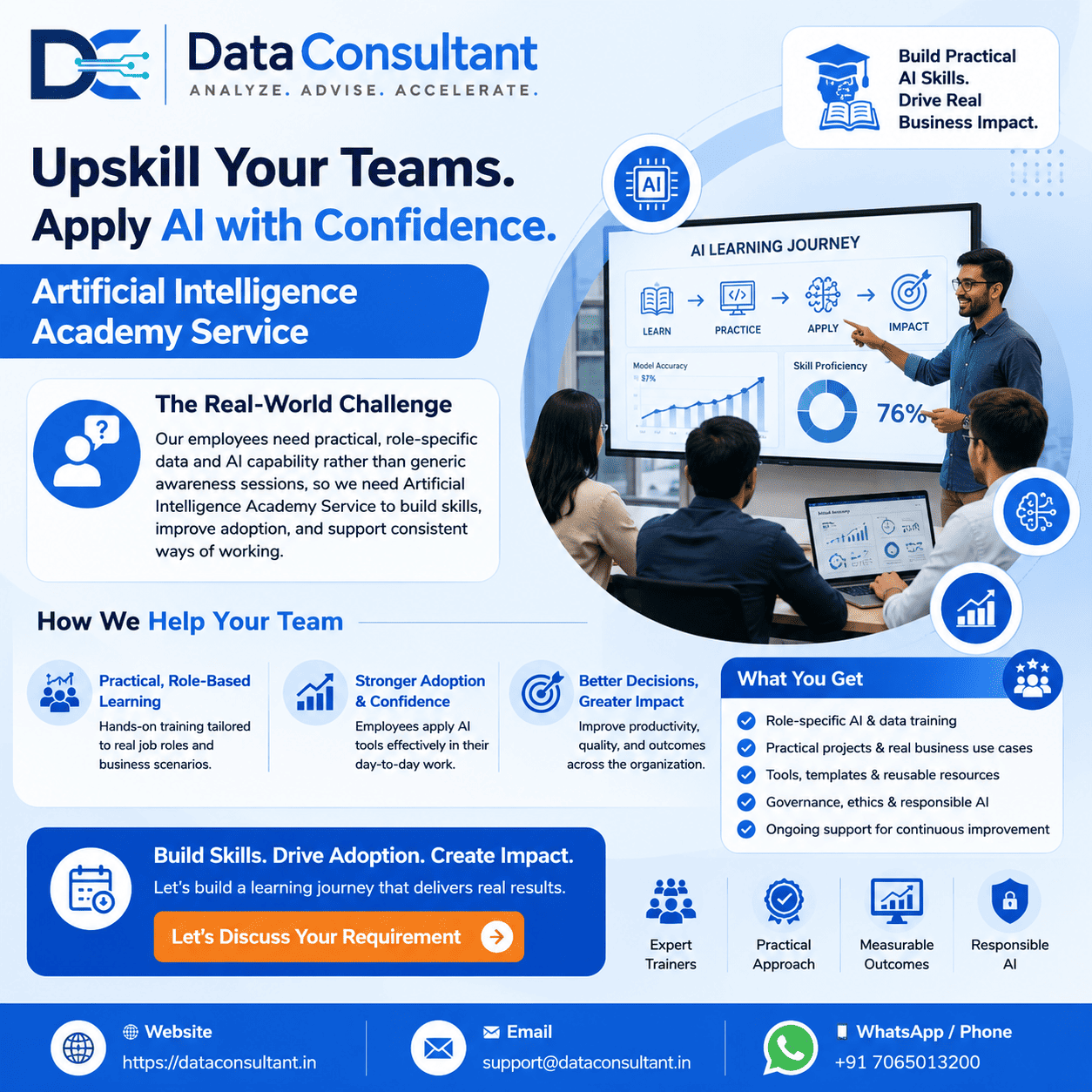
DataConsultant academy support can help with capability diagnostics, academy design and structured learning programmes. Where the obstacle is the underlying data environment rather than the curriculum, a data assessment or data governance engagement may be more relevant.
Summary: Use Free Certification for the Right Problem
Free online certification is appropriate when a learner has a clear skill gap, suitable course content is available, safe practice is possible and an internal owner can verify application. Internal staff and a free course may be entirely sufficient for narrow learning needs. A software learning platform may be enough when pathways, governance and assessment are already defined.
Use a short diagnostic when the business cannot agree on the problem, data quality is uncertain, access is unclear or reporting foundations are weak. Use a defined project when multiple roles need coordinated learning, governed practice environments, custom exercises, documentation and handover. Choose ongoing support or a managed capability model only when learning needs, tools and governance requirements continue to change.
Before investing, validate the business goal, data quality, access, governance, internal ownership, scope, budget, timeline, security, documentation, quality assurance, knowledge transfer and handover. The best decision is the smallest intervention that creates reliable capability.
FAQs on Free Online Course Certification
Can online course certification free options be useful for business teams?
Yes, free online course certifications can be useful for baseline learning, onboarding and low-risk skills exploration. They are most valuable when the syllabus matches a defined role need and learners can practise the skill in real work. A certificate alone does not prove job performance, data quality, governance awareness or the ability to apply a method safely. Verify the learning outcomes, assessment method and workplace relevance before treating the credential as evidence of capability.
What does a free online course certificate actually prove?
Usually, it proves that a learner completed the provider’s stated requirements, which may include viewing content, passing quizzes or submitting an assessment. The strength of that evidence varies by course. Check who issued the certificate, what was assessed, whether identity was verified, and whether practical work was required. For business decisions, combine the certificate with a task, portfolio, supervised exercise or manager review.
Are free certificates suitable for hiring data or analytics staff?
They can support a hiring decision, but they should not replace skills assessment, experience review or role-specific evidence. A candidate may understand concepts yet still struggle with messy data, stakeholder requirements, governance controls or production tools. Use certificates as one signal, then test practical reasoning with a realistic case, sample analysis or technical task appropriate to the role.
Should a company use free courses instead of a data academy?
Use free courses when the need is narrow, the learner group is small and internal leaders can curate content, set practice tasks and review outcomes. A structured academy becomes more useful when multiple roles need different pathways, approved datasets and tools must be governed, or learning must be measured consistently across teams. The decision is about operating capability, not the volume of course content.
How should we evaluate the quality of a free certification course?
Review the syllabus, prerequisites, instructor or issuing organisation, assessment design, recency, practical exercises and certificate conditions. Check whether examples match the tools and decisions your team actually uses. Also review data-handling, privacy and account requirements before asking employees to upload files or use sensitive business information on a learning platform.
What hidden costs come with free online certification?
The course fee may be zero while the organisation still pays through employee time, manager review, practice-environment setup, data preparation, support and opportunity cost. Some providers may also charge for identity verification, graded assessments or the final certificate. Estimate total internal effort before deciding that a free course is the lowest-cost option.
How can we measure whether free training improved capability?
Define a baseline task before learning and repeat a comparable task afterwards. Measure the quality, accuracy, speed and governance of the work rather than relying only on course completion. For data and analytics skills, review whether learners can interpret requirements, use approved data, document assumptions and explain limitations. Track workplace adoption over time where the skill is expected to become routine.
When should a business involve a data consultant?
Consider a data consultant when the learning problem is actually mixed with unclear KPIs, poor data quality, fragmented reporting, integration issues, governance gaps or uncertain AI readiness. A consultant can help diagnose the underlying problem, define role-based capability requirements, design governed practice, prioritise a pilot and specify handover. External support is unnecessary when the skill gap is simple and internal owners can manage it confidently.
Who should own free certification programmes inside a company?
Ownership should sit with the business function that needs the capability, supported by learning, data, technology, risk or security teams where relevant. Managers should define the work outcomes, learning teams can coordinate delivery, and technical or governance owners should approve tools and practice data. Clear ownership prevents a collection of certificates from becoming disconnected from actual business priorities.
Need Help Structuring Data Skills?
If free courses are not resolving inconsistent reporting, unclear data ownership or uneven analytics capability, DataConsultant can help determine whether you need a short diagnostic, a role-based academy project or another targeted data intervention.
Discuss your requirementAt DataConsultant.in, we help organisations turn data and AI priorities into governed, reliable, and practical business capability.