
Artificial Intelligence Javatpoint: A Business Decision Guide
If you searched for “artificial intelligence javatpoint”, start by treating it as a learning question before treating it as a technology-buying decision. A tutorial can explain what artificial intelligence is, the difference between machine learning and rule-based automation, and why models need data. For a business, however, the central decision is not “Which AI feature should we buy?” It is “Which business decision, workflow or customer outcome is important enough to improve, and do our data, controls and people support that change?” The main caution is to avoid commissioning a chatbot, forecasting model or automation programme before the operational problem is defined.
The practical starting point is to separate education from implementation. Use educational material when leaders or teams need shared vocabulary. Use a short diagnostic when the problem, data quality or readiness is uncertain. Use a defined project when the target outcome, systems and deliverables can be scoped. Choose ongoing support only when models, data sources, governance requirements or use cases will need continuing specialist attention.
This decision guide is for founders, business owners, technology leaders, finance and operations teams, data leaders, risk functions and procurement teams moving from introductory artificial intelligence concepts to a real organisational decision. It explains readiness, alternatives, data requirements, governance, costs, expected deliverables and the conditions under which specialist data and AI support is useful.
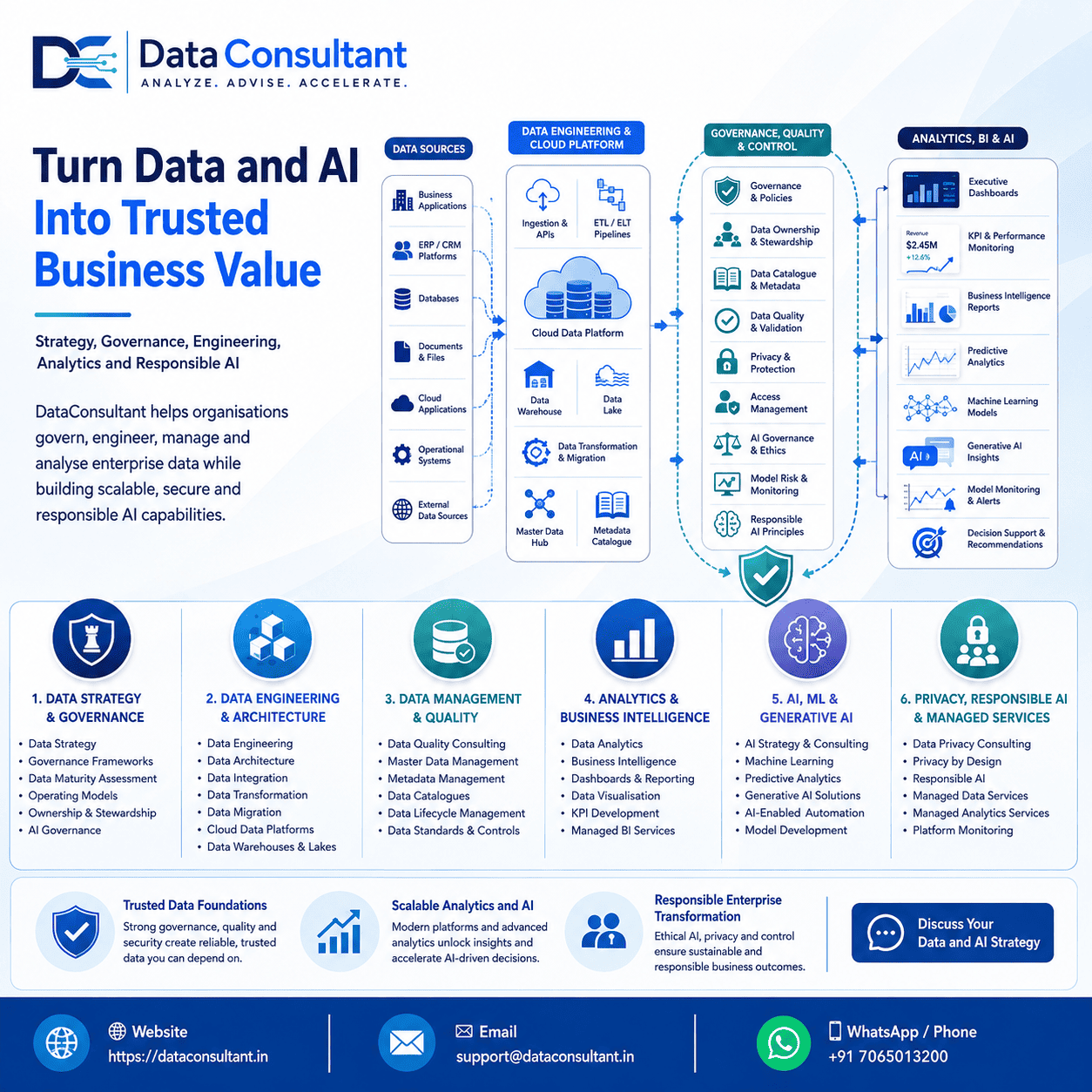
Quick Answer: Learn AI First, Then Test Readiness
Introductory AI learning is useful when the organisation needs a common understanding of concepts. It is not, by itself, a business case or implementation plan. Before investing, identify one decision or workflow where better prediction, classification, generation, search or automation could create useful capability.
Use internal staff when the objective is clear and the team already has the required data and technical skills. Buy or configure a software tool when requirements are stable and the main gap is functionality. Use a short diagnostic when teams disagree about the problem or the data is uncertain. Use a defined consulting project for a bounded build, integration, governance or analytics outcome. Consider ongoing support only when the workload is genuinely continuous.
The main caution remains the same: do not hire a consultant or buy AI technology before defining the business decision or operational problem. Artificial intelligence cannot compensate for missing data ownership, inconsistent source processes or unclear accountability.
Key Takeaways
- Separate learning from implementation: tutorial-level knowledge helps teams ask better questions but does not prove readiness.
- Check data readiness early: model quality depends on relevant, accessible and sufficiently reliable data.
- Keep internal ownership: a business owner must remain accountable for the decision, process and acceptance of outputs.
- Scope deliverables clearly: require defined use cases, architecture, test evidence, documentation and handover where relevant.
- Build governance into the design: privacy, security, data quality and responsible AI controls should not be added at the end.
- Choose the smallest suitable engagement: education, internal delivery, a tool, diagnostic, project or ongoing support solve different problems.
- Plan knowledge transfer: internal teams should understand how outputs are produced, monitored and changed after external support ends.
Table of Contents
- Turn AI learning into a business decision
- Compare internal, tool and consulting options
- Check data and organisational readiness
- Set technical, governance and security needs
- Estimate cost, time and internal resources
- Apply the decision to practical AI situations
- Move from discovery to controlled implementation
- Decide where specialist support adds value
- Summary
Turn AI Learning into a Business Decision
The useful step after introductory artificial intelligence learning is to define a decision that can be improved. “We need AI” is not a requirement. “We need to classify support requests faster while retaining human review for high-risk cases” is closer to one because it identifies a workflow, an output and an operational boundary.
Start with the decision, not the model
Describe who makes the decision today, what information they use, what goes wrong, how often the process occurs and what a better output would look like. This prevents a common failure mode: choosing a fashionable technology and then searching for a problem that justifies it.
Decide whether AI is even necessary
Some problems are better solved by clearer policies, data-quality fixes, workflow automation, better reporting or conventional analytics. A rules engine may be easier to explain and maintain than a model when logic is stable. A dashboard may be sufficient when the real need is visibility rather than prediction. The correct decision can be to postpone AI until the underlying data or process is reliable.
Decision rule: if you cannot state the business decision, the user of the output and the evidence needed to judge success, remain in discovery rather than moving to model selection.
Compare AI Delivery Options Before You Commit
The right delivery model depends on problem clarity, data readiness, internal capability, urgency and continuity. A tutorial, an internal analyst, an off-the-shelf AI product and a consulting team are not interchangeable because they solve different gaps.
| Option | Best fit | Typical outputs | Internal requirement | Main risk |
|---|---|---|---|---|
| Internal team | Clear use case, accessible data and sufficient technical capability | Analysis, prototype, integration or automation | Protected delivery time and accountable owner | Competing priorities or missing specialist skills |
| Software tool | Stable process where functionality is the main gap | Configured product capability and workflow | Data integration, governance and adoption ownership | Tool is bought before requirements are validated |
| Short data and AI diagnostic | Unclear use case, conflicting data or uncertain readiness | Readiness findings, prioritised use cases and roadmap | Stakeholder access and evidence sharing | Recommendations stall without an internal owner |
| Defined consulting project | Bounded architecture, integration, analytics or AI objective | Design, pilot, testing, documentation and handover | Business, data, technology and risk participation | Scope expands without acceptance criteria |
| Ongoing consultant support | Models, analytics and controls need continuing specialist input | Monitoring, optimisation, governance and new use cases | Regular prioritisation and operating cadence | Dependency grows if knowledge is not transferred |
| Dedicated specialist or managed team | Substantial continuous workload across several disciplines | Predictable delivery capacity and coordinated operations | Executive sponsor and clear service ownership | Capacity is wasted if demand or adoption is weak |
Choose the smallest model that closes the real capability gap. If a problem can be solved by internal staff or a well-scoped tool configuration, external consulting is not automatically the better choice.
Check Data Readiness Before Building AI
Artificial intelligence is constrained by the data and operating environment around it. Assess readiness across five areas: business clarity, data quality, access, governance and internal ownership. A prototype can sometimes proceed with imperfect data, but a production decision process needs known limitations and accountable controls.
Test the data that the model would actually use
- Identify the source systems and data owners.
- Check whether important fields are complete, consistent and historically available.
- Understand labels, definitions and changes in business rules over time.
- Separate data that can be used for experimentation from data that needs additional approval.
- Document known biases, gaps and manual workarounds that could distort outputs.
For wider data-governance principles, the OECD overview of data governance is a useful reference. The practical point is that AI readiness is not only a model question; it is also a data-management and accountability question.
Do not confuse volume with readiness
A business may have millions of records and still lack usable training or evaluation data. Conversely, a narrow use case can sometimes be tested with a smaller but well-defined dataset. Readiness depends on relevance, quality, lineage, permissions and whether the data represents the decision you are trying to improve.
Set AI Architecture, Governance and Security Needs
A production AI initiative needs a clear technical boundary: where data comes from, where processing occurs, which systems receive outputs, who can access them and how failures are detected. This applies whether the system uses a predictive model, a large language model, retrieval-augmented generation or a packaged AI feature.
Define the technical and operational inputs
- Approved data sources, APIs, databases and document repositories.
- Identity and access requirements for users, services and administrators.
- Hosting, cloud, integration and environment constraints.
- Evaluation data and acceptance criteria for model or workflow outputs.
- Logging, monitoring, incident and change-management requirements.
- Fallback or human-review procedures when outputs are uncertain or high impact.
The NIST AI Risk Management Framework provides a structured way to think about AI governance and risk management. Information-security controls should align with the organisation’s security-management approach; ISO/IEC 27001 is one recognised reference point. Apply the laws and internal policies relevant to your jurisdiction and use case rather than treating a general framework as legal advice.
Estimate AI Cost from Scope and Data Complexity
Artificial intelligence project cost is driven by scope clarity, data preparation, integration, model or platform complexity, security review, testing, change management and ongoing operations. The software licence or model API is only one part of the total resource requirement.
Budget for internal participation
Business subject-matter experts must explain the current decision and validate outputs. Data and technology teams need to provide access, integration and environments. Privacy, risk and security teams may need to approve controls. Procurement and legal teams may review third-party terms. Managers need time to test whether the new workflow actually works.
A short diagnostic is easier to estimate because the deliverables can be bounded around interviews, evidence review, data profiling and a roadmap. A defined pilot adds architecture, build, evaluation and documentation. Production implementation adds integration, monitoring, operating procedures, training and handover. Avoid fixed-price expectations until the scope and dependencies are understood.
Practical Decisions After Learning the AI Basics
Ecommerce team wants an AI revenue forecast
An ecommerce business sees conflicting revenue and customer reports and assumes a predictive model will create a single answer. The actual problem is inconsistent KPI definitions and source mappings. The better decision is a short data diagnostic before modelling. Likely deliverables include a metric dictionary, source review, quality backlog and a prioritised forecasting roadmap. Finance, marketing, ecommerce and data owners must participate.
Operations team wants a generative AI assistant
A service operation wants a chatbot to answer policy questions, but documents are duplicated, outdated and owned by different teams. The real problem is content governance and retrieval quality. A defined project may still be appropriate, but it should start with document inventory, ownership rules, access controls and an evaluation set before building the assistant. Operations, knowledge-management, security and technology teams need to be involved.
Startup wants machine learning before reliable data capture
A startup wants predictive analytics for customer churn, but event tracking changes frequently and customer identifiers are inconsistent. The better decision is to stabilise data collection and define the commercial action that follows a churn prediction. A small analytics improvement may deliver more value initially than a complex model. Specialist guidance can help sequence the data foundation and later AI work without overbuilding the first phase.
Move from AI Discovery to Controlled Implementation
Implementation should progress through evidence, not enthusiasm. Start with a bounded discovery that validates the decision, data and risk assumptions. Then test a pilot against agreed acceptance criteria before integrating it into production workflows.
Expect decision-ready deliverables
- Problem statement and prioritised use case.
- Data-readiness and data-quality findings.
- Architecture and integration requirements.
- Governance, privacy and security requirements.
- Prototype or pilot with evaluation evidence where appropriate.
- Implementation roadmap with dependencies and responsibilities.
- Documentation, test evidence, operating procedures and knowledge transfer.
For AI systems, quality assurance should include more than technical accuracy. Evaluate whether outputs are useful for the intended user, whether important failure cases are understood, whether human review is required and whether the monitoring process can detect material change after launch.
Use Specialist Support Only for a Real Capability Gap
External support is useful when the organisation needs an independent data and AI readiness assessment, a prioritised roadmap, data architecture, integration design, governance, analytics engineering or a controlled AI pilot and does not have enough internal capacity or specialist depth to complete the work safely.
DataConsultant’s Data Advisory Service can support discovery, maturity assessment and roadmap definition. Where the issue is data pipelines or platform integration, the Data Engineering Service is more relevant. For AI readiness, use-case prioritisation and implementation planning, the AI Data Service is the closer fit.
The engagement should still leave ownership with the organisation. Require clear acceptance criteria, documentation, security responsibilities and knowledge transfer. If the work is recurring and multi-disciplinary, ongoing support or a managed team may be sensible; if the issue is narrow and stable, a short project is usually enough.
Summary: Move from AI Concepts to a Governed Decision
The search phrase “artificial intelligence javatpoint” is best treated as a starting point for understanding AI, not as proof that a business should implement it. Use internal staff when the problem is defined and capability is available. Buy a tool when requirements and integrations are already clear. Use a short diagnostic when the business question, data quality or readiness is uncertain. Use a defined consulting project for a bounded architecture, integration, analytics or AI outcome, and choose ongoing support or a managed team only when the need is continuous.
Before committing budget, validate business goals, data quality, access, governance and internal ownership. Then agree scope, timeline, security responsibilities, quality assurance, documentation and handover. The objective is not to “adopt AI” in the abstract; it is to build a reliable capability that improves a specific decision or workflow.
FAQs on Artificial Intelligence and Business Readiness
What does artificial intelligence javatpoint mean for a business reader?
The phrase usually signals educational intent: the reader wants a clear explanation of artificial intelligence before deciding what to do with it. For a business, the useful next step is to separate learning from implementation. Tutorials can explain concepts, but a live initiative also needs a defined business decision, usable data, accountable owners, technical integration, security controls and a way to measure results.
Is an AI tutorial enough to start an AI project?
Usually not. A tutorial can help people understand terms such as machine learning, neural networks, generative AI and model training, but it does not validate your data, process, architecture or risk controls. Before implementation, confirm the business problem, available evidence, data access, owner, expected output and acceptance criteria.
How do I know whether my business is ready for AI?
Your business is more ready when the target decision is clear, relevant data is accessible and sufficiently reliable, system owners can support integration, privacy and security constraints are understood, and a business owner can evaluate the output. If those conditions are uncertain, a short data and AI readiness assessment is often more useful than building a prototype immediately.
Should we buy an AI tool or use a consultant?
Buy or configure a tool when the process, data sources, ownership and success criteria are already clear and the main gap is functionality. Use specialist consulting support when requirements are unclear, data must be integrated or governed, several disciplines are involved, or the organisation needs an independent roadmap and implementation plan. Sometimes the right answer is to use neither yet.
What information should we prepare before an AI engagement?
Prepare the business objective, current workflow, relevant data sources, system owners, known data-quality issues, access constraints, privacy or security requirements, existing reports or models, decision stakeholders, budget range and desired timeline. The consultant should still test these assumptions rather than treating them as complete requirements.
How much does an artificial intelligence project cost?
There is no reliable single price because cost depends on problem clarity, data preparation, integration, model complexity, cloud or software usage, security review, testing, change management and ongoing support. A bounded discovery or readiness phase is usually easier to estimate than a broad request to 'implement AI across the business'.
How long does an AI implementation take?
A narrow diagnostic or proof of feasibility can be shorter than a production implementation, but duration depends heavily on data access, approvals, integration and testing. A production system normally takes longer than a demonstration because it needs monitoring, security, documentation, ownership and handover. Treat any timeline as scope-dependent until discovery confirms the work.
What deliverables should a data and AI consultant provide?
Expected deliverables may include a problem statement, data-readiness findings, prioritised use cases, architecture or integration design, governance requirements, prototype or pilot outputs, test evidence, implementation roadmap, operating procedures, documentation, training and handover. The exact set should be agreed against acceptance criteria before delivery starts.
Who owns the data, models, code and documentation after the project?
Ownership and usage rights should be written into the engagement terms. The organisation should know who owns source data, customised code, model artefacts, prompts, evaluation datasets, dashboards and documentation, and which third-party components remain subject to external licences. Operational ownership should also be assigned internally before go-live.
When is ongoing AI consulting support appropriate?
Ongoing support is appropriate when models, data sources, controls or use cases change continuously and the organisation does not yet have enough internal capacity to manage them safely. It can cover monitoring, evaluation, data-quality review, governance updates, optimisation and new use cases. If the workload becomes stable and substantial, an internal team or managed team may be more appropriate.
Need an AI Readiness Diagnostic?
If your team understands the AI concepts but is unsure whether the data, use case, architecture or controls are ready, a bounded assessment can identify the smallest practical next step before a larger investment.
Explore assessment supportAt DataConsultant.in, we help organisations turn data and AI priorities into governed, reliable, and practical business capability.