
Artificial Intelligence for Beginners: A Business Decision Guide
Artificial intelligence for beginners should start with a small business decision, not with an AI product. Choose one useful, low-risk workflow, define what better performance would look like, confirm that the required data can be used safely, and keep a person accountable for the result. A request such as “we need AI” is a technology request; “we need to reduce manual triage of customer enquiries while preserving review quality” is a business problem that can be tested.
For most organisations, the first decision is not which model to buy. It is whether the problem can be solved by clearer processes, better data, existing software, a simple automation, an AI-enabled tool, or specialist support. Beginners should also distinguish learning from implementation: experimenting with public information is different from connecting AI to customer, employee, finance or operational data.
This guide explains the practical choices: what AI can and cannot do, how to assess readiness, when internal staff or a software tool may be enough, when a short diagnostic or defined consulting project is justified, what governance and security controls matter, what a pilot should deliver, and how to measure whether the result is genuinely useful.
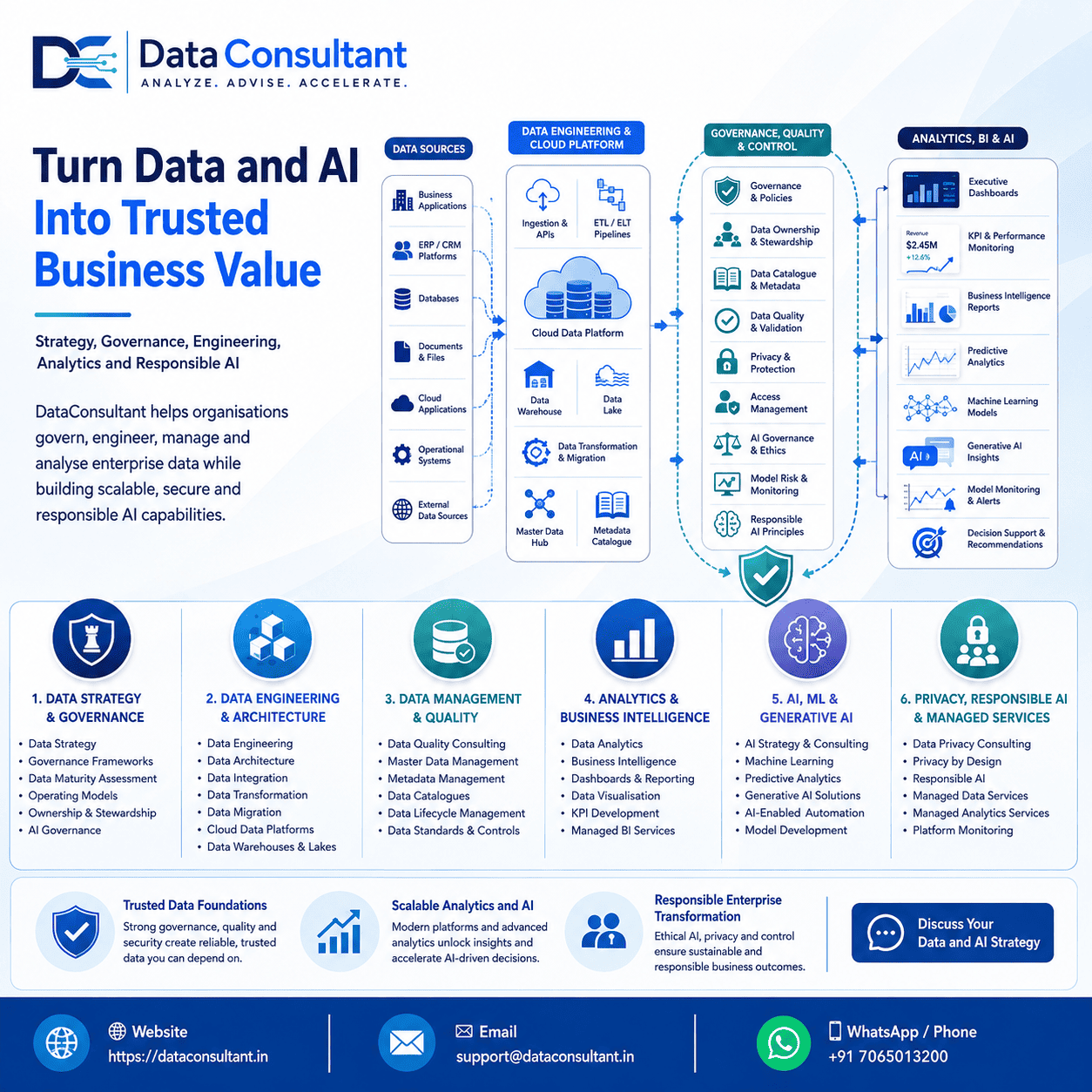
Quick Answer: Start Small, Govern Early
Start with one low-risk use case that a human can review. Define the user, task, data, expected output, failure conditions and measure of success before choosing a model or platform. If those basics are unclear, use discovery rather than implementation.
Use internal staff when the problem and data are well understood. Configure a tool when the main gap is functionality. Use a short diagnostic when priorities, data quality or governance are uncertain. Use a defined project when integration, testing, documentation and handover are needed. Choose ongoing support only when the workload and change are genuinely continuous.
The main caution is simple: do not hire a consultant or buy an AI platform before defining the business decision or operational problem. AI can amplify weak processes and unreliable data as easily as it can automate useful work.
Key Takeaways
- Start with a bounded decision: name the workflow, user and outcome before selecting technology.
- Check data readiness: identify ownership, quality, sensitivity and access before connecting business data.
- Keep internal ownership: a business owner must remain accountable for use, review and adoption.
- Scope deliverables: require a use-case definition, risk controls, test results, documentation and handover.
- Govern proportionately: privacy, security, human oversight and supplier controls should match the impact.
- Measure the workflow: compare against a baseline and account for review effort, errors and exceptions.
- Plan knowledge transfer: a successful project leaves people able to operate and challenge the solution.
Table of Contents
- Understand what AI can solve
- Check business and data readiness
- Choose internal, tool or specialist support
- Set governance and security boundaries
- Design a controlled first pilot
- Estimate cost, time and resources
- Apply the decision to real situations
- Decide when specialist support fits
- Summary
Understand What AI Can Solve Before Buying It
AI is most useful when there is a repeatable information task, enough examples or context to support the task, and a clear way to review output. Generative AI can draft, summarise, transform and retrieve information. Predictive models can estimate probabilities or future outcomes. Classification can route or label records. These capabilities become business use cases only when they are attached to a workflow and an accountable decision.
Separate AI needs from process problems
If a team cannot agree on what a metric means, who owns a customer field, which policy version is current or what the approval process should be, AI is unlikely to fix the underlying ambiguity. A beginner project should first ask whether the constraint is knowledge, process design, data quality, system integration or genuinely an AI capability gap.
Beginner rule: if you cannot explain how a person does the task today and how you will check whether the AI result is acceptable, the use case is not ready for automation.
Check Data Readiness Before Connecting Business AI
You do not need a perfect data estate, but you do need enough control to know what information the system may use and what its limitations are. For a first AI use case, assess five areas: business clarity, data quality, authorised access, governance rules and internal ownership.
For risk management, the NIST AI Risk Management Framework provides a voluntary structure for managing AI risks. The OECD AI Principles provide a broader reference for trustworthy and human-centred AI.
Choose Internal, Tool or Specialist AI Support
The right starting model depends on how clear the problem is, whether the data and controls are ready, how much technical work is required and whether the need is temporary or continuous. The cheapest-looking software licence can become an expensive choice if teams still need to define the workflow, clean data, integrate systems and create controls.
| Option | Best fit | Expected output | Internal requirement | Main risk |
|---|---|---|---|---|
| Internal team | Clear low-risk use case and capable staff | Experiment, process change or small pilot | Time, ownership and evaluation capability | Competing priorities or weak governance |
| AI software tool | Known workflow with suitable built-in capability | Configured feature and user process | Data, security and adoption ownership | Tool chosen before requirements |
| Short diagnostic | Unclear priorities, data readiness or risk | Use-case shortlist, readiness findings and roadmap | Stakeholder interviews and evidence access | Recommendations stall without an owner |
| Defined consulting project | Integration, customisation or governed implementation | Pilot, controls, testing, documentation and handover | Business, data, technology and risk participation | Scope expands without acceptance criteria |
| Ongoing support | Use cases and controls change regularly | Advisory, optimisation, monitoring and new pilots | Regular prioritisation and governance | External dependency without knowledge transfer |
| Dedicated specialist or managed team | Substantial continuous multi-disciplinary workload | Predictable AI and data delivery capacity | Executive sponsor and operating cadence | Capacity is wasted without a prioritised backlog |
For many beginners, a short diagnostic followed by one controlled pilot is safer than committing immediately to an enterprise platform or a large transformation programme.
Set AI Governance, Privacy and Security Boundaries
Beginner AI governance does not need to begin as a large bureaucracy. It does need clear accountability. Record the approved use case, system or vendor, data classes, business owner, users, human-review requirement, testing approach, known limitations, incident path and conditions for stopping or changing the system.
Protect sensitive data before experimentation
Do not put personal, confidential, regulated or commercially sensitive information into an unapproved AI service. Confirm contractual terms, retention, training-data treatment, access controls and logging before business use. The UK Information Commissioner's Office provides guidance on AI and data protection for organisations processing personal data.
Scale governance with impact
An internal drafting assistant and an automated decision affecting employment, credit, healthcare or customer rights do not carry the same risk. More consequential use cases need stronger validation, oversight, documentation and escalation. Organisations formalising AI management can also refer to ISO/IEC 42001 for AI management systems.
Design a Controlled First AI Pilot
A useful pilot tests a business hypothesis with limited exposure. It should produce evidence about workflow fit, data suitability, output quality, risk controls and user behaviour—not merely a demonstration that the model can generate an impressive response.
Define the pilot contract
- Name one business owner and one primary user group.
- Describe the current workflow and baseline performance.
- Specify approved data sources and prohibited data.
- Define acceptable output, failure examples and human review.
- Test representative normal, edge and adverse cases.
- Record security, privacy and supplier assumptions.
- Set a go, revise or stop decision at the end.
If the pilot requires retrieval from internal documents, system integration or model evaluation, the technical team should document data flows, access permissions, source freshness and how unsupported answers are handled. For generative AI, NIST's Generative AI Profile is a useful companion to the wider AI RMF.
Estimate AI Cost from Scope, Data and Controls
Cost is driven less by the word “AI” than by the work around it. A beginner project may need discovery, data preparation, API or platform fees, integration, identity and access setup, security review, testing, user training, change management, monitoring and documentation. Internal stakeholder time is part of the cost even when no invoice is issued for it.
Ask for estimates by phase rather than one opaque total: discovery, pilot, implementation, handover and optional ongoing support. Tie payment or acceptance to tangible outputs where appropriate, such as an approved use-case brief, architecture, tested prototype, evaluation results, control documentation and operating guide.
Time follows the same logic. A contained use case with approved data may progress quickly; a use case that touches multiple systems, personal information, regulated decisions or unresolved data ownership can take much longer. Avoid fixed promises before discovery establishes the dependencies.
Use Beginner AI Decisions in Real Business Situations
Example 1: Customer-service summaries
A growing ecommerce team wants “an AI support agent”. The real problem is that agents spend too much time reading long ticket histories. A safer first decision is an internal summarisation assistant with human review, limited to approved ticket data. Likely deliverables include a use-case definition, data-access design, prompt or configuration, evaluation set, user guidance and pilot results. Customer-service, security and data owners need to participate.
Example 2: Management reporting
A professional-services company wants AI to produce monthly management commentary, but its finance and operations reports use inconsistent definitions. The actual problem is data and KPI consistency. The better engagement may be a short diagnostic covering source data, metric definitions and reporting ownership before any generative AI work. AI becomes relevant only after the reporting foundation is stable enough to ground outputs.
Example 3: Predictive sales forecasting
A startup wants machine learning to forecast sales before it has reliable historical pipeline stages or consistent close-date data. The immediate need is improved data capture and a baseline forecasting method, not a complex model. A phased roadmap can define minimum data quality, measurement and the point at which predictive modelling becomes justified.
Use Specialist AI Support Only Where It Adds Value
External support is most useful when the organisation lacks temporary expertise to define the use case, assess data readiness, design architecture, establish AI governance, integrate systems, evaluate a pilot or transfer capability to internal teams. It is less useful when the problem is already clear, the required feature exists in an approved tool and the internal team can configure and govern it confidently.
For organisations still deciding where AI fits, DataConsultant.in can support a focused assessment or audit, AI and data advisory work, or a defined data project where readiness, integration and governance need to be resolved together. The appropriate engagement should remain proportional to the problem.
Need a Clear First AI Decision?
Start with the smallest decision that removes uncertainty: clarify the use case, test data readiness and define the controls before committing to a larger build.
Explore AI Data SupportSummary
For beginners, AI is appropriate when a real workflow can be defined, the required data is usable, a human owner is accountable, risks can be controlled and success can be measured. Internal staff or an existing tool may be sufficient for a narrow, well-understood need. A short diagnostic is useful when the use case, data quality, access or governance are unclear. A defined project is justified when implementation needs specialist architecture, integration, evaluation and documentation. Ongoing support or a managed team makes sense only when the workload is substantial and continuous.
Before committing budget, validate the business goal, data quality, access, governance, scope, timeline, security, quality assurance, documentation, knowledge transfer and handover. The strongest first AI project is not the most ambitious one; it is the one that creates evidence and leaves the organisation better able to make the next decision.
Artificial Intelligence for Beginners FAQs
What does artificial intelligence for beginners mean in a business context?
For a business beginner, artificial intelligence means using software that can recognise patterns, generate content, classify information, make predictions or support decisions. Start with one bounded business problem and a measurable human-owned outcome. Do not begin by buying an AI tool before confirming the data, workflow, risk and ownership needed to use it safely.
What is the best first AI use case for a beginner business?
Choose a low-risk, repetitive task where success can be checked by a person, such as drafting internal summaries, classifying support requests or finding information in approved documents. Avoid beginning with high-impact automated decisions. Define the baseline process, permitted data, review step and success measure before piloting.
Do I need good data before starting with AI?
Yes, if the use case depends on your organisation’s own data. AI cannot reliably repair unclear ownership, inconsistent definitions or missing source information by itself. A lightweight data-readiness check should confirm what data exists, who owns it, how sensitive it is and whether its quality is sufficient for the intended decision.
Should a beginner buy an AI tool or hire a consultant?
Buy or configure a tool when the use case, data, controls and internal ownership are already clear. Use a short advisory or diagnostic engagement when teams are unsure what problem to solve, what data can be used, how risks should be controlled or how value will be measured. A defined consulting project is more appropriate when integration, governance or implementation work is required.
How much does a first business AI project cost?
There is no universal price because cost is driven by scope, data preparation, software licensing, integration, security review, testing, change management and specialist time. A small pilot is usually easier to budget than a broad transformation. Ask for explicit assumptions, deliverables, acceptance criteria and internal-resource requirements before approving spend.
How long should a beginner AI pilot take?
A useful pilot should be short enough to test one business hypothesis without creating a new permanent platform by default. Timing depends on data access, security approval, integration and evaluation requirements. If discovery cannot define the user, workflow, data, risk owner and success criteria, the organisation is not ready to commit to a large implementation.
What AI governance does a beginner organisation need?
Begin with proportionate controls: a named business owner, approved use cases, data-access rules, human review, testing, incident escalation, supplier review and documented limitations. NIST AI RMF and ISO/IEC 42001 provide structured references for organisations that need a more formal approach. Governance should scale with the impact and risk of the use case.
Can beginners use generative AI with confidential company data?
Only when the organisation has approved the tool, contractual terms, data handling, retention, access controls and intended use. Do not paste confidential, personal or regulated information into an unapproved service. Security, privacy and legal teams may need to define which data classes and workflows are permitted.
How do we measure whether an AI beginner project worked?
Measure the business workflow, not only model output. Compare the pilot with a baseline such as turnaround time, error rate, rework, user effort, service quality or decision consistency, and record any new review workload or risk. Keep human judgement in the evaluation and do not claim causation where other process changes contributed.
When is ongoing AI support appropriate?
Ongoing support is appropriate when use cases, models, vendors, data sources or governance requirements change continuously and the organisation lacks enough internal capacity. If the need is narrow and stable, a documented project with knowledge transfer may be sufficient. The goal should be sustainable internal ownership rather than permanent dependency.
At DataConsultant.in, we help organisations turn data and AI priorities into governed, reliable, and practical business capability.