
Governance: A Practical Data Governance Decision Guide
Governance is the operating discipline that makes data ownership, decisions, access, quality and accountability explicit enough for a business to use data reliably. The practical decision is not whether your organisation needs more policies; it is whether unclear ownership or inconsistent controls are blocking reporting, analytics, platform change, compliance work or AI adoption. Start with the business decisions and data domains that matter most, then determine whether internal staff can resolve the issue, a tool can automate an already-defined process, or external data consulting is needed to diagnose and design the operating model.
The main caution is to avoid treating governance as a technology purchase or a document-production exercise. A catalogue cannot decide who owns customer data. A policy cannot reconcile two departments using different revenue definitions. A committee cannot improve quality unless somebody has authority to resolve root causes. Effective governance connects decision rights, data standards, stewardship, access, privacy, security, architecture and change management to real operational work.
This guide helps founders, business leaders, data and technology teams, finance, marketing, operations, risk, privacy, security and procurement teams decide when governance support is appropriate, what inputs and stakeholders are required, what deliverables to expect, and how to avoid creating governance that adds ceremony without improving business capability.
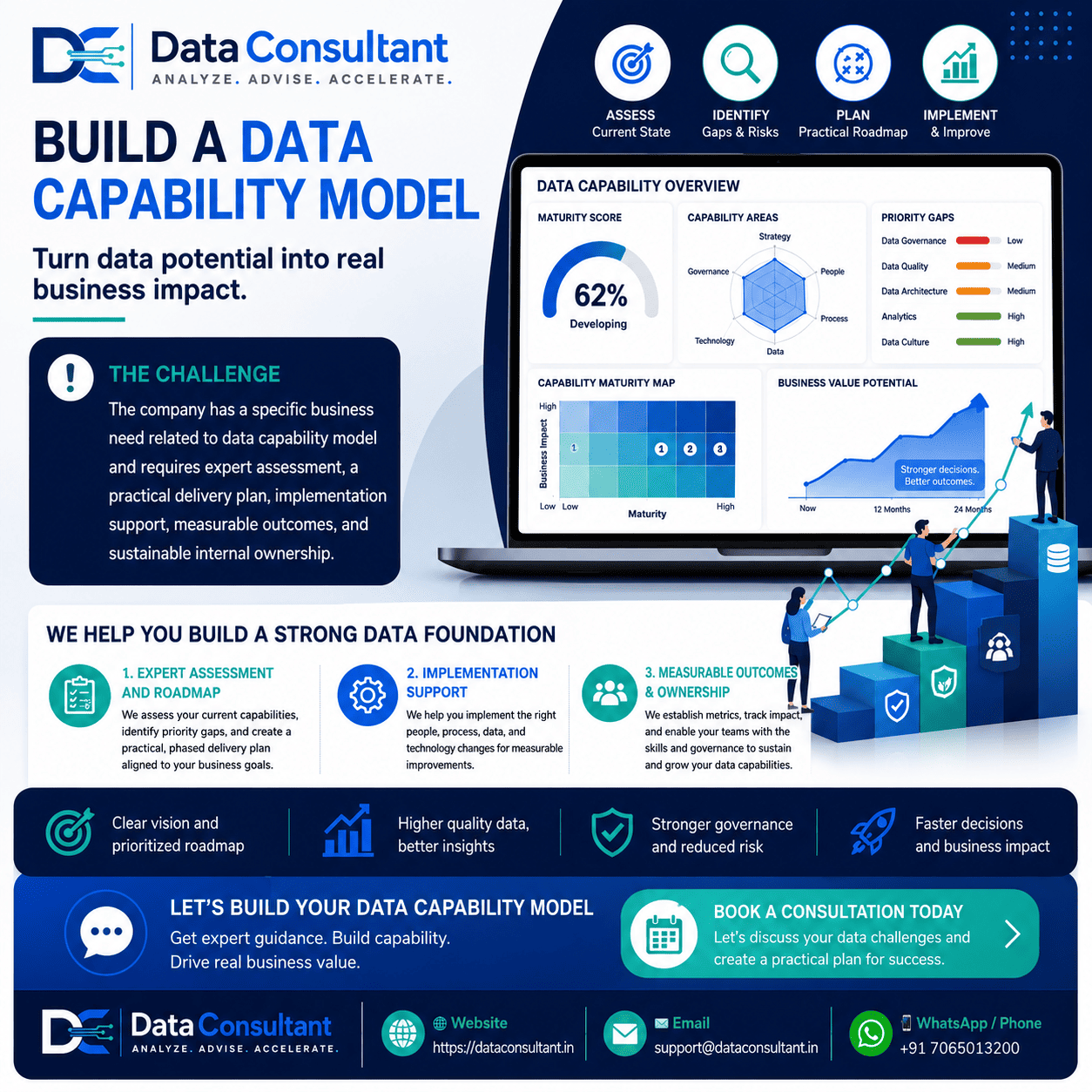
Quick Answer: Govern Decisions, Not Everything
Use governance when important data decisions are inconsistent, disputed or unmanaged. Begin with a small number of business-critical domains, reports, data products or regulatory obligations. Define who owns them, who stewards definitions and quality, who approves access, which standards apply and how unresolved issues are escalated.
Use internal staff when the scope is narrow and authority is clear. Configure a governance tool when roles, definitions and workflows already exist and automation is the main gap. Use a short diagnostic when the problem is unclear. Use a defined consulting project when you need an operating model, policies, data-domain ownership, quality controls, metadata practices or implementation support. Choose ongoing support only when governance work is genuinely continuous across multiple teams or data domains.
Do not hire a consultant before defining the business decision or operational problem. Governance should enable reliable decisions and responsible data use; it should not become an objective detached from delivery.
Key Takeaways
- Start with decision pain: conflicting metrics, unclear ownership, uncontrolled access or recurring quality issues are stronger triggers than a general desire for “better governance”.
- Assess data readiness: governance can start with imperfect data, but teams need enough evidence about systems, flows, definitions and defects to prioritise work.
- Keep internal ownership: accountable business and technology leaders must retain authority for data decisions after external support ends.
- Scope the operating model: require clear decision rights, roles, standards, forums, issue workflows, implementation priorities and acceptance criteria.
- Integrate risk controls: privacy, security, retention, access and regulatory requirements should be built into data processes rather than treated as separate paperwork.
- Demand usable deliverables: a roadmap, ownership map, glossary, policy templates and implementation backlog should be usable by operating teams.
- Plan knowledge transfer: governance succeeds when stewards, owners and delivery teams know how to apply and maintain the model without permanent consultant dependency.
Table of Contents
- Recognise when governance is the real problem
- Check governance and data maturity
- Choose internal, tool or consulting support
- Define ownership, controls and access
- Turn governance design into operating practice
- Estimate effort, cost and timeline
- Measure whether governance is working
- Apply governance decisions to real situations
- Use specialist support where it adds value
- Summary
Recognise When Governance Is the Real Data Problem
Governance is the right intervention when the obstacle is not simply missing technology but unclear authority over data. Typical symptoms include finance and sales publishing different versions of the same KPI, customer records being changed without agreed standards, access approvals depending on personal judgement, data-quality defects recurring because no owner can fix the source process, or AI teams using data whose permitted purpose is unclear.
Separate governance gaps from engineering gaps
A broken pipeline is primarily an engineering problem. A pipeline that repeatedly breaks because nobody owns the source schema, change notices are optional and quality thresholds are undefined is a governance problem as well. Likewise, a dashboard that loads slowly may need technical optimisation; a dashboard showing disputed numbers needs ownership, definitions and control before visual redesign.
Governance therefore works across business and technology. The OECD overview of data governance describes governance across technical, policy and regulatory arrangements throughout the data lifecycle. For a business, the useful translation is simple: decide who can make which data decisions, on what evidence, under which controls.
Decision rule: if the same data issue keeps returning because ownership, standards or escalation are unclear, solve the governance condition rather than treating each incident as an isolated technical defect.
Check Governance and Data Maturity Before Scaling
You do not need mature governance to start improving it, but you need enough visibility to choose a sensible first scope. Assess five dimensions: business priority, data ownership, data quality evidence, system and metadata visibility, and control maturity. Weakness in one area changes the engagement.
- Business priority: identify decisions, reports, customer journeys, regulatory obligations or AI use cases that depend on the data.
- Ownership: distinguish accountable business owners from technical custodians and operational stewards.
- Quality evidence: record known defects, reconciliation failures and downstream impact instead of relying on general perceptions.
- Visibility: identify major source systems, transformations, critical reports and data consumers, even if formal lineage is incomplete.
- Controls: document how access, retention, sharing, change and exception handling work today.
Where privacy risk is material, the NIST Privacy Framework provides a risk-based structure that can complement operational data governance. The objective is not to copy a framework verbatim, but to ensure governance decisions are consistent with the organisation’s actual privacy and risk obligations.
Choose Internal, Tool or Consulting Support
The right governance model depends on problem clarity, internal capability, urgency and continuity. External consulting is not automatically the best option, and software is not automatically the cheapest solution once definition, implementation and adoption work are included.
| Option | Best fit | Expected output | Internal requirement | Main risk |
|---|---|---|---|---|
| Internal team | Clear scope, known owners and sufficient governance capability | Local standards, stewardship and issue resolution | Protected time and executive authority | Governance loses priority beside delivery work |
| Software tool | Defined ownership and processes needing automation | Catalogue, lineage, workflow or policy automation | Configured definitions, integration and product ownership | Tooling formalises weak or disputed processes |
| Short data diagnostic | Conflicting reports, uncertain ownership or unclear maturity | Findings, priority domains, risks and roadmap | Stakeholder interviews and evidence access | Recommendations stall without accountable sponsors |
| Defined consulting project | Operating model and implementation need structured delivery | Roles, standards, workflows, roadmap, pilot and handover | Business, data, risk and technology participation | Scope expands into enterprise transformation |
| Ongoing consultant support | Multiple data domains require continuing specialist coordination | Governance facilitation, reviews and improvement backlog | Regular prioritisation and internal decision owners | Dependency develops without knowledge transfer |
| Dedicated specialist or managed team | Substantial recurring governance workload across disciplines | Predictable capacity for stewardship, quality and controls | Executive sponsor and clear operating cadence | Capacity is wasted if authority remains unresolved |
A hybrid is often practical: internal leaders own policy and decisions while external specialists provide diagnostic depth, implementation capacity or temporary expertise.
Define Ownership, Controls and Data Access
A professional governance engagement should make decision rights explicit. “Data owner” is not enough unless the role has a defined scope, authority, escalation route and expected cadence. Clarify who approves definitions, quality thresholds, access, retention, sharing, schema changes and exceptions for each priority data domain.
Prepare evidence, not perfect documentation
Useful inputs include current policies, key reports, data models, architecture diagrams, access procedures, audit findings, quality incidents, glossary terms, regulatory obligations and examples of unresolved disputes. The consultant should also interview the people who create, transform, approve and consume the data. Where documentation conflicts with operational practice, the operating evidence matters.
Connect governance to standards and controls
The ISO 8000-51 data governance standard addresses exchange of data-governance policy statements, while broader governance programmes may use other standards and internal policies depending on the organisation’s environment. The practical requirement is traceability: teams should be able to explain which rule applies, who approved it, how compliance is checked and what happens when data falls outside the rule.
Turn Governance Design Into Operating Practice
Governance becomes useful only when it changes routine work. Start with one or two priority data domains, assign accountable owners and stewards, define a small set of decisions and controls, then test the model through real issues. For example, run a disputed KPI definition through the new approval path, test an access request, and resolve a known data-quality defect using the agreed escalation process.
Expect implementation-ready deliverables
- Governance maturity findings and a prioritised implementation roadmap.
- Data-domain map with accountable owners, stewards and technical custodians.
- Decision-rights and escalation matrix for definitions, access, quality and change.
- Business glossary or KPI governance approach for critical terms.
- Policy, standard and issue-management templates adapted to actual workflows.
- Governance forum terms, decision logs and reporting cadence.
- Pilot backlog with acceptance criteria, owners and dependencies.
- Documentation, training and knowledge-transfer materials for internal teams.
If implementation is likely to expose extensive data-engineering work, separate governance decisions from remediation delivery. A governance project can prioritise defects and assign accountability; it should not disguise an unbounded platform rebuild.
Estimate Governance Effort, Cost and Timeline
Governance cost is mainly driven by organisational scope, number of data domains, system complexity, stakeholder availability, regulatory constraints and the depth of implementation required. A diagnostic covering one business area is materially different from establishing enterprise governance across finance, customer, product and operational data.
Budget for internal participation. Business owners must make decisions. Data engineers and architects need to explain flows and constraints. Privacy, security and legal teams may need to validate controls. Analysts and operational teams must test whether definitions and workflows work in practice. A proposal that assumes the consultant can create governance independently of these stakeholders is unrealistic.
Commercial check: compare scope, deliverables, assumptions, stakeholder commitments, change-control rules, documentation and handover. A lower day rate does not compensate for unclear acceptance criteria or a programme that cannot be operated internally.
Measure Whether Governance Changes Data Decisions
Measure governance through operating evidence, not the number of policies created. Useful indicators may include the percentage of critical data domains with accepted owners, time to resolve quality issues, proportion of priority KPIs with approved definitions, access-request consistency, recurring defect rates, unresolved ownership disputes, lineage coverage for critical reports, and completion of agreed remediation actions.
Avoid claiming governance caused business improvements without evidence. Better reporting, faster analysis or reduced rework may also reflect system upgrades, staffing changes or process redesign. Use measures that connect directly to governance decisions and track whether internal teams continue using the operating model after handover.
Apply Governance Decisions to Real Situations
Ecommerce teams disagree on customer revenue
An ecommerce business finds that finance, marketing and trading teams report different customer revenue. Leaders initially consider buying a new BI platform. The actual problem is conflicting metric definitions, channel mappings and ownership. A short governance diagnostic is the better first step. Likely deliverables include an agreed KPI decision process, domain ownership, source mapping, glossary priorities and a remediation backlog. Finance, marketing, ecommerce, analytics and engineering all need to participate.
Professional services rely on unmanaged spreadsheets
A professional-service firm wants tighter controls over operational reporting built in spreadsheets. Replacing every workbook would be expensive and may not address accountability. A defined governance project can classify critical reports, assign owners, establish input and review standards, define retention and access rules, and identify which processes justify automation. Internal finance, operations and technology teams need to validate which controls are proportionate.
Startup wants AI before data ownership is clear
A startup plans customer-facing AI using product, support and behavioural data but has no agreed data owners or documented permitted uses. The mistaken assumption is that model selection is the next decision. The better step is a focused governance and AI-readiness assessment covering data purpose, ownership, quality, access, privacy, retention and approval routes. Advanced implementation should follow only when these foundations are sufficient.
Use Specialist Governance Support Where It Adds Value
External support is most useful when leaders need an independent maturity assessment, disputed ownership resolved through structured facilitation, governance roles designed across functions, priority data domains mapped, controls connected to architecture, or a roadmap translated into implementation work. It can also help when the organisation needs temporary governance capacity while internal owners develop capability.
Where the requirement is specifically governance-related, DataConsultant data governance support can be scoped around assessment, operating-model design and implementation. If the first need is diagnostic, a data assessment or audit may be the smaller starting point. If governance exposes platform or pipeline remediation, data engineering support should be scoped separately rather than folded into an unlimited governance engagement.
Summary
Governance is useful when reliable data decisions are being blocked by unclear ownership, inconsistent definitions, uncontrolled access, recurring quality defects or weak accountability. Internal staff may be sufficient when the problem is narrow and authority is clear. A software tool may be sufficient when the operating model already exists and the main gap is workflow automation. A short diagnostic is appropriate when the organisation is not yet sure which governance problem matters most.
A defined project is justified when roles, decision rights, standards, controls, implementation priorities and handover need structured design. Ongoing support or a managed team is appropriate only when the workload is genuinely continuous. Before committing, validate the business goal, data quality, access, stakeholder ownership, privacy and security constraints, scope, budget, timeline, documentation, quality assurance and knowledge-transfer expectations.
Governance FAQs
What does governance mean in a data consulting context?
Governance means defining who can make decisions about data, who owns important data domains and metrics, which rules apply, and how quality, access, privacy, security and change are controlled. A consultant can help design that operating model, but accountable business and technology owners still need to approve decisions and run it after handover.
How do I know whether my business needs governance consulting?
Governance consulting is useful when teams cannot agree on data ownership, reports conflict because definitions differ, access decisions are inconsistent, regulatory or privacy obligations are hard to operationalise, or major platform and AI initiatives are proceeding without clear controls. If the issue is only a small local process with clear ownership, internal staff may be sufficient.
Should we fix data quality before starting governance?
Do both in a controlled sequence. Governance provides the ownership, standards and escalation routes needed to improve data quality, while real quality issues reveal where governance must become practical. Start with a few high-value data domains and known defects rather than trying to govern every dataset at once.
Can a software tool replace data governance consulting?
A catalogue, lineage, quality or policy tool can automate parts of governance, but it cannot decide business ownership, settle conflicting definitions, create acceptable decision rights or secure stakeholder commitment. Buy or configure a tool only after the operating model, priority use cases and stewardship responsibilities are clear.
What should we prepare before a governance engagement?
Prepare the priority business decisions, critical reports and data products, current policies, architecture diagrams, data inventories where available, known quality issues, access processes, regulatory constraints and a list of accountable stakeholders. Limited documentation is not a blocker, but the consultant needs access to the people and evidence required to verify how data is actually used.
How much does data governance consulting cost?
Cost depends on scope, number of data domains, organisational complexity, regulatory requirements, data-platform landscape, stakeholder availability and whether implementation support is included. A focused diagnostic is typically lower effort than designing and rolling out an enterprise operating model. Compare proposals by deliverables, assumptions, internal effort and acceptance criteria rather than price alone.
How long does a governance project take?
A focused diagnostic can often be completed faster than a full operating-model rollout, but no responsible timeline can be set without scope and access details. Time increases when ownership is disputed, documentation is weak, many systems are involved, legal or security review is required, or several business units must adopt common standards.
What deliverables should a governance consultant provide?
Useful deliverables may include a governance assessment, prioritised roadmap, decision-rights model, data-domain map, ownership and stewardship roles, policy or standard templates, KPI or business-glossary recommendations, issue-management workflow, governance forums, implementation backlog, measurement approach, documentation and knowledge-transfer materials. Deliverables should match the problem rather than a generic framework.
Who owns governance after the consultant leaves?
Your organisation should. Executives, business data owners, stewards, technology teams, risk, privacy and security functions need clear ongoing responsibilities. The engagement should include handover, decision logs, reusable templates, documentation, capability transfer and a practical cadence so governance does not depend on the external consultant indefinitely.
Need a practical governance starting point? Define the business decision, priority data domain and current ownership problem first. If specialist help is justified, use a bounded assessment or governance project with explicit deliverables, internal owners and handover requirements.
At DataConsultant.in, we help organisations turn data and AI priorities into governed, reliable, and practical business capability.