
Data and Governance: When External Support Makes Sense
Data and governance should be treated as a business decision system, not a policy exercise. The practical question is whether your organisation can trust, access, explain and control the data used in important decisions. If reporting teams dispute revenue, customer or operational numbers; ownership is unclear; access is inconsistent; or AI and analytics initiatives are moving faster than the data foundation, governance support may be justified. The main caution is to define the business decision or operational risk before buying a catalogue, quality platform or governance tool. Technology can enforce and document controls, but it cannot decide what a metric means, who owns a domain or which trade-offs the business accepts.
Start with one priority data problem. Identify the decisions affected, the systems involved, the people who create or consume the data, the known quality or access failures and the consequences of getting it wrong. If internal teams can resolve that problem with clear ownership and existing capability, external consulting may be unnecessary. If the problem is cross-functional, technically complex or repeatedly blocked, a short diagnostic can clarify the operating model and roadmap before a larger commitment.
This guide helps founders, business leaders, data and technology teams, risk functions and procurement teams choose between internal delivery, tooling, a focused governance assessment, a defined consulting project, ongoing specialist support or a managed data team.
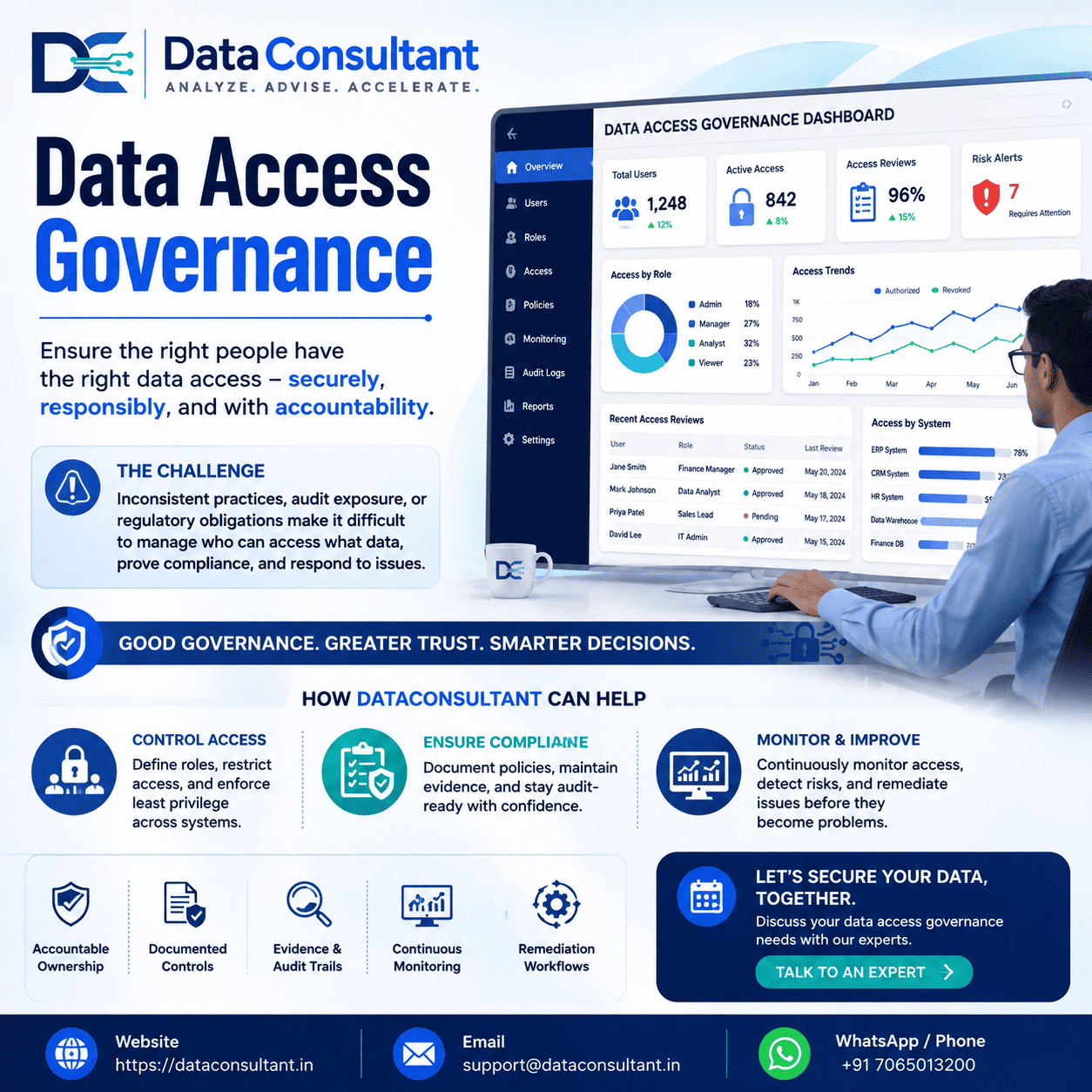
Quick Answer: Govern the Decisions That Matter
Use internal staff when the priority data is known, ownership is clear and the team has enough data, technical and change capability to fix the issue. Buy or configure a tool when the operating model and control requirements are already defined and the main gap is workflow, metadata, lineage, quality monitoring or access administration.
Use a short diagnostic when reports conflict, ownership is disputed, data quality is uncertain or technology choices are being discussed before requirements are clear. Use a defined consulting project when you can scope outputs such as a governance operating model, data-domain ownership, quality rules, data catalogue design, access controls, architecture changes or an implementation roadmap. Choose ongoing support only when governance decisions, issue management and data change are genuinely continuous.
The decision rule is simple: do not hire a consultant or buy software before you can state which business decision, data risk or operating problem the work must improve.
Key Takeaways
- Govern priority data first: begin with data that affects important decisions, customers, reporting, risk or regulated processes.
- Keep business ownership internal: consultants can facilitate governance, but accountable data owners must sit inside the organisation.
- Assess readiness before tooling: unclear definitions and weak ownership are operating-model problems, not software gaps.
- Scope deliverables precisely: require named domains, decision rights, controls, documentation, implementation responsibilities and acceptance criteria.
- Connect quality to use: every data-quality rule should protect a defined report, process, customer outcome or analytical use case.
- Coordinate privacy and security: governance should align data ownership and use with access, risk, retention and regulatory obligations.
- Plan knowledge transfer: the engagement should leave internal teams able to operate, review and improve the governance model.
Table of Contents
- Start with the data decision
- Assess governance readiness
- Compare delivery options
- Define ownership and controls
- Implement governance in phases
- Estimate cost and timeline
- Measure governance outcomes
- Apply the decision to examples
- Use specialist support selectively
- Summary
Start With the Data Decision, Not the Policy
Governance is most effective when it starts from a real decision or risk. Instead of asking “What governance framework should we implement?”, ask which data is creating uncertainty, delay, rework or unacceptable exposure. That framing makes scope visible and prevents a programme from becoming an abstract committee exercise.
Separate symptoms from root causes
A dashboard dispute may look like a business-intelligence problem but actually come from different source mappings or KPI definitions. Repeated access requests may look like a security bottleneck but reflect missing role definitions and data classification. Poor AI outputs may look like a model issue but originate in incomplete, duplicated or badly labelled source data. Governance clarifies ownership and decision rights so the technical fix is attached to the right business rule.
Choose the smallest useful scope
Start with one or two critical data domains, reports or processes. Define what “good enough” means for accuracy, timeliness, completeness, access and accountability. Broader enterprise governance can follow if the initial model works. A limited scope is easier to validate and gives internal owners evidence before they invest in wider tooling or programme structures.
Assess Whether Governance Is Ready to Work
A governance initiative can begin in an imperfect environment, but it needs enough organisational readiness to make decisions stick. Check five areas: business priority, ownership, data visibility, technical cooperation and control requirements.
- Business priority: leaders can name the decisions, processes or risks affected by the data.
- Ownership: there are people with authority to approve definitions, priorities and remediation.
- Data visibility: teams can identify major sources, transformations, consumers and known limitations.
- Technical cooperation: engineering, platform or application teams can support profiling, lineage, access or remediation work.
- Control context: privacy, security, contractual and regulatory requirements can be brought into design decisions.
The NIST Data Governance and Management Profile work is a useful reminder that governance and management activities need to connect with privacy and cybersecurity practices rather than operate in isolation. The OECD data governance overview also frames governance as a wider set of arrangements for responsible data access, sharing and use.
Readiness rule: if nobody can approve a definition, accept a quality threshold or fund remediation, the organisation is not ready for a large governance rollout. Start with sponsorship and decision rights.
Compare Internal, Tool and Consulting Options
The right option depends on problem clarity, internal capability, urgency, complexity and continuity. The table below compares the main choices specifically for data and governance work.
| Option | Best fit | Expected output | Internal requirement | Main risk |
|---|---|---|---|---|
| Internal team | Clear problem, stable ownership, limited scope | Definitions, controls, issue resolution and documentation | Time, authority and cross-functional capability | Governance loses priority against delivery work |
| Software tool | Operating model and requirements already defined | Catalogue, lineage, quality, workflow or access support | Configuration, stewardship and process ownership | Tool becomes an expensive repository without adoption |
| Short diagnostic | Conflicting reports, unclear ownership or uncertain maturity | Evidence, maturity findings, priority domains and roadmap | Stakeholder access and source documentation | Recommendations stall without an executive owner |
| Defined consulting project | Governance model and implementation can be scoped | Operating model, controls, roles, quality rules and handover | Business, data, security and platform participation | Scope expands across too many domains |
| Ongoing specialist support | Recurring governance, quality and analytics decisions | Advisory, stewardship support, issue reviews and optimisation | Regular prioritisation and internal accountability | Dependency if capability is not transferred |
| Dedicated specialist or managed team | Large, continuous multi-domain workload | Predictable capacity across governance and data disciplines | Executive sponsor and operating cadence | Cost is wasted if decision rights remain unclear |
The software option is appropriate only when governance decisions already exist. If ownership, definitions or priorities are unresolved, technology should follow a diagnostic or operating-model decision rather than lead it.
Define Data Ownership, Quality and Access Controls
A professional governance engagement should make accountability executable. That means moving from broad principles to named roles, data domains, definitions, controls, workflows and evidence.
Specify the inputs a consultant needs
- Priority business decisions, reports and operational processes.
- System inventory, architecture or data-flow documentation where available.
- Examples of conflicting metrics, data defects, access problems or audit findings.
- Named business owners, stewards, technical custodians and security or privacy contacts.
- Current policies, retention rules, data classifications and contractual constraints.
- Access to representative metadata or data for profiling where permitted.
Make controls proportional to risk
Not every field needs the same governance. Critical financial measures, customer identifiers, regulated information and data feeding high-impact models may need stricter definitions, access review, lineage and quality monitoring than low-risk operational data. The ISO/IEC 27001 information security management standard provides a recognised risk-management reference for information security, while the NIST Privacy Framework can help organisations structure privacy-risk management. Apply the laws and contractual requirements relevant to your jurisdictions and sector.
Implement Governance Through a Narrow First Domain
Implementation should prove that the operating model works before it expands. Select a domain with visible business value, available stakeholders and manageable technical complexity. Examples include customer, product, finance, supplier or workforce data, depending on the organisation.
Expect concrete governance deliverables
- Current-state assessment and prioritised issue register.
- Data-domain map and accountable owner or steward roles.
- Critical-data definitions and a business glossary.
- Data-quality dimensions, rules, thresholds and issue workflows.
- Access, classification, retention or sharing controls where in scope.
- Lineage or metadata requirements for priority data flows.
- Governance forum, decision rights and escalation process.
- Tool configuration requirements if technology is justified.
- Implementation roadmap with milestones, dependencies and acceptance criteria.
- Documentation, training and knowledge-transfer materials.
Good governance also distinguishes policy from remediation. If a source application cannot capture a required attribute, or an integration destroys important context, a governance decision must trigger engineering or process work. Documentation alone does not fix the data.
Data Quality and Scope Drive Cost and Timeline
The biggest cost drivers are usually the number of domains, stakeholder complexity, data fragmentation, quality problems, required data profiling, tooling, security review and the amount of implementation work. A limited diagnostic can concentrate on interviews, evidence review and a roadmap. A multi-domain programme involving catalogue configuration, quality controls, access governance and source-system remediation requires much more internal and external capacity.
Timelines also depend on decision speed. A technically simple definition can take weeks if several departments disagree about ownership. Conversely, complex profiling may move quickly when one owner has authority and the relevant systems are accessible. Ask suppliers to separate analysis, design, tool configuration, remediation, change management and ongoing support so you can see what is actually driving cost.
Commercial rule: compare the total operating effort, not only consulting days or software licence fees. Internal stakeholder time, data access, remediation and ongoing stewardship are part of the real cost.
Measure Whether Governance Changes Data Decisions
Governance is useful when it changes how data decisions are made and how recurring issues are resolved. Avoid treating the number of policies, glossary terms or committee meetings as sufficient evidence of progress.
- Percentage of critical data elements with an accountable owner and approved definition.
- Time taken to resolve priority data-quality issues and recurring causes.
- Adoption of approved definitions across reports and analytical products.
- Coverage of lineage, classification or access review for priority data.
- Reduction in duplicated reconciliation work where evidence supports the link.
- Number of exceptions requiring escalation and whether decisions are documented.
- Ability of internal stewards and owners to operate the model without consultant intervention.
Choose measures that reflect the original problem. If the goal was to stop conflicting revenue reports, improved agreement on the revenue definition and fewer reconciliation disputes matter more than the size of the glossary.
Practical Data and Governance Decisions
Ecommerce revenue does not reconcile
An ecommerce company sees different revenue and customer numbers in finance, marketing and operations. The mistaken assumption is that a new dashboard will create one version of truth. The actual problem is inconsistent source mappings, refund treatment and customer definitions. A short diagnostic should identify authoritative sources, owners and reconciliation rules before dashboard redevelopment. Likely outputs include a KPI dictionary, lineage map, issue register and remediation roadmap.
Multi-location KPIs mean different things
A growing services business uses the same KPI names across regions but calculates them differently. Buying a data catalogue alone would document inconsistency without resolving it. A defined governance project can establish metric ownership, approval rules, glossary standards and an exception process. Regional leaders and finance or operations owners must participate because the key decision is organisational, not purely technical.
Startup wants predictive analytics too early
A startup wants predictive churn modelling but customer events are inconsistently captured and consent or retention rules are not fully operationalised. The better decision is to stabilise collection, define critical fields, clarify access and establish basic quality monitoring first. A focused readiness assessment can create a phased roadmap so advanced analytics is delayed until the data foundation supports credible modelling.
Enterprise data platform migration
An enterprise is moving data to a modern platform while business domains use inconsistent classifications and ownership rules. Governance cannot be postponed until after migration because the new platform will otherwise reproduce old ambiguity. A cross-functional project may combine domain ownership, metadata standards, access patterns, quality controls and migration acceptance criteria. Ongoing support may be justified during the transition if the workload and number of domains remain high.
Use Specialist Governance Support Where It Adds Value
External support is most valuable when the organisation needs independent diagnosis, cross-functional facilitation, specialist governance design, data-quality assessment, architecture input or implementation capacity that is not available internally. It should not replace executive sponsorship or business ownership.
DataConsultant data governance support can help define ownership, quality, metadata, controls and implementation roadmaps. Where uncertainty is still high, a data assessment or audit may be the smaller first step. If the root issue is technical integration or platform structure, data engineering support may be more relevant than expanding governance scope.
Summary: Govern the Smallest Valuable Data Scope
Data and governance support is appropriate when important decisions are being blocked by unreliable definitions, weak ownership, recurring quality problems, unclear access or cross-functional complexity. Internal staff may be sufficient when the scope is narrow and the organisation already has authority, capability and time. A software tool may be sufficient when the governance operating model is already defined and the gap is execution support.
Use a short diagnostic when the problem or maturity level is unclear. Use a defined consulting project when you can specify domains, controls, deliverables, milestones and handover. Choose ongoing support or a managed team when governance work is substantial and continuous. Before committing, validate business goals, data quality, access, ownership, privacy, security, scope, budget, timeline, documentation and knowledge transfer.
FAQs on Data and Governance
What does data and governance mean in a business context?
Data and governance means managing data as a business asset with clear ownership, definitions, quality expectations, access rules, lifecycle controls and decision rights. The aim is not to create policy for its own sake, but to make data sufficiently reliable, understandable and controlled for reporting, operations, analytics and AI. The right starting point is a specific business decision or risk, then the minimum governance needed to support it.
How do I know whether my organisation needs a data consultant?
External support is useful when teams disagree about data definitions or ownership, reporting conflicts persist, data access is difficult to govern, an architecture or migration decision needs specialist input, or internal teams lack time or experience to establish a workable governance model. If the problem is narrow, well understood and already owned internally, existing staff may be sufficient.
Should we buy a data governance tool before defining the operating model?
Usually not. A catalogue, lineage, quality or access-governance tool can support an established process, but it does not decide who owns a data domain, which definitions are authoritative, what quality is acceptable or how issues are resolved. Define the operating model, priority data and control requirements first, then select or configure tools against those needs.
What information should we prepare for a governance assessment?
Prepare the business goals, priority reports or processes, current data sources, known quality issues, architecture diagrams where available, access and security constraints, existing policies, regulatory obligations, named stakeholders and examples of disputes or rework caused by data. A consultant also needs realistic access to subject-matter experts and enough evidence to distinguish symptoms from root causes.
How much does a data and governance engagement cost?
Cost depends on scope, number of data domains, system complexity, stakeholder availability, regulatory requirements, required tooling, data profiling effort and whether implementation is included. A short diagnostic has a different cost structure from a multi-domain governance programme or a managed data team. Ask for assumptions, deliverables, acceptance criteria and internal resource commitments rather than comparing day rates alone.
How long does a data governance project take?
A focused diagnostic can often be completed faster than a full implementation because it concentrates on evidence, ownership gaps and a prioritised roadmap. A defined governance project may run for weeks or months depending on the number of domains, policies, technology integrations and change-management needs. Large programmes should be phased so value and control can be tested before broad rollout.
Can data governance improve data quality?
Yes, when governance creates accountable ownership, shared definitions, measurable quality rules and a repeatable issue-resolution process. Governance does not automatically repair source data. Quality improvement may also require source-system changes, integration fixes, master-data controls, process redesign and ongoing monitoring. The important point is to connect each quality rule to a business use and an owner.
How do privacy and security fit into data governance?
Privacy and security are related control disciplines that should be coordinated with governance. Governance clarifies what data exists, why it is used, who is accountable and how decisions are made; privacy and security add requirements for lawful handling, risk management, access, protection, retention and incident response. The exact obligations depend on your jurisdictions, contracts and internal policies, so general frameworks should not be treated as legal advice.
Who should own data governance after a consultant leaves?
Internal business and technology owners should retain governance ownership. A consultant can design the operating model, facilitate decisions, create policies, define controls, configure tooling and transfer knowledge, but durable governance needs named data owners, stewards, technical custodians and an escalation path inside the organisation. Contracts should also clarify ownership of documentation, code, configurations and other project assets.
When is ongoing governance support appropriate?
Ongoing support is appropriate when the organisation has recurring data-quality issues, many changing data domains, regular access and policy decisions, continued platform change, audit or regulatory demands, or a sustained pipeline of analytics and AI use cases. If governance responsibilities are stable and internal owners can operate the model, a defined project with strong handover may be enough.
Need a Data Governance Diagnostic?
Share the decision problem, priority data domains, reporting or quality issues, current systems and ownership constraints. DataConsultant can help determine whether internal action, a focused assessment, a defined governance project or ongoing specialist support is the most proportionate next step.
Discuss your requirementAt DataConsultant.in, we help organisations turn data and AI priorities into governed, reliable, and practical business capability.